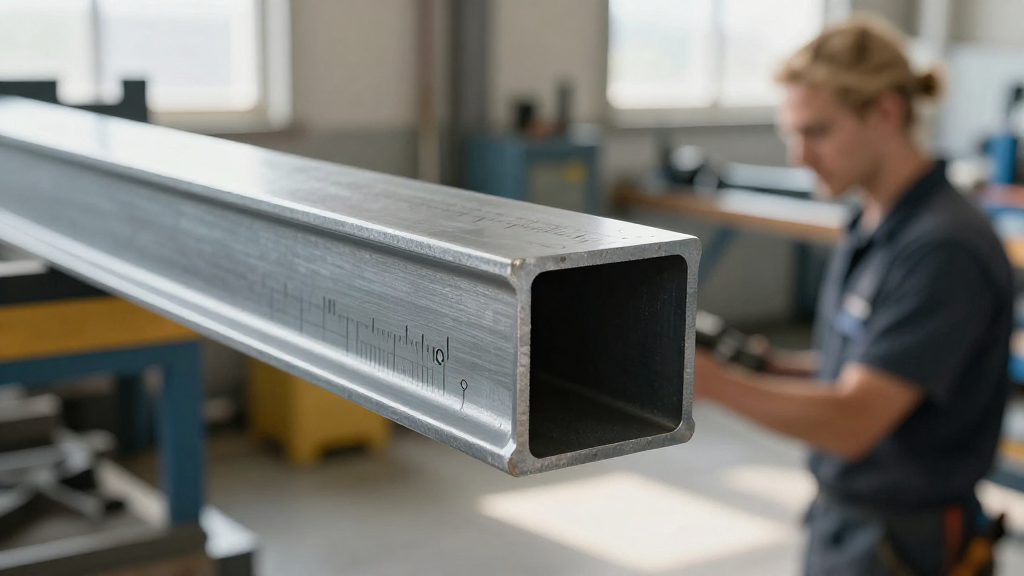
The beam moment of inertia refers to a property of a structural element that quantifies its resistance to bending under load.
Understanding the beam moment of inertia is crucial for engineers and architects, as it significantly influences the design and stability of structures.
What Is Beam Moment of Inertia?
The beam moment of inertia is a scalar value that is used in structural engineering to determine how a beam will bend when subjected to a load.
It is mathematically represented as (I), and its units are typically in inches to the fourth power (in(^4)) or millimeters to the fourth power (mm(^4)).
Why Is Beam Moment of Inertia Important?
The importance of beam moment of inertia can be summarized with the following points:
- Bending Resistance: The greater the moment of inertia, the more the beam resists deformation when loads are applied.
- Deflection Calculation: Knowing the moment of inertia allows engineers to calculate how much a beam will deflect under a given load.
- Material Optimization: Effective use of materials can be ensured without compromising strength and stability.
- Design Safety: Understanding the moment of inertia helps in creating structures that are safe and sound under various loading conditions.
How Is Beam Moment of Inertia Calculated?
Calculating the beam moment of inertia depends on the cross-sectional shape of the beam. Here are some common beam shapes and their moment of inertia formulas:
- Rectangular Beam
For a beam with a rectangular cross-section, the moment of inertia (I) is calculated as:
[
I = \frac{b h^3}{12}
]
Where:
– (b) = width of the rectangle
– (h) = height of the rectangle
- Circular Beam
For a circular section, the formula is:
[
I = \frac{\pi d^4}{64}
]
Where:
– (d) = diameter of the circle
- I-Beam
For an I-beam or H-beam, the calculation becomes more complex as it involves the properties of each segment of the beam.
The general formula for an I-beam is:
[
I = \frac{b t_w^3}{12} + 2\left(\frac{b_f h_f^3}{12} + b_f h_f t_f\left(\frac{h_f}{2} + t_w\right)\right)
]
Here, (t_f) is the flange thickness, (t_w) is the web thickness, (b_f) is the flange width, and (h_f) is the height of the beam through the flange.
What Factors Affect Beam Moment of Inertia?
Several factors can affect the beam moment of inertia:
- Cross-Sectional Shape: Different shapes possess different resistances to bending and lateral-torsional buckling.
- Material Properties: The type of material (steel, concrete, wood) helps determine rigidity and overall structural performance.
- Loading Conditions: Whether the load is distributed evenly or concentrated can influence how the moment of inertia impacts the beam’s performance.
- Beam Length: Longer beams may experience different moments and deflection patterns compared to shorter ones, even if they have the same moment of inertia.
How to Use Beam Moment of Inertia in Structural Engineering?
In structural engineering, the beam moment of inertia is used in various calculations and applications:
- Deflection Calculations: Engineers use the moment of inertia along with Young’s Modulus to calculate the expected deflection of a beam under load.
The general formula for deflection (δ) of a simply supported beam subjected to a uniform load (w) across its length (L) is:
[
\delta = \frac{5wL^4}{384EI}
]
Where:
– (E) = Young’s modulus
– (I) = beam moment of inertia
- Bending Stress Calculations: The bending stress ((\sigma)) can also be calculated using the moment of inertia:
[
\sigma = \frac{M \cdot c}{I}
]
Where:
– (M) = bending moment at the section
– (c) = distance from the neutral axis to the outermost fiber
- Design Optimization: By understanding the moment of inertia, engineers can select appropriate beam sizes and shapes to optimize material use without sacrificing structural integrity.
How Does Beam Moment of Inertia Affect Structural Safety?
The beam moment of inertia plays a pivotal role in ensuring the safety and reliability of structures.
If a beam’s moment of inertia is inadequately calculated, several safety issues may arise:
- Excessive Deflection: Over time, excessive beam deflection can lead to structural failure or serviceability concerns.
- Fatigue: Repeated loading can cause fatigue failures if the moment of inertia is not sufficient.
- Buckling Issues: Insufficient resistance to bending can result in buckling under compressive loads in slender beams.
- Failure of Connected Structural Elements: If one beam fails, it may lead to a cascade of failures in connected structures.
Conclusion: The Critical Nature of Beam Moment of Inertia
The beam moment of inertia is a critical component of structural analysis and design.
Understanding its calculation and implications helps engineers create safe and efficient structures.
Whether you are an architect, civil engineer, or student, mastering the concept of beam moment of inertia is essential for effective engineering practice.
As building codes continue to evolve, having a robust grasp of this knowledge will ensure you remain competent and capable in the field of structural engineering.
In sum, recognizing the importance of the beam moment of inertia not only aids in structural innovation but also in implementing safer construction practices, leading to more resilient and durable infrastructures.