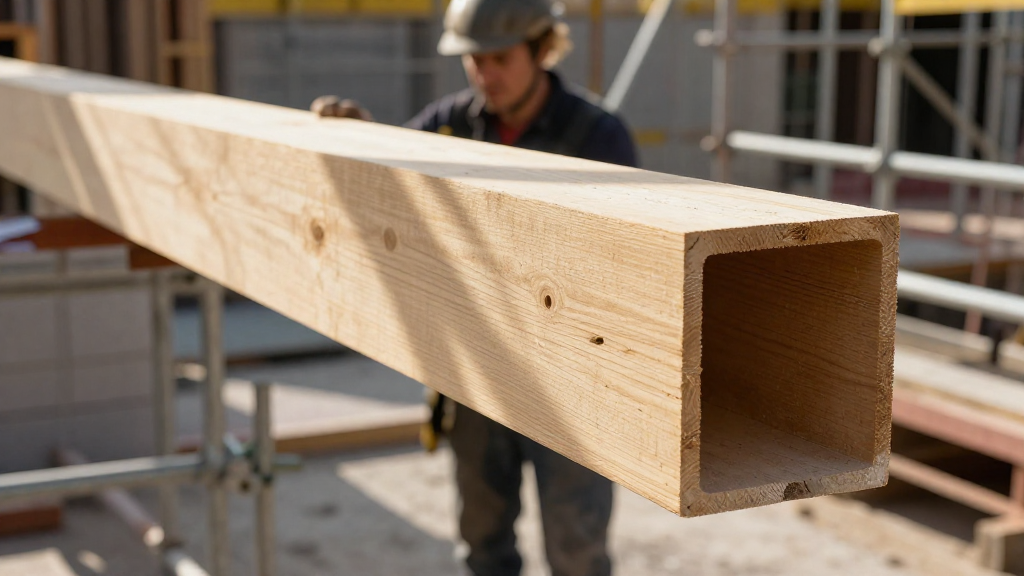
A beam as simply supported is a fundamental concept in structural engineering that plays a vital role in the design and analysis of various structures.
Understanding how this type of beam functions is essential for engineers, architects, and builders alike. In this article, we will delve into the definition, characteristics, and applications of a beam as simply supported, ensuring that you have a comprehensive understanding of this crucial structural component.
What Defines a Simply Supported Beam?
A simply supported beam is a structural element that rests on supports at either end. It is characterized by the following features:
-
Load Distribution:
– A simply supported beam can carry distributed loads or point loads.
– It allows for the transfer of weight from the beam to its supports without creating additional moments or rotational forces. -
Reaction Forces:
– The supports generate reaction forces to counterbalance the applied loads.
– This ensures that the beam remains stable and static. -
No Fixed Ends:
– Unlike fixed beams, a simply supported beam does not have any fixed ends.
– It can rotate freely at its supports, which means it can deflect under load.
How Does a Beam as Simply Supported Operate?
When analyzing a beam as simply supported, we can break down its operation into several key principles. These principles help to explain the behavior of the beam under different loads:
1. Equilibrium Conditions:
For a simply supported beam to remain in a state of equilibrium,
- The sum of vertical forces must equal zero.
- The sum of moments about any point must also equal zero.
These conditions help in determining the reaction forces that develop at the supports.
2. Deflection:
When loads are applied to a simply supported beam,
- The beam bends, leading to deflection.
- The maximum deflection occurs at the midpoint for symmetrical loading.
Understanding deflection is crucial for ensuring that a beam does not exceed allowable limits, which could lead to structural failures.
3. Bending Moment and Shear Force:
In a simply supported beam, the internal forces develop as follows:
- Bending Moment: It represents the internal moments generated due to applied loads. The maximum bending moment typically occurs at the center of the beam when loads are concentrated there.
- Shear Force: This force acts perpendicular to the beam’s longitudinal axis and is crucial for understanding how loads are transferred through the beam.
What Materials Are Used for Simply Supported Beams?
A beam as simply supported can be constructed from a variety of materials. The choice of material depends on factors such as:
- Load Requirements
- Span Length
- Cost-Effectiveness
Common materials include:
-
Steel:
– Known for its high strength-to-weight ratio.
– Convenient for longer spans and heavy loads. -
Concrete:
– Typically used in construction for its durability.
– Prefabricated concrete beams are common in residential and commercial buildings. -
Wood:
– A traditional material that is often used in smaller structures.
– It is cost-effective and readily available. -
Composite Materials:
– Combine different materials to enhance performance.
– These may include a mixture of steel and concrete or advanced polymer composites.
What Are the Applications of Simply Supported Beams?
The versatility of a beam as simply supported makes it suitable for a variety of applications. Here are some common uses:
-
Bridges:
– Simply supported beams form the basis for many bridge designs, allowing vehicles to traverse spans safely. -
Buildings:
– They are integral to floor systems and roof structures, providing support across columns and walls. -
Industrial Structures:
– Used in warehouses and manufacturing facilities to support heavy machinery and storage areas. -
Cantilever and Overhanging Structures:
– Sometimes, simply supported beams can be extended beyond one of their supports, creating overhangs for balconies or roofs.
How to Analyze a Simply Supported Beam?
Analyzing a beam as simply supported involves several steps, usually incorporating mathematical formulas and methods. Here’s a simplified approach:
1. Identify the Loads:
Begin by determining the types of loads acting on the beam:
- Point Loads: Concentrated loads acting at specific points.
- Distributed Loads: Loads that spread out over a length of the beam.
2. Calculate Reaction Forces:
Use equilibrium equations to solve for reaction forces at each support. Set up equations based on:
- Balance of vertical forces.
- Moment about one support.
3. Draw Shear and Moment Diagrams:
These diagrams illustrate how shear forces and bending moments vary along the length of the beam. They provide insight into critical locations for the beam’s performance.
4. Determine Maximum Deflection:
Use deflection formulas or software tools to calculate the maximum permissible deflection, ensuring it meets industry standards and safety regulations.
What Are the Design Considerations?
When designing a beam as simply supported, several factors must be taken into account:
- Span Length: The distance between supports influences the beam’s size and material.
- Load Characterization: Consider both live loads (temporary loads) and dead loads (permanent loads).
- Serviceability: Ensure that the deflection and vibrations are within acceptable limits for the intended use.
Conclusion
In summary, a beam as simply supported is a fundamental structural element that plays a critical role in various applications across engineering and architecture.
Its inherent simplicity, coupled with the ability to efficiently carry loads, makes it a preferred choice for many structural designs.
Understanding the behavior, analysis, and design considerations of simply supported beams is essential for anyone involved in construction or engineering. By mastering these concepts, you ensure that the structures you design are both safe and functional.