If you are searching for a SABRENT VOLTIK Charging Station review that goes beyond marketing language, this model is easiest to judge as a desk power hub.
It is built for people who want one shared charger for laptops, phones, tablets, and accessories without filling every outlet on the wall.
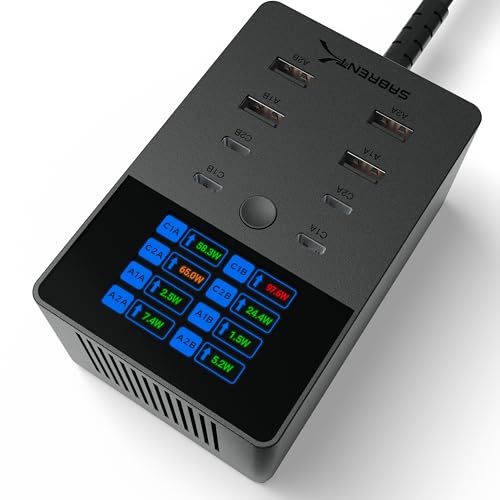
VOLTIK Charging Station Review Summary
The SABRENT VOLTIK Charging Station makes sense for buyers who want one organized charging point instead of a pile of brick adapters.
Its main appeal is the mix of 8 ports, a 252W shared power budget, and a live LCD readout, which together make it more useful than a basic multi-port USB charger for a busy desk, family charging spot, or small office.
It is not a magic high-wattage solution for eight devices at full output simultaneously.
The listing is clear that the 252W total is shared across all ports, so the product works best when one or two power-hungry devices are paired with several lighter loads.
That is the right tradeoff for buyers who care more about cable management, visibility, and convenience than about squeezing peak power from every port at once.
Review Scorecard
| Category | Score | Why it rates this way |
|---|---|---|
| Power flexibility | 8/10 | Four USB-C and four USB-A ports cover laptops, phones, tablets, and accessories. |
| Desk organization | 9/10 | One compact station can replace several wall chargers and reduce clutter. |
| Port visibility | 8/10 | The LCD shows real-time wattage, voltage, amperage, and internal temperature. |
| High-load practicality | 7/10 | Strong for mixed use, but the shared 252W budget limits simultaneous peak output. |
| Device compatibility | 9/10 | USB-C, USB-A, PD 3.0, PPS, QC 4.0, and QC 3.0 support broad modern coverage. |
| Safety confidence | 8/10 | UL certification and overcharge, overcurrent, overheating, and short-circuit protection add reassurance. |
| Best-value fit | 8/10 | Buyers who need an organized, monitorable hub will get more value than those who only need one charger. |
Key Features and Specifications of VOLTIK Charging Station
The core spec is straightforward: 252W total power shared across 8 ports.
There are four USB-C ports and four USB-A ports, and the listing gives each USB-C port up to 100W and each USB-A port up to 18W, with the important caveat that those numbers are not all available at once across every port.
That shared-power design matters because it tells you exactly what the charger is, and what it is not.
The built-in color LCD is the most distinctive feature after the port count.
According to the listing, it can cycle through the eight ports and show current wattage, voltage, amperage, and internal temperature.
For a desktop charger, that is unusually informative and makes it easier to tell whether a device is negotiating a fast charge or simply trickling.
The station also supports modern charging protocols including PD 3.0, PPS, QC 4.0, and QC 3.0.
In practical terms, that means the charger is aimed at current USB-C and USB-A gear rather than legacy devices.
The USB-C ports are positioned for laptops and tablets, while the USB-A ports are better suited to phones, earbuds, watches, and other accessories.
Safety is another meaningful part of the value proposition.
The product is UL certified and the listing calls out protection against overcharge, overcurrent, overheating, and short circuits.
That does not make it a special-case industrial device, but it does make the product easier to trust in a home office or shared family space where it may run for long sessions.
Useful facts from the listing:
- 8 ports total: 4 USB-C and 4 USB-A
- 252W shared output budget
- USB-C ports rated up to 100W each, depending on total load
- USB-A ports rated up to 18W each, depending on total load
- Color LCD with wattage, voltage, amperage, and internal temperature readouts
- Supports PD 3.0, PPS, QC 4.0, and QC 3.0
- UL certified with multi-layer protection
Pros and Cons of VOLTIK Charging Station
Pros
- Highly practical port mix. Four USB-C and four USB-A ports cover most desk-side charging needs without forcing adapters.
- Excellent for cable cleanup. One station can replace several scattered bricks and consolidate devices in one place.
- Live charging feedback. The LCD is genuinely useful if you want to see how power is being distributed.
- Good modern protocol support. PD, PPS, and QC support make it relevant for current devices.
- Safety-focused positioning. UL certification and protection claims will matter to cautious buyers.
Cons
- Shared power means compromise. The 252W total is divided across all active ports, so it is not an eight-device full-power monster.
- USB-A remains secondary. Those ports are fine for accessories, but they are not the main event for demanding devices.
- Desk utility matters more than portability. This is a station, not a travel charger.
- The LCD adds value only if you care about visibility. Buyers who just want simple plug-in charging may not use it much.
Who Should Buy VOLTIK Charging Station?
This charger is a strong match for home office users, shared desks, families with several daily-charge devices, and anyone who wants a central charging hub.
It is especially sensible if your setup includes a laptop plus a phone, tablet, earbuds, or a smartwatch, because that is exactly the kind of mixed workload the shared 252W design is meant to handle.
It is also a good fit for buyers who like information.
If you want to see what each port is drawing, or you prefer having a visual check on charging behavior, the LCD gives the product a real advantage over generic multi-port blocks.
It is less compelling for people who want the simplest possible charger, or for buyers who expect every port to deliver maximum output all the time.
If you mainly need one fast charger for a single laptop, this may be more capability than you need.
If you want a compact travel brick, this is the wrong category entirely.
Charging Behavior and Real-World Fit
Shared Power Strategy
The most important thing to understand is that the charger is designed around shared allocation.
That makes it attractive for mixed-device charging, but it also means buyers should think in terms of balance instead of maximum per-port claims.
USB-C and USB-A Roles
The USB-C side is the headline for laptops and tablets, while the USB-A ports are best treated as support ports for lower-demand devices.
That separation helps the station function like a real desktop hub rather than a random port cluster.
LCD Visibility
The color LCD is more than decoration because it turns the charger into something you can actually monitor.
If your priority is knowing whether a port is pulling useful power, the display gives the station an edge.
Safety and Placement
The UL certification and protection suite make the unit easier to place in a shared environment.
That matters when a charger is expected to stay plugged in and serve multiple devices every day.
Alternatives to VOLTIK Charging Station
If you want a similar category product with different tradeoffs, start with the Anker Prime charging station, which is often the first comparison point for premium multi-device desktop charging.
For buyers who want a simpler multi-port desktop hub, the UGREEN USB-C charging station is a credible alternative.
If your priority is raw ecosystem familiarity and broad accessory support, the Baseus desktop charger is another common search path.
For people who mostly need one or two very high-output USB-C ports rather than a shared 8-port layout, a Satechi multi-port charger may fit better.
And if you want a lower-complexity brand-name option for a desk or nightstand, search for Belkin USB-C charger models that emphasize reliability over port density.
Is VOLTIK Charging Station Worth It?
Yes, if your main problem is messy, fragmented charging and you want a monitorable desktop hub. The SABRENT VOLTIK Charging Station is worth considering because it combines a serious shared wattage budget, broad device support, UL-certified safety positioning, and a genuinely informative LCD.
It is not the best choice for buyers chasing maximum simultaneous output from every port, and it is not a travel charger.
But for a desk, office, or family charging station, the design is coherent and useful.
If that is your use case, the VOLTIK is a sensible buy.