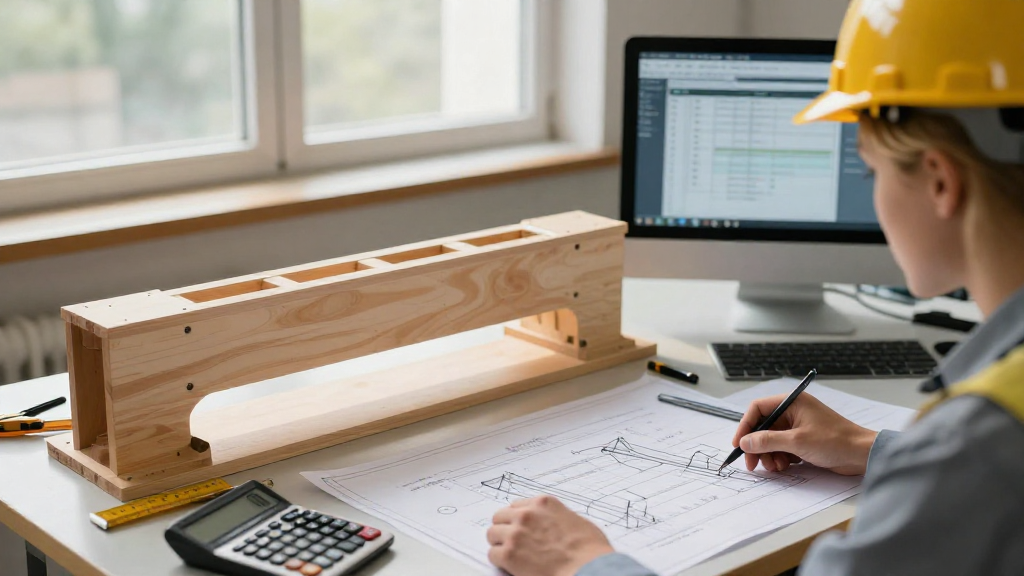
Calculating beam reactions is an essential aspect of structural engineering that ensures the safety and stability of structures.
In this article, we will explore the process of beam reactions calculation, the fundamental principles involved, and the key steps you need to follow to achieve accurate results.
What are Beam Reactions?
Beam reactions are the forces and moments that occur at the supports of a beam when it is subjected to loads.
These reactions ensure that the beam remains in equilibrium.
Understanding beam reactions is crucial for engineers and architects when designing buildings, bridges, and other structures.
When performing a beam reactions calculation, we typically focus on three main types of support:
- Simply Supported Beam: This type has a pin support at one end and a roller support at the other.
- Cantilever Beam: Fixed at one end, this beam extends without any support at the other end.
- Continuous Beam: This type is supported by more than two supports and extends over multiple spans.
Each of these beam types may exhibit different reactions, so understanding their unique behaviors is critical during calculations.
Why are Beam Reactions Important?
Correctly determining beam reactions is vital for several reasons:
- Safety: Ensures the structure can support the intended loads without failure.
- Stability: Prevents excessive deflection and structural instability.
- Material Efficiency: Selects appropriate materials and dimensions for a beam, avoiding over-engineering.
- Compliance: Adheres to building codes and safety standards.
How to Start with Beam Reactions Calculation?
To perform an effective beam reactions calculation, you must follow a systematic approach.
Here’s a step-by-step guide:
Step 1: Identify the Structure
Before you begin the calculations, identify the type of beam and support system you’ll be working with.
- Simply Supported Beam: Involves two supports; use for basic spans.
- Cantilever Beam: Analyze usually when extending from a wall or similar structure.
- Continuous Beam: Analyze beams supported at various intervals.
Step 2: Define Loads Acting on the Beam
Loads can be classified into various categories and must be correctly identified to ensure accurate calculations:
- Point Loads: Concentrated at a specific point along the beam.
- Uniformly Distributed Loads (UDL): Spread evenly across the length of the beam.
- Variable Loads: Changing loads that impact the beam differently along its span.
Step 3: Draw a Free Body Diagram
A free body diagram (FBD) provides a visual representation of the beam and the forces acting upon it.
To create an FBD:
- Sketch the beam and label its supports.
- Depict all loads acting on the beam, including their magnitudes and directions.
- Indicate the support reactions (often labeled as ( R_A ) for support A and ( R_B ) for support B).
Step 4: Apply Equilibrium Conditions
Using the principles of static equilibrium, set up the equations necessary for solving for beam reactions.
The two main equilibrium conditions are:
- Sum of Vertical Forces (ΣFy) = 0: This ensures that the vertical forces acting on the beam are balanced.
Formula:
[
R_A + R_B – P = 0
]
where ( P ) is the total vertical load.
- Sum of Moments (ΣM) = 0: This ensures that all moments about any point on the beam are balanced.
Choose a point (usually one of the supports) to take moments about it.
[
R_B \cdot d – P \cdot d_1 = 0
]
where ( d ) is the distance from the support to the point of load application and ( d_1 ) is the distance from the reference point to where the load acts.
Step 5: Solve the Equations
Once you have your equations set up from the equilibrium conditions, proceed to solve them one by one.
Start with the moment equation:
- Calculate the reaction forces.
- Substitute the calculated values back into the vertical force equation to confirm equilibrium.
Example: A Simple Beam Reaction Calculation
Let’s look at a quick example:
Suppose you have a simply supported beam of length 10 meters with a point load of 20 kN located 4 meters from the left support.
-
Draw the FBD:
– Free-body diagram would show a beam with load and two support reactions ( R_A ) and ( R_B ). -
Apply Equilibrium Conditions:
– Sum of vertical forces:
[
R_A + R_B – 20 = 0 \quad (1)
]
– Sum of moments about A:
[
-20 \cdot 4 + R_B \cdot 10 = 0 \quad (2)
] -
Solve:
From equation (2):
[
R_B \cdot 10 = 80 \Rightarrow R_B = 8 \, kN
]
Substitute ( R_B ) into equation (1):
[
R_A + 8 – 20 = 0 \Rightarrow R_A = 12 \, kN
]
Thus, the beam reactions calculation gives ( R_A = 12 \, kN ) and ( R_B = 8 \, kN ).
Step 6: Verify the Results
Always double-check your calculations and that both equilibrium equations are satisfied.
Consistency in results strengthens the reliability of your analysis.
What Tools Can Aid in Beam Reactions Calculation?
While traditional methods work well for smaller projects, more advanced software can streamline the beam reactions calculation process for larger, more complex structures.
Here are some popular tools:
- AutoCAD: Useful for drafting and visualizing structures.
- SAP2000: A robust software for structural analysis, suitable for beam reactions.
- MATLAB: Ideal for custom calculations and simulations.
- RISA: Structural analysis software employed for beam and frame analysis.
These tools can significantly reduce human error and increase efficiency, especially in larger engineering projects.
Conclusion: Mastering Beam Reactions Calculation
Calculating beam reactions may seem daunting, but with a clear understanding of the principles and methods outlined above, you can ensure the stability and safety of your structures.
Remember to:
- Identify the type of beam.
- Define the loads accurately.
- Create detailed free body diagrams.
- Apply equilibrium conditions systematically.
By mastering the method of beam reactions calculation, you will enhance your expertise in structural engineering, contributing to safe and effective designs in your projects.
Whether you are an aspiring engineer or an experienced professional, these skills are foundational to successful engineering practices. Don’t overlook the importance of verifying results and employing modern tools to aid in your calculations.
Keep practicing, and soon you will be proficient in beam reactions calculation!