A laser projector can turn gaming into a genuinely cinematic experience, but the best choice depends on more than resolution. Input lag, refresh rate, brightness, throw distance, HDR performance, and room lighting all affect how playable and immersive the image feels.
We selected 10 laser projectors for gaming that cover competitive play, console gaming, home theater, golf simulation, and flexible living-room setups. Use the guide below to narrow the list by performance, installation needs, and budget.
Best 10 Laser Projectors for Gaming Picks for 2026
Competitive 4K Pick

- 4ms input lag and 240Hz refresh rate
- 4K RGB triple-laser picture with Dolby Vision
- Google TV and automatic setup features
Best For: Competitive gamers wanting a feature-rich home theater
Bright Short-Throw Choice

- 3200 ANSI lumens for brighter rooms
- 4ms response at 1080p/240Hz
- 4K HDR with short-throw placement
Best For: Living-room console and PC gaming
Flexible Premium Theater

- 4ms input lag and 240Hz gaming
- 0.9–1.5x optical zoom for flexible placement
- 15,000:1 contrast with HDR10+ and EBL
Best For: Gaming and cinema enthusiasts with varied room layouts
Compact Full HD Value

- 3500 ANSI lumens in a compact body
- Short-throw Full HD projection
- Laser light source rated up to 30,000 hours
Best For: Casual console gaming in compact spaces
Best for Xbox Performance

- 4K UHD with HDR/HLG and SuperColor
- 240Hz refresh rate with 4.2ms input lag
- Optical zoom and flexible image adjustment
Best For: Xbox gaming, golf simulation, and large-screen home theater
Best for Bright-Room Gaming

- 3200 ANSI lumens for living-room viewing
- 4K UHD with HDR10/HLG support
- 4ms response at 1080p/240Hz
Best For: PS5, Xbox, and PC gaming in brighter rooms
Best Portable Smart Projector

- 4K triple-laser color with HDR10
- Google TV and officially licensed Netflix
- Portable 4.4-pound design with 17ms latency
Best For: Portable gaming, streaming, and flexible room-to-room use
Best Short-Throw Pick
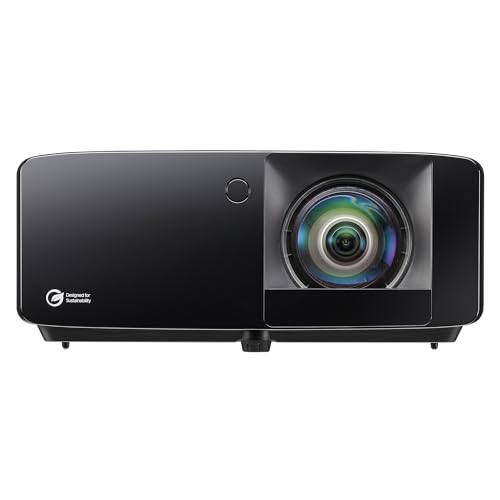
- 4,200 ANSI lumens
- Short-throw Full HD design
- 30,000-hour laser source
Best For: Bright gaming and golf simulation in compact rooms
Best Premium Gaming Features

- Native 4K RGB triple laser
- 1ms and 240Hz gaming features
- Google TV and Dolby Vision
Best For: Feature-rich 4K gaming and home cinema
Best Bright Installation Option

- 5,500 ANSI lumens
- 30- to 300-inch image range
- Flexible 360-degree installation
Best For: Bright rooms, golf simulation, and permanent setups
Competitive 4K Pick – StreamMaster Plus2
For gamers seeking laser projectors for gaming with fast response and premium picture quality, the Valerion StreamMaster Plus2 combines 4K UHD resolution, 4ms input lag, and a 240Hz refresh rate. Its Google TV platform and automatic setup features also make it practical for everyday entertainment.
Best For: Competitive gamers who also want a large-screen home theater and streaming hub.
Pros:
- 4ms input lag and 240Hz refresh rate support responsive gameplay.
- RGB triple-laser light source, 2000 ISO lumens, Dolby Vision, and HDR10 deliver vivid 4K images.
- Automatic focus, alignment, keystone correction, and obstacle avoidance simplify setup.
- Google TV, AirPlay 2, Miracast, and Chromecast are built in.
Cons:
- Its extensive theater and smart features may be more than casual gamers need.
- Brightness is lower on paper than some brighter laser alternatives.
The StreamMaster Plus2 is a strong all-in-one choice when gaming responsiveness, cinematic features, and convenient smart functionality matter equally.
Bright Short-Throw Choice – BenQ TK710STi
The BenQ TK710STi is a practical option among laser projectors for gaming when you need a bright image in a living room. Its 3200 ANSI lumens, short-throw design, 4K resolution, and low-latency gaming mode are suited to both console and PC play.
Best For: Gamers who play in rooms with ambient light and want a compact short-throw setup.
Pros:
- 3200 ANSI lumens help keep games bright with the lights on.
- 4ms response at 1080p/240Hz supports low-lag competitive gaming.
- 4K resolution, HDR10, and 95% Rec.709 coverage provide detailed, colorful images.
- Short-throw design and Android TV reduce setup and streaming needs.
Cons:
- Its listed 240Hz gaming response applies at 1080p rather than 4K.
- The supplied specifications identify HDMI as the primary hardware connection.
Choose the TK710STi if brightness and flexible living-room gaming are priorities, especially when a short-throw projector is easier to place than a standard model.
Flexible Premium Theater – VisionMaster Pro 4K
The Valerion VisionMaster Pro 4K stands out among laser projectors for gaming with a flexible 0.9–1.5x optical zoom, 4ms input lag, and 240Hz support. It is designed for users who want competitive gaming performance without giving up a large, cinema-focused image.
Best For: Enthusiasts needing flexible placement, high contrast, and premium gaming and movie features.
Pros:
- 4ms input lag and 240Hz refresh rate support fast gameplay, including ultra-wide formats.
- 2500 ISO lumens, 15,000:1 contrast, EBL, and HDR10+ target detailed, high-contrast images.
- 0.9–1.5x optical zoom accommodates more room layouts without relying only on digital adjustments.
- 4K UHD, IMAX Enhanced, 3D, and Dolby Vision support broaden its theater appeal.
Cons:
- Its premium cinema and optical features may exceed the needs of casual players.
- Brightness is below the BenQ model in this roundup.
The VisionMaster Pro 4K is the most adaptable pick here for buyers balancing serious gaming responsiveness with advanced image control and a large-screen theater experience.
Compact Full HD Value – Optoma GT2000HDR
The Optoma GT2000HDR is a straightforward choice among laser projectors for gaming, offering a compact short-throw design, 3500 ANSI lumens, and Full HD resolution. It suits gamers who want a bright, large image without moving up to a 4K projector.
Best For: Casual console gamers who prioritize brightness, portability, and simple Full HD projection.
Pros:
- 3500 ANSI lumens provide a bright image for home entertainment use.
- Short-throw design can create a large picture from a relatively close position.
- Laser light source is rated for up to 30,000 hours.
- Compact body supports tabletop placement and includes HDMI, USB, and 3.5mm audio connections.
Cons:
- Native resolution is 1920×1080 rather than 4K.
- The supplied notes do not specify an input-lag or refresh-rate advantage for competitive gaming.
- It lacks the smart TV and advanced gaming features listed on the other models.
The GT2000HDR is best viewed as a bright, compact Full HD gaming projector for straightforward setups rather than a specialized competitive-gaming display.
Best for Xbox Performance – ViewSonic LX700-4K
The ViewSonic LX700-4K is a strong pick among laser projectors for gaming if you want 4K detail, Xbox-focused features, and very fast refresh rates. Its 240Hz mode, 4.2ms input lag, HDR support, and up to 150-inch recommended projection range suit both competitive gaming and cinematic home entertainment.
Best For: Xbox players and home-theater users who want large-screen 4K gaming with flexible installation options.
Pros:
- 4K UHD resolution with HDR/HLG support and SuperColor technology.
- 240Hz refresh rate and 4.2ms ultra-low input lag for fast-paced play.
- Supports 1.3x optical zoom, four-corner adjustment, and horizontal/vertical keystone correction.
- Dedicated Golf Mode and compatibility with major golf simulators.
Cons:
- Its Xbox-oriented feature set may be more than needed for casual players.
- At 3500 ANSI lumens, room-darkening may still improve contrast for movie viewing.
Choose the LX700-4K when responsive Xbox gaming and versatile big-screen setup matter most. It is especially appealing for medium-sized rooms, where a 100-inch image can be produced from about 7.7 feet.
Best for Bright-Room Gaming – BenQ TK710
The BenQ TK710 is one of the more practical laser projectors for gaming in rooms where the lights stay on. Its 3200 ANSI-lumen output, 4K UHD resolution, HDR10/HLG support, and laser light source combine with low-latency gaming modes for a responsive big-screen setup.
Best For: Living-room gaming with PS5, Xbox, or PC when brightness and 4K image quality are priorities.
Pros:
- 3200 ANSI lumens help maintain a visible image in brighter living spaces.
- True 4K UHD resolution with HDR10/HLG and Dynamic Function contrast adjustment.
- Supports 4ms response at 1080p/240Hz and 16ms input lag at 4K/60Hz.
- Includes a durable laser light source, 1.3x zoom, lens shift, and eARC support.
Cons:
- Its maximum listed image size is 144 inches, smaller than some large-format alternatives.
- Connectivity is listed primarily around HDMI, limiting the included connection variety.
The TK710 makes sense when you want a gaming projector that can handle ambient light without giving up 4K detail. Its clearest advantage is the balance between bright-room usability and responsive performance across different resolutions.
Best Portable Smart Projector – JMGO N1S 4K Upgrade
The JMGO N1S 4K Upgrade takes a more flexible approach to laser projectors for gaming, combining 4K visuals with a portable design, Google TV, and a built-in gimbal. Its triple-laser color system, 17ms latency, HDMI 2.1, and automatic image adjustments make it convenient for gaming and streaming in different locations.
Best For: Portable gaming and entertainment setups that need built-in streaming, flexible placement, and strong color performance.
Pros:
- 4K UHD resolution, HDR10, and MALC 3.0 RGB triple-laser technology.
- Integrated gimbal rotates vertically by 127 degrees for flexible positioning.
- Google TV with officially licensed Netflix, Google Cast, and Google Assistant.
- Portable 4.4-pound design with HDMI 2.1 and 17ms latency.
Cons:
- Its 1700 ISO-lumen output is lower than the brighter ViewSonic and BenQ models.
- 17ms latency is less suited to highly competitive gaming than the fastest options here.
- Best results may require careful keystone and focus adjustment.
The N1S 4K Upgrade is the most convenient choice for moving between rooms, projecting outdoors, or using a ceiling or wall as the screen. Pick it for portability and smart-TV convenience rather than maximum brightness or lowest possible gaming latency.
Best Short-Throw Pick – Optoma GT2400HDR
If you want laser projectors for gaming that can create a large Full HD image from a short distance, the Optoma GT2400HDR is a practical option. Its 4,200 ANSI-lumen brightness, short-throw design, low-input-lag gaming focus, and 30,000-hour laser light source suit game rooms and golf simulation setups.
Best For: Gamers and golf-simulation users who need bright 1080p images in a compact installation.
Pros:
- Short-throw design works from approximately 2.6 to 3.7 feet.
- 4,200 ANSI lumens supports bright images.
- Full HD 1920 x 1080 native resolution with up to 4K display support.
- 30,000-hour DuraCore laser light source and IP6X-rated dust protection.
Cons:
- Native resolution is 1080p rather than 4K.
- Connectivity is comparatively focused, with HDMI and RCA listed.
- Its 9.4-pound desktop form factor may be less convenient for portable use.
The GT2400HDR emphasizes bright, low-lag gaming and flexible tabletop, wall, or floor mounting. Choose it when short-throw placement and durability matter more than built-in smart-TV features.
Best Premium Gaming Features – XGIMI HORIZON 20
The XGIMI HORIZON 20 stands out among laser projectors for gaming with native 4K resolution, an RGB triple-laser engine, and gaming features including 1ms response, 240Hz operation, VRR, and ALLM. Built-in Google TV, Harman Kardon speakers, and an integrated stand also reduce the need for extra equipment.
Best For: Gamers seeking high-resolution, high-refresh-rate projection with integrated streaming and audio.
Pros:
- Native 3840 x 2160 resolution with up to a 300-inch image.
- Gaming-oriented 1ms response, 240Hz refresh rate, VRR, and ALLM.
- RGB triple-laser engine delivers 3,200 ISO lumens and a 100,000:1 contrast ratio.
- Includes Google TV, licensed Netflix, Dolby Vision, and Harman Kardon speakers.
Cons:
- Its 4.9 kg weight is less portable than a small tabletop projector.
- Minimum throw distance is listed as 1.06 meters, so it is not an ultra-short-throw model.
- The supplied specifications list 220V and 240V voltage compatibility.
With optical zoom, lens shift, and a flexible floor-mount design, the HORIZON 20 is built for adaptable home setups. It is the strongest fit here for buyers prioritizing modern gaming performance and cinematic image features in one unit.
Best Bright Installation Option – ViewSonic LS740HD
For laser projectors for gaming used in larger or brighter spaces, the ViewSonic LS740HD combines Full HD resolution with a powerful 5,500 ANSI-lumen output. Its 1.13–1.47 throw ratio, optical zoom, golf mode, and broad installation adjustments make it suitable for gaming rooms, simulators, classrooms, and permanent setups.
Best For: Bright-room gaming, golf simulation, and fixed installations requiring flexible positioning.
Pros:
- 5,500 ANSI lumens helps maintain image visibility in bright environments.
- Supports 30- to 300-inch images with 1.3x optical zoom.
- H/V keystone, four-corner adjustment, portrait mode, and 360-degree projection aid installation.
- Includes dual HDMI inputs, USB, RS232, audio out, and a built-in 15W speaker.
Cons:
- Native resolution is Full HD 1080p rather than 4K.
- Stationary ceiling-mount design is less suited to casual portability.
- The listed light-source life is 20,000 hours, shorter than some competing laser models.
The LS740HD prioritizes brightness, placement flexibility, and installation-oriented connectivity over cutting-edge gaming specifications. It is a sensible choice when your setup needs a large, visible image and reliable mounting options.
How We Picked the Best Laser Projectors for Gaming
We focused on the specifications that matter most during real gameplay: input lag, supported refresh rates, resolution, brightness, HDR compatibility, throw flexibility, and laser light-source advantages. Short-throw models received extra consideration for smaller rooms, while brighter projectors are better suited to spaces with ambient light. We also considered gaming-oriented features such as console compatibility, motion handling, image presets, and suitability for large-screen home theater use.
Specifications can vary by resolution and operating mode, so check the manufacturer’s stated latency and refresh-rate limits for the connection you plan to use. A projector advertised at 240Hz may support that rate only at a lower resolution, while 4K gaming may run at a different refresh rate.
Quick Comparison
| What matters most | Best fit | Models to consider |
|---|---|---|
| Fast competitive gaming | Low latency and high refresh rates | Valerion StreamMaster Plus2, Valerion VisionMaster Pro, ViewSonic LX700-4K |
| Small rooms | Short-throw placement | BenQ TK710STi, Optoma GT2000HDR, Optoma GT2400HDR |
| Bright rooms | High rated brightness | Optoma GT2400HDR, ViewSonic LS740HD, ViewSonic LX700-4K |
| 4K home entertainment | High detail and HDR | BenQ TK710, JMGO N1S, XGIMI HORIZON 20 |
Key Buying Factors for Laser Projectors for Gaming
Input Lag and Refresh Rate
Input lag is critical for shooters, racing games, and fighting games. Look for a dedicated gaming mode and verify latency at your preferred resolution. A high refresh rate can make camera movement smoother, but it is useful only if your console or gaming PC can supply the required frame rate.
Resolution, HDR, and Image Quality
Native or pixel-shifted 4K provides a sharper image on very large screens, while 1080p can still look excellent and may offer lower cost or higher refresh-rate flexibility. HDR support improves contrast and color when the projector has enough brightness and dynamic range to display it effectively.
Throw Distance and Brightness
Short-throw projectors reduce the distance needed to create a large image and help limit shadows from players or furniture. Brightness matters most in rooms that are not fully dark, but ratings are not always directly comparable across brands. Dark walls, blackout curtains, and a suitable screen can improve perceived contrast more than chasing a higher specification alone.
Connections, Sound, and Installation
Check HDMI bandwidth, eARC or optical audio support, built-in streaming features, lens shift, keystone controls, and mounting options. For serious gaming, connect consoles or PCs directly to the projector when possible and use an external soundbar or AV receiver for better audio.
Who Should Buy Which Laser Projectors for Gaming?
Competitive players should prioritize the Valerion and ViewSonic gaming-focused models with high refresh-rate support and low stated response times. Small-room gamers should start with the BenQ TK710STi or an Optoma short-throw option. Movie-and-gaming households may prefer a 4K model with HDR, Dolby support, or a smart TV platform, such as the JMGO, XGIMI, or Valerion options. Bright-room users and golf-simulation buyers should favor the higher-output Optoma GT2400HDR or ViewSonic LS740HD. Before ordering, measure the available throw distance, confirm the screen size, and make sure the projector supports the resolution and refresh rate your gaming hardware can output.