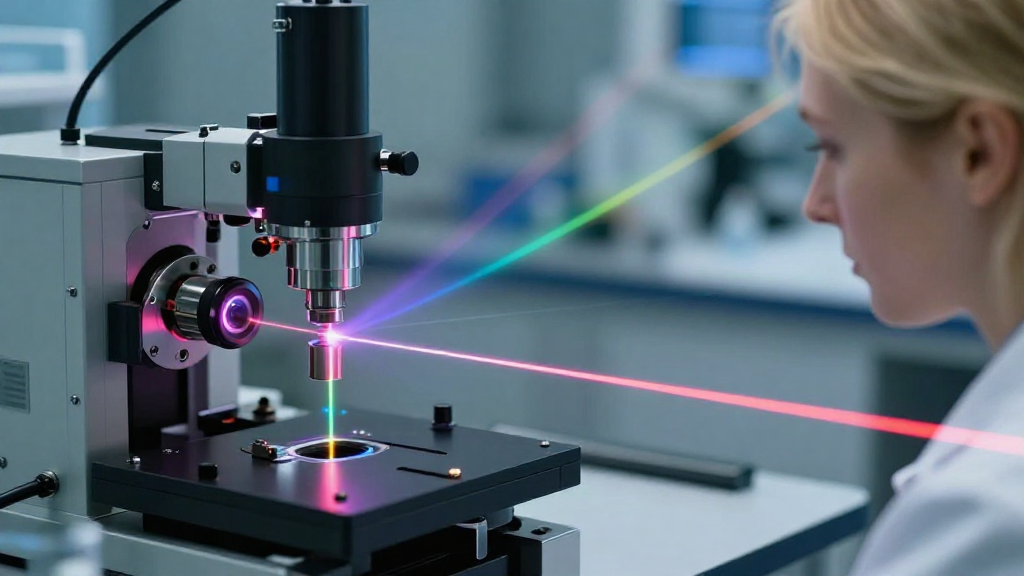
Beam propagation methods are crucial in understanding how light and other forms of radiation travel through various media.
What Is Beam Propagation?
Beam propagation refers to the way waves — especially optical waves — move through different environments.
In optics, beam propagation is essential for designing systems like:
- Lasers
- Fiber optics
- Imaging systems
- Microscopes
Understanding beam propagation methods (BPM) helps engineers and scientists predict the behavior of beams in different settings.
How Do Beam Propagation Methods Work?
What Are the Key Concepts in Beam Propagation?
- Wavefront: This is a surface over which the optical wave has a constant phase. Wavefronts play a significant role in understanding how light propagates in different directions.
- Propagation Vector: This vector gives the direction of energy flow in a wave.
- Phase: The position of a point in time on a waveform cycle, often measured in degrees or radians.
- Amplitude: This represents the maximum extent of a wave’s oscillation, which correlates with the intensity of the beam.
Using beam propagation methods, these concepts help develop models that can predict the behavior of beams in various conditions like diffraction, dispersion, and non-linearity.
How Do Different Media Affect Beam Propagation?
What Are the Factors Influencing Beam Propagation?
When light travels through different media, several factors impact its propagation:
- Medium Type: Whether it is air, water, glass, or any other material affects beam propagation.
- Wavelength: The frequency of the light wave can lead to different behaviors such as refraction.
- Temperature: Variations can change the refractive index, which also influences how beams propagate.
- Shape of the Beam: The initial shape and size of the beam can determine how it spreads and interacts with the medium.
Understanding these factors is critical for implementing effective beam propagation methods.
How Are Beam Propagation Methods Used in Technology?
In Which Applications Do Beam Propagation Methods Play a Role?
Beam propagation methods find applications across various fields:
1. Telecommunications
- High-speed internet over fiber optics relies heavily on BPM.
- Models are used to optimize signal integrity and minimize loss.
2. Medical Technology
- Beam propagation methods are essential in designing medical imaging techniques, such as ultrasound and laser treatments.
- They help in predicting how beams penetrate different tissues.
3. Manufacturing
- In laser cutting and engraving, BPM ensures precision and efficiency.
- It helps in optimizing laser beam settings to achieve the desired effect.
4. Scientific Research
- BPM allows researchers to calculate light behavior in experimental setups, including innovative optical devices.
- Facilitates simulations which benefit materials science and photonics.
Understanding beam propagation methods allows industries to innovate and improve their existing technologies.
How Do Engineers Use Beam Propagation Methods?
What Techniques Are Employed in Beam Propagation?
Engineers employ several techniques when using beam propagation methods:
-
Numerical Simulations:
– Techniques such as the Finite Difference Time Domain (FDTD) and Split-Step Fourier Method (SSFM) allow for complex modeling of beam propagation in non-uniform media. -
Analytical Models:
– Simple cases often utilize analytical solutions to wave equations to derive beam characteristics. -
Experimental Validation:
– Empirical data collected from experiments helps refine theoretical models of beam propagation.
These techniques enable better predictions and outcomes for various applications.
How Are Beam Propagation Methods Related to Nonlinear Optics?
What Is the Importance of BPM in Nonlinear Optics?
Nonlinear optics is a field that deals with the behavior of light in nonlinear materials.
In such materials, the response to an electric field is not proportional to the field strength, leading to phenomena such as:
- Self-focusing: A beam can focus itself, often resulting in drastically higher intensities.
- Four-wave mixing: This process can create new frequencies from existing light, which is crucial in telecommunications.
In nonlinear scenarios, beam propagation methods are even more significant.
These methods allow researchers to predict how beams will react in various environments, helping in the design of advanced optical devices.
How Do Beam Propagation Methods Influence Design Criteria?
What Are the Design Considerations for Beam Propagation?
Utilizing beam propagation methods requires careful design considerations depending on the application at hand:
- Output Quality: The purity and clarity of the light beam must meet the stringent requirements.
- Efficiency: The design should minimize losses through the medium.
- Cost: More complex BPM can be more expensive. Finding a balance between precision and cost-effectiveness is crucial.
- Scalability: The choices made in BPM should be able to accommodate scale without compromising performance.
By integrating these considerations, engineers can enhance their designs and applications.
How Do Innovations Shape Beam Propagation Methods?
What Are the Future Trends in Beam Propagation?
Innovations in computing, materials science, and optics are leading to exciting advances in beam propagation methods:
- Machine Learning: Advanced algorithms can help in creating predictive models, optimizing beam behavior better than traditional methods.
- Metamaterials: These engineered materials can manipulate light waves in unprecedented ways, leading to new applications in optics.
- Quantum Technologies: Developments in quantum optics also utilize BPM to understand light-matter interactions at a fundamental level.
The integration of these innovations promises to enhance beam propagation methods further, making them even more versatile and efficient.
Conclusion: The Importance of Beam Propagation Methods
Beam propagation methods play an essential role in understanding how light and other fields of radiation interact with various materials.
From telecommunications to medical technology and beyond, the applications are vast.
By utilizing these methods, engineers and scientists can design better systems and improve existing technologies.
As innovations continue to emerge, the future of beam propagation looks promising, with the potential to redefine how we understand and use light.