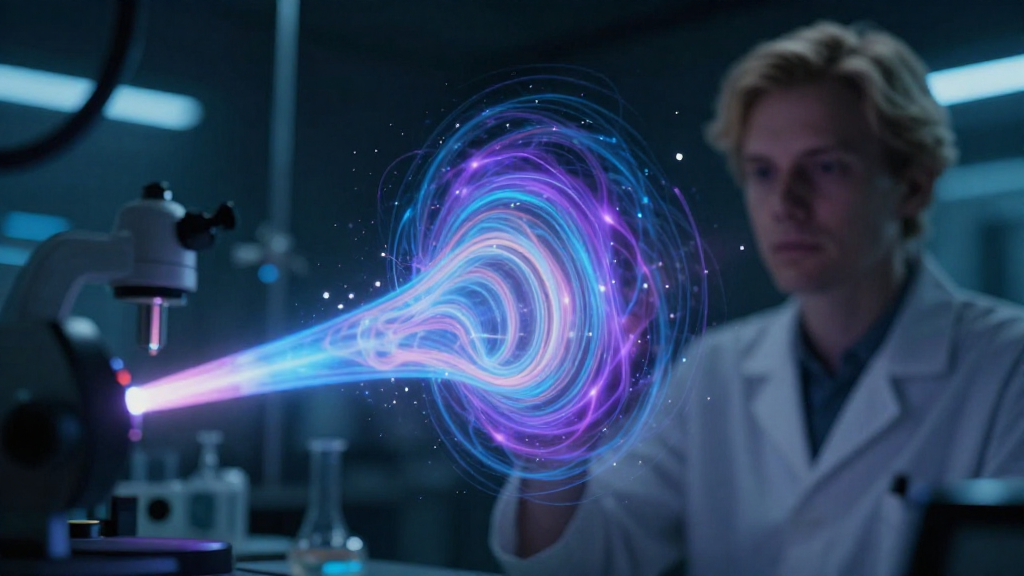
In the realm of physics, beam quantum effects play a critical role in understanding how beams of particles, such as electrons or photons, behave at very small scales.
What Are Beam Quantum Effects?
Beam quantum effects encompass a range of phenomena that occur when particles are treated as both waves and particles, which is a fundamental principle of quantum mechanics.
These effects can include:
- Wave-Particle Duality: Particles like electrons and photons exhibit both particle-like and wave-like behavior.
- Superposition: Particles can exist in multiple states or positions simultaneously until observed.
- Entanglement: Two or more particles can become entangled, meaning the state of one instantly influences the state of the other, no matter the distance separating them.
How Do Quantum Effects Influence Beams?
Understanding the influence of beam quantum effects on various types of beams is crucial for advancements in technology and research. Here are some key ways quantum effects come into play:
- Interference Patterns
-
What Are They? When beams of light or particles overlap, they can create interference patterns, observable in experiments like the double-slit experiment.
-
Importance: This phenomenon provides compelling evidence for wave-particle duality.
- Diffraction
-
What Is It? The bending of waves around obstacles or the spreading of waves when they pass through small openings.
-
How It Affects Beams: Quantum diffraction can lead to unique patterns when high-energy beams are directed at various targets, essential in quantum imaging and materials science.
- Quantum Noise
-
What Is It? The inherent uncertainty of particle positions and velocities as dictated by the Heisenberg Uncertainty Principle.
-
Implications for Beams: Quantum noise can impact measurements in high-precision instruments like lasers, affecting their stability and coherence.
What Are the Applications of Beam Quantum Effects?
The effects of beam quantum phenomena extend far beyond theoretical physics; they have tangible applications in a variety of fields:
- Quantum Computing: Utilizes the principles of superposition and entanglement to perform calculations at speeds unattainable by classical computers.
- Medical Imaging: Quantum effects can enhance imaging technologies such as MRI, providing clearer images and better diagnostics.
- Telecommunication: Quantum entanglement is being explored for secure data transmission, drastically reducing the risk of eavesdropping.
How Are Quantum Effects Harnessed in Technology?
As researchers continue to explore and harness beam quantum effects, several technologies are emerging:
- Quantum Dots
-
What Are They? Nanoscale semiconductor particles that exhibit quantum mechanical properties.
-
Uses: They are used in displays, solar cells, and biological imaging.
- Laser Technology
- How Are Quantum Effects Utilized? Lasers rely on stimulated emission, a quantum effect, to produce coherent light essential in a multitude of applications.
- Ion Beams in Microscopy
- Why Does It Matter? High-energy ion beams that utilize quantum effects can provide insights into the structure of materials at the atomic level, revolutionizing fields like nanotechnology.
What Challenges Are Associated with Beam Quantum Effects?
Despite their potential, beam quantum effects are accompanied by several challenges, including:
- Stability and Control: Maintaining stable quantum states over time and across measurements is difficult due to sensitivity to external influences.
- Scalability: Technologies that utilize these effects currently face hurdles in scaling for widespread commercial use.
- Complexity of Measurement: Quantum effects often result in probabilistic outcomes that are challenging to predict and measure.
How Can Beam Quantum Effects Be Studied?
To better understand beam quantum effects, researchers employ various experimental techniques:
-
Particle Colliders: Massive accelerators that collide particles at high speeds to observe the fundamental constituents of matter.
-
Quantum Interferometers: Devices that exploit interference patterns to study quantum states and measure minute changes in energy levels.
-
Cryogenic Techniques: These methods manipulate materials at near absolute zero, reducing thermal noise and enhancing quantum effects.
What Does the Future Hold for Beam Quantum Effects?
The exploration of beam quantum effects is a rapidly developing field with significant implications for technology and our understanding of the universe. As research continues, several areas show great promise:
-
Advancements in Quantum Computing: As quantum bits (qubits) become more feasible to create and manipulate, we may see powerful new computational capabilities.
-
Improved Sensors: Quantum sensors that leverage beam effects promise to offer unprecedented sensitivity, potentially transforming fields from geophysics to navigation.
-
New Materials Development: Understanding and utilizing quantum effects in beams could lead to the development of new materials with unique properties.
Conclusion
In summary, beam quantum effects are a vital aspect of modern physics, influencing a diverse array of technologies and promising intriguing advancements across various sectors.
From their role in quantum computing and medical imaging to their applications in cutting-edge technologies like lasers and ion beams, understanding these effects is crucial for further innovation.
As we delve deeper into these quantum phenomena, we unlock new possibilities that could redefine our interaction with the natural world and technology itself.
By investing in research and increasing our understanding of beam quantum effects, we pave the way for the next generation of scientific breakthroughs and technologies that could change the fabric of our daily lives.