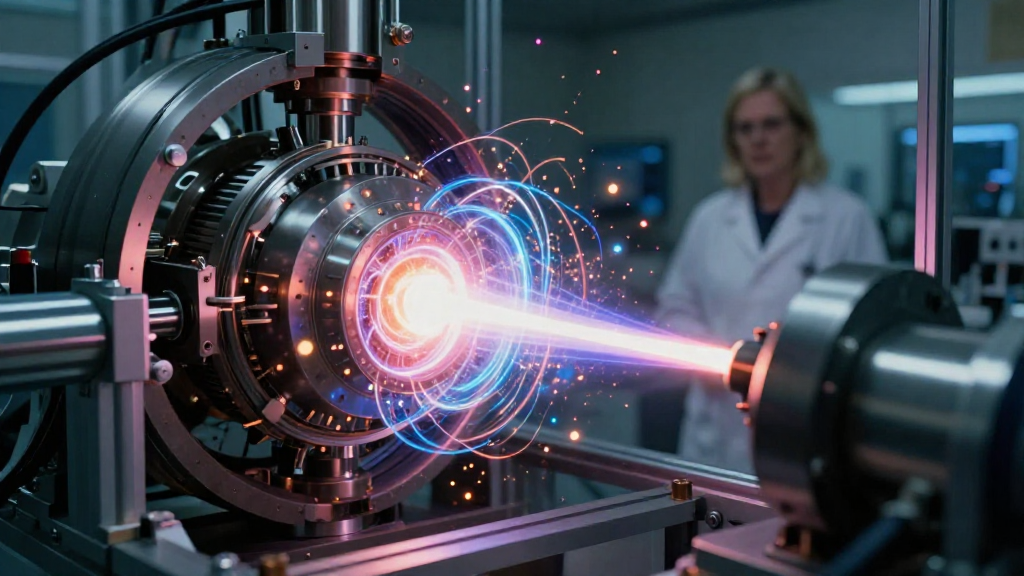
In the realm of beam physics, understanding concepts like beam relativistic mass is crucial for analyzing the behavior of particles at high speeds.
What Is Beam Relativistic Mass?
Beam relativistic mass refers to the increase in mass that a particle exhibits when moving at relativistic speeds—typically close to the speed of light.
At these speeds, the effects of relativity become significant, and the classical equations of motion no longer apply.
How Does Relativistic Mass Differ from Rest Mass?
-
Rest Mass:
– Also known as invariant mass.
– It is the mass of a particle when it is at rest.
– Does not change, regardless of the particle’s velocity. -
Relativistic Mass:
– Increases with speed.
– Defined by the equation:
[
m_{rel} = \frac{m_{rest}}{\sqrt{1 – \frac{v^2}{c^2}}}
]
– Here, (v) is the velocity of the particle, and (c) is the speed of light.
As a particle approaches the speed of light, its relativistic mass increases dramatically.
This increase impacts how beams of particles behave in electromagnetic fields, further complicating the dynamics of particle acceleration.
Why Is Beam Relativistic Mass Important in Physics?
Understanding beam relativistic mass is essential for various applications in physics, including:
- Particle Accelerators:
-
In high-energy physics experiments, where particles are accelerated to speeds approaching that of light, knowing how relativistic mass affects motion and energy is fundamental.
-
Astrophysics:
-
Knowing how relativistic mass affects the energy and behavior of cosmic rays helps researchers understand celestial phenomena.
-
Quantum Mechanics:
-
Concepts of mass and energy interplay in quantum field theories.
-
Engineering Applications:
- Designing equipment like magnetic confinement systems for plasma and accelerator facilities.
What Are the Effects of Increasing Beam Relativistic Mass?
As particles are accelerated, the following occurs:
-
Kinetic Energy:
– Increases non-linearly due to the relativistic mass effect.
– The energy required to continue acceleration also increases. -
Momentum:
– Changes according to the formula:
[
p = mv_{rel} = \frac{mv_{rest}}{\sqrt{1 – \frac{v^2}{c^2}}}
] -
Beam Dynamics:
– As the relativistic mass increases, adjustments may be needed in beam stability systems to maintain trajectories.
How Is Beam Relativistic Mass Measured?
Measuring beam relativistic mass involves several techniques:
- Time-of-Flight Measurements:
-
Using detectors to measure travel time over a set distance enables calculations of speed and thus relativistic mass.
-
Energy Measurements:
-
Cryogenic equipment and advanced sensors can directly measure energy expenditures, from which mass can be derived using relativistic relationships.
-
Tracking Systems:
- Sophisticated beamline diagnostics provide real-time assessments of particle properties.
Common FAQs About Beam Relativistic Mass
How does relativistic mass affect particle acceleration?
As the relativistic mass increases, more energy is required to continue increasing the particle’s speed, which can impact the design of accelerators and particle colliders.
Is the concept of relativistic mass still relevant in modern physics?
While some physicists prefer to use invariant mass concepts, beam relativistic mass remains relevant for practical applications in high-energy physics.
Can relativistic mass be neglected at low speeds?
Yes, at speeds much lower than the speed of light, relativistic effects become negligible, and classical mechanics provides an accurate description.
What Are the Theoretical Implications of Beam Relativistic Mass?
The concept of beam relativistic mass presents intriguing implications within theoretical frameworks:
- Energy-Mass Equivalence:
-
Reinforces Einstein’s equation, (E=mc^2), which shows that energy and mass are interchangeable.
-
Gravity and Spacetime:
-
Affects theories of gravitation, especially in high-energy regimes, where massive particles interact through gravitational fields.
-
Oscillating Behavior:
- Introduces complications in how particles oscillate or behave in quantum fields, due to changes in effective mass.
What Challenges Does Beam Relativistic Mass Present?
Challenges associated with beam relativistic mass include:
- Complex Calculations:
-
Equations involving relativistic mass lead to complex modifications to classical models.
-
Data Interpretation:
-
High-precision data from accelerators needs careful analysis to account for relativistic effects.
-
Safety Protocols:
- Increased velocities and associated effects can have safety implications during experiments in particle physics.
Conclusion: The Role of Beam Relativistic Mass in Physics
In conclusion, beam relativistic mass plays an essential role in understanding the dynamics of particles at high speeds.
From enhancing our knowledge of fundamental physics principles to practical applications in advanced technologies, the impact of this concept is profound.
As research progresses, refining our understanding of beam relativistic mass and its implications will be crucial for the future of particle physics and beyond.
By grasping the nuances of how relativistic mass interacts with beams of particles, scientists and engineers are better equipped to push the boundaries of our understanding of the universe.
As a vibrant field constantly evolving, beam physics remains a source of inspiration and discovery.