A reliable stage monitor helps vocalists hear pitch, timing, and musical cues without pushing the main PA harder. The right model can make a small worship service, rehearsal, club set, or touring performance noticeably easier to manage.
We selected 10 powered and passive monitor options across compact, budget-friendly, and high-output designs. This guide explains what to compare before choosing a monitor for your voice, venue, and performance style.
Best 10 Stage Monitors for Vocalists Picks for 2026
Best All-Around Control

- 700W coaxial powered monitor
- Three input channels and onboard DSP
- 90° x 90° coverage with 55° monitor angle
Best For: Performers needing powerful, adjustable vocal monitoring
Best Passive Value

- 12-inch woofer with 600W peak handling
- 90° x 40° horn and 97dB sensitivity
- Built-in pole socket and protection circuitry
Best For: Existing PA systems using separate amplification
Best Compact Powered Pick

- 350W powered 8-inch monitor
- Two-channel mixer with Bluetooth
- Lightweight enclosure with handles and pole socket
Best For: Small gigs, rehearsals, and portable vocal setups
Best High-Output 10-Inch Monitor

- 800W active coaxial monitor
- XLR/¼-inch input and XLR link output
- FOH/Monitor selector for placement flexibility
Best For: Live performers needing compact, high-output monitoring
Powerful Feedback-Control Monitor

- 12-inch woofer with 250W powered output
- Adjustable feedback filter and limiter
- Multiple wired input options
Best For: High-output vocal monitoring with feedback control
Flexible Compact Stage Wedge

- 10-inch woofer with titanium compression driver
- Integrated 300W amplifier
- Three-band EQ and daisy-chain output
Best For: Small venues, churches, rehearsals, and flexible setups
Compact Vocal Monitor Mixer
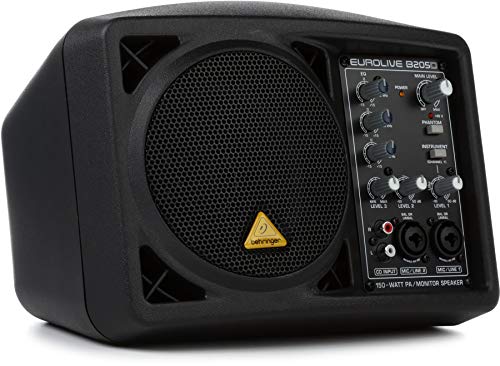
- Lightweight 7.05-pound active design
- 150W output with three-channel mixer
- Phantom-powered mic inputs and instrument input
Best For: Portable vocal monitoring, rehearsals, and home studios
High-Output Wedge
Rockville RSM15A 15-Inch Powered Monitor

- 1400W peak output with a 15-inch woofer
- XLR/TRS inputs and adjustable feedback filter
- Rugged tilt-back cabinet with ergonomic handles
Best For: Large stages, bands, and performers needing powerful vocal monitoring
Lightweight Control
Behringer EUROLIVE F1320D Active Monitor

- 300W 2-way design with a 12-inch woofer
- Class-D amplifier weighs 33.1 pounds
- Feedback filter, limiter, processor, and 3-band EQ
Best For: Portable live monitoring, rehearsals, and playback applications
Portable Power
Rockville RSM12A V2 12-Inch Monitor

- 1000W peak output with 250W RMS power
- 12-inch woofer and 1-inch titanium driver
- XLR/TRS connectivity and ergonomic handles
Best For: Gigging vocalists, small venues, DJs, and rehearsals
Best All-Around Control – Electro-Voice PXM-12MP
For vocalists who need flexible stage monitors for vocalists, the Electro-Voice PXM-12MP combines a coaxial 12-inch driver with a powerful 700W amplifier and onboard sound-shaping tools. Its wide 90° x 90° coverage and 55° monitoring angle help deliver clear monitoring from different positions onstage.
Best For: Vocalists, bands, and sound engineers who want powerful monitoring with built-in mixing and DSP control.
Pros:
- 700W Class-D amplification with system protection and limiting
- Three input channels, including two XLR/¼-inch combo inputs and stereo RCA
- DSP includes EQ presets, low-cut filters, parametric EQ, and feedback notch filtering
- Can integrate with a dedicated subwoofer as a compact 3-way PA
Cons:
- At 29.8 pounds, it is less convenient than smaller 8-inch monitors
- Requires corded power and is not waterproof
The PXM-12MP is a strong choice when vocal clarity, output, and adjustment options matter more than minimum size. Its integrated mixer and DSP make it especially practical for performers who want more control without relying entirely on an external mixer.
Best Passive Value – Yamaha BR12M
The Yamaha BR12M is a straightforward floor monitor for vocalists who already have an amplifier and mixer. Its 12-inch woofer, titanium compression driver, and 90° x 40° horn are designed for focused stage coverage, while the 97dB sensitivity supports efficient sound reinforcement.
Best For: Bands and live-performance setups seeking a durable passive monitor with conventional speaker-cable connectivity.
Pros:
- 12-inch woofer with 300W program and 600W peak power handling
- 90° x 40° constant-directivity horn for focused coverage
- Built-in pole socket allows stand mounting
- Protective features include integral protection circuitry and a rugged handled cabinet
Cons:
- Passive design requires a separate amplifier
- Heavier than the listed compact powered options at 15.6 kg
- No onboard mixer, EQ, or wireless connectivity
The BR12M makes sense for a conventional PA system where amplification and processing are already available. It offers a familiar, no-frills monitoring format suited to permanent rigs, rehearsal spaces, and live sound reinforcement.
Best Compact Powered Pick – Alto TX408
The Alto TX408 is a compact powered option for vocalists who need portable stage monitors for vocalists at small gigs, rehearsals, or intimate venues. Its 8-inch woofer, 350W bi-amplified system, two-channel mixer, and Bluetooth connectivity support both microphone monitoring and background playback.
Best For: Solo performers, small bands, DJs, and presenters who prioritize portability and simple setup.
Pros:
- Compact 8-inch design with 350W Class-D amplification
- Built-in two-channel mixer supports microphone, line-level, and Bluetooth inputs
- Bluetooth True Wireless Stereo enables cable-free stereo pairing
- Metal grille, ergonomic handles, and 36mm pole socket improve setup flexibility
Cons:
- 8-inch driver offers less low-frequency scale than the 10- and 12-inch models
- Bluetooth range is listed at up to 75 feet and performance depends on the setup
- Not water resistant
The TX408 is a practical choice when easy transport and built-in source flexibility are more important than maximum stage volume. Its wedge-monitor format and onboard mixer make it convenient for compact vocal rigs and multi-use events.
Best High-Output 10-Inch Monitor – Samson RSXM10A
The Samson RSXM10A gives vocalists a compact active monitor with an 800W output rating and coaxial 10-inch design. Its XLR/¼-inch combo input, link output, and FOH/Monitor selector make it useful for stage monitoring, DJ booths, and sound-engineering applications.
Best For: Performers and crews who want high output, a compact coaxial cabinet, and straightforward connection options.
Pros:
- 800W Class-D active monitor with a 10-inch low-frequency driver
- Coaxial construction keeps the monitor compact
- XLR/¼-inch combo input and XLR link output support practical signal routing
- FOH/Monitor selector helps optimize the speaker for its placement
Cons:
- At 30 pounds, it is not the lightest portable option
- Only one primary input channel is specified
- No onboard EQ or Bluetooth connectivity is listed
The RSXM10A is a solid middle ground between compact size and substantial output. Its routing features and FOH/Monitor switch are particularly useful for vocalists working with a conventional mixer-based live sound system.
Powerful Feedback-Control Monitor – Behringer EUROLIVE F1220D
For vocalists who need substantial stage volume, the Behringer EUROLIVE F1220D is a powered 12-inch monitor with a 250-watt output and a built-in feedback filter. Its Class-D amplification keeps the cabinet relatively light while supporting a wide frequency range for live monitoring.
Best For: Vocalists and performers who want a larger powered wedge with dedicated feedback control.
Pros:
- 12-inch woofer with 250-watt powered output
- Adjustable feedback filter and integrated limiter
- Class-D amplifier technology helps reduce weight
- Supports XLR, 1/4-inch, RCA, and Speakon connections
Cons:
- At 23.6 pounds, it is less portable than compact vocal monitors
- Not waterproof or water resistant
- Designed for corded power
The F1220D is a strong choice when clear, high-output monitoring and feedback management matter more than minimizing cabinet size. Its range of wired connections also makes it adaptable to different stage setups.
Flexible Compact Stage Wedge – Sound Town METIS-10MPW
The Sound Town METIS-10MPW is a practical powered option for stage monitors for vocalists, combining a 10-inch woofer, 1-inch titanium compression driver, and integrated 300-watt amplification. Its onboard three-band EQ allows quick adjustments for different rooms and stage positions.
Best For: Vocalists, small venues, churches, rehearsals, and performers who need flexible source connections.
Pros:
- Two-way design with a 10-inch woofer and titanium compression driver
- Built-in 300-watt amplifier for live monitoring
- Three-band bass, mid, and treble controls
- XLR input and output support daisy chaining, plus auxiliary and MP3 inputs
Cons:
- Carpet covering may require more care than a molded enclosure
- Not waterproof or water resistant
- Requires corded power
With its low-profile wedge shape, recessed handle, metal grille, and reinforced corners, the METIS-10MPW is suited to straightforward transport and regular stage use. It offers useful connectivity and tone shaping without requiring a separate amplifier.
Compact Vocal Monitor Mixer – Behringer Eurolive B205D
The Behringer Eurolive B205D is a compact 150-watt active monitor designed specifically for uses including vocal and keyboard monitoring. Its 5.25-inch neodymium driver, three-channel mixer, microphone preamps, and instrument-ready input make it useful when space and setup simplicity are priorities.
Best For: Vocalists who need a lightweight monitor with built-in mixing for rehearsals, home studios, presentations, or compact stages.
Pros:
- Lightweight 7.05-pound design
- 150-watt active speaker output
- Three-channel mixer with three-band EQ
- Two microphone preamps with phantom power and an instrument-ready input
Cons:
- Its 5.25-inch driver is smaller than the woofers in the other listed monitors
- Lower output rating than the larger stage-monitor options
- Supplied notes do not specify multiple external connection formats
The B205D stands out for portability and integrated controls rather than maximum low-frequency reach or stage volume. It is a sensible fit for vocalists who value a compact all-in-one monitoring solution.
High-Output Wedge – Rockville RSM15A 15-Inch Powered Monitor
The Rockville RSM15A is a high-output option for vocalists who need powerful stage monitors for vocalists setups. Its 15-inch woofer, titanium driver, tilt-back wedge design, and adjustable feedback filter make it suited to larger live stages and band monitoring.
Best For: Bands, DJs, and live performers who want strong low-end output and flexible sound shaping.
Pros:
- 1400W peak and 350W RMS output with a 15-inch woofer.
- Combo XLR/TRS input supports microphones, mixers, and instruments.
- Includes a 3-band EQ and adjustable 300Hz-5kHz feedback filter.
- Rugged MDF-and-steel construction with handles and a tilt-back wedge shape.
Cons:
- At 61.2 pounds, it is relatively heavy to transport.
- The large 15-inch cabinet may be more speaker than smaller stages require.
- It is not waterproof.
The RSM15A is a compelling pick when vocal monitoring needs plenty of headroom and bass presence. Its size and weight favor stationary or larger-stage use over highly portable setups.
Lightweight Control – Behringer EUROLIVE F1320D Active Monitor
The Behringer EUROLIVE F1320D offers a practical balance for vocalists comparing stage monitors for vocalists use. Its 12-inch woofer, 300-watt Class-D amplifier, integrated sound processor, and feedback filter provide controlled monitoring for live and playback applications.
Best For: Vocalists and performers who want a lighter active monitor with built-in protection and feedback control.
Pros:
- 300-watt 2-way system uses a 12-inch woofer and 1-inch compression driver.
- Class-D amplification helps keep the monitor relatively light at 33.1 pounds.
- Adjustable feedback filter, integrated limiter, and sound processor support system control.
- Includes a 3-band EQ for additional tonal adjustment.
Cons:
- Its 300-watt rating is lower than the Rockville alternatives in this roundup.
- The supplied notes do not specify XLR input details.
- It is not water resistant.
The F1320D is a sensible choice for singers who prioritize manageable weight and built-in processing over maximum output. It fits rehearsals, playback, and moderate live-monitoring duties well.
Portable Power – Rockville RSM12A V2 12-Inch Monitor
The Rockville RSM12A V2 is a practical middle ground for vocalists shopping for stage monitors for vocalists setups. It combines 1000W peak output, a 12-inch woofer, a titanium compression driver, and XLR/TRS connectivity in a cabinet designed for transport.
Best For: Gigging vocalists, small venues, DJs, and rehearsal setups that need strong output in a 12-inch format.
Pros:
- 1000W peak and 250W RMS output provide substantial stage volume.
- 45Hz-20kHz frequency range supports vocals and instruments across a broad range.
- XLR and TRS inputs simplify connection to mixers, microphones, and instruments.
- 33-pound cabinet includes ergonomic handles for easier setup and transport.
Cons:
- It is not waterproof.
- The supplied dimensions and listed weight vary slightly between the product details and bullets.
- It offers less low-end potential than a 15-inch monitor.
The RSM12A V2 stands out for singers who want a portable powered wedge without giving up significant output. Its 12-inch format makes it easier to manage than the larger RSM15A while remaining suitable for live work.
How We Picked the Best Stage Monitors for Vocalists
We focused on the features that matter most during live vocal performance: intelligible midrange, useful output, practical cabinet size, feedback-management features, connection flexibility, and ease of placement. The lineup includes powered monitors for simpler setups, passive designs for users with an external amplifier, and compact speakers for cramped stages or personal monitoring.
We also considered how each format suits different venues. A small wedge may be ideal for a solo singer, while a larger 12- or 15-inch monitor can provide more headroom for loud bands. Specifications such as wattage are useful, but they do not tell the whole story; speaker sensitivity, dispersion, cabinet design, and gain structure also affect real-world performance.
Quick Comparison
| Monitor type | Best suited to | Main advantage |
|---|---|---|
| Compact powered monitor | Soloists, speech, small stages | Easy setup and low footprint |
| 8- to 10-inch powered monitor | Acoustic acts and modest venues | Balanced portability and vocal clarity |
| 12-inch powered monitor | Bands, churches, clubs | More output and fuller low-mid response |
| 15-inch powered monitor | Loud stages and larger setups | High acoustic headroom and broad low-end support |
| Passive floor monitor | Installed or amplifier-based systems | Flexible integration with existing gear |
Key Buying Factors for Stage Monitors for Vocalists
Power and Headroom
Choose enough output to remain clear over drums, guitars, and amplified instruments. Extra headroom reduces the need to run a speaker at its limit, which can help preserve vocal detail and reduce audible strain.
Speaker Size and Portability
Eight- and 10-inch models are easier to carry and often work well for vocals and acoustic instruments. Twelve-inch monitors are a versatile choice for full bands, while 15-inch cabinets suit louder stages but add considerable size and weight.
Feedback Control and Placement
Feedback resistance depends on microphone technique, monitor angle, room acoustics, and equalization—not just the speaker. Built-in feedback filters or processing can help, but position the wedge toward the performer’s ears and away from the microphone’s most sensitive pickup area.
Inputs, Controls, and Powered Design
Powered monitors simplify a compact rig by combining the amplifier and speaker in one cabinet. Check for the input type, pass-through output, level controls, EQ or filter options, and compatibility with your mixer or audio interface.
Who Should Buy Which Stage Monitors for Vocalists?
Solo vocalists and small acoustic acts: Choose a compact powered monitor that is easy to transport and provides focused midrange clarity.
Churches, clubs, and small bands: A powered 10- or 12-inch wedge usually offers the best balance of volume, vocal presence, and manageable size.
Loud bands and larger stages: Prioritize a higher-output 12- or 15-inch model with sufficient headroom and a cabinet that can be positioned securely as a floor wedge.
Existing PA owners: A passive monitor may make sense if you already have suitable amplification and want consistent integration with your current system.