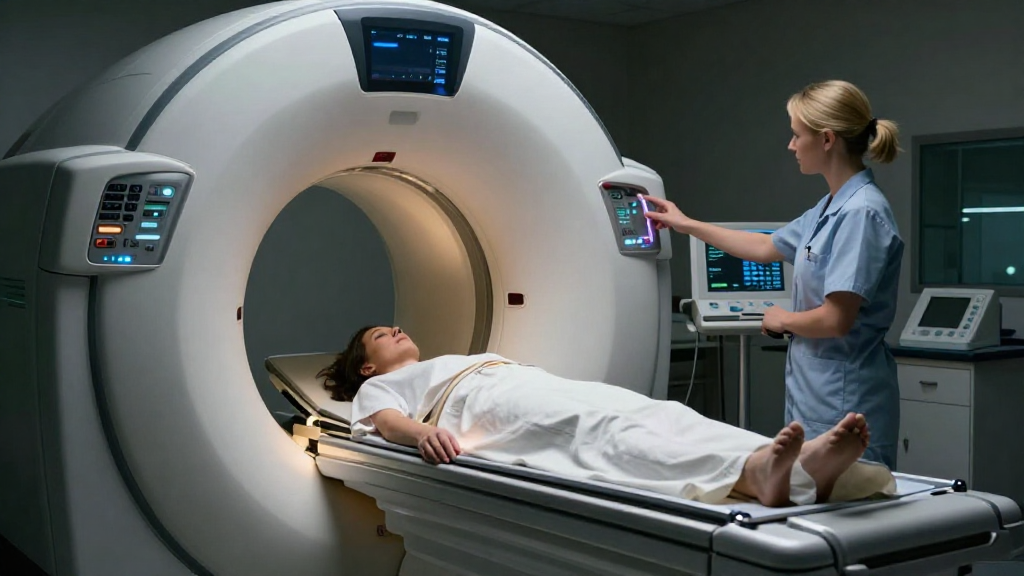
CT scans are invaluable diagnostic tools that allow medical professionals to view detailed internal images of the body.
But have you ever wondered how beams work in CT scans?
In this article, we will explore the principle behind beam CT scans, the technology involved, and why understanding these beams is crucial for accurate imaging.
What Are Beams in CT Scans?
A beam CT scan utilizes X-ray beams to create cross-sectional images of the body.
X-ray beams are directed through the body, and a detector captures the radiation that passes through.
This process involves a few key components:
- X-ray tube: Generates the X-ray beams.
- Detector: Captures the X-rays after they pass through the body.
- Computer: Processes the data to create images.
Each of these elements works together to ensure that the resulting images are clear and informative.
How Is the Beam Generated?
The beam in a beam CT scan starts with the X-ray tube.
Here’s how it works:
- Electricity is applied: The X-ray tube uses an electric current to generate high-energy electrons.
- Electron acceleration: These electrons are accelerated toward the target material, usually tungsten.
- X-ray production: When the electrons collide with the material, they produce X-rays, emitting them in all directions.
The generated X-rays are then shaped into a beam and directed toward the part of the body being imaged.
How Do Beams Pass Through the Body?
When the X-ray beam reaches the body, several interactions occur:
- Transmission: Some X-rays pass through the body, depending on the density and composition of the tissues.
- Absorption: Dense tissues, like bones, absorb more radiation, resulting in less radiation reaching the detector.
- Scattering: Some X-rays scatter, which can affect the clarity of the image.
The results of these interactions allow the computer to differentiate between various types of tissues, creating a detailed cross-sectional image of the internal structures.
What Role Do Detectors Play?
The detector is a crucial component in a beam CT scan.
Its primary functions include:
- Capturing X-rays: Collects the X-ray photons that have passed through the body.
- Converting X-rays: Converts these photons into electrical signals for processing.
- Image reconstruction: Sends the signals to the computer, where they are reconstructed into images.
Modern CT scans often use solid-state detectors, which provide higher sensitivity and faster image acquisition compared to older technologies.
How Is the Data Processed?
Once the detectors gather the data from the X-ray beams, it needs to be processed to create visual representations.
This is done using advanced algorithms and computing power:
- Data collection: The computer collects signals from hundreds of detectors.
- Mathematical algorithms: Software applies complex algorithms to transform the data into images.
- Image display: Finally, the processed images are displayed in a format that physicians can analyze, often in two or three dimensions.
This processing happens in seconds, allowing for real-time imaging results.
What Are the Types of CT Scans That Use Beams?
Beam CT scans can come in various forms.
Here’s a list of some common types:
- Spiral (Helical) CT: Continuous rotation of the X-ray beam around the body, producing a spiral of images.
- Multi-Slice CT (MSCT): Multiple detectors capture images simultaneously, increasing the speed and quality of imaging.
- Positron Emission Tomography (PET) CT: Combines PET and CT imaging, using beams to enhance the detection of metabolic activity.
Each type employs beams in different ways, tailored to specific diagnostic needs.
What Are the Advantages of Beam CT Scans?
Beam CT scans offer numerous advantages in medical imaging. Here are some of the primary benefits:
- High-resolution images: The use of X-ray beams enables detailed images, essential for accurate diagnosis.
- Quick imaging: CT scans are faster than traditional X-rays or MRIs, making them suitable for emergency settings.
- 3D visualization: The ability to create 3D images allows for better understanding of the anatomy and pathology.
- Wide application: CT scans are used for various conditions, from trauma assessments to tumor detection.
These advantages make beam CT scans a go-to option for many healthcare providers.
Are There Risks Involved with Beam CT Scans?
While beam CT scans are generally safe, they do come with some risks, primarily due to radiation exposure.
Key points to consider include:
- Radiation dose: CT scans expose patients to more radiation than standard X-rays.
- Cumulative exposure: Frequent scans can increase the risk of radiation-related complications.
- Risk assessment: Always discuss the necessity and safety of a CT scan with your healthcare provider.
In many cases, the diagnostic benefits outweigh the risks, but it’s crucial to understand them before the procedure.
How Can Patients Prepare for a Beam CT Scan?
Preparation can greatly enhance the quality of images obtained during a beam CT scan. Here are some tips for patients:
- Consult with your doctor: Always discuss any concerns or medical conditions that may affect the scan.
- Avoid certain foods: If required, fasting may be necessary, particularly if contrast material is used.
- Inform about medications: Share your medication list, especially if you’re on blood thinners or have allergies.
- Wear comfortable clothing: Loose-fitting, metal-free clothing can facilitate a smoother scan process.
Proper preparation can help ensure that the scan yields the most informative results.
Conclusion: The Importance of Understanding Beams in CT Scans
Understanding how beams work in CT scans is essential for both patients and healthcare providers alike.
These technologies have revolutionized medical imaging, providing critical insights with precision and speed.
With knowledge about beams, patients can better understand the technology behind their diagnostics, leading to improved trust in their medical care.
If you have any further questions about your upcoming beam CT scan, don’t hesitate to reach out to your healthcare provider for more information and guidance.