Small venues need lighting control that is capable without becoming another complicated production task. The right DMX controller can simplify scene changes, coordinate fixtures, and give DJs, churches, and event operators dependable control from setup through the final cue.
This roundup compares 10 options ranging from compact scene recorders and straightforward 192-channel boards to standalone systems with deeper programming and modern workflow features.
Best 10 Dmx Controllers for Small Venues Picks for 2026
Best All-in-One Pick

- Standalone touchscreen control without a laptop
- Four DMX universes and extensive fixture support
- Protective Decksaver cover included
Best For: Mobile DJs, churches, events, and growing small venues
Best Established Scene Controller

- 192 channels for up to 12 fixtures
- Stores 240 scenes and six chases
- Dedicated fog, strobe, and MIDI controls
Best For: DJs and venues that prefer tactile scene programming
Best for Simple Cue Playback

- Five buttons provide direct cue recall
- Supports DMX512, Art-Net, and sACN
- Standalone playback after scene recording
Best For: Fixed venues with repeatable shows and simple staff operation
Best Software-Integrated Pick

- Two DMX universes with thru support
- Direct Engine DJ hardware compatibility
- Tactile controls plus BPM-synced lighting
Best For: DJs and performers needing music-aware lighting control
Best Traditional Console

- Controls 512 DMX channels
- Stores up to 48 scenes
- Includes cable and gooseneck console lamp
Best For: Standalone fixture control with physical faders and scenes
Best Compact Standalone Option

- 37 backlit silicone buttons
- Four rotary encoders for adjustment
- Supports up to four universes
Best For: Compact standalone control for small stages and mobile setups
Versatile 192-Channel Pick
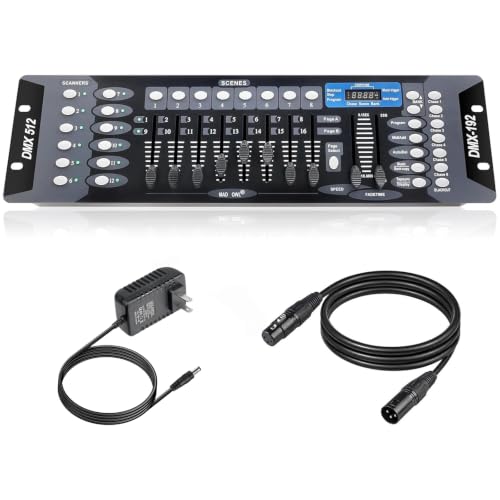
- Controls up to 12 fixtures with 16 channels or fewer
- Stores 240-step scenes in six programmable chases
- Includes a 6.6-foot DMX cable
Best For: Small venues building repeatable stage and DJ lighting shows
Best Compact Dimmer
12-Channel Mini DMX Controller

- Controls up to 12 DMX512 channels
- Portable aluminum design for quick setup
- Includes six sub-control faders and blackout
Best For: Small-stage rigs with modest channel needs
Easy-Start Show Controller

- Controls up to 12 fixtures with 16 channels each
- Programs up to 240 scenes and 40 steps per scene
- Adds voice control and adjustable transition timing
Best For: Small events needing flexible scenes and convenient control
Best All-in-One Pick – ADJ WMX1 MK2 WolfMix Bundle
For small venues that need powerful dmx controllers for small venues without relying on a laptop, the ADJ WMX1 MK2 offers touchscreen operation, extensive fixture support, and automated or manual show control. This bundle also includes a Decksaver cover for transport and storage.
Best For: Mobile DJs, churches, event technicians, and small bars or clubs needing a compact standalone controller.
Pros:
- Controls up to 680 fixtures across four DMX universes.
- Includes a 4.3-inch touchscreen, 37 backlit buttons, BPM detection, and MIDI support.
- Comes with a protective polycarbonate Decksaver cover.
- Supports thousands of built-in and additional fixture profiles.
Cons:
- Its broad feature set may be more than a very simple venue requires.
- At 2.36 pounds, it is portable, but still requires separate lighting fixtures and cables.
The WMX1 MK2 is the most expandable option here, combining standalone operation with deep programming capacity. It is especially appealing when a venue expects its lighting system to grow.
Best Established Scene Controller – CHAUVET DJ OBEY40
The CHAUVET DJ OBEY40 is a practical choice among dmx controllers for small venues when you want physical sliders, structured scene storage, and dedicated fog and strobe controls. Its layout is designed for managing several intelligent fixtures without the complexity of a computer-based system.
Best For: Small venues, DJs, and event operators controlling multiple fixtures with programmed scenes and chases.
Pros:
- Controls up to 12 fixtures with as many as 16 channels each.
- Offers 192 DMX channels, 240 scenes, and six programmable chases.
- Includes fog and strobe controls plus MIDI compatibility.
- Reversible sliders accommodate different operating preferences.
Cons:
- It uses a button-and-slider interface rather than a touchscreen.
- The listed model dates to 2010, so buyers should verify current support and compatibility needs.
With generous scene and chase memory, the OBEY40 suits venues that repeat programmed looks throughout performances. It is a straightforward hardware console for operators who prefer tactile controls.
Best Value 192-Channel Console – MINGJIE DMX512 Controller
The MINGJIE DMX512 Controller provides a conventional hardware layout for venues seeking capable dmx controllers for small venues at a manageable scale. It combines 192 channels, scene and chase programming, sound activation, and an included DMX cable.
Best For: Small stages, clubs, KTV bars, mobile DJs, and event setups using up to 12 intelligent fixtures.
Pros:
- Controls 192 channels and up to 12 intelligent fixtures.
- Stores 240 scenes in 30 banks and supports six chases.
- Includes sound-activated operation and a 4-foot 3-pin DMX cable.
- Rugged alloy housing and 100–240V input support venue portability.
Cons:
- Its traditional controls may require more hands-on programming than an automated controller.
- The supplied notes do not specify touchscreen, MIDI, or network-control features.
This console is a sensible fit for operators who want familiar faders and dedicated programming sections. The included cable and wide-voltage input make it convenient for varied event locations.
Best for Simple Cue Playback – Pknight 5-Button DMX Recorder
The Pknight 5-Button DMX Scene Recorder is a specialized option among dmx controllers for small venues. Rather than serving as a full programming console, it records prepared cues and lets staff recall them using five physical buttons.
Best For: Fixed installations, clubs, bars, churches, weddings, and small stages with repeatable lighting shows.
Pros:
- Five buttons provide direct, tactile cue operation.
- Each button can trigger one scene on press and another on release, allowing up to 10 actions.
- Records DMX512, Art-Net, and sACN signals.
- Plays back stored scenes without the original console, computer, or software.
Cons:
- It is intended for cue playback rather than comprehensive live programming.
- Scenes must first be created and recorded using another console or software system.
The Pknight is best viewed as a venue-friendly playback station. It can simplify daily operation when nontechnical staff need reliable access to prebuilt lighting looks.
Best Software-Integrated Pick – SoundSwitch Control One
For small venues seeking DMX controllers for small venues with music-aware automation, the SoundSwitch Control One combines tactile hardware controls with SoundSwitch software. It offers two DMX universes, dual USB ports, and direct compatibility with Engine DJ devices.
Best For: DJs and small live setups that want software-based lighting control with hands-on adjustments.
Pros:
- Two DMX universe inputs and outputs with a thru option for installations
- Works directly with compatible Denon DJ and Numark Engine DJ hardware without a computer
- Touch strip, encoders, and RGB performance pads provide responsive control
- Supports live audio BPM detection and control of colors, brightness, strobes, moving heads, and gobos
Cons:
- SoundSwitch software is central to its broader feature set
- Some AlphaTheta PRO DJ LINK Bridge configurations require a laptop running SoundSwitch
The Control One is a strong choice when lighting needs to follow music while still allowing real-time intervention. Its compact design and broad source support suit mobile DJs, performers, and smaller stages.
Best Traditional Console – DMX512 512-Channel Controller
This DMX512 console is a practical option for small venues that prefer dedicated faders, buttons, and a display instead of computer-based control. It supports 512 channels, up to 32 fixtures, and stored scenes for repeatable lighting shows.
Best For: DJs, event operators, and venues wanting a conventional standalone console for multiple DMX fixtures.
Pros:
- 512 channels and support for up to 32 fixtures at 16 channels per fixture
- Stores and runs up to 48 scenes
- LCD display, joystick, faders, and dedicated control areas support programming and live operation
- Includes a gooseneck console lamp, power cable, manual, and 3-pin DMX cable
Cons:
- At 17.73 pounds, it is substantially less portable than compact controllers
- Its traditional console layout may require more setup and programming than software-based systems
With its metal casing and extensive physical controls, this controller is suited to installations or operators who value a dedicated lighting desk. The included accessories also help get a basic setup running quickly.
Best Compact Standalone Option – ADJ WMX1 Mk2
The ADJ WMX1 Mk2 is a compact standalone choice among DMX controllers for small venues, offering dedicated buttons and rotary encoders in a portable format. Its backlit controls are designed for hands-on operation in dim performance environments.
Best For: Small stages, mobile operators, and users who want standalone control with a compact footprint.
Pros:
- Standalone DMX lighting controller with 37 backlit silicone buttons
- Four rotary encoders provide hands-on parameter adjustment
- Supports up to four universes and includes four output sockets
- Compact 10-by-9.25-inch footprint is easier to accommodate than a full-size console
Cons:
- The supplied notes do not specify channel capacity or scene-storage limits
- Its control layout may offer fewer physical controls than a larger console
The WMX1 Mk2 balances dedicated operation with a relatively small footprint. It is worth considering when a venue needs standalone DMX control and multiple universe outputs without committing to a large lighting desk.
Versatile 192-Channel Pick – Programmable DMX Board
For small venues that need room to expand, this 192-channel DMX controller for small venues supports up to 12 fixtures with 16 channels or fewer. Its banks, programmable scenes, and chases make it suitable for building repeatable lighting shows rather than making only basic live adjustments.
Best For: Small stages, clubs, and performance venues using multiple DMX fixtures.
Pros:
- Controls up to 12 fixtures with up to 16 channels each.
- Provides 23 banks of eight programmable scenes.
- Supports 240-step scenes across six programmable chases.
- Includes a 6.6-foot DMX cable and uses straightforward faders and buttons.
Cons:
- Its 22.44-inch width may require dedicated console or rack space.
- It is designed for fixtures with 16 channels or fewer.
This is a strong choice when a compact venue wants extensive scene and chase programming without moving to a larger professional console. The metal construction and rack-mount design also suit a more permanent setup.
Best Compact Dimmer – 12-Channel Mini DMX Controller
This mini DMX controller for small venues focuses on simple, hands-on control of up to 12 DMX512 channels. Its lightweight aluminum housing, six sub-control faders, and main control fader make it a practical option for small-stage lighting systems with modest channel requirements.
Best For: Small stages and portable setups using DMX fixtures with 12 channels or fewer.
Pros:
- Offers direct control of up to 12 DMX512 channels.
- Compact and lightweight for travel and quick installation.
- Includes six sub-control faders, a main control fader, and a blackout function.
- Uses a standard three-pin XLR DMX output.
Cons:
- It cannot be used with stage lighting equipment requiring more than 12 channels.
- It is intended to work with a DMX512-controllable dimming power supply for a permanent dimming system.
This controller is best suited to operators who value portability and uncomplicated manual adjustments. Its limited channel count is a clear constraint, but that same simplicity can be useful for a small lighting rig.
Easy-Start Show Controller – 192-Channel DMX Console
For buyers seeking an approachable DMX controller for small venues, this 192-channel console combines control for up to 12 fixtures with scene programming and voice control. The organized layout is aimed at amateur users, while adjustable step timing supports more detailed transitions for DJ, church, wedding, and event lighting.
Best For: Small events and venues that want programmable scenes, voice control, and broad fixture compatibility.
Pros:
- Controls up to 12 intelligent lights with up to 16 channels each.
- Supports up to 240 scenes and up to 40 steps per scene.
- Offers voice control for switching lighting scenes.
- Includes a three-pin XLR DMX512 output and cable for compatible equipment.
Cons:
- The console has multiple control sections that may take time for new users to learn.
- It is limited to fixtures with up to 16 channels each.
This model stands out when quick scene changes and flexible programming matter more than minimal controls. Its voice-control feature adds convenience, while the adjustable pause and fade timing allows more polished lighting transitions.
How We Picked the Best Dmx Controllers for Small Venues
We focused on the features that matter most in compact clubs, churches, mobile DJ rigs, rehearsal spaces, and event rooms: channel capacity, scene and cue control, fixture compatibility, portability, setup complexity, and day-to-day usability. The selection includes both beginner-friendly consoles and more capable standalone controllers so different venue sizes and lighting ambitions are represented.
We also considered whether a controller works well for repeatable shows. A unit that can save scenes, recall cues quickly, or integrate with a computer-based lighting workflow may be more useful than a higher-channel model that takes excessive time to program.
Quick Comparison
| Controller Type | Best For | What to Look For |
|---|---|---|
| Standalone advanced console | Mobile DJs and recurring productions | Fixture libraries, effects, cue playback, and dependable hardware control |
| Computer-integrated controller | Operators who prefer software workflows | Software compatibility, MIDI or audio features, and laptop requirements |
| 192-channel board | Basic stage and party lighting | Faders, banks, scene storage, and fixture addressing |
| Scene recorder or compact controller | Simple repeatable setups | Fast recording, cue recall, and minimal programming |
| Small dimmer controller | Limited fixtures or basic stage zones | Channel count, dimming compatibility, and output reliability |
Key Buying Factors for Dmx Controllers for Small Venues
Channel Capacity and Fixture Support
Choose a controller with enough channels for your current fixtures plus reasonable room to expand. A 192-channel controller may be sufficient for several simple fixtures, while moving heads, pixel effects, and multi-parameter lights can consume channels quickly. Confirm that the controller supports the DMX modes and fixture profiles you plan to use.
Scenes, Chases, and Cue Playback
Scenes store lighting looks, while chases and cues help create timed sequences or rapid transitions. For live events, dedicated playback controls and clearly labeled buttons can be more valuable than a large specification sheet.
Programming and Portability
Compact consoles are easier to transport and place beside a DJ booth or stage. More advanced units can reduce setup time after programming, but they may require a steeper learning curve. Consider who will operate the system and how often the lighting changes.
Connections and Reliability
Check for standard DMX input and output, suitable cable runs, termination practices, and any required adapters. If the controller depends on a computer, include the laptop, software, power, and backup plan in your setup. For important events, saved show files and a simple manual fallback are worthwhile.
Who Should Buy Which Dmx Controllers for Small Venues?
Choose an advanced standalone controller if you run frequent mobile shows, need effects and layered cues, or want to operate without a laptop. Choose a computer-integrated system if you prefer software control, visual programming, or synchronization with music. Choose a 192-channel console for affordable control of conventional fixtures and straightforward LED setups. Choose a scene recorder when a volunteer or occasional operator needs reliable cue recall with minimal training. Choose a compact dimmer controller for a small stage with only a few basic lighting zones.
Before buying, inventory every fixture, note its DMX channel footprint, and map the scenes you actually need. That simple check will help you avoid both an underpowered controller and unnecessary complexity.