The best portable radios make it easy to follow news, weather alerts, music, and talk programming without relying on Wi-Fi or a smartphone. This lineup includes simple AM/FM models, shortwave and Bluetooth options, and emergency radios with solar charging, hand cranks, and phone-power capabilities.
Use the guide below to compare power options, tuning controls, reception, portability, and emergency features so you can choose a radio that fits your daily routine or preparedness kit.
Best 10 Portable Radios Picks for 2026
Top Emergency Pick
Midland ER310PRO Weather Radio
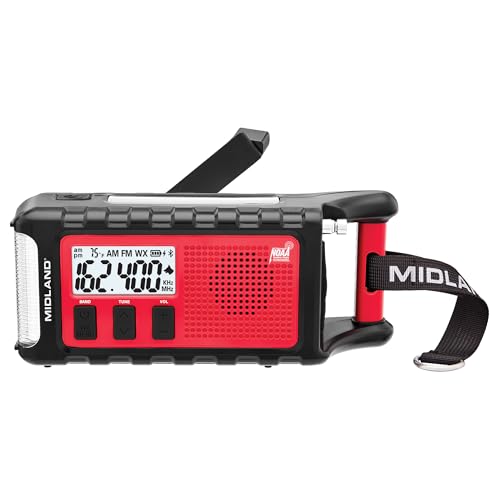
- NOAA weather scanning with alerts
- 10,000 mAh power bank and multiple charging methods
- Bluetooth, flashlight, SOS beacon, and rescue siren
Best For: Emergency preparedness and extended outdoor use
Simple Listening Pick

- Analog AM/FM tuning
- Powerful mono speaker with headphone socket
- Battery or AC operation with carry handle
Best For: Everyday indoor listening and simple operation
Compact Emergency Value

- AM/FM/NOAA reception
- Solar, hand-crank, AAA, and USB power options
- 2,000 mAh bank, flashlight, reading light, and SOS alarm
Best For: Compact emergency kits and power outages
Retro Music Pick

- AM/FM/short-wave reception
- Bluetooth, USB, and TF-card playback
- Solar, USB, rechargeable-battery, and D-battery power
Best For: Casual music listening with vintage style
Best for Easy Setup

- Automatic NOAA alert scanning
- Six charging options and phone charging
- Flashlight, reading lamp, SOS, and headphone jack
Best For: Emergency kits, camping, and severe-weather preparedness
Best Simple Everyday Radio
Panasonic RF-2400-K AM/FM Radio

- Easy AM/FM operation with stable AFC tuning
- Large fluorescent dial pointer
- AC adapter, four-AA battery support, and headphone jack
Best For: Simple home, camping, and outage listening
Best High-Capacity Backup
Leaton 10000mAh Emergency Radio

- 10000mAh battery with USB phone charging
- Solar, hand-crank, and USB-C charging
- IPX6 splash resistance, lights, SOS, and compass
Best For: Outages, camping, RV travel, and emergency go-bags
Best Plug-In & Battery Radio

- AM/FM reception with a large analog dial
- AC adapter or four AA battery operation
- Loud speaker plus earphone jack
Best For: Home listening, seniors, and emergency backup
Best Pocket-Sized Radio
PRUNUS J-166 AM/FM Portable Radio
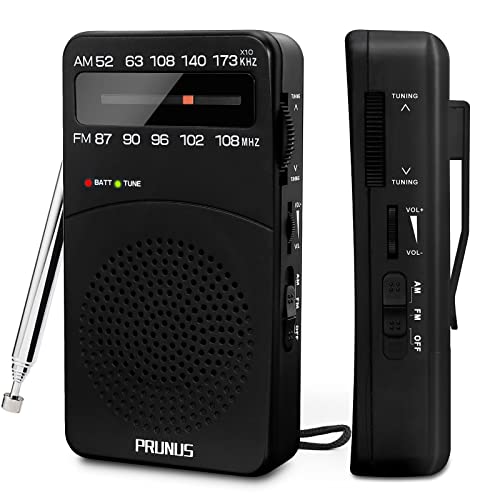
- Lightweight design with clip and lanyard
- AM/FM reception with adjustable antenna
- Battery and signal indicators
Best For: Walking, exercise, and emergency kits
Best Shortwave Portable Radio
DreamSky AM/FM/SW Portable Radio

- AM, FM, and shortwave band support
- LCD display with backlight and clock formats
- AC or four AA battery operation
Best For: Shortwave listeners and emergency preparedness
Top Emergency Pick – Midland ER310PRO Weather Radio
The Midland ER310PRO is a feature-rich choice for shoppers comparing portable radios for emergencies, travel, or outdoor use. It combines AM/FM and NOAA weather reception with Bluetooth streaming, several charging options, and built-in signaling tools.
Best For: Emergency preparedness, severe-weather alerts, camping, and keeping mobile devices powered during outages.
Pros:
- NOAA Weather Scan automatically searches seven weather channels and locks onto the strongest signal.
- Offers solar and hand-crank charging, plus a 10,000 mAh power bank for compatible devices.
- Includes Bluetooth streaming, a 130-lumen CREE flashlight, Morse-code SOS beacon, and rescue siren.
- Provides up to 200 hours of radio use according to the supplied notes.
Cons:
- Its emergency-focused features may be more than casual listeners need.
- The plastic enclosure is functional but not positioned as a premium material.
Choose this model when backup power and emergency signaling matter as much as radio reception. Its broad feature set makes it especially practical for storm kits and extended off-grid use.
Simple Listening Pick – Sony ICF-506 AM/FM Radio
The Sony ICF-506 is a straightforward option for shoppers who want portable radios without emergency-oriented extras. Its analog AM/FM tuner, powerful mono speaker, carry handle, and AC or battery operation keep everyday listening simple.
Best For: Home listening, kitchens, workshops, and users who prefer uncomplicated analog controls.
Pros:
- Dedicated AM/FM tuner provides familiar two-band operation.
- Powerful mono speaker is designed to deliver big sound from a portable unit.
- Built-in carry handle makes it easier to move around.
- Runs on three AA batteries or the included AC power cord and has a headphone socket.
Cons:
- Does not include NOAA weather reception, Bluetooth, solar charging, or a hand crank.
- At about 2.1 pounds, it is heavier than some compact portable radios.
- It is not water resistant.
The ICF-506 is a good fit when dependable AM/FM listening and easy operation are the priorities. It is less suitable for emergency kits or wireless music streaming, but its conventional design may appeal to listeners who want fewer complications.
Compact Emergency Value – FosPower A1 Weather Radio
The FosPower A1 is a compact choice among portable radios for weather preparedness and power outages. It combines AM/FM/WB reception with solar, hand-crank, battery, and USB power options, along with lighting and device-charging features.
Best For: Emergency kits, family power-outage supplies, camping, and users who want a small weather radio with multiple power sources.
Pros:
- Receives NOAA emergency broadcasts along with AM and FM stations.
- Uses solar charging, hand-crank charging, four AAA batteries, or USB power.
- Includes a 2,000 mAh power bank for small tablets or phones.
- Provides a 1W flashlight, four-LED reading light, and SOS alarm.
Cons:
- The 2,000 mAh power bank is smaller than the Midland model’s listed capacity.
- AAA batteries are required if you are not using the rechargeable power options.
- Its emergency features are less focused on everyday music playback.
For a compact emergency radio, the A1 offers a balanced collection of reception, lighting, charging, and backup-power tools. Its limited lifetime warranty is an added benefit for preparedness buyers.
Retro Music Pick – PRUNUS J-150 Bluetooth Radio
The PRUNUS J-150 stands out among portable radios for shoppers who want radio reception and flexible music playback in a vintage-style design. It supports AM, FM, and short wave, while Bluetooth, USB, and TF-card playback add everyday entertainment options.
Best For: Backyard use, camping, casual listening, and buyers who like retro styling with modern playback features.
Pros:
- Supports AM, FM, and short-wave reception with a telescopic antenna and DSP chip.
- Offers Bluetooth 5.0 streaming plus USB-drive and TF-card playback.
- Can run from USB charging, its 1,200 mAh rechargeable battery, solar power, or two D batteries.
- Compact carry-handle design weighs about 1.2 pounds and supports TWS pairing with another J-150.
Cons:
- It is not water resistant, so outdoor use requires protection from moisture.
- Two D batteries are not included according to the supplied notes.
- It does not list NOAA weather-band reception.
The J-150 is a versatile entertainment radio rather than a dedicated emergency communicator. Its retro appearance, multiple playback inputs, and short-wave support make it appealing for relaxed listening at home or outdoors.
Best for Easy Setup – Raynic NOAA Weather Radio
The Raynic is a versatile choice among portable radios for emergency preparedness, outdoor trips, and power outages. It combines automatic NOAA alerts with AM/FM/SW reception, multiple charging methods, lighting, and a phone-charging USB output.
Best For: Households and outdoor users who want automatic weather alerts and extensive backup-power options.
Pros:
- Automatically scans for NOAA emergency and weather alerts, including while in standby mode.
- Offers six power options: rechargeable battery, AC adapter, USB input, hand crank, solar charging, and three AAA batteries.
- Includes a 3W flashlight, reading lamp, SOS siren, USB device charging, LCD display, and headphone jack.
- Supports AM, FM, shortwave, and NOAA broadcasts in a compact, IPX3 water-resistant design.
Cons:
- AAA batteries are not included.
- Its IPX3 rating provides limited water resistance rather than protection from heavy rain or immersion.
Choose this model if automatic alerts are a priority. Its broad charging flexibility and built-in lighting make it especially practical for emergency kits, though it is more feature-rich than a basic everyday radio.
Best Simple Everyday Radio – Panasonic RF-2400-K AM/FM Radio
Panasonic Portable AM/FM Radio, Battery Operated Analog Radio, AC Powered, Black (RF-2400-K)
Check Price On AmazonThe Panasonic RF-2400-K is a straightforward option for shoppers seeking portable radios without emergency-focused extras. Its AM/FM tuner, large fluorescent pointer, AC adapter, battery operation, and headphone compatibility make it easy to use at home or on a camping trip.
Best For: Listeners who want a familiar, simple AM/FM radio for home use, camping, severe weather, or outages.
Pros:
- Simple interface with AM/FM reception and antennas designed to pick up both bands.
- Large dial and fluorescent pointer are easy to view, including in dark conditions.
- Digital tuning with AFC helps provide smoother, more stable tuning.
- Works with the included AC adapter or four AA batteries and supports 3.5 mm headphones.
Cons:
- Does not include NOAA reception, automatic alerts, solar charging, or a hand crank.
- It is not water resistant.
This Panasonic is a good fit when dependable basic radio listening matters more than emergency features. It offers flexible AC or battery power, but shoppers needing weather alerts or outdoor durability should consider an emergency-oriented model instead.
Best High-Capacity Backup – Leaton 10000mAh Emergency Radio
The Leaton is one of the more capable portable radios for users who want substantial backup battery capacity alongside NOAA and AM/FM reception. Its 10000mAh internal battery, USB-C input, hand crank, solar panel, lighting, compass, and IPX6 splash resistance suit emergency and outdoor gear.
Best For: Emergency kits, camping, RV travel, and outdoor users prioritizing phone backup power and splash resistance.
Pros:
- Large 10000mAh battery can provide emergency USB phone charging; the notes estimate about 1–1.5 iPhone 14 charges.
- Supports USB-C, solar, and hand-crank charging, with the radio usable while charging via USB-C.
- Includes a three-mode flashlight, reading lamp, SOS signaling, and built-in compass.
- Compact 1.1-pound design has an IPX6 water-resistance rating for splashes and water spray.
Cons:
- NOAA broadcasts require manual tuning; there are no automatic, SAME, or location-based alerts.
- The IPX6 rating is not intended for immersion or heavy rain.
- Actual phone-charging capacity varies because of conversion loss and device efficiency.
The Leaton stands out when backup power and outdoor features are more important than automatic warnings. Its manual NOAA operation requires active listening, but the large battery and multiple charging methods add useful resilience during outages.
Best Plug-In & Battery Radio – DreamSky AM/FM Portable Radio
For shoppers seeking dependable portable radios for home use, yard work, or emergency preparedness, this DreamSky model offers a straightforward AM/FM setup. Its large analog dial, loud speaker, earphone jack, and choice of AC or battery power make it practical for everyday listening.
Best For: Seniors, bedside or kitchen listening, and buyers who want both wall power and outdoor portability.
Pros:
- Supports both AM and FM reception with a large, easy-to-read analog dial.
- Includes a loud speaker and 3.5mm earphone jack for shared or private listening.
- Runs from the included AC adapter or four AA batteries for flexible use.
Cons:
- Four AA batteries are required but not included.
- It is not water resistant.
- The analog display may be less precise than a digital tuner.
This is a sensible choice when simple controls and flexible power matter more than advanced features. It is especially useful as an easy-to-operate household or backup radio.
Best Pocket-Sized Radio – PRUNUS J-166 AM/FM Portable Radio
If compact size is your priority, this PRUNUS J-166 is among the more convenient portable radios for walks, exercise, or an emergency kit. It weighs about 4.2 ounces without batteries and includes a pocket clip and lanyard for easy carrying.
Best For: Walkers, commuters, and anyone who wants a small battery-powered radio with simple physical controls.
Pros:
- Compact design measures approximately 2.7 by 5 by 1.1 inches and weighs 4.2 ounces without batteries.
- Back clip and lanyard provide multiple carrying options.
- Includes AM/FM tuning, a 3.5mm earphone jack, and reception and battery indicators.
Cons:
- It requires two AA batteries, which are not included.
- It is not water resistant.
- The small body and speaker may be less suitable for filling a room with sound.
The J-166 focuses on portability and uncomplicated operation. Its indicators and carrying features are useful extras for mobile listening, while the antenna and DSP chip are designed to help with station reception.
Best Shortwave Portable Radio – DreamSky AM/FM/SW Portable Radio
For shoppers who want more than standard AM/FM, this DreamSky model adds shortwave reception, a digital LCD display, and adjustable high- and low-tone sound. It can plug into a wall indoors or run on four AA batteries outdoors, making it one of the more versatile portable radios for home and backup use.
Best For: Listeners who want AM, FM, and shortwave bands along with a large speaker, digital tuning display, and flexible power.
Pros:
- Receives AM, FM, and SW shortwave broadcasts.
- Large speaker, long antenna, and high/low tone selection support flexible listening.
- LCD display with backlight shows station information and offers 12- or 24-hour time formats.
- Works with an AC adapter or four AA batteries.
Cons:
- Four AA batteries are not included.
- It is not water resistant.
- The large feature set may be more than needed for shoppers seeking a basic AM/FM radio.
This model is a strong fit when shortwave capability and a visible digital display are worth prioritizing. Its dual power options also make it useful during outages, outdoor activities, or routine indoor listening.
How We Picked These Portable Radios
We selected these Portable Radios to cover the main ways people use them: everyday AM/FM listening, travel, power outages, severe-weather preparedness, and flexible audio playback. We considered tuning range, power sources, portability, controls, expected convenience, and useful extras such as NOAA weather alerts, Bluetooth, shortwave reception, USB playback, headphone outputs, and phone charging.
Because needs vary, this list includes both straightforward battery or AC-powered radios and feature-rich emergency models. A simple radio can be the better choice if you value ease of use, while a hand-crank model makes more sense when backup power and weather information are priorities.
Quick Comparison
- Best for emergency preparedness: Look for NOAA alerts, multiple charging methods, a bright flashlight, and a large internal battery.
- Best for everyday listening: Choose clear AM/FM reception, simple tuning, readable controls, and dependable battery or AC operation.
- Best for flexible entertainment: Consider Bluetooth, shortwave, USB, TF or microSD playback, and a headphone jack.
- Best for home use: AC compatibility can reduce battery costs, while a compact backup battery keeps the radio usable during outages.
Key Buying Factors for Portable Radios
Tuning and Reception
AM/FM is sufficient for most news, music, and talk programming. Shortwave adds access to more broadcasts but can be more sensitive to location and antenna position. A telescoping antenna and clearly marked analog dial can make stations easier to find.
Power Options
Battery operation is useful for travel and outages, while AC power is convenient beside a bed or in a kitchen. Emergency radios may add solar charging, a hand crank, or USB charging. Treat these features as backup power rather than a guarantee of unlimited operation, and check battery capacity and charging requirements before buying.
Weather and Emergency Features
NOAA weather reception or alerts can be valuable in areas affected by storms. Flashlights, sirens, signal lights, and USB phone charging add utility, but they also increase size and complexity. Confirm which functions work independently and whether the radio requires a charged internal battery.
Size, Controls, and Sound
A lighter radio is easier to carry, but larger speakers may deliver fuller sound. Prioritize a readable dial, tactile knobs, accessible buttons, and a headphone jack if you plan to listen privately. For emergency storage, also consider durability and how easily the radio can be operated in low light.
Who Should Buy Which Portable Radios?
Choose a basic AM/FM radio if you want an affordable, uncomplicated option for kitchens, bedrooms, garages, or power outages. Choose an emergency crank or solar radio if weather alerts, backup charging, lighting, and phone-power capability matter most. Choose a Bluetooth or shortwave model if you want one portable device for radio, stored audio, and broader broadcast access. Finally, choose an AC-and-battery model for a home radio that stays plugged in but remains usable when the power goes out.