The best handheld voice recorders make it easier to capture lectures, meetings, interviews, and personal notes without relying on a phone. The right model should deliver clear audio, simple controls, dependable battery life, and enough storage for your routine.
This roundup compares 10 options ranging from straightforward digital dictaphones to AI-enabled recorders that can transcribe and summarize conversations. Use the guide below to narrow your choice by recording quality, storage, portability, and workflow features.
Best 10 Handheld Voice Recorders Picks for 2026
Best High-Capacity Pick
EVISTR L357 64GB Voice Recorder

- 64GB storage with up to 4,660 hours at 32Kbps
- Noise reduction and seven recording-gain levels
- Up to 32 hours of continuous recording
Best For: Students, interviews, lectures, and long recording sessions
Best AI Note-Taking Pick
Plaud Note Pro AI Voice Recorder
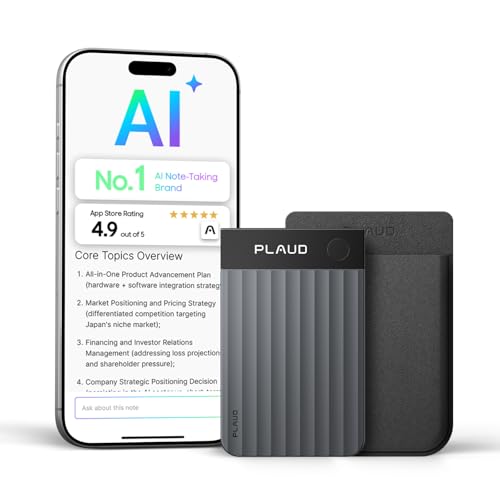
- Transcribes in 112 languages with speaker labels
- Creates summaries, action items, and follow-ups
- Supports in-person, phone, and online meetings
Best For: Professionals who want automated meeting notes
Best Simple Sony Pick
Sony ICD-PX370 Digital Voice Recorder

- Up to 57 hours of battery life
- Built-in USB supports direct computer transfer
- Simple MP3 recording in a compact design
Best For: Straightforward lectures, reminders, and interviews
Best AI Storage Combo

- 128GB storage with up to 9,216 hours at 32kbps
- AI transcription and summaries in 113 languages
- Up to 3072Kbps recording with noise reduction
Best For: Users wanting high capacity and app-based AI organization
Best for Easy Setup

- One-touch recording and saving
- Up to 3072 kbps with DSP noise cancellation
- 8GB storage plus included 64GB TF card
Best For: Compact, high-capacity recording for meetings, interviews, and lectures
Best for Long Sessions

- Up to 68 hours of continuous recording
- 136GB total storage with included 128GB TF card
- PCM recording with noise reduction and voice activation
Best For: Extended classes, meetings, interviews, and high-volume recording
Best Budget Option

- Simple three-button operation
- Voice activation and stereo recording
- A-B repeat and variable playback speed
Best For: Everyday lectures, meetings, study sessions, and casual recording
Simple Recording Pick

- One-button recording and A-B repeat
- 1536kbps recording with noise reduction
- Voice activation and USB storage functions
Best For: Straightforward lectures, meetings, and personal notes
Best Heavy-Duty Pick

- Stores up to 9,296 hours of recordings
- 1536kbps PCM, MP3, and WAV options
- Password protection and voice activation
Best For: Frequent recording with extensive file storage
Long-Battery Option

- 2-inch OLED display for key status information
- Up to 72 hours of listed recording time
- Voice activation and digital encryption
Best For: Long sessions, interviews, meetings, and lectures
Best High-Capacity Pick – EVISTR L357 64GB Voice Recorder
For shoppers comparing handheld voice recorders, the EVISTR L357 combines high storage capacity, adjustable recording gain, and straightforward controls. It records in WAV or MP3, supports voice activation, and includes a Type-C connection for transferring files to Windows or Mac computers.
Best For: Students, teachers, interviewers, and anyone who needs extended recording capacity with playback controls.
Pros:
- 64GB storage can hold up to 4,660 hours at 32Kbps.
- PCM noise reduction, 360-degree sound pickup, and seven recording-gain levels support clearer recordings.
- Voice activation, scheduled recording, A-B repeat, rewind, and variable-speed playback add flexibility.
- 500mAh battery provides up to 32 hours of continuous recording and 35 hours of playback.
Cons:
- The extensive feature set may take time to learn despite the simplified controls.
- Its built-in microphone and 3.5mm headphone jack may not suit users seeking wireless operation.
The L357 is a practical choice when storage, recording endurance, and manual playback tools matter more than app-based transcription.
Best AI Note-Taking Pick – Plaud Note Pro AI Voice Recorder
Among handheld voice recorders, the Plaud Note Pro stands out for turning recordings into searchable notes rather than simply storing audio. Its microphones support in-person, phone, and online meetings, while the connected Plaud workspace can transcribe in 112 languages and create structured summaries.
Best For: Professionals and teams who want meeting recordings converted into transcripts, action items, decisions, and follow-ups.
Pros:
- Four MEMS microphones and one VPU use AI beamforming to capture voices across a room.
- Smart dual-mode recording switches between phone calls and in-person conversations.
- Plaud Intelligence offers speaker labels, summaries, action items, and templates in 112 languages.
- Credit-card-sized design includes a 0.95-inch AMOLED display, magnetic case, and magnetic ring.
Cons:
- AI transcription and summaries depend on the Plaud app and service plans.
- Battery life is listed at 30 hours, shorter than some basic recorders.
- There is no headphone jack for direct audio monitoring.
The Note Pro is best viewed as a compact AI productivity system with recording hardware, especially if organized meeting notes are more valuable than standalone audio files.
Best Simple Sony Pick – Sony ICD-PX370 Digital Voice Recorder
Sony ICD-PX370 Mono Digital Voice Recorder with Built-In USB Voice Recorder,black
Check Price On AmazonIf you want handheld voice recorders without an elaborate setup, the Sony ICD-PX370 keeps the essentials simple. It records MP3 audio, offers up to 57 hours of battery life, and uses a built-in USB connection to transfer files directly to a computer.
Best For: Buyers who prefer a familiar, basic recorder for lectures, reminders, interviews, and general voice capture.
Pros:
- Direct built-in USB connection simplifies computer file transfers.
- Up to 57 hours of battery life supports extended use.
- Records MP3 audio in a compact, established Sony design.
Cons:
- Its 4GB storage is substantially lower than the EVISTR models in this roundup.
- It uses two AAA batteries rather than a rechargeable battery.
- The 2.5mm headphone jack is less common than a 3.5mm connection.
The ICD-PX370 makes sense for shoppers who value uncomplicated MP3 recording and direct USB transfer over advanced transcription or high-capacity storage.
Best AI Storage Combo – EVISTR L359 128GB AI Recorder
The EVISTR L359 is one of the more capable handheld voice recorders for users who want both local storage and AI-assisted follow-up. It records up to 3072Kbps, supports voice activation, and connects to the AI DVR Link app through a wired OTG connection for transcription, summaries, speaker identification, and Ask AI features.
Best For: Students and professionals who need extensive recording storage plus app-based transcription and summaries.
Pros:
- 128GB storage can hold up to 9,216 hours at 32kbps.
- Supports transcription in 113 languages, smart summaries, mind maps, speaker identification, and Ask AI insights.
- Up to 3072Kbps recording and intelligent noise reduction support detailed audio capture.
- One-button recording, password encryption, a HOLD switch, and wired OTG transfers add convenience and control.
Cons:
- AI processing requires the AI DVR Link app and a compatible phone or computer workflow.
- Continuous recording is listed at up to 33 hours, so it still requires periodic charging.
- Wired OTG transfer is secure and stable but less convenient than wireless syncing.
The L359 is a strong fit when maximum storage and AI-assisted organization are priorities, particularly for users comfortable connecting the recorder to an app.
Best for Easy Setup – Compact 72GB Voice Recorder
For shoppers comparing handheld voice recorders, the NekSide stands out with one-touch recording, a compact metal body, and substantial storage. Its omnidirectional microphone, DSP noise cancellation, and support for up to 3072 kbps recording make it a practical choice for interviews, meetings, lectures, and everyday notes.
Best For: Users who want a compact recorder with high-capacity storage, fast operation, and clear audio capture.
Pros:
- One-touch recording and saving can be used even without first switching on the power.
- Supports up to 3072 kbps recording with an omnidirectional microphone and DSP noise cancellation.
- Includes 8GB built-in storage plus a 64GB TF card, with more than 22 hours of continuous recording.
- Compact metal design, USB-C charging, recording while charging, and low-battery auto-save.
Cons:
- The supplied specifications list different recording-capacity figures, so actual runtime and file capacity will depend on recording settings.
- The included TF card is 64GB, rather than the full 72GB being built into the recorder.
This is a strong all-around option when quick controls, expandable storage, and portability matter most. Read the manual before use to become familiar with its controls and storage setup.
Best for Long Sessions – Tonfarb 136GB Voice Recorder
The Tonfarb is one of the most practical handheld voice recorders for extended sessions. It combines 68 hours of continuous battery life with 136GB of total storage, one-click controls, voice activation, and PCM recording, making it well suited to back-to-back meetings, classes, and interviews.
Best For: Students, interviewers, and professionals who need long battery life and extensive recording storage.
Pros:
- Up to 68 hours of continuous recording from its 1100mAh rechargeable battery.
- 8GB built-in memory plus an included 128GB TF card provides 136GB of total storage.
- Supports 1536 kbps PCM recording, automatic noise reduction, and voice-activated recording.
- Large LCD screen, one-click recording and saving, A-B repeat, and password protection.
Cons:
- At approximately 97–100 grams, it is heavier than some smaller pocket recorders.
- The supplied details describe a 1.44-inch screen, which may feel small for users who prefer larger displays.
Choose this model if endurance and storage capacity are higher priorities than having the smallest possible recorder. Its straightforward controls and playback features also make reviewing lectures or interview segments easier.
Best Budget Option – Simple 8GB Voice Recorder
If you need straightforward handheld voice recorders for lectures, meetings, or personal notes, this HoTiyan model keeps the controls simple while adding useful playback features. It offers stereo recording, voice activation, 8GB of storage, and up to 20 hours of continuous recording in a lightweight design.
Best For: Students and casual users who want an affordable recorder for everyday lectures, meetings, and repeated listening.
Pros:
- Simple three-button operation supports quick recording, saving, and playback.
- Voice-activated recording can reduce silent sections and conserve storage space.
- 8GB storage supports up to 128 hours at the listed 192 kbps setting, with lower-quality modes offering longer times.
- Includes A-B repeat, variable playback speed, password protection, timestamps, and MP3 playback.
Cons:
- Its 8GB capacity is considerably smaller than the other models in this roundup.
- Continuous recording is rated at up to 20 hours, so it is less suitable for multiday or extended unattended sessions.
- File transfers use the supplied Micro USB cable rather than USB-C.
This recorder is a sensible fit when ease of use and basic recording features matter more than premium capacity or maximum battery endurance. Its repeat and variable-speed playback tools are especially useful for reviewing class material.
Simple Recording Pick – Compact 16GB Voice Recorder
For shoppers comparing handheld voice recorders, this compact Sunlan model emphasizes straightforward controls and practical everyday recording. Its one-button recording workflow, built-in speaker, voice activation, and 16GB of storage make it suited to lectures, meetings, interviews, and personal notes.
Best For: Users who want simple operation, portable size, and essential playback features.
Pros:
- One-button recording with dedicated playback and A-B repeat controls.
- Noise-reduction microphone records at up to 1536kbps.
- Voice activation can reduce silent sections and power use.
- Functions as an MP3 player and USB data-storage device.
Cons:
- Mono recording may be less suitable for stereo music or ambient sound.
- Listed playback battery life is 7 hours, shorter than its 30-hour recording time.
- The 1-inch screen is relatively small for navigating files.
Choose this recorder if ease of use and a lightweight 35-gram design matter more than advanced file-management features. It offers a focused set of recording tools in a small package.
Best Heavy-Duty Pick – 128GB EVIDA Voice Recorder
Among handheld voice recorders, the EVIDA 9296 stands out for its substantial 128GB capacity and extended battery rating. It supports PCM, MP3, and WAV recording options, voice activation, password protection, and organized folder storage for users managing many files.
Best For: Students, professionals, and frequent recorders who need extensive storage and longer continuous sessions.
Pros:
- 128GB capacity is listed for up to 9,296 hours of recording storage.
- Captures up to 1536kbps PCM audio with a noise-cancelling microphone.
- Supports six voice-activation sensitivity levels to reduce quiet sections.
- Includes password protection, A-B repeat, bookmarks, and four storage folders.
Cons:
- No headphone jack is listed in the specifications.
- Its feature-rich controls may take longer to learn than a basic recorder.
- The listed microphone operation is mono.
This is the stronger fit for high-volume recording and file organization, especially when password protection and voice activation are useful. Its stated 54-hour battery life also supports longer recording periods between charges.
Long-Battery Option – Jaswill 64GB Voice Recorder
For shoppers seeking handheld voice recorders with a larger display, the Jaswill A1 combines a 2-inch OLED screen with 64GB of storage and support for MP3 and WAV audio. Voice activation, noise reduction, and a long listed recording runtime make it practical for meetings, lectures, interviews, podcasts, and memos.
Best For: Users who prioritize a readable display, long battery performance, and broad everyday use.
Pros:
- 2-inch OLED screen shows recording status, battery level, and operating information.
- 64GB of storage supports extended recording sessions.
- Listed battery life reaches 80 hours, with up to 72 hours of digital recording.
- Includes voice activation, noise cancellation, and 6-bit digital encryption.
Cons:
- At 100 grams, it is heavier than the smaller Sunlan recorder.
- The listed microphone mode is mono rather than stereo.
- Multiple formats and functions may be more than needed for simple note-taking.
The Jaswill is a practical choice when screen visibility and endurance are central priorities. Its capacity, format support, and security feature give it flexibility for longer recording workflows.
How We Picked These Handheld Voice Recorders
We selected models that cover the main needs of students, professionals, journalists, researchers, and everyday users. Our comparison focuses on recording clarity, microphone performance, voice-activation features, playback controls, storage capacity, battery convenience, file transfer, and overall ease of use.
We also included both traditional recorders and newer AI-focused devices. Conventional models are often simpler and more affordable, while AI recorders may save time by transcribing, organizing, or summarizing captured audio. Storage claims can vary by recording quality and file format, so treat advertised capacities as maximums rather than guaranteed recording hours.
Quick Comparison
| Best For | Look For | Typical Advantage |
|---|---|---|
| Lectures and classes | Voice activation, long battery life, clear playback | Less manual control during note-taking |
| Meetings and interviews | Dual microphones, noise reduction, easy file transfer | More intelligible speech in group settings |
| AI-assisted notes | Transcription, summaries, app or cloud support | Faster conversion from audio to written notes |
| Private or sensitive recordings | Password protection and local storage | Greater control over saved files |
| Basic everyday recording | Simple buttons, built-in USB, dependable playback | Lower learning curve and fewer setup steps |
Key Buying Factors for Handheld Voice Recorders
Recording Quality and Microphones
For speech, clarity matters more than headline bitrate alone. A recorder with a well-placed microphone, noise reduction, and suitable recording modes can outperform a higher-capacity model with weak pickup. Dual microphones are useful for meetings or interviews, while a compact single-mic design may be sufficient for dictation.
Storage and File Management
Choose enough internal storage for your longest sessions, then check how recordings are transferred. Built-in USB can simplify backups, but a USB-C or app-based workflow may be more convenient for frequent users. Playback controls, folders, timestamps, and password protection are valuable when managing many files.
Battery, Size, and Controls
Long battery life is especially important for lectures, conferences, and interviews. Physical buttons are often faster and more reliable than menus when you need to start recording quickly. A screen, compact body, and headphone output can also make reviewing files easier.
Transcription and Privacy
AI transcription and summaries can be useful, but verify whether they require a subscription, internet connection, smartphone app, or cloud upload. If recordings contain confidential information, prioritize local storage, clear privacy terms, and password protection.
Who Should Buy Which Handheld Voice Recorders?
Students and lecture note-takers: Choose a lightweight recorder with voice activation, long battery life, simple playback, and enough storage for several classes.
Professionals and meeting users: Look for dual microphones, noise reduction, fast file transfer, and organized file management. AI transcription is worthwhile if you regularly turn discussions into written notes.
Interviewers and journalists: Prioritize speech clarity, reliable battery performance, accessible controls, and headphone monitoring. A recorder that transfers files easily can reduce editing time.
Privacy-conscious users: Select a model with password protection and local file storage, and review any cloud or transcription requirements before recording sensitive conversations.
Casual users: A basic digital voice recorder is usually the best value. Avoid paying for AI tools or complex apps unless you will use transcription and summaries regularly.