A small desk does not leave much room for bulky security hardware, but a dependable laptop lock can help deter casual theft in shared offices, classrooms, libraries, and home workspaces.
These 10 laptop locking cables for small desks include traditional slot-compatible cables, slim combination models, and adhesive-anchor systems for devices without a built-in security slot. Use the guide below to match the lock type, footprint, and setup to your workspace.
Best 10 Laptop Locking Cables for Small Desks Picks for 2026
Best Slot-Free Pick
LORADAR 6.7-Foot Laptop Cable Lock

- Supports devices with or without a security slot
- Includes a 6.7-foot braided steel cable
- Comes with three traceable keys
Best For: MacBooks, tablets, and shared workspaces
Best Desk Accessory Kit
Kensington Desktop & Peripherals Locking Kit 2.0
- Includes an 8-foot carbon steel cable
- Adds adapters and a peripheral cable trap
- Uses a 5mm keyed locking system
Best For: Desks securing a computer and multiple peripherals
Best Flexible Compatibility
Hardware Security Cable Lock with Anchor Plate

- Works with standard slots or an adhesive anchor
- Uses a 6.5-foot PVC-coated steel cable
- Rotating lock head turns 360 degrees
Best For: Mixed laptop, tablet, phone, and monitor setups
Best Traditional Slot Lock
Kensington T-Bar 6-Foot Laptop Lock
- Designed for standard Kensington security slots
- Includes a 6-foot carbon steel cable
- Pivoting head suits thin laptops
Best For: Slot-equipped laptops and monitors on compact desks
Flexible Fit Security
Universal Combination Laptop Cable Lock

- Works with slotted and non-slotted devices
- 6.23-foot, 5mm braided cable
- Resettable four-digit combination
Best For: Small desks with mixed laptops, tablets, and electronics
Trusted Standard-Slot Protection
Kensington T-Bar Combination Lock

- Six-foot cut-resistant carbon-steel cable
- Resettable four-wheel combination
- Push-button one-handed engagement
Best For: Standard Kensington-slot laptops and peripherals
Multi-Device Adhesive Security

- Two adhesive anchor sets included
- Six-foot galvanized steel cable
- Two-key operation for quick access
Best For: Multiple flat devices on compact desks or displays
Low-Profile Standard-Slot Security

- Low-profile head helps laptops lie flat
- Six-foot cut-resistant carbon steel cable
- 10,000 resettable combination codes
Best For: Thin laptops with a standard Kensington slot on compact desks
Adhesive-Mount Flexibility
- Adds a lock plate to devices without safety holes
- Works with laptops, tablets, and smartphones
- Includes a 5 mm cable and three spacers
Best For: Mixed-device desks and laptops without built-in security slots
Multi-Slot Compatibility

- Fits standard, Nano, and wedge-shaped slots
- Six-foot carbon steel cable
- Resettable dial with 10,000 combinations
Best For: Shared small desks with laptops using different slot types
Best Slot-Free Pick – LORADAR 6.7-Foot Laptop Cable Lock
For laptop locking cables for small desks, the LORADAR is a flexible choice when your device may or may not have a security slot. Its 6.7-foot cable can loop around a fixed object, while the included adhesive anchor supports laptops, tablets, and other slot-free devices.
Best For: MacBooks, tablets, slim laptops, and shared workspaces where an adhesive anchor is useful.
Pros:
- Works with a standard Kensington-style slot or an adhesive anchor.
- 6.7-foot cut-resistant braided steel cable offers useful reach around a desk or table.
- Includes three traceable, keyed-different keys.
- Anchor adhesive is rated for over 100 pounds after full curing.
Cons:
- The adhesive anchor requires 24–48 hours to fully cure.
- Removing the anchor requires warming the adhesive and gently prying it off.
This is a practical option for compact desks and devices without built-in lock slots, though installation time matters if you need protection immediately.
Best Desk Accessory Kit – Kensington Desktop & Peripherals Locking Kit 2.0
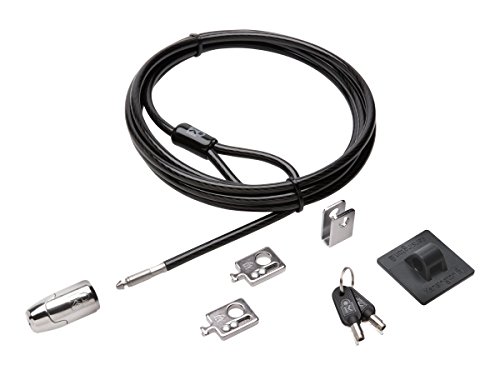
For laptop locking cables for small desks that also need peripheral protection, Kensington’s Desktop & Peripherals Locking Kit 2.0 combines an 8-foot carbon steel cable with adapters, a cable trap, and an anchor plate. It is designed to secure computers and accessories to a desk, table, or other fixed structure.
Best For: Small workstations with a desktop computer or multiple peripherals that need to be secured together.
Pros:
- 8-foot cut-resistant carbon steel cable provides flexible anchoring options.
- Includes two adapters for devices without a Kensington Security Slot.
- Cable trap helps secure peripheral accessories.
- Uses a 5mm keyed system with Hidden Pin Technology.
Cons:
- Its broader desktop-and-peripherals design may be more equipment than a single laptop requires.
- The kit uses a standard keyed lock rather than a combination lock.
This is a strong fit when a small desk holds more than just a laptop, especially if monitors or accessories also need a tethering solution.
Best Flexible Compatibility – Hardware Security Cable Lock with Anchor Plate
This hardware security cable is worth considering when shopping for laptop locking cables for small desks and you need support for both standard-slot laptops and slot-free tablets. The 6.5-foot PVC-coated twisted steel cable loops around a fixed object, while the adhesive anchor plate provides an alternative mounting method.
Best For: Mixed device setups that include laptops, tablets, phones, monitors, or projectors.
Pros:
- Supports standard lock slots and devices used with the adhesive anchor plate.
- 6.5-foot cable offers room to reach a fixed desk or table structure.
- Rotating lock head is designed to turn 360 degrees.
- Compatible device examples include MacBook, iPad, Surface, Kindle, and Android devices.
Cons:
- Some models require the I3C adhesive security plate.
- Using the anchor plate is necessary for devices without a standard lock slot.
Its wide device compatibility makes it useful for compact shared desks, but confirm whether your particular device needs the specified adhesive plate before buying.
Best Traditional Slot Lock – Kensington T-Bar 6-Foot Laptop Lock
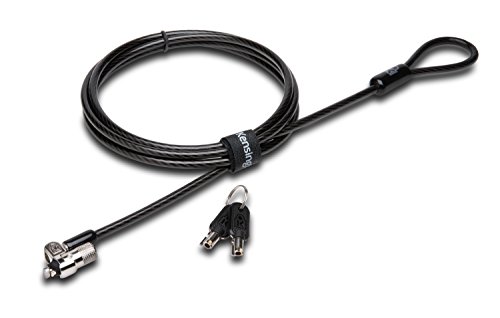
For a small desk with a laptop that already has a compatible Kensington security slot, this Kensington T-Bar lock offers a straightforward keyed setup. Its 6-foot carbon steel cable anchors to a desk, table, or other fixed structure, while the pivoting lock head is designed for thin devices.
Best For: Laptops and monitors with a standard Kensington security slot.
Pros:
- Pivoting 10mm T-Bar lock head is designed for thin laptops and devices.
- 6-foot carbon steel cable has a protective plastic sheath.
- Hidden Pin Technology supports the anti-pick tubular lock.
- Special hinge helps reduce awkward locking angles.
Cons:
- Does not work with Dell’s newer wedge lock slot.
- Some HP devices use a NanoSaver slot instead.
- It requires a compatible built-in security slot and does not include an adhesive anchor.
This is a clean, compact choice for a slot-equipped laptop, but checking the manufacturer’s lock-slot type is essential before ordering.
Flexible Fit Security – Universal Combination Laptop Cable Lock
For laptop locking cables for small desks, this kit is a flexible choice when you need to secure devices with or without a built-in security slot. Its adhesive anchor plate, long cable, and keyless combination lock can work well where desk space is limited.
Best For: Small desks and mixed devices, including laptops, tablets, and other electronics without standard lock holes.
Pros:
- Supports devices with built-in slots and devices that need the included adhesive lock plate.
- 6.23-foot, 5mm braided cable allows extra movement around a small workspace.
- Resettable four-digit combination avoids the need to carry a key.
- Stainless-steel lock head has a push-button, 360-degree rotating design for one-hand operation.
Cons:
- Devices without security holes require adhesive installation on a hard surface.
- The four-digit combination must be remembered because there is no key backup.
This is a practical all-around option for compact work areas, especially if you need one locking approach for both slotted and non-slotted devices. Check the adhesive plate placement and allow room for the cable to reach a fixed object.
Trusted Standard-Slot Protection – Kensington T-Bar Combination Lock
For laptop locking cables for small desks, the Kensington T-Bar is a straightforward pick when your laptop has a standard Kensington security slot. The six-foot carbon-steel cable is designed to anchor to a desk, table, or other fixed structure without taking much workspace.
Best For: Laptops and peripherals with a Kensington standard-size security slot in offices, homes, or public spaces.
Pros:
- Push-button design supports one-handed engagement.
- Resettable four-wheel combination provides 10,000 possible codes.
- Six-foot cut-resistant carbon-steel cable can anchor to fixed structures.
- Compatible with a range of slotted devices, including laptops, monitors, docking stations, and projectors.
Cons:
- Not compatible with Dell or Alienware models that use a different lock slot.
- Some 2016-and-newer Dell laptops and tablets may require a Noble-slot Kensington model instead.
- It requires a compatible standard security slot.
This is a good compact-desk choice when compatibility is confirmed in advance. Its main advantage is the familiar T-Bar format, but Dell and Alienware owners should verify the slot type before buying.
Multi-Device Adhesive Security – AboveTEK Keyed Cable Lock Kit
For laptop locking cables for small desks, the AboveTEK kit is useful when you want adhesive anchors for devices such as tablets, phones, and laptops. It includes two anchor sets, making it practical for securing more than one mobile device around a compact workstation or display area.
Best For: Small desks, retail displays, cafes, libraries, and other shared spaces where multiple flat devices need keyed cable security.
Pros:
- Includes two adhesive sticker and anchor-plate sets for multiple devices.
- Industrial-grade 3M adhesive is designed for most flat surfaces.
- Six-foot galvanized steel cable allows device movement while secured.
- Keyed operation is simple and quick, with two keys included.
Cons:
- Adhesive anchors require suitable flat surfaces and careful installation.
- Uses keys rather than a combination, so keys must be stored and managed.
- The notes do not indicate compatibility with built-in security slots.
This kit stands out for multi-device setups where adhesive mounting is appropriate. The extra anchor set adds value for compact desks or displays, while the keyed design keeps operation simple for frequent access.
Low-Profile Standard-Slot Security – Slim T-Bar Combination Lock
For small desks, a laptop locking cable should secure your computer without making it awkward to use. This Kensington Slim T-Bar model has a low-profile lock head that helps thin laptops and 2-in-1s lie flat while its six-foot cable anchors to a desk, table, or other fixed structure.
Best For: Thin and light HP, Lenovo, Acer, Asus, and other laptops with a standard Kensington lock slot.
Pros:
- Slim head design helps the laptop remain flat and stable.
- Six-foot cut-resistant carbon steel cable works with desks and tables.
- Resettable four-wheel combination provides 10,000 possible codes.
- Pivoting head and push-button engagement support one-handed use.
Cons:
- Not compatible with Dell or Alienware models listed for the K68008WW.
- Requires a standard Kensington T-Bar slot; Kensington NanoSaver slots need a different model.
This is a practical choice when desk space is tight and you want a combination lock that does not lift an ultra-thin laptop off the surface. Confirm your laptop’s slot type before buying.
Adhesive-Mount Flexibility – Laptop Lock with Slot Plate
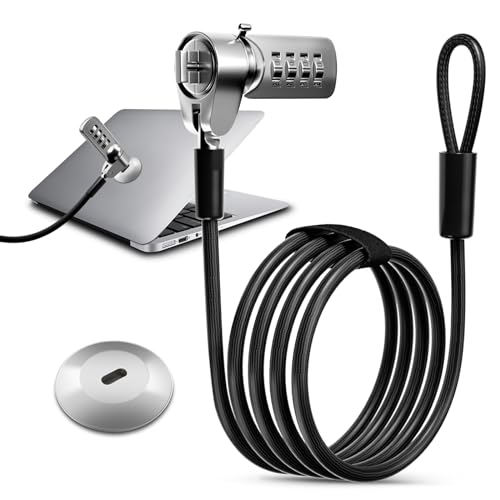
If your device lacks a built-in security slot, this laptop locking cable for small desks adds one with a double-sided adhesive plate. The combination lock is designed for laptops, tablets, smartphones, and other devices, giving you a flexible way to anchor electronics to a fixed structure.
Best For: Devices without existing safety holes, including laptops, tablets, and smartphones.
Pros:
- Includes an adhesive lock slot plate for devices without security holes.
- Four-digit resettable combination offers over 10,000 possible codes.
- Six-foot-plus cut-resistant braided steel cable has a 5 mm diameter.
- Includes three spacer sizes and a 360-degree rotating head.
Cons:
- Adhesive installation requires following the included instructions.
- It is a universal add-on solution rather than a built-in laptop slot lock.
This option is especially useful for a small desk setup with mixed devices or a laptop that has no locking slot. Its included plate and spacers broaden compatibility, but proper installation is important.
Multi-Slot Compatibility – Universal 3-in-1 Laptop Lock
For compact workspaces where laptops may change over time, this Kensington universal cable lock is designed to fit standard, Nano, or wedge-shaped security slots. Its six-foot carbon steel cable and resettable combination make it a versatile option for securing compatible laptops to a nearby desk or table.
Best For: Small desks shared by laptops with different security-slot shapes or brands.
Pros:
- Three interchangeable tips fit standard, Nano, and wedge-shaped slots.
- Six-foot carbon steel cable provides cut and theft resistance.
- Resettable four-number dial offers 10,000 possible combinations.
- Unused lock tips stay attached to the lock for convenient storage.
Cons:
- Its interchangeable-tip design may be more involved than a single-slot lock.
- The cable is six feet long, which may be more reach than some very small desks need.
This is the strongest fit when slot compatibility matters more than having the simplest possible lock. The interchangeable tips help one lock serve laptops with different security-slot designs.
How We Picked the Best Laptop Locking Cables for Small Desks
We focused on practical security for compact work areas: cable length, anchoring method, lock format, compatibility, installation demands, and everyday convenience. The lineup includes keyed and combination locks, standard and slim T-bar designs, universal options, and adhesive anchors for laptops or tablets without a dedicated lock slot.
Because these products are primarily deterrents rather than high-security vault hardware, we prioritized designs that can be attached consistently to a sturdy desk leg, frame, or other fixed object without consuming valuable workspace.
Quick Comparison
| Lock type | Best for | Main consideration |
|---|---|---|
| Keyed cable lock | Fast, familiar daily use | Keep track of the keys |
| Combination cable lock | Shared spaces or key-free access | Choose and protect a memorable code |
| Adhesive-anchor lock | Devices without a security slot | Requires careful surface preparation |
| Slim T-bar lock | Thin laptops and crowded desks | Confirm the device slot standard |
| Universal lock | Mixed devices | Check included adapters and fit |
Key Buying Factors for Laptop Locking Cables for Small Desks
Compatibility and Attachment Method
First, inspect your laptop’s security slot. A standard T-bar slot accepts many Kensington-style locks, while some thin models use a different format or have no slot at all. For slot-free devices, an adhesive anchor may be the practical option, but it should be installed only on a clean, smooth, compatible surface and allowed to bond according to the manufacturer’s directions.
Footprint and Cable Routing
On a small desk, a six-foot cable can provide useful reach without requiring a large base. Route it around a fixed, difficult-to-remove structural part of the desk rather than a lightweight accessory. Look for a compact lock head that will not block ports, interfere with a mouse, or force the laptop into an awkward position.
Keyed Versus Combination Security
Keyed models are simple and quick when one person manages the device. Combination locks eliminate loose keys and work well in shared environments, but the code must remain private. Resettable combinations are preferable when several users or changing assignments are involved.
Build Quality and Routine Use
Prefer a steel cable, a firm locking mechanism, and hardware that does not feel loose when tension is applied. A lock is most useful when it is convenient enough to use every time you leave the desk. Consider whether the cable can remain attached while you work and whether the lock is easy to store during transport.
Who Should Buy Which Laptop Locking Cables for Small Desks?
Choose a keyed T-bar lock if your laptop has a standard slot and you want the quickest straightforward setup. Pick a combination model when multiple people need access or you do not want to manage keys. A slim combination lock is a better fit for especially thin laptops or crowded work surfaces, provided the slot is compatible.
For MacBooks, tablets, monitors, or laptops without a built-in security slot, an adhesive-anchor kit can expand compatibility. Universal systems are useful for households, classrooms, and offices managing several device types. Whichever option you choose, verify the lock slot or anchor compatibility before buying and attach the cable to a genuinely fixed part of the desk.