Choosing your first synthesizer can feel confusing because “beginner-friendly” covers everything from compact pocket instruments to full-featured keyboards with sequencing, sampling, and computer integration.
This roundup compares 10 approachable options across different styles and budgets, so you can match the right instrument to your goals—whether you want hands-on sound design, portable practice, beat making, or a flexible setup for future growth.
Best 10 Synthesizers for Beginners Picks for 2026
Best Experimental Pick
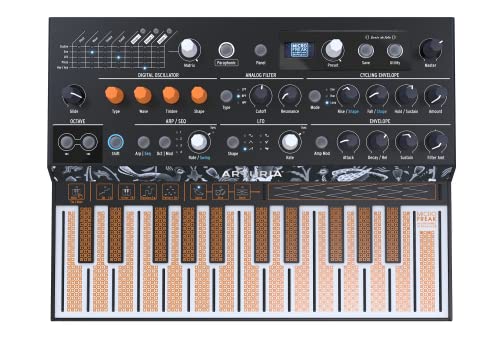
- Hybrid digital oscillator and analog-filter design
- Expressive 25-key poly-aftertouch touch surface
- Sequencer, modulation matrix, CV, USB, and MIDI
Best For: Exploratory beginners who want deep sound design
Best Portable Beatmaking Pick

- Standalone sampler with battery, speaker, and microphone
- 16 pads with chopping, timestretching, and repitching
- Includes kits, effects, USB-C, and microSD support
Best For: Beginners focused on beats and portable sampling
Best Simple Analog Starter

- Compact, lightweight analog ribbon synthesizer
- Simple interface for quick sound adjustments
- Adds modulation options for creative exploration
Best For: Beginners wanting a small, straightforward analog instrument
Best Controller for Learning
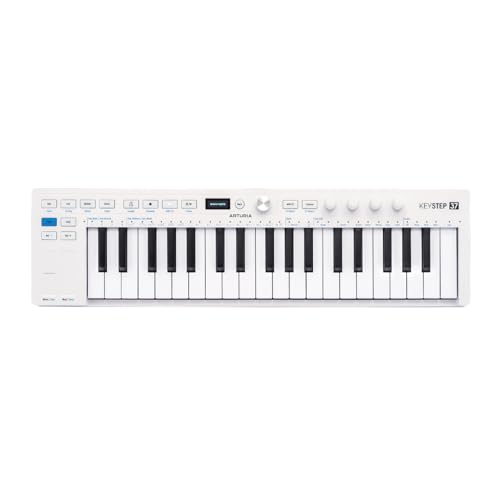
- 37 velocity-sensitive keys with aftertouch
- Chord, scale, arpeggiator, and 64-step sequencer modes
- USB-C MIDI, DIN MIDI, sync, and four CV outputs
Best For: Beginners controlling software or external synthesizers
Best Pocket Pick
Stylophone Original Pocket Synthesizer

- Stylus-controlled interface is beginner-friendly
- Pocket-sized and battery-powered
- Three octaves with iconic analog sound
Best For: Portable first experiments with electronic music
Best Feature-Rich Keyboard
Novation MiniNova Analog Modeling Synthesizer

- 37 mini keys and 18-voice polyphony
- 256 presets plus 128 user storage slots
- Vocoder, VocalTune, arpeggiator, and Animate controls
Best For: Growing beginners who want deeper synthesis features
Best Hybrid Starter

- Over 100 built-in drum and instrument sounds
- 25 velocity-sensitive keys plus eight MPC pads
- Works standalone or as a USB MIDI controller
Best For: Beginners combining synth practice with beat-making
Hybrid Sound Explorer

- 37-key hybrid synthesizer for hands-on sound exploration
- Portable design with USB connectivity
- Includes MiniFreak VST counterpart
Best For: Beginners who want a dedicated hybrid synthesizer
Computer-Free Control Center

- 37-key controller with three full octaves
- Built-in 64-step sequencer
- CV/Gate and MIDI I/O for external gear
Best For: Beginners building a flexible DAW or hybrid studio
Compact Production Starter

- 25 velocity-sensitive mini keys in a portable format
- MPC pads, knobs, display, and performance modes
- Includes software instruments and learning tools
Best For: Beginners making beats and producing on the go
Best Experimental Pick – Arturia MicroFreak
For beginners seeking synthesizers for beginners that encourage experimentation, the Arturia MicroFreak offers an unusually broad sound-design toolkit in a compact format. Its digital oscillator modes, analog filter, touch-sensitive 25-key surface, sequencer, and modulation matrix provide plenty to explore, though the feature set may take time to master.
Best For: Curious beginners who want to explore hybrid synthesis, sequencing, and unconventional performance controls.
Pros:
- Offers numerous oscillator modes, including wavetable, physical modeling, vocoder, and Noise Engineering options.
- Touch-plate keyboard supports individual pressure or poly-aftertouch expression.
- Includes sequencing, automation, Spice and Dice randomization, and a 5×7 modulation matrix.
- Connects to DAWs, MIDI gear, and modular equipment through USB, MIDI, and CV.
Cons:
- The supplied specifications identify it as advanced, so its many features may feel overwhelming at first.
- The 25-key touch surface is compact and differs from a conventional moving-key keyboard.
The MicroFreak is a strong long-term choice if you want a beginner synth that can grow with your sound-design ambitions. It is less suited to shoppers seeking a straightforward, traditional keyboard experience.
Best Portable Beatmaking Pick – Akai MPC Sample
The Akai MPC Sample is a practical entry point for beginners comparing synthesizers for beginners with sampling-focused hardware. It combines standalone sampling, sequencing, effects, pads, a speaker, microphone, rechargeable battery, and microSD storage, so you can make beats without a computer or DAW.
Best For: New beatmakers, finger drummers, and DAWless creators who want portable sampling and groove production.
Pros:
- Runs standalone with a rechargeable battery, built-in speaker, microphone, and microSD storage.
- Provides 16 MPC pads, a color display, sample chopping, timestretching, repitching, and resampling.
- Includes over 100 factory kits and 60 internal effects across four FX processors.
- Offers USB-C audio/MIDI, line input and output, headphones, sync, and MIDI connectivity through an adapter.
Cons:
- MIDI DIN connection requires a 1/8-inch-to-MIDI DIN adapter, which is not included.
- Its emphasis is sampling and beatmaking rather than traditional keyboard-based synthesis.
Choose the MPC Sample if hands-on rhythm creation and portability matter more than playing melodies on keys. Its self-contained workflow can make getting started less intimidating for beginners.
Best Simple Analog Starter – Korg monotron DUO
The Korg monotron DUO is a compact option for beginners who want an uncomplicated introduction to analog sound shaping. Its small ribbon-synth format and auxiliary connection make it easy to carry, while the supplied notes highlight added modulation and control for more varied sounds.
Best For: Curious beginners who want a lightweight, hands-on analog instrument for simple sound exploration.
Pros:
- Compact and lightweight at 6.4 ounces, making it easy to transport.
- Analog sound profile offers a direct way to explore basic synthesizer textures.
- Simple controls and additional modulation options support quick experimentation.
Cons:
- The ribbon-synth format is more limited than a full keyboard synthesizer.
- The supplied specifications provide fewer detailed production and connectivity features than the other products here.
The monotron DUO makes sense as a low-complexity starting point or portable sound experiment. Consider a larger synth if you want conventional keys, extensive sequencing, or deeper computer integration.
Best Controller for Learning – Arturia KeyStep 37
The Arturia KeyStep 37 is a strong choice for beginners shopping synthesizers for beginners who plan to control software or external hardware. It is a controller and sequencer rather than a self-contained sound-producing synth, but its velocity-sensitive keys, aftertouch, chord and scale modes, arpeggiator, and sequencer make it useful for learning musical ideas.
Best For: Beginners who already use a computer or external synth and want expressive keys with built-in sequencing tools.
Pros:
- Provides 37 velocity-sensitive Slimkeys with aftertouch in a compact design.
- Includes chord and scale modes, a 16-mode arpeggiator, and a polyphonic 64-step sequencer.
- Mutate and pattern tools help generate and develop musical ideas.
- Supports USB-C MIDI, MIDI DIN, sync, pedal input, and four configurable CV outputs.
Cons:
- It is a controller and sequencer, not a standalone synthesizer with its own sound engine.
- Using its broader capabilities may require compatible software or external hardware.
The KeyStep 37 is ideal when the goal is to learn sequencing, keyboard performance, and hardware control in one compact unit. Pair it with a software or hardware synth for a complete sound-making setup.
Best Pocket Pick – Stylophone Original Pocket Synthesizer
The Stylophone is one of the most approachable synthesizers for beginners, using a stylus and touch-sensitive metal surface instead of conventional keys. Its compact, battery-powered design makes it a practical choice for experimenting with notes, vibrato, and vintage electronic sounds.
Best For: Beginners, curious musicians, and anyone wanting a highly portable introduction to synthesis.
Pros:
- Simple stylus-based interface is easy to start playing.
- Compact, pocket-friendly design with built-in speaker and headphone socket.
- Produces an iconic analog sound with three octaves and optional vibrato.
- Can connect to a computer or other gear through a 3.5mm stereo cable.
Cons:
- Runs on three AA batteries, which are not listed as included.
- The unconventional playing surface may not suit players seeking a standard keyboard.
- Its feature set is more limited than that of a full-size synthesizer.
The Stylophone prioritizes fun, portability, and immediate playability over extensive sound design. It is a strong starter instrument for simple melodies and retro textures, especially when space and ease of use matter most.
Best Feature-Rich Keyboard – Novation MiniNova Analog Modeling Synthesizer
The Novation MiniNova is a more capable option for beginners who want room to grow beyond basic melodies. Its 37 mini keys, preset library, performance controls, and analog-modeling engine provide an accessible way to explore basses, leads, pads, effects, and vocal processing.
Best For: Beginners who want a compact keyboard synthesizer with substantial sound-shaping and performance features.
Pros:
- Offers up to 18-voice polyphony and powerful effects.
- Includes 256 searchable presets and space for 128 user sounds.
- Animate buttons, pitch and modulation wheels, and an arpeggiator support hands-on performance.
- Built-in microphone and VocalTune expand its vocal-processing options.
Cons:
- The larger feature set may take longer for complete beginners to learn.
- Its 37 mini keys provide less playing space than a full-size keyboard.
- The unit weighs 6 pounds, making it less pocketable than simpler beginner instruments.
MiniNova balances a beginner-accessible preset workflow with enough synthesis depth for continued exploration. It is a sensible choice if you want a compact keyboard that can cover substantially more ground than a novelty-sized starter synth.
Best Hybrid Starter – Akai MPK Mini Play MK3
The Akai MPK Mini Play MK3 is a flexible entry point for synthesizer beginners who also want beat-making tools. It combines 25 velocity-sensitive mini keys, built-in sounds, drum pads, an arpeggiator, and a speaker, while also working as a USB MIDI controller with a computer.
Best For: Beginners who want standalone sounds, beat pads, and computer-based music production in one portable device.
Pros:
- Includes over 100 internal drum and instrument sounds.
- Eight velocity-sensitive MPC pads, eight knobs, an arpeggiator, and note repeat support hands-on creation.
- Built-in speaker and battery operation make it suitable for portable use.
- Includes MPC Beats, AIR instruments, Melodics lessons, and other software extras.
Cons:
- Only 25 mini keys are available for playing melodies and chords.
- Batteries are required for portable use but are not included.
- Its primary computer connection is USB, so setup depends on compatible software for expanded production.
The MPK Mini Play MK3 is especially practical for beginners deciding between a small synthesizer and a MIDI controller. Its internal sounds allow standalone practice, while the pads and included software provide a clear path into beat-making and computer-based production.
Hybrid Sound Explorer – Arturia MiniFreak
Arturia MiniFreak 37 Key Polyphonic 6-Voice Hybrid Synthesizer Keyboard (Standard, 37 Key)
Check Price On AmazonFor beginners seeking synthesizers for beginners, the Arturia MiniFreak offers a compact way to explore both digital and analog-style sound design. Its 37-key layout, portable build, and included MiniFreak VST counterpart make it suitable for learning hands-on synthesis while also working with computer-based setups.
Best For: Beginners who want a dedicated hybrid synthesizer with room to explore evolving sounds and computer integration.
Pros:
- Hybrid digital-and-analog sound profile encourages broad experimentation.
- 37 keys provide three octaves for melodic and harmonic playing.
- Portable 2.94 kg design with USB connectivity.
- Includes a MiniFreak VST counterpart and a two-year manufacturer warranty.
Cons:
- It is a corded-electric instrument rather than a battery-powered option.
- The 37-key format is less compact than a 25-key controller.
The MiniFreak is the most complete standalone instrument in this selection for beginners who want to learn synthesis directly from hardware. Choose it when sound exploration matters more than the smallest possible setup.
Computer-Free Control Center – Akai MPK Mini Plus
The Akai Professional MPK Mini Plus is a strong option for beginners comparing synthesizers for beginners with MIDI controllers. It does not generate sounds by itself, but its 37-key keyboard, pads, controls, sequencer, and CV/Gate and MIDI connections can control software, synthesizers, modular gear, and other sound sources.
Best For: Beginners building a flexible computer-based or hybrid studio around a DAW, external synthesizer, or modular equipment.
Pros:
- 37 keys provide three full octaves for melodic and harmonic performance.
- Built-in 64-step sequencer supports drums and melodies or chords without a computer.
- CV/Gate and MIDI I/O expand compatibility with external music equipment.
- Includes MPC Beats, NKS integration, and a complimentary Komplete 15 Select bundle choice.
Cons:
- It is a MIDI keyboard controller, not a standalone synthesizer with its own sound engine.
- Its wider feature set may be more than a beginner needs for basic keyboard input.
The MPK Mini Plus is best viewed as a command center rather than a traditional synthesizer. It is a practical starting point if you plan to make music in a DAW or connect multiple external sound sources.
Compact Production Starter – Akai MPK Mini IV
For beginners looking at synthesizers for beginners as part of a portable production setup, the Akai Professional MPK Mini IV combines 25 velocity-sensitive mini keys with pads, knobs, a display, and performance modes. It is a USB-C MIDI controller, so its sounds come from compatible software or connected equipment rather than the keyboard itself.
Best For: Beginners who want a compact controller for beat making, DAW production, songwriting, and mobile or travel setups.
Pros:
- 25 velocity-sensitive keys suit synth leads, piano-style parts, and portable production.
- Eight velocity- and pressure-sensitive MPC pads support finger drumming and sample triggering.
- Chord, Scale, and arpeggiator modes help beginners develop ideas quickly.
- Includes a software instrument collection, DAW integration, Melodics trial, and Splice access.
Cons:
- It is a MIDI controller rather than a standalone synthesizer.
- The 25-key layout offers less playing range than the 37-key options.
The MPK Mini IV is the most travel-friendly choice here and provides useful guidance features for new producers. Choose it when compact size, pads, and included software are more important than a larger keyboard range.
How We Picked the Best Synthesizers for Beginners
We focused on instruments that make the first learning steps approachable without limiting long-term usefulness. The selection includes standalone synthesizers, hybrid instruments, MIDI controllers, and compact groove-oriented devices because beginners do not all need the same type of setup.
Our comparison emphasizes control layout, portability, built-in sounds or sound-generation features, sequencing and sampling capabilities, computer compatibility, keyboard size, and overall learning value. We also considered whether each product works independently or requires a computer, phone, or external sound module.
Quick Comparison
| Best For | Recommended Types | What to Look For |
|---|---|---|
| Learning synthesis | MicroFreak, monotron DUO, MiniNova | Accessible controls, varied sound engines, and hands-on editing |
| Playing melodies and chords | MiniFreak, MiniNova | More keys, polyphony, and comfortable performance controls |
| Computer-based production | KeyStep, MPK Mini models | MIDI connectivity, software integration, and useful control layouts |
| Beat making and sampling | MPC Sample, MPK Mini Play MK3 | Pads, sequencing, sampling, and standalone or portable operation |
| Low-cost experimentation | Stylophone, monotron DUO | Small size, simple controls, and low entry cost |
Key Buying Factors for Synthesizers for Beginners
Standalone or Controller?
A standalone synthesizer creates sound on its own, while a MIDI controller sends performance information to software or another sound source. Controllers are often flexible and affordable, but they may need a computer or compatible device. Check the product’s connectivity before buying.
Keyboard Size and Playing Style
Compact 25-key models are portable and suitable for simple bass lines, leads, and basic chords. A 37-key instrument gives your hands more room and can be more comfortable for learning. Ribbon, touch, or mini-key designs are useful for experimentation but may not feel like a traditional keyboard.
Polyphony, Sound Engine, and Controls
Polyphony determines how many notes can sound simultaneously, which matters for chords and layered parts. Monophonic or simpler instruments can still be excellent for learning synthesis. Beginners should also consider whether they prefer immediate knobs and sliders or deeper menu-based editing.
Sequencing, Sampling, and Software
If you want to build complete ideas without a computer, prioritize onboard sequencing, sampling, speakers, or battery operation. If you plan to produce in a DAW, look for dependable USB or MIDI connectivity and included software support.
Who Should Buy Which Synthesizers for Beginners?
Choose the Arturia MicroFreak or Korg monotron DUO if your priority is hands-on experimentation and unusual electronic sounds. The Stylophone is the simplest pocket-sized choice for casual play and quick musical sketches.
Choose the Arturia MiniFreak or Novation MiniNova if you want a more conventional synthesizer experience with broader performance potential, richer sound design, and room to grow beyond basic exercises.
Choose the Arturia KeyStep or an Akai MPK Mini controller if you primarily work with music software. The KeyStep suits melody, chord, and sequence control, while MPK models add pads and compact production controls. The MPK Mini Play MK3 is especially useful if you want more portable, self-contained practice.
Choose the Akai MPC Sample if sampling and beat construction matter more than traditional keyboard playing. Before purchasing, confirm the included accessories, software requirements, power options, and compatibility with your existing setup.