The right fiber optic tester can turn a frustrating troubleshooting call into a quick, documented repair. This roundup compares 10 options spanning basic visual fault locators, optical power meters, termination kits, and advanced OTDR platforms.
Whether you need a compact tool for fiber identification or a broader test system for commissioning and maintenance, use the guide below to match features, wavelength support, connector compatibility, and testing depth to your work.
Best 10 Fiber Optic Testers for Technicians Picks for 2026
Quick Signal Detection

- Detects 850–1625 nm optical signals
- Non-contact light and sound indication
- Automatic shutoff; batteries included
Best For: Rapid live-fiber checks on ports and patch cords
Meter and Source Kit
- Seven calibrated meter wavelengths
- Includes four-wavelength light source
- Self-calibration and rugged field housing
Best For: Insertion-loss and signal-level testing
Multifunction Pocket Tester

- Tests 10 wavelengths from 850–1650 nm
- Adds VFL, RJ45 testing, and LED light
- Stores up to 500 readings
Best For: Portable multi-function field troubleshooting
Connector-Rich Fault Locator Kit

- Locates breaks, bends, and poor connections
- Supports ST, SC, FC, and LC interfaces
- Includes five adapters and three patch cords
Best For: Mixed-connector physical fault troubleshooting
Long-Range All-in-One Pick
- 1310/1550 nm OTDR with 28/26 dB dynamic range
- 12-function toolkit includes OPM, OLS, VFL, and RJ45 testing
- Short 3.0 m event blind zone; stated range up to 80 km
Best For: Fiber installation and maintenance teams needing broad coverage
Compact Power-Check Pick
Mini 4-in-1 Optical Power Meter

- Lightweight 200 g body with two-AA battery operation
- OPM range of 800–1700 nm and -70 to +6 dBm stated power range
- Combines OPM, VFL, fiber testing, and network cable testing
Best For: Portable optical checks and basic field troubleshooting
Network Integration Pick

- 1310/1550 nm OTDR with 28/26 dB dynamic range
- Adds IP-camera, RJ45 TDR, PoE, Wi-Fi, and network diagnostics
- 5.4-inch touchscreen with event-map and curve review
Best For: Fiber, security-camera, and Ethernet service work
Complete Field Kit
Fiber Optic Termination & Testing Set

- Includes OPM, VFL, cleaver, stripper, and cleaning tools
- Tests 10 listed wavelengths from 850 to 1650 nm
- Supports fiber preparation and mechanical-splice work
Best For: Technicians needing a broad installation and maintenance kit
Portable 3-in-1 Tester

- Combines optical power, VFL, and RJ45 testing
- Weighs 140 g for easy field carrying
- Supports eight listed wavelengths and user calibration
Best For: Technicians needing lightweight multi-function diagnostics
Quick Fault Finder

- Identifies breaks, bends, and connector faults
- Includes two compact visual fault locator pens
- Supports single-mode and multimode cable checks
Best For: Installers focused on fast continuity and fault tracing
Quick Signal Detection – Fluke FiberLert-125
For technicians who need a fast way to confirm whether fiber is carrying an optical signal, the Fluke Networks FiberLert-125 is a straightforward option among fiber optic testers for technicians. It detects optical power across near-infrared wavelengths from 850 to 1625 nm and uses light and sound rather than requiring meter interpretation.
Best For: Quickly checking live single-mode or multimode ports, patch cords, and UPC or APC connections.
Pros:
- Detects signals from 850 to 1625 nm without setup.
- Non-contact detection helps reduce the risk of fiber damage.
- Compact, lightweight design with automatic five-minute shutoff.
- Includes two AAA batteries and a two-year warranty.
Cons:
- Provides signal presence detection rather than a detailed optical power reading.
- Battery powered, with only basic light-and-sound indication.
The FiberLert-125 is best when speed and simplicity matter more than quantitative testing. It is a practical first-check tool for field technicians, though users needing dBm measurements will need a full optical power meter.
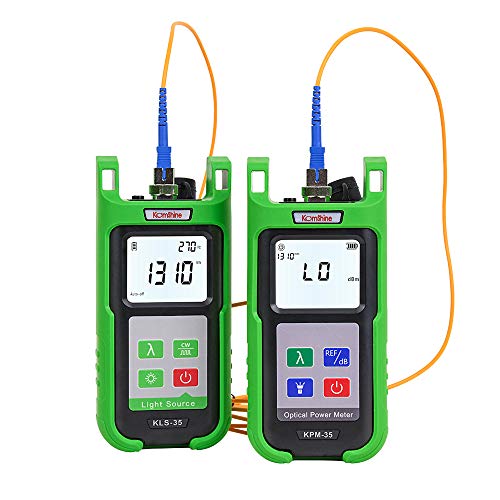
Meter and Source Kit – Komshine KPM-35/KLS-35-MS
The Komshine KPM-35 and KLS-35-MS pair gives technicians both a calibrated optical power meter and a fiber light source. With seven meter wavelengths, four source wavelengths, self-calibration, and rugged field-oriented features, it is a versatile choice among fiber optic testers for technicians.
Best For: Technicians performing insertion-loss and signal-level checks across common single-mode and multimode wavelengths.
Pros:
- Power meter covers 850, 980, 1300, 1310, 1490, 1550, and 1625 nm.
- Light source supports 850, 1300, 1310, and 1550 nm.
- Includes self-calibration, a qualified certificate, and automatic shutdown.
- Waterproof keys, silicone jacket, and stated two-meter drop resistance suit field use.
Cons:
- Two-piece kit is heavier and less compact than a basic detector.
- Supplied meter measurement range is listed as -70 to +6 dBm.
This kit is a strong fit when technicians need a matched source-and-meter setup instead of simple signal confirmation. Its broad wavelength coverage and protective construction add flexibility for FTTH and outdoor work.
Multifunction Pocket Tester – M70-10 OPM and VFL
The M70-10 combines an optical power meter, 10 mW visual fault locator, RJ45 wiring test, and LED light in one portable unit. For technicians building a compact kit of fiber optic testers for technicians, it adds broad wavelength coverage, data storage, and a stated measurement error below ±0.2 dB.
Best For: Field technicians who want one pocket-sized tool for fiber power checks, basic fault locating, network wiring tests, and work lighting.
Pros:
- Measures 10 standard wavelengths from 850 to 1650 nm.
- Combines OPM, 10 mW VFL, RJ45 sequence testing, and LED lighting.
- Stores up to 500 readings and supports user calibration.
- Displays linear mW and dBm values with selectable backlight and automatic shutoff.
Cons:
- Two AAA batteries are required but not included.
- Its integrated functions may be more than needed for simple signal-presence checks.
The M70-10 offers unusually broad functionality for a single portable tester. It is particularly useful for technicians who prefer carrying one multipurpose device, provided they supply their own batteries and do not require a separate dedicated source.
Connector-Rich Fault Locator Kit – Fiber Optic Troubleshoot Kit
This visual fault locator kit is designed for locating fiber breaks, bends, cracks, and poor connections without removing cables from a distribution panel. Its adapters and patch cords make it a practical accessory among fiber optic testers for technicians working across multiple connector types.
Best For: Field troubleshooting of single-mode and multimode cables using ST, SC, FC, or LC connections.
Pros:
- Helps locate breaks, bends, cracks, and poor connections.
- 2.5 mm universal connector supports ST, SC, and FC interfaces.
- Includes FC, ST, LC, and SC couplers plus an FC-to-LC adapter.
- Three patch cords support panel troubleshooting without cable removal.
Cons:
- AA batteries are not included.
- It is a visual fault locator kit, not a quantitative optical power meter.
- The supplied adapters and cords add bulk compared with a standalone locator.
This kit stands out for connector coverage and included accessories rather than measurement depth. It is a useful choice for technicians who regularly encounter mixed connector systems and need to isolate physical fiber faults quickly.
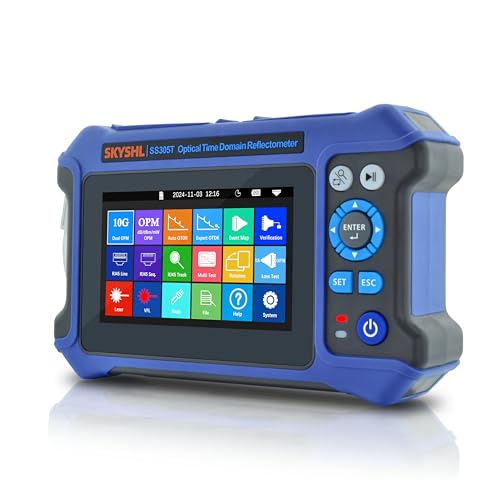
Long-Range All-in-One Pick – SS305T-2A1 OTDR Fiber Tester
For technicians who need versatile fiber optic testers for technicians, the SKYSHL SS305T-2A1 combines dual-wavelength OTDR testing with optical power, loss, light-source, VFL, event-map, multi-fiber, and RJ45 testing. Its 28/26 dB dynamic range and stated 5–80 km measurement range suit installation and maintenance work.
Best For: Fiber installation and maintenance teams that want broad testing capability in one handheld unit.
Pros:
- 1310/1550 nm OTDR with 28/26 dB dynamic range and up to 80 km stated test distance
- Includes OTDR, event map, OPM, 10G OPM, OLS, VFL, optical loss, multi-fiber, and RJ45 functions
- Short stated event and attenuation blind zones of 3.0 m and 8.0 m for short-distance fault work
- Supports APC and UPC connections through SC, FC, ST, and LC accessories
Cons:
- The extensive feature set may be more than needed for basic power checks
- At 0.8 kg, it is less lightweight than a simple optical power meter
- The supplied notes specify single-mode OTDR testing, so it is not presented as a multimode OTDR
The SS305T-2A1 is the strongest fit when technicians want one instrument to cover fiber characterization, fault location, optical measurements, and selected copper-cable tasks. Its automatic and expert OTDR modes also make it more approachable for mixed-experience teams.
Compact Power-Check Pick – Mini 4-in-1 Optical Power Meter
Technicians looking for portable fiber optic testers for technicians may prefer this mini 4-in-1 meter for routine optical checks. It combines an optical power meter, visual fault locator, network cable test capability, and fiber testing in a 200 g battery-powered body.
Best For: Field technicians who prioritize a small tool for optical power readings, visible fault checks, and basic cable testing.
Pros:
- Compact 200 g design powered by two AA batteries
- OPM covers 800–1700 nm with a stated power range of -70 to +6 dBm
- VFL uses 650 nm output and supports SC, FC, and ST connectors; LC use requires an adapter
- Supports multiple calibration wavelengths from 850 through 1650 nm
Cons:
- It does not provide OTDR distance-to-fault or event-map analysis
- VFL output is listed as 2 mW, which is less than the 10 km VFL distance specified for the SKYSHL model
- LC connections require an SC male-to-LC female connector according to the supplied notes
This mini meter is a practical choice for quick verification and troubleshooting rather than full fiber-link characterization. Its low weight and AA-battery operation make it convenient to carry as a daily service tool.
Network Integration Pick – MT-5500 OTDR Cable Tester
For technicians handling both fiber and network infrastructure, the WANLUTECH MT-5500 expands beyond standard fiber optic testers for technicians with IP-camera, PoE, Wi-Fi, and copper-cable tools. Its 1310/1550 nm OTDR provides 28/26 dB dynamic range, while the 5.4-inch touchscreen displays fiber curves and event-map results.
Best For: Telecom and security technicians who install or maintain fiber links alongside IP cameras and Ethernet cabling.
Pros:
- Single-mode 1310/1550 nm OTDR with 28/26 dB dynamic range and quick or professional parameter modes
- Includes OPM, VFL, light source, optical-loss testing, and event-map visualization
- Tests up to 4K 12MP IP cameras and provides RJ45 TDR, cable tracing, and UTP fault testing
- Adds PoE output up to 30 W, Wi-Fi analysis, and network diagnostics such as Ping and IP scan
Cons:
- The supplied notes state that this 1310/1550 nm model does not support testing live fiber
- Its many network and camera functions may be unnecessary for fiber-only work
- It requires a 12 V power input, making it less pocket-friendly than the mini meter
The MT-5500 makes the most sense when a service call involves more than optical fiber. Its combination of OTDR analysis and Ethernet, camera, PoE, and Wi-Fi diagnostics can reduce the number of separate tools technicians need to carry.
Complete Field Kit – Fiber Optic Termination & Testing Set
For technicians who need fiber optic testers for technicians alongside preparation and cleaning tools, this battery-powered kit combines an optical power meter, visual fault locator, cleaver, stripper, and fiber-cleaning accessories. It is suited to field work involving installation, mechanical splicing, troubleshooting, and connector maintenance.
Best For: Technicians who want one organized kit for fiber preparation, cleaning, visual fault finding, and optical power measurements.
Pros:
- Combines OPM, VFL, cleaning tools, cleaver, stripper, and Kevlar scissors.
- Measures 10 listed wavelengths from 850 to 1650 nm with a -70 dBm to +10 dBm range.
- Supports SC, FC, LC, and ST interfaces, with an FC-to-LC adapter included.
- The cleaver supports bare fiber, pigtail, and leather cable, with 16 cutting points.
Cons:
- At 1.4 kg, it is less lightweight than a tester-only tool.
- The broad accessory set may be more than needed for simple continuity checks.
This is the most comprehensive option of the three for technicians handling several stages of fiber work. Choose it when termination and cleaning capabilities matter as much as testing.
Portable 3-in-1 Tester – OPM, VFL & RJ45 Fiber Tester
This compact tester is a practical choice for technicians who need fiber optic testers for technicians that combine optical power measurement, visible fault locating, and RJ45 testing. Its 140 g body and universal FC/SC/ST interface make it convenient for routine service calls and network checks.
Best For: Field technicians who want a lightweight, multi-function tester for fiber links and RJ45 checks.
Pros:
- Integrates an optical power meter, VFL, and RJ45 tester in one device.
- Measures eight listed wavelengths from 850 to 1650 nm with a -70 dBm to +6 dBm range.
- Offers backlight selection, wavelength memory, automatic shutdown, and user calibration.
- Supports simultaneous linear mW and nonlinear dBm display.
Cons:
- Two AA batteries are required but are not included.
- Its power range is lower at the upper end than the larger termination kit.
- The listed connector support is FC, SC, and ST rather than a broader adapter set.
With its integrated functions and low weight, this model is well suited to quick diagnostics. It is a better fit for portable testing than for technicians who also need cleaving, stripping, or connector cleaning tools.
Quick Fault Finder – 2-Piece Red Light VFL Kit
For technicians who need fiber optic testers for technicians focused on continuity and fault tracing, this two-piece visual fault locator kit offers a simple red-light approach. Its one-button operation and compact aluminum housing are designed for checking breaks, bends, connectors, and fiber routing during installation or maintenance.
Best For: Installers and network maintenance teams that need straightforward visual fault locating across single-mode and multimode cabling.
Pros:
- Helps identify breaks, sharp bends, damaged connectors, and routing problems.
- Compatible with SC, ST, and FC connectors through its universal 2.5 mm interface.
- Includes two VFL pens, a carrying pouch, and a two-year limited warranty.
- Compact aluminum construction is suited to repeated field transport and use.
Cons:
- It is a visual fault locator kit rather than an optical power meter.
- The supplied notes do not specify measurement wavelengths or an optical power range.
- Its connector compatibility is centered on 2.5 mm SC, ST, and FC connections.
This kit prioritizes speed and simplicity over measurement versatility. It makes sense as a dedicated fault-finding option or as a convenient backup for teams that already own an optical power meter.
How We Picked the Best Fiber Optic Testers for Technicians
We evaluated these tools by looking at the measurements technicians commonly need in the field: visual fault location, optical power, insertion loss, cable continuity, and, for advanced units, OTDR trace and event-map analysis. We also considered portability, interface options, wavelength coverage, stated measurement ranges, and whether a tester combines several functions in one housing.
Because job requirements vary, this list includes both focused tools and multifunction instruments. A simple VFL may be the best choice for locating a visible break, while an OTDR-based tester is more appropriate for documenting long links, identifying splice problems, or finding faults at a measured distance.
Quick Comparison
- Best for basic identification: A visual fault locator or compact VFL/power-meter combination.
- Best for everyday power testing: An optical power meter covering the wavelengths used by your network.
- Best for mixed copper and fiber work: A multifunction tester with RJ45 testing alongside OPM and VFL functions.
- Best for installation kits: A termination and cleaning kit that includes preparation and inspection accessories.
- Best for detailed fault analysis: An OTDR with event mapping, multiple wavelengths, and sufficient dynamic range.
Key Buying Factors for Fiber Optic Testers for Technicians
Choose the Required Test Functions
A VFL sends visible red light through a fiber to reveal breaks, sharp bends, and poor connections near accessible points. An optical power meter measures received signal strength, while an optical light source helps perform insertion-loss testing. OTDRs provide a graphical view of reflections and loss along a link, but they require more training and careful setup.
Check Wavelengths and Measurement Range
Single-mode networks commonly use 1310, 1490, 1550, or 1625 nm, while multimode systems often use 850 and 1300 nm. Confirm that the meter supports your equipment and that its stated dBm range is suitable for both weak signals and normal operating levels.
Verify Connectors and Fiber Compatibility
FC, SC, and ST interfaces are common, but adapters may be needed for LC connections. Confirm whether the tool supports single-mode, multimode, or both. Clean connector end faces before testing because contamination can create misleading loss readings.
Consider Field Usability
Technicians working in cabinets, rooftops, and outside-plant locations should prioritize readable displays, protected controls, rechargeable or easily replaced batteries, durable housings, and straightforward operation. A compact tester that is always available can be more useful than a feature-rich unit that is difficult to carry.
Who Should Buy Which Fiber Optic Testers for Technicians?
Choose a VFL pen or basic cable tester if your main task is tracing fibers and locating obvious breaks. Select an OPM, or an OPM/VFL combination, for routine signal checks and maintenance. A kit with a cleaver, stripper, cleaner, and locator suits installers who need preparation tools as well as basic verification.
For network technicians handling both copper and fiber, an integrated RJ45 and fiber tester can reduce the number of devices in a tool bag. Choose an OTDR-based model when you need distance-to-fault measurements, event maps, link certification support, or more detailed troubleshooting on long or complex fiber runs. Before buying, confirm connector adapters, calibration expectations, battery requirements, and compatibility with the documentation standards used by your team.