Finding a dependable fiber tester does not require a large professional-tool budget. The best fiber optic testers under $100 combine essential functions such as optical power measurement, visual fault locating, and network cable testing in compact kits.
This roundup compares 10 budget-friendly options for installers, technicians, IT teams, and hands-on users. Use the guide below to match the right tester to your connectors, testing range, and troubleshooting needs.
Best 10 Fiber Optic Testers Under 100 Picks for 2026
Best Integrated Value

- Measures eight wavelengths from 850–1650 nm
- Combines OPM, VFL, and RJ45 testing
- Supports memory, backlight, auto-shutdown, and calibration
Best For: Portable routine fiber and RJ45 troubleshooting
Best Long-Range VFL

- Uses a 650 nm red laser to expose fiber faults
- Stated detection distance reaches up to 30 km
- Supports ST, SC, FC, and includes an FC-to-LC adapter
Best For: Long-distance visual fault locating
Best Rechargeable Multifunction Tester
- Combines OPM, VFL, RJ45 tester, and flashlight
- Supports 10 wavelengths and -70 to +10 dBm
- Rechargeable via USB-C with 500-group data storage
Best For: Field work requiring rechargeable power and saved readings
Best Feature-Packed Compact Tester

- Covers 10 wavelengths with a -70 to +10 dBm range
- Adds VFL, RJ45 sequence testing, and LED lighting
- Stores 500 readings and includes an FC-LC adapter
Best For: Portable multi-function fiber and network testing
Compact 4-in-1 Choice
Mini Optical Power Meter & VFL

- Measures -70 to +6 dBm across broad wavelengths
- Adds a 650 nm visual fault locator
- Lightweight design with SC/FC/ST support
Best For: Portable fiber and basic network testing
All-in-One Network Pick

- Combines optical power and fiber testing
- Checks RJ45/RJ11 and Ethernet cable wiring
- Supports FC, SC, and ST interfaces
Best For: Mixed fiber and copper network diagnostics
Long-Range Fault Finder
- Detects fiber faults up to 30–50 km
- Works with ST, SC, FC, and LC interfaces
- Compact AA-powered pen design
Best For: Fiber tracing and visual fault location
Budget Fault Finder

- Locates breaks, bends, and poor connections
- Supports FC, LC, SC, and ST interfaces
- Rugged aluminum and stainless-steel construction
Best For: Basic fiber tracing and visual fault location
Pocket 3-in-1 Tester
TM570 Fiber Optic Field Tester
- Combines OPM, VFL, and RJ45 testing
- Measures -70 to +10 dBm across 10 wavelengths
- Rechargeable 130 g compact design
Best For: Portable FTTH and network maintenance work
Feature-Rich 5-in-1
Portable Fiber Optic Cable Tester
- Adds OPM, VFL, cable finder, RJ45 tester, and flashlight
- Supports 10 wavelengths and -70 to +10 dBm
- Stores up to 500 inspection records
Best For: Multi-function field diagnostics and inspection records
Best Integrated Value – OPM-VFL-1 Fiber Optic Tester
If you need fiber optic testers under 100 for basic optical measurements and cable troubleshooting, the OPM-VFL-1 combines an optical power meter, visual fault locator, and RJ45 tester in one portable unit. It supports eight wavelengths, FC/SC/ST interfaces, and a broad -70 to +6 dBm test range.
Best For: Buyers seeking one compact tester for optical power readings, visible fault checks, and RJ45 testing.
Pros:
- Measures eight standard wavelengths from 850 to 1650 nm.
- Combines OPM, VFL, and RJ45 functions.
- Supports backlight selection, wavelength memory, automatic shutdown, and user calibration.
- Displays linear mW and dBm readings simultaneously.
Cons:
- Two AA batteries are required but not included.
- Its power-meter range tops out at +6 dBm.
The OPM-VFL-1 is a practical multifunction choice when portability matters more than advanced data storage. Its universal interface and straightforward feature set make it useful for routine field checks.
Best Long-Range VFL – 30km Visual Fault Locator
Among fiber optic testers under 100, this VFL kit is a focused option for locating visible faults rather than measuring optical power. Its 650 nm red laser helps reveal breaks, bends, cracks, and weak connections, with a stated detection distance of up to 30 kilometers.
Best For: Technicians who primarily need a portable visual fault locator for long fiber runs.
Pros:
- 650 nm red laser makes fiber faults visible at problem points.
- Designed for detection over distances up to 30 km.
- 2.5 mm connector supports ST, SC, and FC interfaces.
- Includes a single-mode FC-to-LC adapter.
Cons:
- Battery is not included.
- It is a VFL rather than a multifunction optical power meter.
This is best viewed as a dedicated fault-finding tool. The rugged pen-style body, anti-ESD design, and long claimed range suit field troubleshooting, provided you do not need power measurements or Ethernet testing.
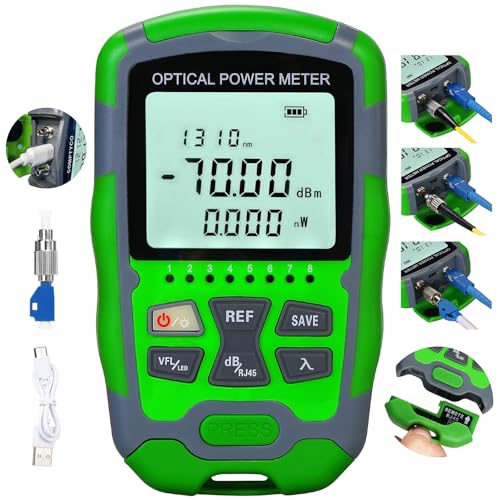
Best Rechargeable Multifunction Tester – 4-in-1 Optical Power Meter
For shoppers comparing fiber optic testers under 100, this rechargeable 4-in-1 model stands out for combining optical power measurement, VFL, RJ45 testing, and an LED flashlight. It covers 10 common wavelengths, supports several connector types with the included adapter, and stores up to 500 data groups.
Best For: Field technicians who want rechargeable power, broad connector compatibility, and measurement-data storage.
Pros:
- Measures -70 to +10 dBm across wavelengths from 850 to 1650 nm.
- Includes OPM, VFL, RJ45 tester, and LED flashlight functions.
- Built-in rechargeable lithium battery charges via USB-C.
- Offers ±0.2 dB stated measurement error and storage for 500 groups.
Cons:
- The notes do not specify the included adapter set beyond the FC-LC adapter.
- Its added functions may be unnecessary for buyers seeking only a basic VFL.
This is the most feature-rich option in the group for organized field work. Rechargeability, reference testing, manual calibration, and data storage make it particularly useful when readings need to be reviewed later.
Best Feature-Packed Compact Tester – M70-10 OPM and VFL
This M70-10 is a strong contender among fiber optic testers under 100 for users who want broad wavelength coverage in a pocket-sized tool. It combines optical power measurement, a 10 mW VFL, RJ45 wiring-sequence testing, and LED lighting, with a -70 to +10 dBm range.
Best For: Network and fiber technicians who want a compact tester with multiple troubleshooting functions and saved measurements.
Pros:
- Supports 10 standard wavelengths from 850 to 1650 nm.
- Provides OPM, 10 mW VFL, RJ45 testing, and LED lighting.
- Stores up to 500 sets of data and supports user calibration.
- Includes an FC-LC fiber optic adapter.
Cons:
- Requires two AAA batteries, which are not included.
- Uses disposable batteries rather than a built-in rechargeable battery.
The M70-10 offers a useful balance of coverage and portability. It is a practical alternative to the rechargeable model for users who prefer replaceable AAA batteries and still want data storage plus several built-in test functions.
Compact 4-in-1 Choice – Mini Optical Power Meter & VFL
For shoppers comparing fiber optic testers under 100, this compact 4-in-1 model combines optical power measurement, a visual fault locator, and network cable testing in a lightweight format. It supports multiple calibration wavelengths and offers both dBm and milliwatt measurements.
Best For: Fiber technicians and DIY users who want a small, battery-powered tester for basic optical and network checks.
Pros:
- Measures from -70 dBm to +6 dBm across an 800–1700 nm wavelength range.
- Includes a 650 nm visual fault locator with 2 mW output.
- Supports SC, FC, and ST connectors, with LC use through an adapter.
- Lightweight 200 g design uses two AA batteries.
Cons:
- LC connectivity requires a separate SC male-to-LC female connector.
- The notes do not specify network cable functions beyond the tester description.
This is a practical all-around option when portability matters and you need several basic testing functions in one device. Its broad wavelength support is useful for varied fiber-network work.
All-in-One Network Pick – Fiber Tester with OPM
Among fiber optic testers under 100, this all-in-one model stands out for combining optical power measurement with fiber identification, RJ45/RJ11 testing, cable continuity checks, wire mapping, and PoE detection. It is designed for installation and troubleshooting across fiber and copper networks.
Best For: Network installers, fiber technicians, and home users who need one tool for fiber and Ethernet cable diagnostics.
Pros:
- Measures optical signals at 850, 980, 1310, 1490, 1550, and 1625 nm.
- Offers constant-light, slow-flash, and fast-flash fiber testing modes.
- Tests RJ45/RJ11 and Cat5, Cat5e, and Cat6 cables for continuity and wiring issues.
- Includes FC, SC, and ST interfaces in a portable 4.8-ounce design.
Cons:
- Its operating temperature range is limited to 32–122°F.
- Requires a 9-volt power supply according to the listed specifications.
This is the most versatile choice of the three for mixed-network work. Choose it if copper-cable testing and fiber troubleshooting are equally important rather than buying a fiber-only tester.
Long-Range Fault Finder – 30–50 km VFL Pen
Visual Fault Locator, 30-50KM Fiber Optic Cable Tester Meter VFL Red Light Pen Light Source Testers
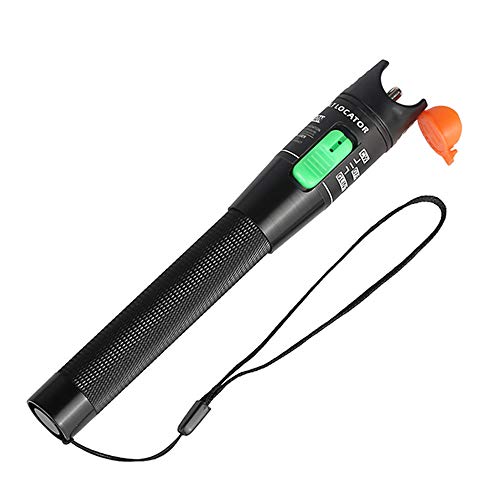
Check Price On AmazonIf you are shopping for fiber optic testers under 100 and mainly need to trace fibers or locate breaks, this visual fault locator keeps the job focused. Its red light output is rated for distances up to 30–50 km and is designed to reveal breaks, bends, poor connections, and cracks.
Best For: Field technicians who need a simple visual tool for fiber tracing, routing, continuity checks, and fault location.
Pros:
- Provides up to 30–50 km of detection distance with output power up to 5 mW.
- Supports constant output and includes a low-battery warning.
- Universal 2.5 mm connector works with ST, SC, FC, and LC interfaces.
- Compact 110 g design runs on two AA batteries.
Cons:
- It is a visual fault locator rather than an optical power meter.
- The listed output is Class IIIa, so appropriate handling is important.
- It does not provide the copper-network testing functions found on multifunction testers.
This pen-style tester is a good fit when fault tracing is your priority. It offers long-distance visual detection and broad connector compatibility, but buyers needing measured optical power should choose a meter-equipped model instead.
Budget Fault Finder – Moocci Visual Fault Locator
For shoppers comparing fiber optic testers under 100, the Moocci Visual Fault Locator is a focused option for tracing fibers and locating visible breaks, bends, poor connections, and cracking. Its 2.5mm universal connector supports FC, LC, SC, and ST interfaces, with an LC-to-FC adapter included in the kit.
Best For: Fiber tracing, continuity checks, and quick fault location when you do not need a full optical power meter.
Pros:
- Bright visual output helps identify breaks, bends, and connection problems.
- Supports common FC, LC, SC, and ST fiber interfaces.
- Stainless-steel head and aluminum body are designed for dust and impact resistance.
- Uses two AA batteries and includes low-battery warning functionality.
Cons:
- Focused on visual fault locating rather than broader multi-function testing.
- Requires AA batteries instead of a rechargeable battery.
This is a practical, straightforward choice for technicians who primarily need a durable visual fault locator for field maintenance and fiber identification.
Pocket 3-in-1 Tester – TM570 Fiber Optic Field Tester
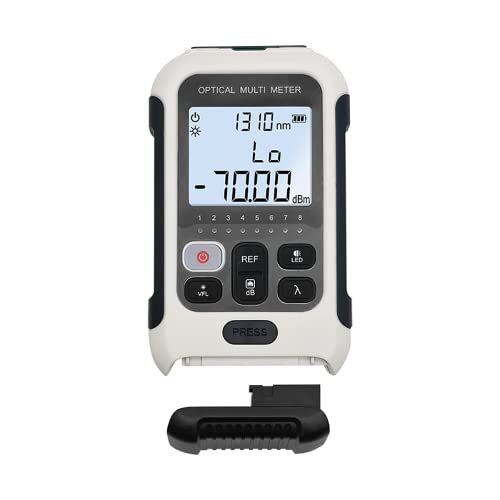
Among fiber optic testers under 100, the TM570 stands out as a compact combination tool with an optical power meter, visual fault locator, and RJ45 cable tester. It measures from -70 to +10 dBm across 10 wavelengths and adds a rechargeable battery for convenient field use.
Best For: FTTH installers and network technicians who want optical power measurement, fiber fault locating, and RJ45 continuity testing in one pocket-sized device.
Pros:
- Combines OPM, VFL, and RJ45 testing in one 130 g unit.
- Supports 10 wavelengths from 800 to 1700nm with stated ±0.2 dB accuracy.
- Rechargeable Li-ion battery, USB charging, and 10-minute auto power-off reduce battery upkeep.
- Backlit display and LED flashlight support work in low-light enclosures.
Cons:
- Its RJ45 tester is intended for continuity testing rather than broader network diagnostics.
- The universal 2.5mm interface is specified for FC, SC, and ST connectors.
The TM570 offers a strong balance of portability and coverage for technicians who regularly switch between fiber measurements, visual fault checks, and copper cable continuity tests.
Feature-Rich 5-in-1 – Portable Fiber Optic Cable Tester
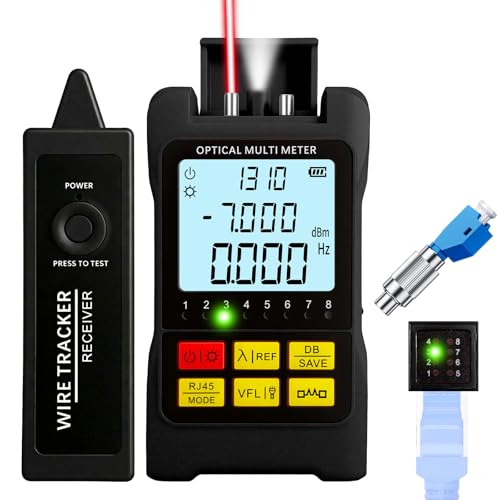
For buyers seeking fiber optic testers under 100 with broader diagnostic coverage, this portable 5-in-1 model combines an optical power meter, 15 km visual fault locator, cable finder, RJ45 tester, and flashlight. It supports 10 wavelengths, displays mW and dBm readings, and includes an LC adapter alongside FC, SC, and ST compatibility.
Best For: Field professionals who want power measurements, fiber fault locating, cable finding, and RJ45 testing in one portable tool.
Pros:
- Combines five functions, including a cable finder and LED flashlight.
- Measures -70 dBm to +10 dBm across 10 standard wavelengths.
- States ≤±0.2 dB deviation and supports both mW and dBm displays.
- Stores up to 500 records and offers adjustable backlight, calibration, and auto shutdown.
Cons:
- The supplied notes do not specify battery type or charging method.
- Its connector compatibility is listed as FC, SC, and ST with an LC adapter.
This model is the most feature-packed option in the group, making it appealing when record keeping and multi-purpose troubleshooting matter as much as basic fault detection.
How We Picked the Best Fiber Optic Testers Under 100
We focused on the functions that matter most during everyday fiber troubleshooting: optical power measurement, visual fault locating, connector compatibility, network cable testing, portability, and rechargeable operation. We also considered useful accessories, stated measurement ranges, supported interfaces, and whether a tester is designed for simple fault finding or broader installation work.
Because budget tools can vary in accuracy and included accessories, treat published specifications as a starting point and verify calibration requirements before relying on readings for critical network certification.
Quick Comparison
| Tester type | Best for | Typical strengths | Potential trade-off |
|---|---|---|---|
| Optical power meter | Signal and loss checks | Direct power readings and broad compatibility | May not identify the exact fault location |
| Visual fault locator | Breaks, bends, and connector faults | Simple red-light troubleshooting | Less useful for quantitative loss measurements |
| 3-in-1 or 4-in-1 tester | General field work | Combines power, VFL, and cable functions | Individual functions may be less specialized |
| 5-in-1 tester | Multi-purpose installation kits | Broadest feature set and cable-finding tools | More controls, bulk, and battery dependence |
Key Buying Factors for Fiber Optic Testers Under 100
Testing Functions
Choose an optical power meter when you need measured signal levels or basic insertion-loss checks. Add a visual fault locator if you regularly trace breaks, sharp bends, poor splices, or connector problems. RJ45 testing is useful for technicians who work on both fiber and copper networks.
Measurement Range and Accuracy
Many affordable meters advertise ranges around -70 to +10 dBm, but range is not the same as accuracy. Check supported wavelengths, display resolution, calibration information, and whether the meter is suitable for your source and fiber type.
Connector Support
FC, SC, and ST interfaces are common on budget testers, while LC connections often require an adapter. Confirm the included adapter type before buying, especially if your network uses compact LC patch panels or transceivers.
VFL Distance and Visibility
A stated 30- to 50-kilometer VFL range can be helpful on clear, compatible fiber, but real-world visibility depends on cable condition, bends, connectors, and ambient light. A stronger VFL is useful for field tracing, not a replacement for power-loss testing.
Power, Durability, and Ease of Use
Rechargeable models reduce battery costs, while replaceable batteries may be more convenient for emergency work. Look for protective caps, a readable display, simple controls, auto power-off, and a rugged case if the tool will travel between sites.
Who Should Buy Which Fiber Optic Testers Under 100?
Choose a VFL-focused tester for occasional fault tracing and connector checks. Choose an optical power meter when signal readings and basic link verification are your priority. Choose a 3-in-1 or 4-in-1 model for the best balance of capability and price when you install or maintain mixed fiber and network cabling. Choose a 5-in-1 model if you want one compact kit for power testing, visual fault locating, cable identification, and RJ45 checks.
For professional certification, high-volume deployment, or strict compliance documentation, consider a calibrated higher-end tester. For home labs, small installations, and routine troubleshooting, the best fiber optic testers under $100 can cover the essential checks without unnecessary complexity.