Adding an audio interface with ADAT expansion lets you increase microphone and line inputs without replacing your main recording setup. It is a practical route to tracking full bands, expanding a hybrid studio, or connecting dedicated preamps and converters.
These 10 options range from affordable eight-channel expanders to fully featured USB-C interfaces with built-in ADAT, premium conversion, and flexible routing. The right choice depends on your channel needs, workflow, and expansion plans.
Best 10 Audio Interface with Adat Expansion Picks for 2026
Best Value ADAT Expander

- Eight microphone preamp channels
- ADAT optical I/O
- 24-bit conversion at 44.1/48 kHz
Best For: Affordable eight-channel mic expansion
High-Resolution Input Expansion

- Eight-channel ADAT input expansion
- 24-bit/96 kHz support
- Rack ears and bundled software included
Best For: High-rate studio input expansion
Complete USB Hub with ADAT

- USB audio/MIDI interface with ADAT I/O
- Eight Midas-designed mic preamps
- 18x20 computer streaming
Best For: Expandable computer recording systems
Best ADAT Output Expander
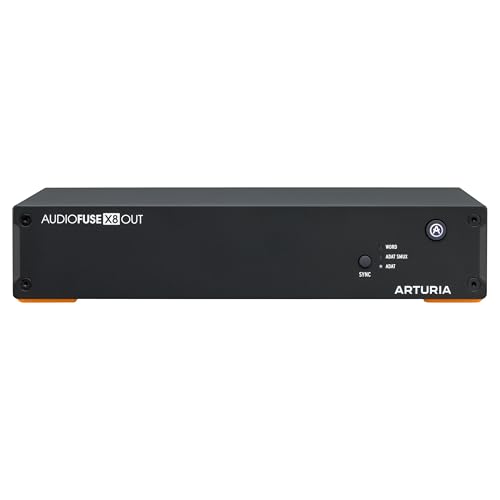
- Eight ADAT-to-analog outputs
- DC-coupled outputs for hardware
- 96 kHz conversion and world-clock input
Best For: Outboard gear and synthesizer routing
Premium Touchscreen Control

- 136 dB dynamic-range converters
- ADAT, AES67, USB, and MIDI connectivity
- DSP mixing with EQ, dynamics, and reverb
Best For: Premium studio monitoring and expandable networked setups
Professional Eight-Preamp Expansion

- Eight Clarett+ mic preamps
- Eight-channel ADAT optical expansion
- 18-in/20-out USB-C connectivity
Best For: Multitrack recording and growing project studios
Modern Workflow and Dual ADAT
Focusrite Scarlett 18i20 4th Gen

- Eight preamps with 18-in/20-out I/O
- Dual ADAT, S/PDIF, MIDI, and Word Clock
- Auto Gain and Clip Safe tools
Best For: Expandable band-recording and rack-based studio systems
Versatile Studio Expansion

- Four Clarett+ mic preamps and two JFET inputs
- ADAT input adds eight digital channels
- 24-bit/192kHz support with dual headphone outputs
Best For: Growing studios needing four preamps and future ADAT expansion
All-in-One Connectivity

- 16 inputs and 16 outputs with ADAT and S/PDIF
- Includes MIDI, six line inputs, and two Hi-Z inputs
- Auto Gain and Clip Safe support efficient recording
Best For: Producers needing extensive I/O and digital studio integration
Compact Expandability

- Two Clarett+ preamps with Air mode and JFET inputs
- ADAT input supports eight additional digital channels
- USB-C bus-powered design with four balanced outputs
Best For: Small setups planning to expand beyond two analog preamps
Best Value ADAT Expander – Behringer ADA8200
Behringer ADA8200 Audiophile 8 In/8 Out ADAT Audio Interface with Midas Mic Preamplifiers
Check Price On AmazonThe Behringer ADA8200 is a practical, rack-mountable choice when you need an audio interface with ADAT expansion for adding eight microphone inputs and eight outputs to a compatible setup. Its Midas-designed preamps, 24-bit conversion, and 44.1/48 kHz operation suit straightforward multitrack recording and channel expansion.
Best For: Home studios and recording setups that need eight additional mic preamps over ADAT.
Pros:
- Provides eight microphone preamplifier channels.
- Includes eight-channel ADAT optical connectivity.
- Uses 24-bit AD/DA conversion at 44.1/48 kHz.
Cons:
- Maximum sample rate is limited to 48 kHz.
- Requires a separate compatible interface with ADAT connectivity.
The ADA8200 focuses on affordable channel expansion rather than high-rate conversion. It is a sensible fit when your existing interface supports ADAT and your priority is adding multiple microphone inputs economically.
High-Resolution Input Expansion – Arturia AudioFuse X8 IN
The Arturia AudioFuse X8 IN is an audio interface with ADAT expansion designed to add eight inputs to a compatible recording system. With 24-bit/96 kHz support, rack ears, bundled software, and Mac and Windows compatibility, it targets producers who want higher-rate digital expansion in a compact unit.
Best For: Producers needing eight-channel ADAT input expansion at sample rates up to 96 kHz.
Pros:
- Adds eight channels through ADAT connectivity.
- Supports 24-bit/96 kHz operation.
- Includes rack ears, bundled software, and an 8-in power supply.
Cons:
- Functions as an input expander rather than a complete computer audio interface.
- Requires an existing ADAT-equipped interface or system.
The AudioFuse X8 IN is a focused expansion solution for setups where eight additional inputs and 96 kHz capability matter. Its included rack hardware also makes it easier to integrate into a studio installation.
Complete USB Hub with ADAT – Behringer UMC1820
The Behringer UMC1820 combines a USB audio/MIDI interface with ADAT I/O, making it a strong starting point if you want an audio interface with ADAT expansion without buying a separate computer interface first. It offers eight Midas-designed mic preamps, 18×20 streaming, and support for common recording software.
Best For: Recording musicians who need a USB interface with built-in mic inputs and room to expand through ADAT.
Pros:
- Combines USB 2.0 audio/MIDI connectivity with ADAT I/O.
- Provides eight mic preamps with +48 V phantom power.
- Streams up to 18 inputs and 20 outputs to a computer.
- Works with popular DAWs including Pro Tools, Ableton Live, and Cubase.
Cons:
- The supplied details list a 48 kHz maximum sample rate despite describing 24-bit/96 kHz resolution.
- Its 18×20 routing capability may be more than a small setup requires.
The UMC1820 is the most self-contained option in this group. It can handle direct computer recording and provides ADAT I/O for future expansion, making it useful for growing microphone and instrument setups.
Best ADAT Output Expander – Arturia AudioFuse X8 OUT
The Arturia AudioFuse X8 OUT is an audio interface with ADAT expansion aimed at adding eight analog outputs to a compatible digital system. Its 24-bit Cirrus Logic converters, DC-coupled outputs, 96 kHz support, and world-clock input make it especially useful for routing audio to external hardware and synthesizers.
Best For: Producers and sound engineers who need eight high-quality analog outputs for outboard gear, effects, monitors, or synthesizers.
Pros:
- Converts eight ADAT channels to analog outputs.
- Provides eight DC-coupled outputs for hardware integration and control.
- Supports 24-bit conversion and sample rates up to 96 kHz.
- Includes world-clock input, front-panel controls, and visual VU meters.
Cons:
- It is an output expander, not a microphone-input interface.
- Requires an ADAT-equipped host system.
- Its half-rack format may require extra planning for installation.
The AudioFuse X8 OUT is the specialist choice for expanding analog routing rather than microphone capture. DC-coupled outputs and world-clock synchronization make it particularly adaptable for hybrid studios and hardware-heavy workflows.
Premium Touchscreen Control – Neumann MT 48 US
The Neumann MT 48 US is a premium USB-C audio interface with ADAT expansion connectivity, high-resolution conversion, and extensive monitoring control. Its touchscreen, DSP processing, AES67 support, and MIDI interface make it suited to detailed studio workflows.
Best For: Producers and engineers who want premium conversion, flexible monitoring, and a compact interface with ADAT and network-audio expansion.
Pros:
- Class-leading converters with a quoted 136 dB dynamic range.
- Two premium mic/line preamps plus two line/instrument inputs.
- ADAT, AES67, USB, and MIDI connectivity support varied studio setups.
- Built-in EQ, dynamics, reverb, four mixers, and talkback enhance monitoring flexibility.
Cons:
- Only two dedicated mic/line preamps are provided.
- Its premium feature set may be more than simple recording setups require.
The MT 48 US stands out when conversion quality and routing flexibility matter as much as basic input count. It is a particularly compelling choice for users planning to integrate ADAT expansion with advanced headphone and monitor control.
Professional Eight-Preamp Expansion – Focusrite Clarett+ 8Pre
The Focusrite Clarett+ 8Pre is a rack-style USB-C audio interface with ADAT expansion, eight Clarett+ preamps, and 18-in/20-out connectivity. It offers a practical foundation for recording multiple microphones while leaving room for compatible ADAT outboard equipment.
Best For: Home and project studios needing eight microphone preamps, substantial analog I/O, and a straightforward path to more digital inputs.
Pros:
- Eight Clarett+ preamps provide high headroom, low distortion, and low noise.
- ADAT optical input adds eight channels of digital expandability.
- Air circuitry is available on every preamp for added high-frequency character.
- Includes two headphone outputs, Focusrite Control, and a software bundle.
Cons:
- It is a relatively large 19-inch rack-format unit.
- ADAT expansion requires compatible external equipment, such as an OctoPre.
With eight preamps and a clearly defined ADAT expansion path, the Clarett+ 8Pre is a strong choice for tracking ensembles or larger sessions. Its balanced feature set favors users who need dependable multichannel recording rather than a minimal desktop interface.
Modern Workflow and Dual ADAT – Focusrite Scarlett 18i20 4th Gen
The Focusrite Scarlett 18i20 4th Gen combines eight mic preamps with dual ADAT, S/PDIF, MIDI, and Word Clock connections. As an audio interface with ADAT expansion, it is designed for larger recording rigs that also benefit from automatic gain tools and extensive I/O.
Best For: Engineers and producers building a flexible rack setup for bands, multiple instruments, or expanded digital and analog routing.
Pros:
- Offers 18 inputs and 20 outputs with eight mic preamps and eight line inputs.
- Dual ADAT supports substantial digital expansion alongside S/PDIF and Word Clock.
- 24-bit/192kHz converters are specified with a 122 dB dynamic range.
- Auto Gain, Clip Safe, Air modes, talkback, and bundled software support efficient sessions.
Cons:
- The extensive I/O may be unnecessary for small, two-channel setups.
- Expansion devices and additional cabling are needed to use the ADAT inputs.
The 4th-generation Scarlett 18i20 is the most expansion-focused option here, pairing eight preamps with dual ADAT and studio-oriented clocking connections. Its workflow features make it especially practical when fast setup and level management are important during busy sessions.
Versatile Studio Expansion – Clarett+ 4Pre
The Focusrite Clarett+ 4Pre is a strong choice for an audio interface with ADAT expansion when you need four quality microphone preamps plus room to add up to eight digital channels. Its Air mode, high-resolution converters, instrument inputs, and multiple outputs suit recording, mixing, and expanding a growing studio.
Best For: Home and project studios that need four preamps now and flexible ADAT expansion later.
Pros:
- Four Clarett+ preamps with low noise, low distortion, and substantial headroom.
- ADAT optical input provides eight channels of digital expandability.
- Includes two JFET instrument inputs, four balanced outputs, and dual headphone outputs.
- Supports up to 24-bit/192kHz recording and includes a software bundle.
Cons:
- ADAT expansion requires compatible external hardware.
- It may offer more connectivity than a small setup needs.
The 4Pre balances useful analog connectivity with substantial digital expansion. It is particularly appealing if you expect to add an ADAT-equipped preamp or converter without replacing your main interface.
All-in-One Connectivity – Scarlett 16i16 4th Gen
The Focusrite Scarlett 16i16 4th Gen is a flexible audio interface with ADAT expansion for producers who also need S/PDIF, MIDI, and extensive line connectivity. With 16 inputs and 16 outputs, it is built for larger routing needs while retaining USB-C computer connectivity and practical level-management tools.
Best For: Producers and project studios that need broad I/O, digital expansion, MIDI, and multiple routing options.
Pros:
- Offers 16 inputs and 16 outputs, including ADAT and S/PDIF.
- Includes two mic preamps, two Hi-Z inputs, and six line inputs.
- 24-bit/192kHz converters provide a stated 122dB dynamic range.
- Auto Gain and Clip Safe simplify level setting and help manage clipping.
Cons:
- Only two mic preamps are built in.
- The extensive I/O may be unnecessary for a simple recording setup.
The 16i16 stands out when connectivity and routing matter as much as preamp count. Its ADAT, S/PDIF, and MIDI support make it a practical centerpiece for a more interconnected production setup.
Compact Expandability – Clarett+ 2Pre
The Focusrite Clarett+ 2Pre is a compact audio interface with ADAT expansion for musicians who want two quality preamps today and up to eight additional digital channels later. It combines USB-C bus power, JFET instrument inputs, Air mode, and balanced outputs in a streamlined format.
Best For: Small studios and mobile-leaning setups that need two preamps with a clear path to more inputs.
Pros:
- Two Clarett+ preamps offer high headroom and low-noise recording.
- ADAT optical input supports eight channels of digital expansion.
- USB-C bus power can simplify smaller setups, with a stated 15W USB-C requirement.
- Includes JFET instrument inputs, four balanced outputs, and 24-bit/192kHz support.
Cons:
- It has fewer built-in mic preamps than the Clarett+ 4Pre.
- USB-C bus power requires a suitable 15W USB-C port.
- Adding eight ADAT channels requires separate compatible equipment.
The 2Pre is a sensible starting point for a smaller rig that may grow. Its two preamps cover basic recording, while the ADAT input provides a straightforward upgrade route without immediately paying for a larger analog front end.
How We Picked the Best Audio Interface with Adat Expansion
We compared these models by looking at their expansion capabilities, connection standards, input and output counts, preamp availability, monitoring and routing features, computer connectivity, and likely studio use. We also considered whether each product works best as a dedicated ADAT expander or as a complete recording interface with ADAT built in.
Compatibility matters. ADAT typically carries up to eight channels at standard sample rates over an optical connection, while higher sample rates can reduce the available channel count through S/MUX. Confirm that your primary interface has compatible optical inputs or outputs and supports the sample rate you plan to use.
Quick Comparison
| Best For | Recommended Options | Why Consider Them |
|---|---|---|
| Affordable eight-channel expansion | Behringer ADA8200, Arturia AudioFuse X8 IN | Add multiple mic or line inputs through ADAT. |
| All-in-one home studio setup | Focusrite Scarlett 18i20, Behringer UMC1820 | Combine USB recording, onboard I/O, and optical expansion. |
| Higher-end recording | Focusrite Clarett+ 8Pre, Neumann MT 48 | Premium conversion, monitoring, and broader studio connectivity. |
| Output expansion | Arturia AudioFuse X8 OUT | Add extra line outputs for monitors, hardware, or cue mixes. |
Key Buying Factors for an Audio Interface with Adat Expansion
Input and Output Requirements
Count the microphones, instruments, monitors, headphones, and hardware processors you need to connect at the same time. An eight-channel ADAT input expander is useful for drums or multiple preamps, while an output expander is better for surround-style monitoring, external effects, or several headphone and cue feeds.
ADAT Format and Sample Rate
Check whether the interface supports ADAT input, output, or both. At 44.1 and 48 kHz, one optical connection commonly carries eight channels. At 88.2 or 96 kHz, channel capacity may fall to four, so verify the manufacturer’s S/MUX implementation before buying.
Preamp Quality and Gain Range
If you will record microphones directly, compare preamp gain, noise performance, phantom power control, and instrument inputs. A dedicated expander with onboard preamps can be simpler than pairing a separate converter with external microphone hardware.
Software, Routing, and Monitoring
Low-latency monitoring, flexible mixer software, MIDI, loopback, and independent headphone mixes can matter as much as raw channel count. Also confirm USB-C compatibility and whether the interface works with your computer’s operating system.
Who Should Buy Which Audio Interface with Adat Expansion?
Choose the Behringer ADA8200 or Arturia AudioFuse X8 IN if you already own a main interface and mainly need more microphone or line inputs. The AudioFuse X8 OUT is the better fit when your priority is expanding analog outputs.
Choose the Scarlett 18i20 or UMC1820 for a versatile central interface with substantial onboard connectivity and room to grow. The Clarett+ models suit users who prioritize refined conversion and recording quality, with the 8Pre offering the most expansion-friendly capacity in that range.
The Scarlett 16i16 and Clarett+ 4Pre work well for smaller studios that need flexible I/O without a rack-sized setup, while the Clarett+ 2Pre suits compact systems. Choose the Neumann MT 48 if premium control, touchscreen workflow, networked audio features, and broad digital connectivity are central to your studio.