The best audio interfaces with better preamps give microphones more usable gain, lower noise, and a clearer path from performance to recording. The right model depends on how many sources you record, the microphones you use, and whether you need expansion or onboard processing.
We compare 10 strong options across compact two-input interfaces, flexible multichannel units, ADAT expanders, and premium studio-centered designs so you can choose confidently without paying for features you will not use.
Best 10 Audio Interfaces with Better Preamps Picks for 2026
Best Class-A Upgrade

- Two Class-A preamps based on Audient’s ASP8024 HE console
- USB-C connectivity with durable all-metal housing
- Two headphone outputs and monitor control features
Best For: Home recording with two premium microphone inputs
Best for Eight-Channel Expansion

- Eight Midas microphone preamplifiers
- ADAT optical output for system expansion
- 24-bit conversion at 44.1/48 kHz
Best For: Adding eight mic inputs to an ADAT-compatible setup
Best for Vintage Character

- Vintage mode draws on UA 610 preamp tones
- Built-in compressor is based on the 1176
- USB-C interface supports computer and mobile recording
Best For: Two-channel vocal, instrument, and streaming setups
Best Eight-Preamp Feature Set

- Eight ultra-linear preamps with 48V phantom power
- Claimed EIN as low as -130.5 dBu
- Dual headphone outputs and zero-latency monitoring
Best For: Multi-mic recording with flexible low-noise monitoring
Premium Expansion Pick

- Two low-noise Clarett+ preamps with substantial headroom
- Air mode, 192kHz conversion, and JFET instrument inputs
- ADAT input supports eight channels of digital expansion
Best For: Expanding home studios and detailed vocal or instrument recording
Compact Console-Style Pick

- Class A mic preamp based on Audient’s ASP8024 console
- USB-C connection and durable all-metal desktop housing
- Compact two-channel design with two headphone outputs
Best For: Solo recording, podcasting, and portable desktop setups
Easy-Recording Value Pick
Focusrite Scarlett 2i2 4th Gen

- Two 4th-generation mic preamps and Hi-Z instrument inputs
- Auto Gain and Clip Safe help protect important takes
- 120dB dynamic range, Air modes, and 192kHz operation
Best For: Beginners and small home studios recording vocals or guitar
Flexible Four-Channel Value
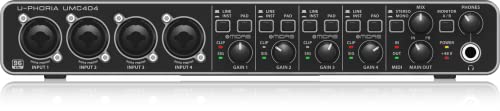
- Four Midas microphone preamps
- 4-in/4-out USB with MIDI I/O
- Up to 24-bit/192kHz recording
Best For: Home studios recording multiple microphones
Expandable Studio Hub
Focusrite Scarlett 16i16 4th Gen

- 69dB-gain fourth-generation preamps
- 16-in/16-out with ADAT and S/PDIF
- Auto Gain, Clip Safe, and Air modes
Best For: Expandable project studios and producers
Classic Preamp Modeling
Universal Audio Apollo Twin X Duo

- Unison models classic preamps and amps
- UAD-2 DUO near-zero-latency processing
- 24-bit/192kHz USB interface with plug-ins
Best For: Windows producers tracking through modeled studio gear
Best Class-A Upgrade – Audient iD14 MKII
For musicians comparing audio interfaces with better preamps, the Audient iD14 MKII is a strong desktop option. Its two Class-A microphone preamps are based on Audient’s high-end ASP8024 HE console, while USB-C connectivity and a durable all-metal enclosure make it practical for home recording.
Best For: Home recordists who need two high-quality microphone inputs in a compact interface.
Pros:
- Two Class-A microphone preamps based on Audient console technology
- USB-C connection supports convenient handling and power delivery
- All-metal desktop housing is stable and durable
- Includes two headphone outputs and monitor mix/panning functions
Cons:
- Provides only two microphone preamps
- Maximum sample rate is 96 kHz
The iD14 MKII focuses on preamp quality and straightforward desktop recording rather than a high input count. It is a sensible pick when clean, console-inspired front-end performance matters more than extensive expansion.
Best for Eight-Channel Expansion – Behringer ADA8200
Behringer ADA8200 Audiophile 8 In/8 Out ADAT Audio Interface with Midas Mic Preamplifiers
Check Price On AmazonThe Behringer ADA8200 is designed for expanding an existing recording setup with eight microphone channels. Its Midas microphone preamps, 24-bit conversion, and ADAT optical output make it useful when your main interface has compatible ADAT input.
Best For: Studios that need eight additional microphone preamps through an ADAT-equipped interface.
Pros:
- Eight Midas microphone preamplifiers
- Eight-channel input and output configuration
- ADAT optical output supports digital expansion
- 24-bit conversion at 44.1/48 kHz
Cons:
- Maximum sample rate is 48 kHz
- ADAT connectivity requires compatible equipment
- Does not function as a standalone USB interface according to the supplied specifications
The ADA8200 is less about portable USB recording and more about adding substantial input capacity. If your system supports ADAT and you need multiple microphone preamps, its eight-channel layout is the main attraction.
Best for Vintage Character – Universal Audio Volt 276
For creators seeking audio interfaces with better preamps and built-in recording character, the Universal Audio Volt 276 combines a Vintage mode inspired by UA 610 preamps with an analog compressor based on the 1176. Its two-channel USB-C design also supports computer and mobile recording.
Best For: Vocalists, instrumentalists, and streamers who want preamp color and simple two-channel recording.
Pros:
- Vintage mode is based on classic UA 610 preamps
- Built-in analog compressor is based on the 1176
- Supports Windows, macOS, iPad, and iPhone
- Supports recording up to 192 kHz
Cons:
- Only two input channels
- Mobile use may require an external power supply and Apple adapter
- One-year manufacturer warranty is listed in the supplied details
The Volt 276 is a feature-focused choice for users who want more than transparent gain. Its Vintage preamp mode and integrated compression can help shape vocals and instruments while keeping the recording workflow compact.
Best Eight-Preamp Feature Set – TOPPING E8x8 Pre
The TOPPING E8x8 Pre stands out among audio interfaces with better preamps by offering eight ultra-linear microphone preamp modules and a claimed EIN as low as -130.5 dBu. It also adds dual headphone outputs, zero-latency monitoring, and compatibility with Windows, Mac, iOS, and Android.
Best For: Multi-microphone sessions that require eight inputs, independent headphone monitoring, and low-noise operation.
Pros:
- Eight ultra-linear microphone preamps with 48V phantom power
- Claimed EIN as low as -130.5 dBu
- Dual independent headphone outputs with powerful headphone amplification
- Zero-latency monitoring and broad device compatibility
Cons:
- Supplied details list 96 kHz/24-bit operation for compatibility, despite a separate 192 kHz maximum-rate listing
- Its extensive eight-preamp design may be more than needed for simple two-channel recording
- Connectivity includes USB and AUX rather than a more broadly specified connection set
The E8x8 Pre is aimed at users who prioritize channel count, low-noise preamps, and monitoring flexibility. Its eight phantom-powered inputs make it especially suited to ensemble or multi-microphone recording setups.
Premium Expansion Pick – Focusrite Clarett+ 2Pre
For creators looking for audio interfaces with better preamps, the Focusrite Clarett+ 2Pre combines two professional-quality Clarett+ preamps with low noise, low distortion, and substantial headroom. Its Air mode, high-performance converters, and ADAT expansion make it a strong choice for more demanding recording setups.
Best For: Home studios, vocal recording, guitarists, and users who may need to expand their input count later.
Pros:
- Two Clarett+ preamps provide clear, powerful recordings with high headroom.
- All-analogue Air mode adds a high-frequency lift and classic ISA 110-inspired character.
- 24-bit/192kHz converters, JFET instrument inputs, and ADAT expansion support advanced setups.
- Improved headphone output and included software bundle add practical studio value.
Cons:
- Its broader feature set may be more than a basic two-input setup requires.
- USB-C bus power requires a 15W USB-C port.
The Clarett+ 2Pre is the most expansion-friendly option here. Choose it when preamp quality, converter performance, and future ADAT connectivity matter as much as straightforward recording.
Compact Console-Style Pick – Audient iD4 MKII
The Audient iD4 MKII is a compact option for shoppers seeking audio interfaces with better preamps without moving to a larger multi-input unit. Its Class A microphone preamp is based on Audient’s high-end ASP8024 console, while USB-C connectivity and a durable metal housing suit desktop and mobile recording.
Best For: Solo vocalists, singer-songwriters, podcasters, and compact home or mobile studios.
Pros:
- Class A console microphone preamp brings Audient’s console-based design to a compact interface.
- High-speed USB-C improves connection and power handling.
- All-metal housing offers stability and durability for travel.
- Compatible with Mac, PC, and iOS devices, with two headphone outputs.
Cons:
- Its two-channel design is less suitable for larger recording sessions.
- Maximum sample rate is 96kHz rather than 192kHz.
The iD4 MKII prioritizes a quality single-microphone preamp and a small footprint. It is a practical fit when you want console-inspired input quality for one main source rather than extensive I/O.
Easy-Recording Value Pick – Focusrite Scarlett 2i2 4th Gen
The Focusrite Scarlett 2i2 4th Gen is a straightforward choice for anyone comparing audio interfaces with better preamps and useful recording assistance. It offers two mic preamps, Hi-Z instrument inputs, a 120dB dynamic range, and tools such as Auto Gain and Clip Safe to help capture usable takes with less level-setting guesswork.
Best For: Beginners, singers, guitarists, and small home studios recording up to two sources at once.
Pros:
- Two 4th-generation mic preamps and two Hi-Z instrument inputs support common recording needs.
- 120dB dynamic range and 24-bit/192kHz operation provide capable technical specifications.
- Auto Gain and Clip Safe help reduce clipping and simplify recording setup.
- Air mode adds presence and harmonic drive to vocals and guitars.
Cons:
- Two inputs limit the interface to smaller recording sessions.
- Its convenience features may be unnecessary for users who prefer fully manual gain control.
The Scarlett 2i2 4th Gen is the accessible all-rounder in this group. Its combination of updated preamps, automatic level tools, Air modes, and bundled software makes it especially easy to start recording quickly.
Flexible Four-Channel Value – Behringer U-PHORIA UMC404HD
Behringer U-PHORIA UMC404HD 4x4 USB Audio Interface, 24-Bit/192kHz, with 4 Midas Mic Preamps
Check Price On AmazonFor home studios needing multiple inputs on a practical budget, the Behringer U-PHORIA UMC404HD is one of the more accessible audio interfaces with better preamps. It provides four Midas microphone preamps, four inputs and four outputs, plus MIDI I/O and support for recording at up to 24-bit/192kHz.
Best For: Home studios, small recording setups, and musicians who need four microphone inputs and MIDI connectivity.
Pros:
- Four Midas microphone preamps provide substantial input capacity.
- 4-in/4-out USB connectivity suits multi-microphone recording.
- Supports up to 24-bit/192kHz audio and includes MIDI I/O.
Cons:
- Its 2.7-pound, four-channel design is less suited to larger productions.
- The supplied notes do not specify advanced features such as onboard DSP or automatic gain control.
The UMC404HD is a sensible choice when channel count matters more than premium workflow features. Its four preamps and high-resolution recording support make it a capable foundation for bands, rehearsal recording, and expanding home studios.
Expandable Studio Hub – Focusrite Scarlett 16i16 4th Gen
The Focusrite Scarlett 16i16 4th Gen is aimed at producers who need more than a basic desktop interface. Its two mic preamps offer 69dB of gain, while ADAT, S/PDIF, MIDI, six line inputs, and 16-in/16-out operation make it a strong option among audio interfaces with better preamps for an expandable studio.
Best For: Producers and project studios that need broad routing, digital expansion, and reliable recording workflow tools.
Pros:
- Fourth-generation preamps provide up to 69dB of gain.
- Offers 16 inputs and 16 outputs with ADAT, S/PDIF, and MIDI I/O.
- Includes Air modes, Auto Gain, Clip Safe, and 24-bit/192kHz converters with 122dB dynamic range.
- Includes a substantial software bundle with recording tools, instruments, effects, and mastering software.
Cons:
- Only two mic preamps are built in, so additional microphone inputs require expansion or external gear.
- Its feature set and external power supply may be more than a simple recording setup needs.
The 16i16 prioritizes connectivity and control rather than a high built-in microphone count. For a producer planning to integrate line-level equipment or digital expansion, its routing options and gain-management features make it a versatile long-term choice.
Classic Preamp Modeling – Universal Audio Apollo Twin X Duo
The Universal Audio Apollo Twin X Duo USB Heritage Edition takes a different approach to audio interfaces with better preamps by pairing 24-bit/192kHz conversion with Unison preamp modeling and onboard UAD-2 DUO processing. It is designed for Windows users who want to track through modeled vintage preamps, compressors, EQs, tape machines, and guitar amps with near-zero latency.
Best For: Vocalists, guitarists, and producers who want modeled classic studio sounds while tracking through a compact desktop interface.
Pros:
- Unison technology models classic tube and transformer-based preamps, amps, and stompboxes.
- UAD-2 DUO processing supports near-zero-latency tracking through compatible plug-ins.
- Includes a built-in talkback microphone and Heritage Edition plug-in bundle.
- Provides 24-bit/192kHz conversion in a compact 2.4-pound design.
Cons:
- The supplied notes describe USB operation for Windows rather than broad platform compatibility.
- Its value depends heavily on wanting the included UAD processing and modeled sounds.
- The notes do not specify the number of microphone preamp inputs.
The Apollo Twin X Duo is best viewed as a sound-shaping and tracking system, not simply an input-count upgrade. Its Unison ecosystem and included plug-ins make it particularly appealing when the character of classic preamps is central to the recording process.
How We Picked the Best Audio Interfaces with Better Preamps
We focused on interfaces with microphone preamps that offer clean gain, practical headroom, and dependable performance for vocals, acoustic instruments, podcasts, and home-studio tracking. We also considered conversion quality, input and output counts, monitoring features, connection type, expansion, software ecosystems, and overall value.
The selection includes compact interfaces for solo creators, models with four or more mic inputs for small sessions, ADAT-compatible hardware for system expansion, and premium options with advanced routing or onboard processing. Published specifications matter, but useful workflow features—such as direct monitoring, monitor control, headphone outputs, and flexible software—can make an equally important difference.
Quick Comparison
- Best compact recording: Audient iD4 MKII or Focusrite Scarlett 2i2 4th Gen.
- Best two-preamp upgrade: Audient iD14 MKII or Focusrite Clarett+ 2Pre.
- Best four-input value: Behringer UMC404HD.
- Best eight-channel expansion: Behringer ADA8200 or TOPPING E8x8.
- Best premium ecosystem: Universal Audio Apollo Twin X Duo.
- Best hardware-inspired workflow: Universal Audio Volt 276.
Key Buying Factors for Audio Interfaces with Better Preamps
Preamp Gain and Noise
More gain is useful for low-output dynamic and ribbon microphones, but maximum gain alone does not define quality. Look for clean, quiet operation at the levels your microphones require. A broad gain range and sensible metering make setup easier, especially when recording quieter sources.
Input Count and Expansion
Two microphone inputs suit solo vocals, guitar, streaming, and overdubs. Choose four inputs for stereo instruments, multiple performers, or drum-related work. Eight-channel interfaces and ADAT units are better suited to larger tracking setups or expanding an existing interface.
Monitoring and Connectivity
USB-C is common, but connector type does not automatically determine sound quality. Prioritize stable drivers, low-latency monitoring, useful headphone outputs, monitor control, and the outputs required for speakers, mixers, or external hardware.
Extra Processing and Software
Some interfaces add compressors, modeled preamp sounds, or software effects. These can speed up tracking and monitoring, but they may increase cost and ecosystem lock-in. Buy them when the workflow benefit matters, not simply because the feature list is longer.
Who Should Buy Which Audio Interfaces with Better Preamps?
Solo musicians and creators should start with a compact two-input interface such as the iD4 MKII or Scarlett 2i2. Vocalists and instrumentalists seeking a stronger preamp-focused upgrade may prefer the iD14 MKII or Clarett+ 2Pre. Small bands and podcasters benefit from four mic inputs on the UMC404HD, while larger recording setups should consider the Scarlett 16i16, TOPPING E8x8, or an ADA8200-based expansion system.
Producers who value integrated effects and a polished monitoring workflow should look at the Volt 276 or Apollo Twin X Duo. Before buying, confirm computer compatibility, available USB ports, required software, and whether the interface supplies enough clean gain for your microphones. The best choice is the one that matches your current recording needs while leaving reasonable room to grow.