Sharing one audio source with several listeners is easier with the right headphone amplifier. These compact units can provide multiple headphone connections for studio monitoring, podcast production, rehearsals, teaching, or group listening.
Our 2026 roundup compares 10 headphone amplifiers with multiple outputs, including compact four-channel splitters, higher-output desktop models, and options with six or eight listening stations. Use the guide below to match channel count, connectivity, controls, and power requirements to your setup.
Best 10 Headphone Amplifier with Multiple Outputs Picks for 2026
Best for Studio Monitoring

- Four stereo headphone channels
- 130 mW per channel
- Monitor control and mute features
Best For: Home studios and shared control-room monitoring
Best for High-Power Headphones

- Up to 4600mW+4600mW balanced output
- 4.4mm and 3.5mm outputs
- 5V or 12V USB-C PD operation
Best For: Demanding headphones and flexible desktop setups
Best for Four-Way Personal Control
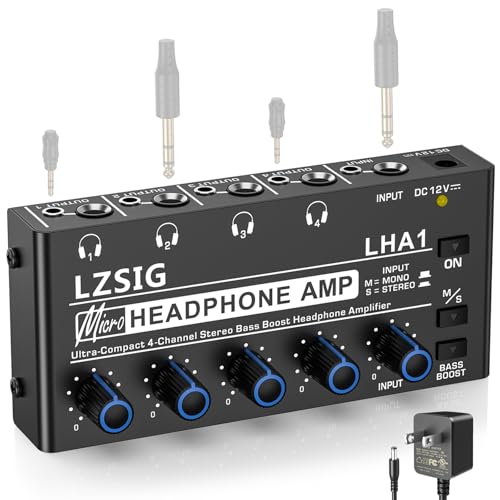
- Four independent volume controls
- 3.5mm and 6.35mm support
- Bass boost and stereo/mono switching
Best For: Shared monitoring with mixed headphone connectors
Best Plug-and-Play Splitter

- Four independent headphone outputs
- 1/4-inch or 1/8-inch source input
- Compact metal enclosure
Best For: Simple tracking sessions and rehearsal monitoring
Best Overall 6-Output Pick
LZSIG LHA2 6-Channel Headphone Amplifier

- Six independently controlled headphone outputs
- 3.5mm and 6.35mm headphone compatibility
- Bass boost and stereo/mono switching
Best For: Group monitoring in home studios, rehearsals, and stage setups
Best Compact 4-Output Option
Pyle PHA40 4-Channel Headphone Amplifier

- Four simultaneous headphone outputs
- Independent volume control per listener
- Compact design with 1/4-inch TRS connections
Best For: Small studios, stage monitoring, and portable setups
Best for Large Groups
LZSIG LHA3 8-Channel Headphone Amplifier

- Eight independently controlled headphone outputs
- 3.5mm and 6.35mm connector compatibility
- Bass boost and stereo/mono modes
Best For: Large recording sessions and shared monitoring for up to eight users
Compact 4-Channel Pick

- Four independently controlled headphone channels
- Compact metal enclosure with 1/4-inch connections
- Designed for 32–100Ω headphones
Best For: Small studios, rehearsals, and shared monitoring
High-Impedance Studio Pick
Fosi Audio PH05 5-Channel Headphone Amp

- Five independently amplified headphone outputs
- Supports 16–300Ω headphones and IEMs
- Includes master volume and one-touch mute
Best For: Studios, podcasts, classrooms, and larger monitoring groups
Portable Metal Value
4-Channel Stereo Headphone Amp

- Four 1/4-inch headphone outputs
- Individual volume control for every channel
- Compact metal body with included 12V adapter
Best For: Portable studio, rehearsal, podcast, and home audio setups
Best for Studio Monitoring – PreSonus HP4
The PreSonus HP4 is a practical choice when you need a headphone amplifier with multiple outputs for tracking, rehearsal, or control-room monitoring. Its four stereo channels provide substantial output power, individual level controls, and a compact metal chassis suited to desktop or rack setups.
Best For: Home studios, rehearsal spaces, and shared monitoring setups that need four 1/4-inch headphone connections.
Pros:
- Four stereo headphone amplifiers rated at 130 mW per channel
- Independent headphone level control for each listener
- Can function as control-room monitor control with monitor mute
- Balanced inputs and monitor outputs support studio integration
Cons:
- Uses 1/4-inch headphone connections rather than 3.5mm outputs
- Its studio-focused features may be more than needed for simple music sharing
The HP4 stands out for users who want both multi-person headphone monitoring and basic control-room functionality. Daisy-chainable monitor outputs and a low-noise design add flexibility for more developed studio systems.
Best for High-Power Headphones – FiiO JadeAudio GIGAS 1
The FiiO JadeAudio GIGAS 1 is a strong option if you want a headphone amplifier with multiple outputs that can handle demanding headphones. It combines a discrete Class AB design with 4.4mm balanced and 3.5mm single-ended outputs, plus flexible 5V or 12V USB-C PD power.
Best For: Desktop listeners using planar magnetic or high-impedance headphones alongside standard headphones, IEMs, or compatible gaming headsets.
Pros:
- Up to 4600mW+4600mW through the 4.4mm balanced output at 32 ohms
- Supports both 4.4mm balanced and 3.5mm single-ended headphones
- Dual gain modes help accommodate sensitive and power-hungry headphones
- Works with RCA and 3.5mm analog sources
Cons:
- It provides two headphone output formats rather than four simultaneously usable channels
- Higher output capability requires compatible 12V USB-C PD power
GIGAS 1 is better suited to power and connection flexibility than to group listening. Its 3.5mm microphone pass-through and broad source compatibility make it useful for desktop, mobile, and gaming-oriented setups.
Best for Four-Way Personal Control – LZSIG LHA2
The LZSIG LHA2 is designed for buyers seeking a headphone amplifier with multiple outputs and independent control for each listener. Its four-channel layout accepts 3.5mm or 6.35mm connections, supports headphones rated from 32 to 100 ohms, and adds a selectable bass-boost function.
Best For: Home studios, shared music listening, and stage or rehearsal setups where four people need separate volume control.
Pros:
- Four independent headphone outputs with separate level controls
- Accepts both 3.5mm and 6.35mm TS or TRS plugs
- Bass boost and stereo/mono switching add monitoring flexibility
- Metal chassis and heavy-duty knobs suit regular use
Cons:
- It is a headphone amplifier, not a mixer
- Its stated headphone support is focused on 32–100 ohm models
- Bass boost changes the sound rather than providing neutral-only monitoring
The LHA2 is a straightforward multi-listener solution when individual volume adjustment matters. Its dual connector compatibility is particularly convenient for mixed headphone collections, while the compact metal build is suitable for desk or portable session use.
Best Plug-and-Play Splitter – Mackie HM-4
The Mackie HM-4 keeps multi-person monitoring simple. This headphone amplifier with multiple outputs drives four headphones from a source with a 1/4-inch or 1/8-inch output, giving each listener an independent volume control in a compact metal enclosure.
Best For: Tracking sessions, rehearsals, and casual group listening where simple four-way distribution is the priority.
Pros:
- Four independent headphone outputs
- Individual level control for each listener
- Accepts 1/4-inch or 1/8-inch source outputs
- Compact design can be attached to a desk, rack, or stand
Cons:
- Its feature set is focused on splitting and volume control
- No additional tone-shaping or monitor-control functions are listed
The HM-4 is a good fit when you want an uncomplicated, compact distribution box rather than a feature-heavy studio amplifier. Its four outputs and per-listener controls cover the core needs of shared headphone monitoring.
Best Overall 6-Output Pick – LZSIG LHA2 6-Channel Headphone Amplifier
If you need a headphone amplifier with multiple outputs for shared monitoring, the LZSIG LHA2 provides six independently controlled headphone channels. It supports 3.5mm and 6.35mm connections, accepts stereo or mono input, and is designed for studio and stage use.
Best For: Home studios, rehearsals, and group listening where six users need separate volume control.
Pros:
- Six headphone outputs with independent level controls.
- Supports both 1/8-inch and 1/4-inch TS/TRS headphone connections.
- Bass-boost switch, stereo/mono mode, and ultra-low-noise circuitry.
- Solid metal chassis with durable control knobs.
Cons:
- Designed for headphones in the 32–100Ω range.
- Its six-channel capacity may be more than needed for smaller setups.
The LHA2 is a flexible choice when you want multiple headphone feeds without giving up individual volume adjustment. Its compact metal construction and broad connector compatibility make it practical for both fixed and mobile monitoring setups.
Best Compact 4-Output Option – Pyle PHA40 4-Channel Headphone Amplifier
For a portable headphone amplifier with multiple outputs, the Pyle PHA40 offers four simultaneous headphone connections in a compact enclosure. Each output has its own rotary volume control, making it useful when several listeners need to monitor the same mix at different levels.
Best For: Small recording setups, on-stage monitoring, and users who prioritize a compact four-channel design.
Pros:
- Powers up to four headphones at the same time.
- Independent volume controls for each channel.
- Four 1/4-inch stereo TRS outputs and a 1/4-inch TRS input.
- Compact design suited to studio or road use.
Cons:
- Uses 1/4-inch connections rather than offering 3.5mm outputs.
- Plastic enclosure may be less rugged than a metal-bodied alternative.
The PHA40 is a straightforward solution for four-person monitoring. Its limited connector selection is worth checking against your headphones and source equipment, but the independent controls and small footprint keep the setup simple.
Best for Large Groups – LZSIG LHA3 8-Channel Headphone Amplifier
The LZSIG LHA3 is a headphone amplifier with multiple outputs built for larger monitoring groups, providing eight independently adjustable channels. It accepts 3.5mm and 6.35mm connections and includes stereo/mono switching plus a bass-boost function.
Best For: Larger home studios, group recording sessions, and shared monitoring with up to eight headphone users.
Pros:
- Eight headphone outputs with individual level controls.
- Compatible with 3.5mm and 6.35mm TS/TRS plugs.
- Uses 11 low-noise ROHM operational amplifiers for low-noise operation.
- Metal chassis and heavy-duty knobs support regular use.
Cons:
- Its eight-channel capacity may be unnecessary for smaller teams.
- Intended for headphones in the 32–100Ω range.
With twice the output capacity of a basic four-channel unit, the LHA3 is suited to sessions where many performers or listeners need access to one source. Independent controls help each person set a comfortable monitoring level without changing the others.
Compact 4-Channel Pick – HA400 Headphone Amplifier
If you need a headphone amplifier with multiple outputs for basic studio monitoring, rehearsal, or shared listening, the HA400 provides four independently controlled channels in a compact metal enclosure. It uses a 1/4-inch TRS input and outputs and is designed for headphones in the 32–100Ω range.
Best For: Small studios, band practice, stage monitoring, karaoke, and portable setups needing four headphone connections.
Pros:
- Four headphone outputs with independent volume controls.
- Compact 90 × 55 × 40 mm metal design.
- Low-noise JRC4580 operational amplifier chip and included 12V adapter.
Cons:
- Uses 1/4-inch connections, so adapters may be needed for other headphone plug sizes.
- Its stated headphone range is narrower than models supporting high-impedance headphones up to 300Ω.
The HA400 is a straightforward choice when four listeners need separate volume adjustment and your headphones fit its supported impedance range. Its small footprint also makes it convenient for mobile or space-limited audio stations.
High-Impedance Studio Pick – Fosi Audio PH05 5-Channel Headphone Amp
The Fosi Audio PH05 is a headphone amplifier with multiple outputs built for larger monitoring groups. Its five independently amplified channels support headphones and IEMs from 16 to 300Ω, making it a flexible option for music production, podcasting, teaching, and shared listening.
Best For: Studios, podcast setups, classrooms, and users who need five headphone outputs with broad impedance compatibility.
Pros:
- Five stereo headphone channels, each with its own level control.
- Supports 16–300Ω headphones and provides up to 310mW per channel at 32Ω.
- Includes a master volume control, one-touch mute button, and 12V power adapter.
- Aluminum-alloy construction, anti-slip feet, and claimed 105dB SNR.
Cons:
- It is larger and heavier than ultra-compact four-channel designs, weighing 1.1 pounds.
- Its five-channel capacity may be unnecessary for smaller listening groups.
Choose the PH05 when channel count and headphone compatibility matter more than the smallest possible footprint. The independent controls and master mute are especially useful when several people are monitoring at different levels.
Portable Metal Value – 4-Channel Stereo Headphone Amp
This compact 4-channel unit is a practical headphone amplifier with multiple outputs for PC, guitar, studio, and stage use. One 1/4-inch TRS stereo input feeds four 1/4-inch outputs, and each listener gets an independent volume knob for group monitoring or audio sharing.
Best For: Home studios, podcast recording, band practice, karaoke, and small live or conference setups.
Pros:
- Four outputs allow simultaneous headphone listening from one source.
- Independent volume controls prevent one listener’s adjustment from affecting others.
- Compact 90 × 55 × 40 mm metal housing is easy to place or transport.
- Includes a 12V power adapter and low-noise JRC4580 amplifier chip.
Cons:
- Limited to 1/4-inch TRS input and output connections.
- Specified for headphones in the 32–100Ω range.
- The listed warranty is 30 days.
This model suits buyers who want a simple, portable four-person monitoring solution with individual volume control. It covers common studio and home applications without adding unnecessary controls or bulk.
How We Picked the Best Headphone Amplifier with Multiple Outputs
We focused on models that accept one audio source and distribute it to multiple headphones, making them useful for recording, monitoring, practice, and shared playback. We considered the number of outputs, output format, power design, portability, individual volume controls, bass-boost features, and suitability for common studio or home-audio setups.
Channel count was also important. Four outputs suit many small sessions, while five-, six-, and eight-channel models are better for larger groups. We included both established audio brands and straightforward budget amplifiers so shoppers can compare build quality, features, and capacity rather than choosing by price alone.
Quick Comparison
- Best for compact studio monitoring: PreSonus HP4 or Mackie HM-4.
- Best for high-power desktop listening: FiiO JadeAudio GIGAS 1.
- Best for larger groups: LZSIG six-channel or eight-channel models.
- Best for simple budget splitting: HA400 or a compact four-channel metal amplifier.
- Best for podcast and production teams: Fosi Audio PH05, with five output channels.
Key Buying Factors for a Headphone Amplifier with Multiple Outputs
Output Count and Layout
Choose a unit with more outputs than you need if your sessions may grow. Four outputs are convenient for most small rooms, but six or eight can reduce the need for additional splitters. Check whether outputs are 1/4-inch TRS, 3.5mm, 4.4mm balanced, or a combination that matches your headphones and adapters.
Volume Control and Monitoring Flexibility
Individual volume knobs let each listener set a comfortable level without changing everyone else’s mix. A shared volume control is simpler but less flexible. Bass boost can be useful for casual listening, though neutral monitoring is generally preferable when making recording or mixing decisions.
Power, Impedance, and Headroom
Active amplifiers require their included power supply and may differ substantially in available output power. For demanding or high-impedance headphones, prioritize a model with adequate headroom and clearly specified output capability. Do not assume that a larger channel count automatically means stronger amplification.
Inputs and Intended Use
Confirm whether the input accepts the connector from your interface, mixer, phone, computer, or playback device. Desktop studio amplifiers are usually best for permanent setups, while mini portable models work well for classrooms, rehearsals, and temporary monitoring stations.
Who Should Buy Which Headphone Amplifier with Multiple Outputs?
Choose a four-channel model if you record with a small group or need a simple shared-listening solution. A five-channel unit is a practical middle ground for podcasts and production teams. Select six or eight outputs when several performers or listeners need simultaneous access, especially if expanding later would be inconvenient.
For critical monitoring, favor established studio-oriented designs with separate level controls and predictable operation. For casual audio sharing, a basic metal mini amplifier may offer all the functionality required. Buyers using demanding headphones should prioritize output power and connector compatibility over channel count, while travelers and mobile users should look for compact construction and a manageable power setup.