The best wireless microphones make it easier to sing, present, record, or perform without managing a cable. This roundup compares 10 systems across handheld karaoke sets, creator-focused lavalier kits, and professional UHF setups.
Use the buying guide below to match microphone type, range, battery life, connectivity, and channel capacity to your setup and budget.
Best 10 Wireless Microphones Picks for 2026
Party-Ready Pick

- Two cardioid handheld mics for clearer vocals
- Up to 20 hours of playtime
- Works with all JBL PartyBox speakers
Best For: JBL PartyBox karaoke and parties
Compact Creator Pick

- 10-gram transmitters for discreet recording
- Up to 48 hours with the charging case
- Two noise-cancellation levels
Best For: Travel content, interviews, and livestreaming
Long-Range Karaoke Pick

- Dual handheld UHF microphone system
- Auto Scan and 200 selectable frequencies
- Up to 328 feet line of sight
Best For: Karaoke, events, churches, and DJ performances
Advanced Production Pick

- Supports up to four transmitters
- 32-bit float internal backup recording
- Adaptive gain and dual-band transmission
Best For: Podcasts, multi-person interviews, and video production
Best for PartyBox Karaoke
JBL Dual Wireless Microphone System
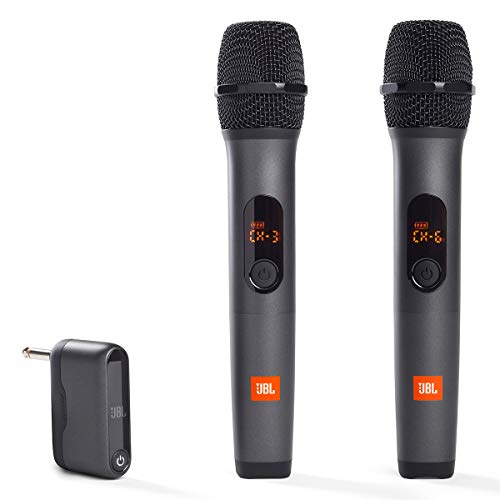
- Two microphones with a dual-channel receiver
- Clear JBL sound for karaoke and parties
- Plug-and-play setup for compatible PartyBox speakers
Best For: JBL PartyBox karaoke duets and casual events
Best for Content Creation

- Two lightweight transmitters for interviews and vlogs
- AI noise cancellation and voice tuning
- Up to 42 hours with the charging case
Best For: Mobile video creators and two-person interviews
Best for Stage Vocals
Shure BLX24/SM58 Wireless System

- SM58 handheld vocal microphone included
- Up to 300 feet of wireless range
- Up to 14 hours on two AA batteries
Best For: Live singers, presenters, and stage performances
Four-Channel Pro Pick
PTU-5000-4H Wireless Microphone System

- Four UHF channels with individual volume controls
- Cardioid handheld mics for clear vocal pickup
- Up to 260 feet of movement; includes eight AA batteries
Best For: Events needing four handheld microphones
Tunable Frequency Pick
PTU-52-2H Dual UHF Microphone System

- Thirty tunable frequency groups in the 500 MHz band
- Frequency hopping with automatic pairing
- Two XLR outputs plus a mixed 1/4-inch output
Best For: Performances and events needing flexible UHF coordination
Party-Ready Pick – JBL PartyBox Wireless Mic
If you want wireless microphones for karaoke, parties, or sing-alongs, the JBL PartyBox Wireless Mic set is a straightforward choice for JBL PartyBox owners. Its two handheld mics use cardioid pickup, built-in pop filters, and shock mounts to help deliver clear vocals while reducing handling and breathing noise.
Best For: JBL PartyBox users who want a simple two-microphone setup for karaoke and parties.
Pros:
- Compatible with all JBL PartyBox speakers, from the Encore to the Ultimate.
- Up to 20 hours of playtime, with continued use while charging.
- Stable 2.4GHz connection reaches up to 30 meters with the wireless dongle.
- Cardioid pickup, shock mounts, and a pop filter support cleaner vocals.
Cons:
- The longest stated battery life is reduced to up to 12 hours when using the digital wireless dongle.
- Designed specifically around JBL PartyBox speakers rather than a broad range of audio systems.
This is a convenient, party-focused package when compatibility with a JBL PartyBox is your priority. The rechargeable batteries and plug-and-play setup make it especially practical for extended events.
Compact Creator Pick – DJI Mic Mini
Among wireless microphones for creators, interviews, livestreams, and travel, the DJI Mic Mini stands out for its small 10-gram transmitters and charging case. The two-transmitter kit offers 48 kHz audio, selectable noise cancellation, automatic limiting, and a stated 400-meter maximum transmission range.
Best For: Content creators, interviewers, and livestreamers who need lightweight lavalier microphones with extended battery life.
Pros:
- Ultralight 10-gram transmitters are designed to be discreet and comfortable on camera.
- Charging case provides up to 48 hours of battery life.
- Offers Basic and Strong noise-cancellation levels for different environments.
- Includes two transmitters, one receiver, phone and camera cables, windscreens, and adapters.
Cons:
- Some direct-connection features depend on compatible DJI OsmoAudio devices.
- Its lavalier form factor is better suited to recording and streaming than handheld performance use.
The Mic Mini is a flexible, travel-friendly system for recording two voices. Its compact design and long case-assisted battery life make it a strong option for mobile production, while the included adapters support camera and USB-C phone workflows.
Long-Range Karaoke Pick – Phenyx Pro PTU-71-2H
For karaoke, public speaking, weddings, and DJ use, the Phenyx Pro PTU-71-2H provides two handheld UHF wireless microphones with a dual-channel receiver. Auto Scan selects a lower-interference frequency, while the cardioid dynamic capsules, selectable channels, and stated 290- to 328-foot line-of-sight range support dependable performance.
Best For: Karaoke hosts, churches, DJs, and event presenters who need two long-range handheld microphones.
Pros:
- Auto Scan helps identify frequencies with less interference.
- Two sets of 100 selectable UHF frequencies support multiset operation up to 16 transmitters.
- Cardioid pickup and tuned EQ aim for balanced vocals with ambient-noise rejection.
- Metal construction, mute controls, and replaceable microphone heads add practical durability.
Cons:
- It uses a receiver and audio connections rather than a compact plug-and-play creator setup.
- The stated operating range depends on line-of-sight conditions.
This system is built for venues and performances where handheld operation, frequency flexibility, and range matter more than portability. Its included receiver, antennas, cables, adapters, and batteries make it a complete starting package.
Advanced Production Pick – DJI Mic 3
For wireless microphones aimed at more demanding video and podcast workflows, the DJI Mic 3 combines two transmitters, a receiver, and a charging case with adaptive gain control and internal recording. It supports up to four transmitters, four-channel output, dual-band anti-interference, selectable voice tones, and two noise-cancellation levels.
Best For: Podcasters, filmmakers, interviewers, and creators recording multiple voices in changing environments.
Pros:
- Receiver can pair with up to four transmitters and sync audio to seven additional receivers.
- Adaptive gain control helps maintain consistent audio when voices vary in volume.
- Dual-file 32-bit float internal recording provides backup protection against clipping or missed takes.
- Charging case supports up to 28 hours of filming and includes USB-C phone connectivity.
Cons:
- Its advanced feature set may be more than needed for simple single-person recording.
- Direct DJI ecosystem connection requires compatible OsmoAudio devices for the listed receiver-free workflow.
The DJI Mic 3 is the most production-oriented option in this roundup. Its multi-transmitter support, backup recording, and gain management make it particularly useful for group conversations and unpredictable recording locations.
Best for PartyBox Karaoke – JBL Dual Wireless Microphone System
If you want a straightforward setup for karaoke, parties, or casual performances, this JBL system is one of the more approachable wireless microphones options. Its dual-channel receiver mixes two handheld microphones through a compatible JBL PartyBox speaker, while the plug-and-play design gets you started quickly.
Best For: Karaoke duets, parties, and JBL PartyBox owners who want two microphones in one system.
Pros:
- Includes two wireless microphones and a dual-channel receiver for singing together.
- JBL Original Pro Sound is designed to deliver clear vocals without noticeable delay or distortion.
- Simple setup: turn on the receiver and microphones, then connect to a compatible speaker.
- Up to six hours of playback, with replaceable AA batteries for the microphones.
Cons:
- Compatibility is centered on listed JBL PartyBox speakers.
- The receiver uses a rechargeable battery, while the microphones require replaceable AA batteries.
This is a practical choice when convenience and two-person karaoke matter more than advanced recording features. Check your PartyBox model before buying to confirm compatibility.
Best for Content Creation – Hollyland LARK A2 Mini Duo
For creators who need portable wireless microphones for interviews, vlogs, podcasts, or social videos, the Hollyland LARK A2 Mini Duo emphasizes clean speech and fast setup. The two transmitters, USB-C receiver, noise cancellation, and charging case make it suited to mobile recording.
Best For: Two-person interviews, vlogs, livestreams, and other smartphone or camera-based content.
Pros:
- Records 48kHz/24-bit audio and includes AI voice tuning for a more polished sound.
- Adjustable AI noise cancellation helps reduce background distractions.
- AI Auto-Limit and a -6dB safety track help protect recordings from sudden loud sounds.
- Each transmitter can run up to seven hours, while the charging case extends total battery life to 42 hours.
Cons:
- The included receiver uses USB-C, so device compatibility and adapters may matter.
- Its omnidirectional lavalier design may pick up more surrounding sound than a focused handheld microphone.
With lightweight 8.5g transmitters, pre-pairing, and claimed transmission up to 200m, this is a flexible kit for creators who value mobility and recording safeguards. It is less suited to traditional stage vocal use.
Best for Stage Vocals – Shure BLX24/SM58 Wireless System
If you need wireless microphones for live vocals, the Shure BLX24/SM58 combines a familiar handheld SM58 capsule with a single-channel UHF receiver. It offers a claimed 300-foot range, simple controls, and extended AA battery life for performances, presentations, and karaoke setups.
Best For: Singers, performers, presenters, and users who want a dependable handheld vocal microphone system.
Pros:
- Includes the established SM58 handheld vocal microphone capsule.
- Operates at up to 300 feet (100m), giving performers room to move.
- Up to 14 hours of operation from two AA batteries.
- Supports system expansion up to 12 channels per frequency band and includes a two-year limited warranty.
Cons:
- This package includes one microphone and a single-channel receiver.
- The H9 frequency band should be checked against local wireless-frequency requirements before purchase.
- It uses a traditional receiver and XLR connection rather than a compact USB-C recording setup.
The BLX24/SM58 is the strongest fit here for live vocal work, especially if you already trust the SM58 format. Confirm the selected frequency band works in your area before ordering.
Four-Channel Pro Pick – PTU-5000-4H Wireless Microphone System
For events that need several performers or speakers at once, the Phenyx Pro PTU-5000-4H is a four-channel wireless microphones system with UHF transmission, individual volume controls, and up to 260 feet of movement. Its cardioid handheld microphones are designed to deliver clear vocals while limiting unwanted noise.
Best For: Churches, weddings, conferences, karaoke, home parties, and small performances requiring four handheld microphones.
Pros:
- Four fixed UHF frequencies provide dedicated channels for simultaneous use.
- Cardioid dynamic cartridges help capture vocals and reject unwanted noise.
- Metal construction, four XLR outputs, and individual volume controls support regular event use.
- Memory settings, snap-on antennas, and included AA batteries simplify setup.
Cons:
- Fixed-frequency operation offers less flexibility than a tunable system.
- Requires an amplifier, speaker, mixer, or other compatible sound system for output.
- Not intended for multiset operation.
The PTU-5000-4H is a practical choice when four wireless microphones are more useful than advanced frequency coordination. It offers a straightforward, durable setup for fixed venues and event applications.
Rechargeable Karaoke Choice – K60-2 Dual Wireless Microphone Set
The Talomen K60-2 is a convenient dual wireless microphones set for karaoke and casual events. Its 2.4 GHz connection reaches up to 160 feet, while automatic matching, DSP noise reduction, and rechargeable USB-C batteries keep operation simple.
Best For: Karaoke, parties, speeches, weddings, and indoor or outdoor use with a compatible microphone input.
Pros:
- Two handheld microphones connect automatically to the receiver without manual pairing.
- Rechargeable batteries provide more than 10 hours of continuous use after a full charge.
- 2.4 GHz transmission offers up to 160 feet of range in suitable conditions.
- Includes a 6.35 mm-to-3.5 mm adapter for compatible microphone inputs.
Cons:
- Supports microphone inputs only and does not work with AUX or line inputs.
- Not compatible with mobile phones, computers, or tablets.
- Both the microphones and receiver need initial charging before use.
The K60-2 stands out for buyers who prioritize simple setup and rechargeable operation. Confirm that your speaker, amplifier, or karaoke machine has a compatible microphone jack before choosing it.
Tunable Frequency Pick – PTU-52-2H Dual UHF Microphone System
The Phenyx Pro PTU-52-2H is a flexible dual wireless microphones system for users who want more frequency control than a fixed-channel setup. It provides 30 tunable frequency groups in the 500 MHz band, frequency hopping, and up to 200 feet of open-space range.
Best For: Karaoke, live performances, church services, outdoor events, weddings, and public speaking with two microphones.
Pros:
- Thirty tunable frequency groups help manage interference and support frequency changes.
- Frequency hopping enables automatic pairing between the microphones and receiver.
- Cardioid capsules are designed for clean transmission with reduced hiss, feedback, and dropouts.
- Provides two XLR outputs and one mixed 1/4-inch output for flexible connections.
Cons:
- Its stated 200-foot operating distance applies to open-space, line-of-sight conditions.
- Uses AA batteries rather than a rechargeable battery system.
- It is a two-microphone system, so larger events may require additional equipment.
Choose the PTU-52-2H when adjustable UHF frequencies and multiple output options matter. Its durable metal construction and frequency controls make it a strong fit for recurring performances and event setups.
How We Picked the Best Wireless Microphones
We selected these Wireless Microphones to cover the main use cases: karaoke and parties, mobile video, presentations, rehearsals, live vocals, and multi-microphone events. We compared the listed specifications and considered microphone format, wireless technology, receiver design, battery approach, operating range, channel capacity, and ease of setup.
Because performance depends on room layout, interference, speaker placement, and the connected sound system, published range and battery figures should be treated as ideal-use estimates rather than guarantees. Compatibility with your mixer, powered speaker, camera, phone, or computer is equally important.
Quick Comparison
| Best For | Recommended Type | What to Prioritize |
|---|---|---|
| Karaoke and parties | Dual handheld system | Simple pairing, rechargeable batteries, clear vocal pickup |
| Video and mobile content | Compact transmitter-and-receiver kit | Low weight, noise reduction, device compatibility |
| Solo live vocals | UHF handheld system | Reliable range, feedback control, microphone quality |
| Events with several performers | Multi-channel UHF system | Independent channels, frequency management, scalable setup |
Key Buying Factors for Wireless Microphones
Microphone and Receiver Format
Handheld systems suit singers, presenters, and karaoke users who want a familiar vocal microphone. Clip-on or compact transmitter kits are better for hands-free video, interviews, and demonstrations. Check the receiver connection before buying: 3.5mm, USB-C, Lightning, XLR, and 1/4-inch outputs are not interchangeable without the appropriate adapter or interface.
Wireless Technology and Interference
Many creator kits use compact digital wireless links, while traditional stage systems commonly use UHF. Digital systems can be convenient and portable; UHF systems often offer flexible frequency selection and are widely used with live sound equipment. In either case, crowded wireless environments can affect reliability, so tunable frequencies, scanning, and clear channel planning are valuable.
Range, Battery Life, and Charging
Choose a system with more range than your typical venue requires, especially when performers move away from the receiver. Rechargeable models reduce battery costs and simplify travel, but check charging time and whether spare batteries or transmitters can be used during a long event.
Sound Quality and Controls
Look for a microphone suited to your voice and environment, plus practical controls such as mute, gain, volume, and noise reduction. A strong signal cannot compensate for poor speaker placement or excessive gain, so allow time to test levels and prevent feedback.
Who Should Buy Which Wireless Microphones?
Choose a dual handheld set for karaoke nights, parties, classrooms, and casual announcements. Choose a compact digital kit for creators, interviews, travel, and phone or camera recording. Choose a UHF single-channel system when vocal consistency and established live-sound compatibility matter. Choose a multi-channel UHF system for bands, venues, productions, or events requiring several microphones at once.
Before ordering, confirm the number of microphones included, receiver outputs, supported frequencies, local wireless regulations, and whether your existing speaker or mixer accepts the signal. Those checks help ensure the system works immediately instead of requiring extra adapters or replacement equipment.