Shopping for a curious maker? These Christmas electronics kit gifts span soldering practice, STEM builds, circuit prototyping, and useful testing tools.
Choose a project that fits the recipient’s experience and interests, and check the listed price before buying to confirm it stays within your budget.
11 Christmas Electronics Kit Gift Ideas Under $50 to Consider in 2026
Temperature-Control Soldering
Aucanla 100W Soldering Iron Kit

- Digital display and adjustable temperature from 356°F to 896°F.
- Includes a stand, brass wool, sponge, three tips, solder wire, and protective sleeve.
- Portable kit for wire soldering and other electronics projects.
Best For: Adult hobbyists and teens who can use it with supervision.
Circuit Troubleshooting Set

- Combines a multimeter, non-contact voltage tester, and GFCI outlet tester.
- Includes test leads, batteries, and a carrying case.
- Useful for checking circuits, batteries, outlets, and voltage.
Best For: Makers and students who want to troubleshoot circuits.
Microcontroller Starter Set
Freenove Raspberry Pi Pico 2 W Starter Kit

- Includes a Raspberry Pi Pico 2 W board and 142 components and accessories.
- Explore 55 projects with step-by-step instructions and wiring diagrams.
- Tutorial materials include code examples in MicroPython and C.
Best For: Tinkerers and beginner coders interested in hands-on projects.
Solar STEM Building Set

- Build a solar-powered car and fan, a wind-powered car, and a wooden plane.
- Includes a screwdriver and assembly instructions; no welding is needed.
- Designed for kids ages 8–12 and family or classroom activities.
Best For: Kids ages 8–12 who enjoy building and science activities.
Solder-Free Circuit Prototyping
BOJACK Breadboard and Jumper Wire Kit

- Includes three breadboards with different tie-point counts and 126 jumper wires.
- Prototype and test circuit designs without soldering.
- Breadboards can be spliced together for different layouts.
Best For: Students and makers assembling simple circuits.
Colorful LED Build
iCubeSmart 8×8×8 LED Cube DIY Kit

- Assemble a 3D cube using 512 red, green, and blue LEDs.
- The board includes more than 20 animation effects and a microphone for audio spectrum mode.
- Requires soldering the LEDs; recommended for ages 12 and up.
Best For: Teens and adults with some soldering ability who enjoy visual builds.
Electronics Parts Assortment
1,900-Piece Electronic Component Kit

- Assortment includes resistors, capacitors, transistors, diodes, LEDs, and more.
- Components are sorted by type in a box, with each type packaged separately.
- A handy supply for building and experimenting with circuits.
Best For: Makers who already have a breadboard or microcontroller.
Digital Signal Debugging
8-Channel USB Logic Analyzer Kit

- Captures digital signals across eight channels at up to 24 MHz.
- Includes breakout and breadboard adapter boards for flexible connections.
- USB-A and USB-C cables support Windows, Mac, and Linux.
Best For: Intermediate makers learning to debug digital electronics.
Spinning LED Circuit Project
2-Pack LED Circuit Soldering Kit

- Build two small circuit boards using CD4017 and NE555 chips.
- When assembled and powered, the LEDs spin like a car wheel.
- Marked boards and video guides support beginner practice.
Best For: Beginners who enjoy colorful electronics projects and soldering practice.
DIY Lo-Fi Synth Build
4093 Chaos NAND Handheld Synth Kit

- Build a portable drone oscillator synthesizer with three NAND oscillators.
- Volume control and switches shape its sounds and effects.
- Beginner-level kit with a 9V battery connector.
Best For: Music lovers and creative electronics hobbyists.
Build-Your-Own Audio Kit
DIY Stereo Speaker Soldering Practice Kit
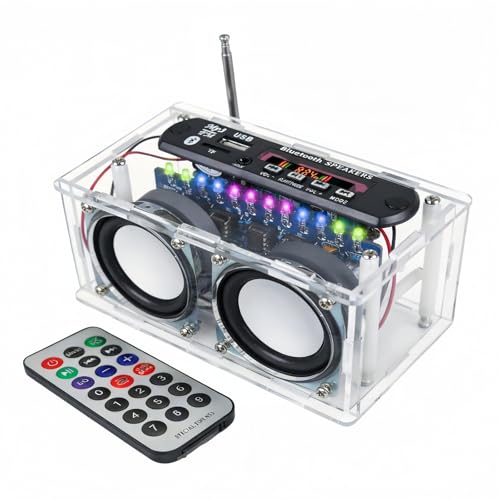
- Assemble a speaker project with USB player and FM receiver functions.
- Includes the PCB, components, enclosure, and assembly instructions.
- Offers hands-on practice with soldering and component assembly.
Best For: Teens with adult supervision and electronics hobbyists.
Christmas Electronics Kit Gift Ideas Under $50: How to Choose
Christmas electronics kit gift ideas under $50 can suit a range of interests, from a child’s first science build to an experienced hobbyist’s circuit experiments. Start with the recipient’s age, experience, and preferred way to learn. Some gifts focus on assembling a finished project, while others provide tools or components for ongoing experimentation.
Match the Project to Experience
For a younger beginner, look for an activity with clear instructions and a defined result. The solar STEM set is described for ages 8–12 and includes several model builds that do not require welding. For someone learning to solder, the two-board lucky wheel set is explicitly intended for practice, while the LED cube requires soldering ability and is described as unsuitable for children under 12. These details help you choose a project that feels engaging without setting the recipient up for a frustrating first build.
More experienced makers may appreciate a starter kit that supports multiple projects. The Raspberry Pi Pico 2 W set includes components and a tutorial covering projects in MicroPython and C. A breadboard assortment supports temporary circuit prototypes, while a component assortment offers parts such as resistors, LEDs, capacitors, and transistors. Think about whether the recipient prefers guided builds, open-ended experimentation, or tools for diagnosing and refining circuits.
Consider the Space and Equipment Needed
Check what the project involves before choosing. Soldering kits need a suitable work area and careful handling; some products include a soldering iron or accessories, while others are practice boards that require a separate iron. A solderless breadboard set offers a way to connect many components without soldering. For any soldering gift, consider whether the recipient has appropriate workspace, supervision if needed, and the confidence to follow the instructions safely.
Budget Considerations for Electronics Gifts
A $50 ceiling can encourage a practical choice, but do not rely on a product category or title to confirm the current price. Check the listing at the time you shop and make sure the complete gift remains strictly below $50. Product prices can change, and the selected items’ prices are not provided here.
Also consider whether a kit appears complete for its intended use. The multimeter kit lists a meter, voltage tester, outlet tester, leads, batteries, manual, and case. By contrast, the LED cube is powered by a USB connection, and the product details say the user solders the LEDs onto a prepared main board. Checking included components and stated requirements can help avoid an unexpected add-on that pushes the total over budget.
Personalization Tips for a Thoughtful Christmas Gift
Personalize the choice around what the recipient likes to make. A child who enjoys building models may prefer a solar-powered car or fan. Someone fascinated by lights could enjoy assembling a cube with dynamic lighting effects. A music-minded electronics hobbyist might find the handheld oscillator or stereo speaker project more appealing, while a troubleshooting enthusiast may value a digital multimeter or logic analyzer.
You can also make the gift feel personal with a short note about why you chose that style of project: a first introduction to circuits, a new soldering challenge, or supplies for independent experiments. Keep the message grounded in the recipient’s interests and the kit’s stated purpose rather than promising results that depend on skill or setup.
Last-Minute Buying Advice
When time is short, verify the current price, product details, and delivery estimate shown by the retailer before placing an order. Delivery dates and availability can vary, so check the listing for the destination and timing that matter to you. If the item is intended for a child, confirm the age guidance and whether adult help may be appropriate for the build.
Finally, scan the product description for project requirements, power connections, included instructions, and any components that may be needed separately. A well-matched electronics gift gives the recipient a clear next step: build, test, learn, and keep experimenting throughout the Christmas season and beyond.