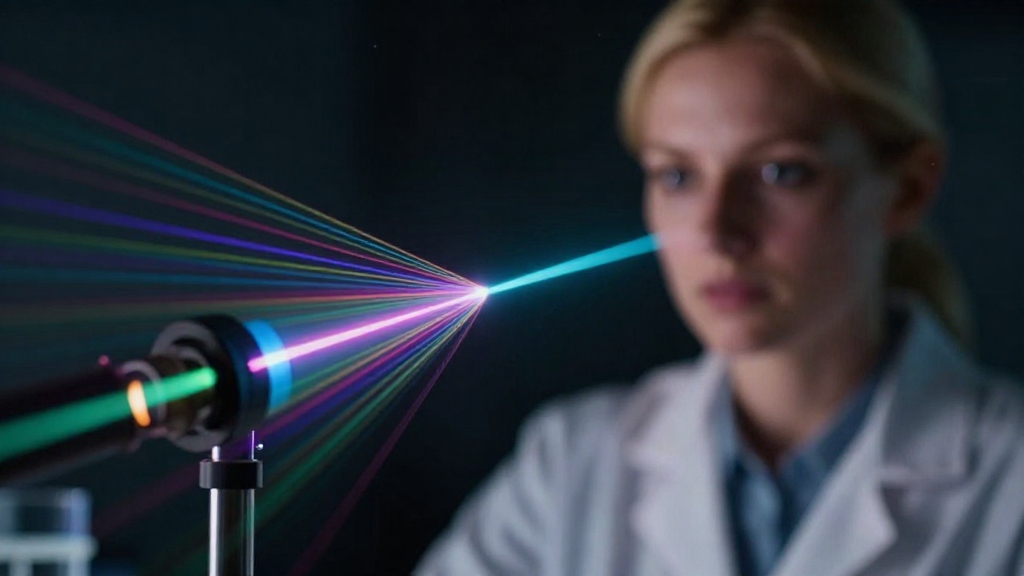
Beam diffraction refers to the phenomenon that occurs when a beam of light or other waves encounters an obstacle or aperture that disrupts the uniform flow of the wavefront.
Understanding beam diffraction is essential in a variety of fields, including optics, acoustics, and even quantum physics.
How Does Beam Diffraction Work?
Beam diffraction occurs due to the wave nature of light. When a beam encounters an obstacle, its waves can spread out, bend around the obstacle, and create patterns known as diffraction patterns.
Key Factors Affecting Beam Diffraction:
-
Wavelength: The size of the wavelength plays a crucial role.
– Longer wavelengths typically result in more noticeable diffraction.
– Conversely, shorter wavelengths tend to diffract less. -
Size of the Aperture or Obstacle:
– If the size of the aperture is comparable to the wavelength, significant diffraction will occur.
– A larger aperture relative to the wavelength results in minimal diffraction. -
Shape of the Obstacle or Aperture:
– Different shapes can affect the resulting diffraction patterns, leading to various interference effects. -
Propagation Medium:
– The environment through which the beam is traveling can also influence diffraction behavior.
Understanding these factors helps physicists and engineers design better optical systems, lasers, and communication devices.
What Are the Applications of Beam Diffraction?
Beam diffraction has a wide range of applications across numerous scientific and engineering fields. Here are some prominent areas where beam diffraction plays a crucial role:
1. Optical Instruments:
- Telescopes often rely on diffraction patterns to gather light from distant stars.
- Microscopes use beam diffraction to enhance image resolution, allowing scientists to view tiny structures.
2. Laser Technology:
- Lasers can be fine-tuned to take advantage of diffraction patterns to achieve higher accuracy in various applications such as cutting and surgery.
3. Telecommunications:
- Beam diffraction informs the design of antennas and communication systems.
- The understanding of diffraction can enhance signal reception and transmission.
4. Astronomy:
- In astronomy, understanding beam diffraction is crucial for interpreting light from celestial bodies.
- It helps astronomers discern details that would otherwise be lost in the vastness of space.
5. Acoustic Applications:
- Beam diffraction is not limited to light; it also applies to sound waves.
- Technologies such as sonar utilize diffraction principles to detect objects underwater.
Why Is Beam Diffraction Important in Research?
Beam diffraction is not just an academic concept but a fundamental principle in various types of research. Here’s why understanding it matters:
1. Material Analysis:
- Researchers can study the structure of materials by analyzing the diffraction patterns produced when beams interact with them.
- X-ray diffraction is a prime example used to determine crystal structures.
2. Nanotechnology:
- In nanotechnology, beam diffraction assists scientists in manipulating light at the nanoscale, enabling the development of advanced materials and devices.
3. Quantum Mechanics:
- The principles of beam diffraction even touch on quantum theories, where wave-particle duality is crucial in understanding phenomena at the atomic and subatomic levels.
4. Medical Imaging:
- Technologies like computed tomography (CT) scans utilize diffraction to produce detailed images of the inside of the human body.
What Are the Main Types of Beam Diffraction?
When discussing beam diffraction, it’s essential to recognize its various forms. The two primary types include:
1. Fresnel Diffraction:
- Description: Occurs when the source and the observation point are at finite distances and can be described by the Fresnel approximation.
- Characteristics: Usually observed in cases involving large apertures or obstacles.
2. Fraunhofer Diffraction:
- Description: Takes place when both the source and observation point are far enough away that the wavefront can be considered plane waves.
- Characteristics: Simpler geometry for analysis, often used in optical devices like gratings and lenses.
Differences Between Fresnel and Fraunhofer Diffraction:
| Criteria | Fresnel Diffraction | Fraunhofer Diffraction |
|---|---|---|
| Distance to Source | Finite distance | Infinite distance |
| Wavefront Type | Curved | Plane |
| Complexity | More complex patterns | Simpler patterns |
How Can You Observe Beam Diffraction?
Observing beam diffraction can be a captivating experiment, and it often requires basic equipment. Here’s how you can do it:
Required Materials:
- Light Source: A laser pointer or a monochromatic light source.
- Aperture/Obstacle: Slits (single or double), a CD or DVD, or any small object.
- Screen: A piece of paper or a wall to capture the diffraction pattern.
Steps to Observe Beam Diffraction:
- Set Up: Position the light source so that it shines onto the aperture or obstacle.
- Align the Screen: Place the screen a few feet away from the aperture.
- Lighting Conditions: Conduct the experiment in a dark or dimly lit room for better visibility.
- Observe the Pattern: Watch the screen and take note of the patterns formed as the beam interacts with the object.
Conclusion: Embracing the Science of Beam Diffraction
Beam diffraction is more than a mere scientific curiosity; it plays a pivotal role in various technologies we use daily.
From enhancing communication systems to aiding in medical imaging, the impact of beam diffraction is indisputable.
By understanding the principles of beam diffraction, you can gain insights into a wide array of scientific phenomena.
Embracing this knowledge can lead to advancements in research and technology that will shape the future.
By exploring the intricate dance of beams as they encounter obstacles, we unlock a world of possibilities that extends far beyond simple diffraction patterns.
With this foundational understanding of beam diffraction, you are now equipped to dive deeper into the fascinating world of waves and light!