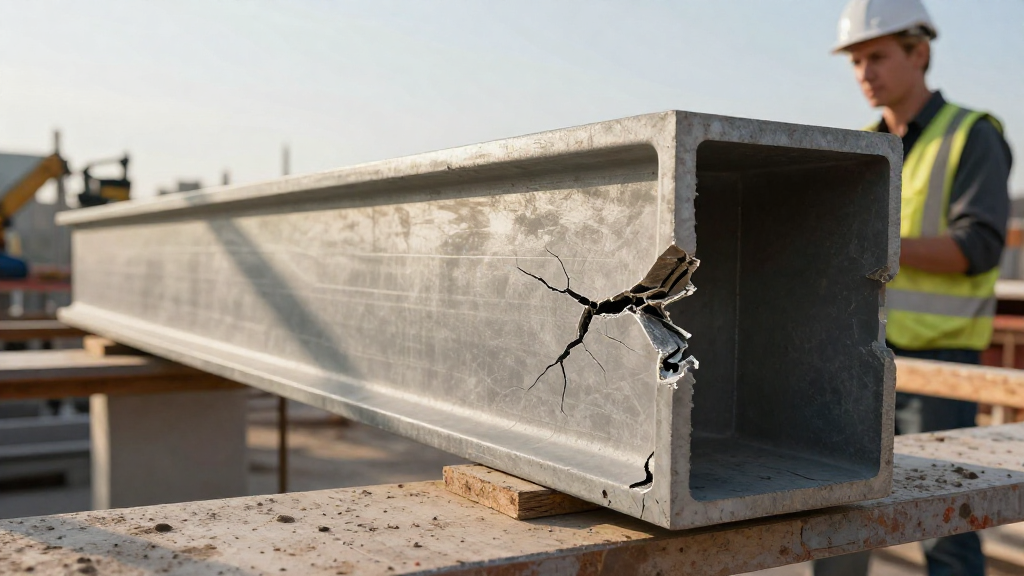
In engineering and construction, understanding the various beam failure modes is crucial in ensuring the stability and longevity of structures.
What Are Beam Failure Modes?
Beam failure modes refer to the different ways in which beams can fail under load.
These failures can significantly impact the overall performance and integrity of a structure.
In civil engineering, beams are critical structural elements designed to support loads, and understanding how they fail can help engineers design safer, more robust structures.
Here are some of the most common beam failure modes:
- Bending Failure
- Shear Failure
- Buckling
- Tension Splitting
- Fatigue Failure
How Does Bending Failure Occur?
Bending failure occurs when a beam is subjected to a moment or load that exceeds its bending strength.
This is one of the most common beam failure modes in structural engineering.
When a beam bends, it develops internal stresses which can lead to:
- Tensile stress on one side
- Compressive stress on the other side
When the applied moment surpasses the beam’s capacity, it can lead to permanent deformation or a complete structural failure.
Engineers often use materials with high tensile and compressive strength to mitigate the risk of bending failure.
What Causes Shear Failure?
Shear failure happens when a beam experiences loads that result in shear forces exceeding its shear strength.
In a typical shear failure scenario:
- The beam fails along a horizontal plane rather than bending.
- This type of failure is common in short beams where the length-to-depth ratio is low or in regions near supports where shear forces are concentrated.
Why Is Buckling a Concern for Beams?
Buckling is another critical failure mode, especially for slender beams and columns.
It occurs when a member is subjected to compressive stresses that cause it to deform laterally.
Key points about buckling include:
- It often happens suddenly and without warning.
- Euler’s buckling theory describes the critical load at which a slender beam will buckle under axial compression.
What Is Tension Splitting?
Tension splitting refers to the failure mode that occurs when a beam experiences excessive tension forces.
The tensile strength of concrete is much lower than its compressive strength, making tension-induced failures particularly concerning.
Here are the primary causes of tension splitting:
- Improper reinforcement: Insufficient or misaligned steel reinforcements within concrete beams can lead to tension cracking.
- Overloading: Excessive loads beyond the design specifications can result in tensile stresses that cause the beam to crack and split.
How Does Fatigue Failure Affect Beams?
Fatigue failure occurs due to cyclic loading over time.
Repetitive loads can create small cracks in the beam material, which can grow progressively larger and eventually lead to a catastrophic failure.
Factors influencing fatigue failure include:
- Load magnitude: Higher loads lead to shorter fatigue life.
- Frequency of loading: Frequent cycling can exacerbate damage.
- Material properties: Different materials exhibit varying resistance to fatigue.
How to Prevent Beam Failure Modes?
Preventing beam failure modes requires a combination of good design practices and ongoing maintenance.
Here are several strategies to mitigate the risk of failure:
-
Proper Material Selection:
– Utilize materials that are best suited for the load conditions and environmental factors. -
Adequate Reinforcement:
– Ensure that beams are reinforced correctly to handle tensile and compressive stresses. -
Load Considerations:
– Accurately calculate expected loads, including live, dead, and environmental loads (like wind or seismic activity). -
Regular Inspections:
– Implement routine inspections to detect early signs of fatigue, tension splitting, or other potential failure modes. -
Design for Flexibility:
– Design beams with enough flexibility to tolerate small deformations without leading to failure.
What Role Does Engineering Play?
Engineering plays a pivotal role in understanding beam failure modes and their implications.
Professional engineers use principles of physics and mathematics to predict how beams will behave under various loads.
They perform detailed analyses and simulations to evaluate potential failure modes.
This proactive approach enables engineers to design structures that can withstand extreme conditions while maintaining safety and functionality.
What Are the Consequences of Beam Failure?
Beam failures can lead to disastrous outcomes, including:
- Structural Collapse: This can endanger lives, cause significant property damage, and lead to economic loss.
- Increased Costs: Repairs and legal liabilities can greatly increase costs associated with construction projects.
- Injury or Fatalities: In extreme cases, beam failure can lead to serious injuries or loss of life.
What Are Emerging Technologies in Beam Design?
Innovative technologies continue to enhance our understanding and prevention of beam failure modes.
-
Advanced Materials:
– Utilization of high-performance fibers, smart materials, and composites can lead to stronger and more resilient beams. -
Design Software:
– CAD and structural analysis software can provide insights into potential failure modes during the design phase. -
Sensor Technology:
– Incorporating sensors within beams to monitor stress and strain in real time can aid in proactively addressing preventative maintenance.
Conclusion
Understanding the beam failure modes is essential in the field of engineering.
From bending and shear failures to the implications of fatigue, a solid grasp of these concepts allows engineers to design safer structures.
Preventative measures, combined with emerging technologies and engineering practices, can greatly enhance the resilience of beams against failure.
Ultimately, investing time and resources into understanding and addressing beam failure modes can lead to safer buildings, reduced costs in repairs, and, most importantly, safeguarding lives.
For engineers, this knowledge is not just theoretical—it’s a matter of real-world application that can have lasting impacts on construction practices and public safety.
By prioritizing design integrity and structural analysis, we can stave off the dire consequences that often accompany beam failures.