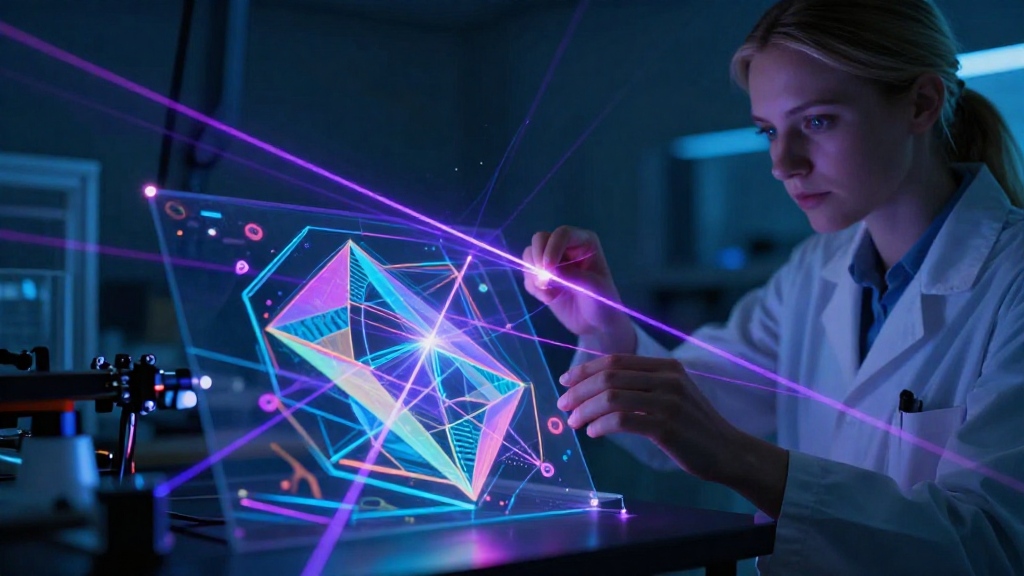
In the realm of optical techniques, beam holography stands out as a revolutionary technology. This article explores the various applications and mechanisms of beams within the fascinating world of holography.
What is Beam Holography?
Beam holography refers to the technique of recording and reconstructing light fields in a three-dimensional space using coherent light sources, such as lasers.
This method takes advantage of interference patterns created by the interaction of multiple beams of light. When two coherent light beams – the object beam and the reference beam – interact, they form a hologram that preserves the light’s phase, amplitude, and spatial information.
Why are Beams Essential in Holography?
Beams, particularly those from lasers, are vital in holography for several reasons:
-
Coherence: Lasers emit coherent light, meaning the light waves are in phase, which is crucial for producing clear and detailed holograms.
-
Directionality: Lasers produce highly directional beams, which helps target specific areas and allows for more controlled holographic techniques.
-
Intensity: The intense beams generated by lasers ensure that sufficient light interacts with the recording medium, making it possible to capture fine details of the object being holographed.
How Do Beams Interact in Holography?
The interaction of beams during the holography process can be broken down into several steps:
-
Illumination: The object is illuminated by a coherent beam (the object beam).
-
Interference: This beam reflects off the surface of the object and interacts with the reference beam, which is directed towards the recording medium.
-
Recording: The resulting interference pattern is recorded on a photosensitive medium, such as a holographic plate or film.
-
Storage: The recorded pattern encodes the light field information, effectively creating a three-dimensional representation of the object.
-
Reconstruction: To view the hologram, a laser beam (the reference beam) is directed at the recorded interference pattern, illuminating it and reconstructing the original light waves from the object.
What Types of Beams Are Used in Holography?
Several types of beams can be utilized in beam holography:
-
Coherent Laser Beams: These are the most common types of beams used. They provide the necessary coherence and stability for high-quality holography.
-
Diverging Beams: In some advanced holographic techniques, diverging beams are used to obtain different perspectives of the object.
-
Gaussian Beams: These beams are particularly effective in laser applications and are employed in phase holography techniques for high-resolution imagery.
What Are the Applications of Beam Holography?
Beam holography has diverse applications across numerous fields:
-
Data Storage: Holographic data storage exploits the principles of beam holography for high-capacity data storage solutions.
-
Security: Holograms created using beams are often used in currency notes, credit cards, and identification documents to prevent counterfeiting.
-
Medical Imaging: In medical diagnostics, holography can create three-dimensional images of tissues and organs, offering more insightful examinations than traditional methods.
-
Art and Entertainment: Holography can produce captivating three-dimensional visual experiences for exhibitions and shows.
-
Telecommunications: Incorporating holographic techniques can enhance data transmission methods, allowing for faster and more secure communications.
How Does Beam Holography Enhance Imaging Techniques?
Through the utilization of beams, beam holography enhances imaging in several ways:
-
3D Representation: Traditional photography captures only two dimensions. Holography, thanks to the interference of beams, provides a vivid three-dimensional representation of objects, allowing for depth perception.
-
Real-Time Imaging: With the appropriate setup, holography can facilitate real-time imaging, enabling dynamic observations of objects in motion.
-
Full Parallax: Unlike traditional images, holograms provide full parallax, meaning they can be viewed from different angles, offering an authentic three-dimensional viewing experience.
What Technological Advancements Are Driving Beam Holography?
Recent technological advancements have significantly impacted beam holography:
-
Laser Technology: Continued improvements in laser technology have led to reduced costs and increased accessibility of high-quality lasers for developers and researchers.
-
Digital Holography: The incorporation of digital methods allows for more complex holograms to be created with precision, vastly improving the applications of holography across industries.
-
Computational Holography: Utilizing powerful computational algorithms enhances the accuracy and efficiency of holographic image reconstruction, pushing the boundaries of what beam holography can achieve.
Conclusion: Why is Beam Holography Important?
In conclusion, beam holography plays a pivotal role in the development of advanced optical techniques. By harnessing the characteristics of coherent light beams, researchers and professionals are elevating the applications of holography across various fields.
The ability to create three-dimensional images, coupled with continuous technological advancements, suggests that the future of beam holography holds exciting possibilities. As lasers and holographic techniques evolve, so will their countless applications, paving the way for innovations in data storage, telecommunications, entertainment, and medical imaging.
Embracing the power of beam holography allows us to visualize the world in entirely new dimensions, forever changing our perceptions and interactions with the physical and digital realms.