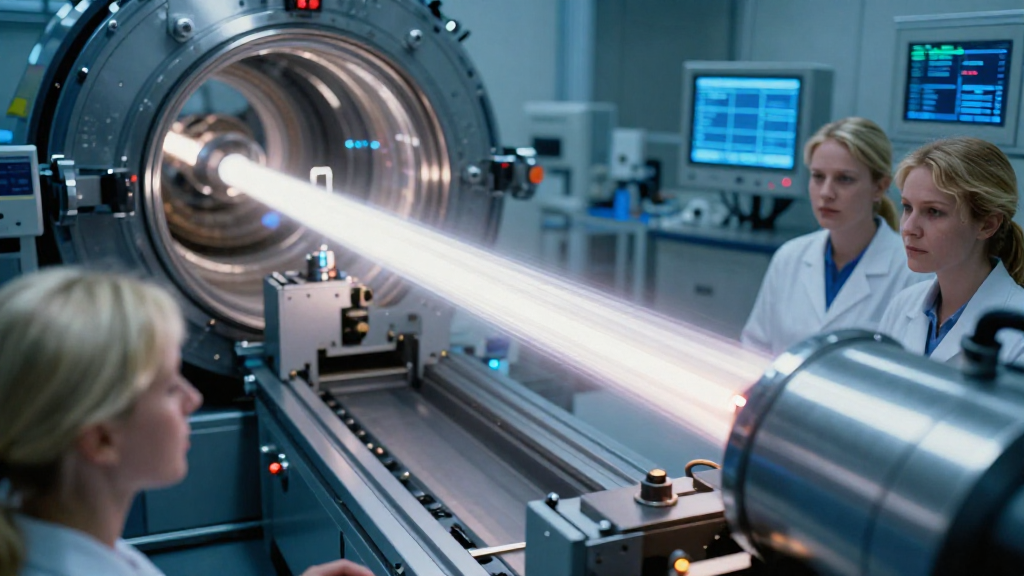
A beam in accelerator physics is a stream of charged particles that are directed through accelerating structures or magnetic fields, used primarily in scientific research and medical applications.
What Are the Components of a Beam in Accelerator Physics?
Understanding a beam in accelerator physics requires familiarity with several key components and concepts.
-
Particle Source: This is the origin of the beam, where particles are generated. Common sources include ion sources, electron guns, and proton sources.
-
Accelerating Structures: These devices increase the velocity of the charged particles. They often consist of radiofrequency cavities or linear accelerators (linacs).
-
Transport Systems: After acceleration, the beam must be guided to its target. This is where beam transport systems—including magnets and vacuum tubes—come into play.
-
Beam Tests: Before using the beam for experiments, it undergoes rigorous testing to measure parameters like intensity, focus, and alignment.
The integrity and quality of the beam significantly influence experimental outcomes in accelerator physics.
How Are Beams Generated in Accelerator Physics?
Generating a beam in accelerator physics involves several stages:
-
Ionization: Particles are often ionized from neutral atoms to create charged particles.
-
Acceleration: The particles are then accelerated using electric fields. These fields can be produced by various means such as radiofrequency cavities or static potentials.
-
Focusing: Once accelerated, beams require focusing to maintain their integrity over distances. This is achieved using magnetic lenses that steer the beam into a narrow path.
Why Is Beam Quality Important in Accelerator Physics?
The quality of a beam in accelerator physics is crucial for several reasons:
-
Precision: A well-focused beam allows for more precise measurements and interactions in experiments.
-
Efficiency: Higher beam intensity leads to more efficient use of resources, translating to better signal-to-noise ratios in data.
-
Safety: In medical applications, high-quality beams minimize exposure and improve treatment accuracy for patients undergoing radiation therapy.
What Are the Types of Beams Used in Accelerator Physics?
Different types of beams in accelerator physics serve various research and clinical purposes:
1. Electron Beams
-
Commonly used in linear accelerators for applications in medical radiation therapy.
-
They offer high energy with relatively low mass, making them ideal for penetrating soft tissues.
2. Proton Beams
-
Used in cancer treatment, specifically in proton therapy.
-
Protons have a high mass and energy level, allowing for precise targeting of tumors while minimizing damage to surrounding healthy tissues.
3. Ion Beams
-
Composed of heavier ions like carbon or helium, these beams have applications in materials science and biological research.
-
Their high energy and mass allow for studies of matter at the atomic level.
4. Neutron Beams
- Generated primarily in nuclear reactors and used in neutron scattering experiments, these beams are essential for determining the structures of materials.
What Are the Key Applications of Beams in Accelerator Physics?
The applications of a beam in accelerator physics are vast and impactful across various fields:
1. Medical Applications
-
Cancer Treatment: High-energy beams are utilized in therapies like proton therapy, which boasts fewer side effects compared to traditional treatments.
-
Diagnostics: Imaging techniques benefit from accelerated particle beams, improving the precision of diagnostic tools like PET scans.
2. Materials Science
-
Research: Accelerated particles allow scientists to study the properties of materials at microscopic levels, facilitating advancements in technology and manufacturing.
-
Engineering: Beams aid in creating and testing new materials, providing insights into their durability and behavior under stress.
3. Fundamental Physics
-
Particle Physics: Research facilities like CERN exploit beams to explore fundamental forces and particles, delving into the origins of the universe.
-
Nuclear Physics: Studies of nuclear interactions and reactions use beams to investigate the properties of atomic nuclei.
4. Industrial Applications
-
Radiation Processing: Accelerated beams treat materials for sterilization or modification, commonly found in the food and medical industries.
-
Diagnostics: Non-destructive testing techniques rely on particle beams to provide accurate results without damaging products.
What Are the Challenges Associated with Beams in Accelerator Physics?
Despite their usefulness, generating and maintaining a beam in accelerator physics comes with several challenges:
-
Beam Loss: Over time or during transport, some particles in the beam may escape, leading to losses in intensity and energy.
-
Instability: A beam can become unstable due to various factors, including external electromagnetic fields or collisions with other particles.
-
Controlled Environment: Maintaining the vacuum levels and magnetic fields necessary for optimal beam performance often requires advanced technology and resources.
-
Cost and Infrastructure: Building and maintaining accelerator facilities is expensive, requiring substantial investment from governments and organizations.
How Do Scientists Monitor Beams in Accelerator Physics?
Monitoring a beam in accelerator physics is essential for ensuring optimal performance and results. Here are several techniques employed:
-
Beam Current Monitors: These devices measure the flow of particles in the beam, allowing scientists to gauge its intensity.
-
Profile Monitors: By obtaining data on the beam’s distribution, these monitors help scientists assess its size and shape.
-
Emittance Measurements: A key factor in describing beam quality, emittance calculations require sophisticated instruments to determine a beam’s spread in position and momentum.
-
Diagnostics: The use of various sensors and imaging techniques allows for real-time monitoring of beam characteristics, ensuring optimal conditions for experiments.
Conclusion
In conclusion, understanding what constitutes a beam in accelerator physics is essential for harnessing their potential across numerous fields.
From medical applications to fundamental research, beams play a pivotal role in advancing our understanding of the universe and improving technology.
As science moves forward, the continued exploration and innovation surrounding beams promise exciting developments in accelerator physics, redefining boundaries and producing groundbreaking advancements across multiple disciplines.