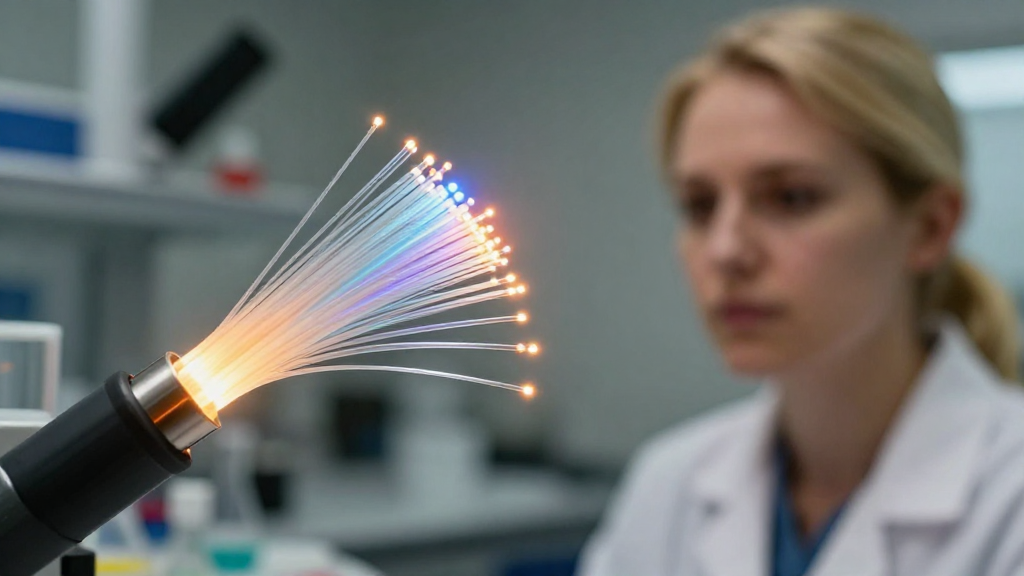
In the world of technology, a beam in fiber optics plays a critical role in transmitting data over long distances and providing high-speed internet access.
Understanding how these beams function is essential for grasping the basic principles of fiber optic technology.
What Is a Beam in Fiber Optics?
A beam in fiber optics refers to a concentrated flow of light generated by a laser or LED source.
This light travels through a flexible glass or plastic fiber, known as a fiber optic cable.
Fiber optics utilize the principle of total internal reflection, allowing beams of light to travel down the fiber with minimal loss of energy.
Through this method, data can be transmitted as light signals, thus facilitating high-speed communication.
How Is a Beam in Fiber Optics Generated?
The generation of a light beam in fiber optics primarily involves:
-
Light Source:
– Lasers are the most commonly used light sources, mainly due to their intensity and coherence.
– LEDs, while less commonly used than lasers, offer cost-effective solutions in applications requiring less precision. -
Coupling:
– Optical couplers ensure that the light generated from the source is efficiently injected into the fiber optic cable.
– The coupling mechanism minimizes the loss of light energy at the entry point. -
Fiber Optic Cable:
– The fiber optic cable consists of a core and a cladding layer.
– The core has a higher refractive index than the cladding, allowing the light beam to bounce back and forth within the core, preserving signal strength over long distances.
Why Is the Beam Important in Fiber Optics?
The beam in fiber optics is fundamental for several reasons:
-
Data Transmission: The core function of a beam is to carry information from one point to another quickly and efficiently.
-
Minimal Signal Loss:
-
Due to the principle of total internal reflection, beams traveling through fiber optics encounter very little attenuation or distortion compared to other transmission mediums such as copper wires.
-
High Bandwidth:
- Fiber optic beams support a significantly higher bandwidth, which facilitates high-speed internet and the transmission of complex data structures.
What Are the Applications of Beams in Fiber Optics?
Beams in fiber optics have a wide variety of applications that span numerous industries, including:
- Telecommunications:
-
High-speed internet services utilize fiber optic cables equipped with beams to transmit extensive volumes of data.
-
Medical:
-
Fiber optics are used in medical equipment for imaging, such as endoscopes, where light beams illuminate internal body structures.
-
Military and Aerospace:
-
Fiber optics provide secure, reliable communication channels that are essential for sensitive operations.
-
Broadcasting:
- Television transmission and other forms of broadcasting use fiber optics to deliver crisp and clear signals directly to homes and businesses.
How Does Attenuation Affect a Beam in Fiber Optics?
Attenuation refers to the loss of signal strength as a beam travels through a fiber optic cable.
Several factors contribute to this phenomenon:
- Absorption:
-
Some of the light energy may be absorbed by the material of the fiber itself, which can diminish the intensity of the beam.
-
Scattering:
-
Impurities or structural imperfections in the fiber can scatter light, reducing the effectiveness of the beam.
-
Bend Loss:
- Tight bends in the fiber can cause significant light leakage, leading to further attenuation.
To mitigate these issues, high-quality materials and innovative manufacturing techniques are employed in fiber optic technology.
How Are Beams Used in Multiplexing?
Multiplexing allows multiple signals to be transmitted simultaneously over a single beam in fiber optics.
This process is critical for maximizing the capacity of fiber optic networks and involves:
-
Wavelength Division Multiplexing (WDM):
– Different light wavelengths are used to transmit separate data streams through the same fiber.
– Each beam corresponds to a different wavelength, allowing multiple data transmissions effectively. -
Time Division Multiplexing (TDM):
– Signals are divided by time, with each data stream assigned a specific time slot.
– This method enables efficient sharing of the beam among various data sources.
What Innovations Are Associated with Beams in Fiber Optics?
The field of fiber optics is constantly evolving, with several innovations enhancing the use of beams:
- Optical Amplifiers:
-
These devices amplify the light beams traveling through fiber optics, allowing for longer transmission distances without additional signal loss.
-
Photonic Crystal Fibers:
-
These fibers utilize unique materials and structures to control the propagation of the beam more effectively.
-
Gradient-Index Fiber:
-
By varying the index of refraction along the fiber, these cables reduce loss and optimize beam transmission over distances.
-
Silicon Photonics:
- Integrating light beams with silicon-based technologies can lead to faster data processing and more efficient communication systems.
What Are the Challenges Faced by Beams in Fiber Optics?
Despite their advantages, beams in fiber optics must overcome specific challenges:
- Cost:
-
The manufacturing and installation costs of fiber optic systems can be higher than traditional copper wiring.
-
Vulnerability to Physical Damage:
-
Fiber optic cables are more fragile than copper cables, making them susceptible to breaks and bends that can affect transmission quality.
-
Installation Complexity:
- Fiber optics require specialized knowledge for installation and maintenance, which may not be readily available in some regions.
Conclusion
The beam in fiber optics serves as the backbone of modern telecommunications and a plethora of other applications.
Understanding how these beams are generated, their significance, and their various applications sheds light on why fiber optics are becoming increasingly crucial in our interconnected world.
As technology continues to advance and demand for faster, more reliable connections increases, the role of beams in fiber optics will only grow in importance.
In embracing new innovations, overcoming challenges, and appreciating the vital functions of a beam in fiber optics, we pave the way for the fascinating future of data communication.