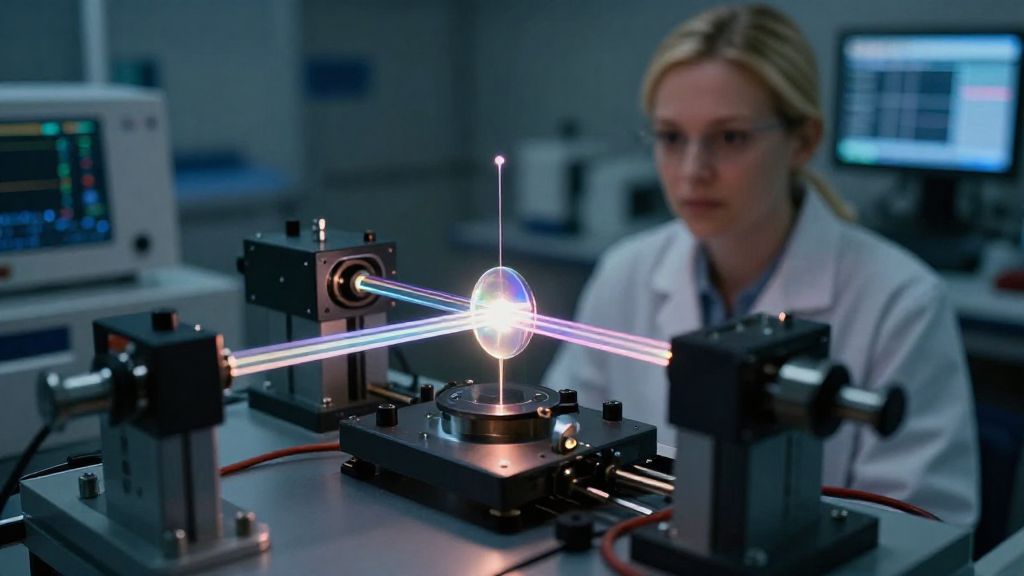
Beam interferometry is a powerful technique in the field of physics and engineering that allows scientists to measure small changes in distance and wavefronts.
In this article, we will explore the fundamentals of beam interferometry, its applications, and why it is an essential tool in precision measurement.
What Are the Principles of Beam Interferometry?
At its core, beam interferometry uses the principles of wave interference to analyze light or other waves.
Here are the fundamental concepts behind beam interferometry:
-
Interference: This occurs when two or more overlapping waves combine.
-
Phase Difference: The time difference between two waves that determines how they interfere with each other.
-
Path Length: The distance that light travels, which can affect its phase.
When a coherent light source splits into two beams, they travel different paths before being recombined.
The recombination results in an interference pattern that can be analyzed to determine various physical properties.
How Does Beam Interferometry Work?
The operation of beam interferometry typically involves optical components that direct and manipulate light.
The general steps include:
-
Light Source: A coherent light source (usually a laser) emits light.
-
Beam Splitting: A beam splitter divides the light into two separate paths.
-
Path Adjustment: The two beams travel different distances or encounter different materials, affecting their phase.
-
Recombination: The beams are recombined at a detector, where they produce an interference pattern.
-
Data Analysis: By analyzing the interference pattern, measurements can be made related to distance, displacement, or refractive index changes.
What Are the Types of Beam Interferometers?
Various types of beam interferometers are employed, depending on the application.
Some common types include:
- Michelson Interferometer:
- The most widely known and used interferometer.
-
Uses a beam splitter and mirrors to create two paths.
-
Mach-Zehnder Interferometer:
- Useful for measuring changes in refractive index.
-
Comprises two beam splitters and allows for flexible path adjustments.
-
Sagnac Interferometer:
- Detects rotation based on the Sagnac effect.
- Used in gyroscopes for navigation.
Each type of beam interferometer has unique features that make it suitable for specific measurements.
What Are the Applications of Beam Interferometry?
Beam interferometry is used across several scientific and engineering disciplines, thanks to its high precision.
Here are some key applications:
- Optics Research:
-
For measuring small changes in optics components or evaluating lens quality.
-
Metrology:
-
For precise measurements in manufacturing processes, including the calibration of measurement equipment.
-
Astronomy:
-
In large telescopes to investigate wavefront distortions caused by atmospheric turbulence.
-
Telecommunications:
-
For testing the integrity of fiber optic cables.
-
Biomedical Engineering:
- In techniques like Optical Coherence Tomography (OCT) to visualize tissue.
Why is Beam Interferometry Important?
Understanding the significance of beam interferometry can shed light on its innovative contributions to various fields.
Beam interferometry is crucial for:
-
High Precision: Scientists can measure extremely small distances, often down to nanometers.
-
Non-Destructive Testing: Many applications allow for testing and measurements without damaging the specimen.
-
Real-Time Analysis: It provides instant feedback, allowing adjustments and corrections during experiments.
-
Broad Versatility: This method can be used in many circumstances, from laboratories to industrial settings.
What Are the Limitations of Beam Interferometry?
Despite its numerous advantages, beam interferometry does have some limitations that must be considered.
Some challenges include:
- Environmental Sensitivity:
-
Interference patterns can be easily disrupted by vibrations and temperature fluctuations.
-
Complex Setup:
-
Requires precise alignment and calibration, which can be time-consuming.
-
Limited Range:
- Generally best suited for short distances, making long-range measurements more challenging.
How Can You Get Started with Beam Interferometry?
If you’re interested in exploring beam interferometry further, here are some steps to consider:
-
Educational Resources:
– Numerous online courses and textbooks focus on optics and interferometry. -
Laboratory Access:
– Find institutions or laboratories that work with interferometry; hands-on experience is invaluable. -
Research Projects:
– Engage in research that employs beam interferometry to gain practical knowledge. -
Networking:
– Join professional groups or forums focused on optics and interferometry to connect with experts in the field.
Conclusion: Why is Beam Interferometry a Game Changer?
Beam interferometry holds immense potential in advancing our understanding of fundamental physics and engineering applications.
By leveraging light’s properties, this technique enables unprecedented precision in measurements that have far-reaching implications across various scientific fields.
Key Takeaways:
-
Fundamental Technique: Beam interferometry relies on wave interference to measure changes in light and other waves.
-
Versatile Applications: Utilized in optics, metrology, astronomy, telecommunications, and biomedical fields.
-
Precision and Non-Destructive: Allows for high-precision measurements without damaging the subject of analysis.
As technology progresses, beam interferometry will undoubtedly continue to serve as a critical tool in both research and industry, paving the way for new discoveries and innovations.