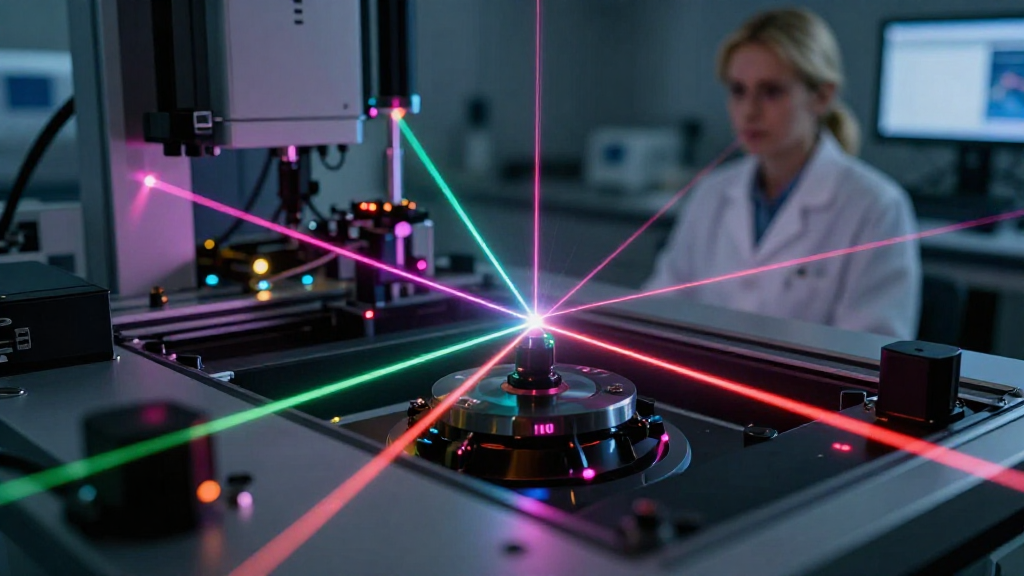
Beam phase shift refers to the change in phase of a light or electromagnetic wave as it interacts with different mediums. Understanding this phenomenon is crucial in various fields such as optics, telecommunications, and engineering.
What is Beam Phase Shift?
Beam phase shift occurs when a traveling wave encounters a change in medium, such as when it passes through different materials or interfaces.
This change in phase can affect several properties of the wave, including:
- Amplitude
- Frequency
- Speed
The phase shift is quantified in degrees or radians, indicating how much the wave has shifted from its original phase.
What Factors Influence Beam Phase Shift?
Several factors contribute to beam phase shift, including:
-
Medium Properties:
– The refractive index of the materials involved
– The density and composition of the medium
– The temperature of the medium -
Frequency of the Light:
– Different wavelengths of light can experience different phase shifts.
– Higher frequencies may lead to a greater phase shift in some materials. -
Angle of Incidence:
– The angle at which the beam strikes a surface plays a crucial role.
– A steeper angle can lead to more significant phase changes. -
Geometric Considerations:
– The shape and curvature of the surface can also influence the phase shift.
– Concave and convex surfaces will have different effects.
How Does Temperature Affect Beam Phase Shift?
Temperature can significantly influence beam phase shift due to its impact on the medium’s properties.
- Thermal Expansion:
-
As materials heat up, they expand, which can alter their refractive index.
-
Molecular Activity:
- Increased temperatures can lead to more molecular motion, affecting how light interacts.
It’s essential to consider these factors, particularly in environments where temperatures may fluctuate significantly.
How Do Materials Affect Beam Phase Shift?
Different materials exhibit unique optical properties that cause varying degrees of beam phase shift.
- Glasses and Plastics:
- Common materials often used in lenses and fiber optics.
-
They typically have a well-defined refractive index, influencing the phase shift significantly.
-
Metals:
- Highly reflective, leading to a different interaction with light.
-
The phase shift can be substantial upon reflection.
-
Semiconductors:
- Their phase shift characteristics can change under applied electrical fields or optical pumping.
Selecting appropriate materials is critical in designing systems that leverage beam phase shift for specific applications.
Why is Understanding Beam Phase Shift Important?
Knowledge of beam phase shift is vital in various fields and applications, including:
- Optical Communications:
-
Phase shifts affect signal integrity and modulation techniques, essential for data transmission.
-
Microscopy:
-
Understanding phase shifts can enhance image contrast and quality.
-
Material Science:
- Analyzing phase shifts helps in understanding material properties and behaviors under different conditions.
What Are the Practical Applications of Beam Phase Shift?
Several applications utilize the concept of beam phase shift, including:
- Interferometry:
-
A technique that exploits beam phase shifts to measure small displacements, refractive index changes, or surface irregularities.
-
Fiber Optics:
-
The design and optimization of fiber optics depend on controlling phase shifts for efficient signal transmission.
-
Optical Coatings:
-
Anti-reflective coatings use precise beam phase shift calculations to enhance performance by minimizing reflections.
-
Quantum Computing:
- Phase shifts play a critical role in qubit operations and the implementation of quantum algorithms.
How Can Beam Phase Shift be Measured?
Measuring beam phase shift is essential for engineers and scientists working in optics and related fields.
-
Interferometry Techniques:
– Using devices like Michelson or Mach-Zehnder interferometers can accurately measure phase shifts. -
Phase Shift Analysis:
– Comparing the output phase of a beam before and after passing through a medium can quantify the shift. -
Detection Instruments:
– Tools such as phase-sensitive detectors or lock-in amplifiers help in accurate measurements.
By utilizing these techniques, researchers can analyze and utilize beam phase shift effectively in their work.
Conclusion: The Importance of Understanding Beam Phase Shift
In conclusion, beam phase shift is a critical phenomenon influenced by various factors such as material properties, temperature, and geometric considerations.
Understanding beam phase shift is essential for:
- Advancing technologies in telecommunications.
- Enhancing the clarity of optical images.
- Designing cutting-edge materials and devices.
Investing time in understanding this concept can yield better results across numerous scientific and engineering disciplines.
Through this knowledge, researchers and engineers can better design systems that take full advantage of the properties of light, ultimately leading to advancements in technology and innovation.