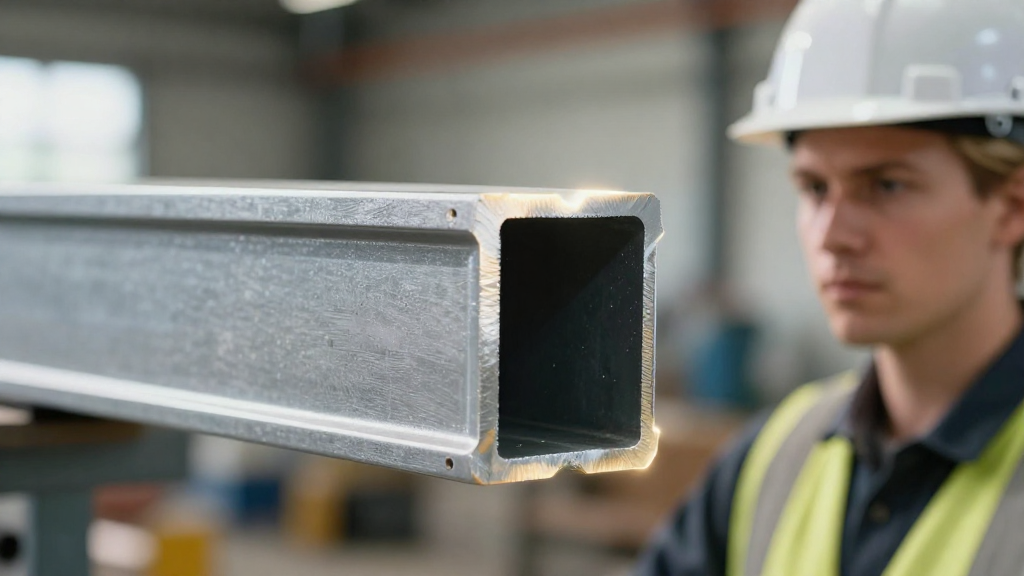
Understanding the beam shear center is crucial for engineers, architects, and anyone involved in structural design.
This article will explore the definition of the shear center, why it’s significant in beam design, and how it affects structural performance.
What is the Beam Shear Center?
The shear center of a beam is the specific point along the cross-section of the beam at which applied shear loads can be considered to act without causing any twisting or rotation.
In technical terms, it’s the point where the resultant shear force must be applied to maintain the beam’s balance.
Here’s why the beam shear center matters:
-
Structural Integrity: Ensuring that loads are applied at the beam shear center helps maintain the structural integrity of the beam.
-
Twisting Prevention: When loads are applied away from the shear center, it creates a torque that can lead to unwanted twisting of the beam.
-
Effect on Design: Knowledge of the shear center is essential in the design process as it influences how beams will perform under various loading conditions.
How to Find the Shear Center of a Beam?
Calculating the shear center involves understanding the geometric properties of the beam’s cross-section.
Steps to Determine the Beam Shear Center:
-
Identify the Beam Cross-section: Different shapes (I-beams, T-beams, etc.) will have different shear center locations.
-
Calculate the Centroid: Determine the centroid of the beam’s cross-section, as this is the first step in finding the shear center.
-
Determine Shear Flow Distribution: Analyze how shear forces distribute across the beam under loading conditions.
-
Locate the Shear Center: Based on your calculations, pinpoint the location of the shear center in relation to the centroid.
For more complex shapes, software tools and numerical methods are available to accurately compute the beam shear center.
Why is the Beam Shear Center Important?
Understanding beam shear center impacts a variety of engineering applications.
Let’s look at a few key reasons:
1. Load Application
Knowing where to apply loads ensures the structure behaves predictably.
When loads are applied at the shear center:
- The likelihood of twisting is minimized.
- The beam can deform uniformly.
2. Material Efficiency
Designing beams with accurate knowledge of the shear center:
- Reduces material waste.
- Allows for optimization of cross-sectional shapes for strength and stiffness.
3. Safety Concerns
In structural engineering, safety is paramount.
Miscalculating the shear center can lead to:
- Structural failures.
- Increased maintenance costs.
- Safety hazards to occupants or users.
4. Deflection Control
Controlling deflection is crucial in beam design.
When shear loads are applied at the shear center, it results in a more predictable deflection pattern:
- Enhancing user comfort and safety.
- Avoiding damage to adjacent structural components.
What Happens When Loads are Applied Away From the Shear Center?
When loads are applied outside the shear center:
Twisting and Torque
- Torque Generation: The result will be a twisting motion induced in the beam, leading to potential failure.
- Uneven Stress Distribution: This can create areas of high stress, increasing the risk of material failure.
Structural Analysis
Engineers must conduct a more complex analysis if the load does not align with the shear center:
- Support reactions will differ.
- Increased calculations are necessary to assess the impacts of twisting forces.
How Does Cross-Section Shape Influence the Shear Center?
Different beam cross-sections significantly influence the location of the beam shear center.
Common Cross-Sections:
-
I-Beams:
– Commonly used in construction due to their high strength-to-weight ratio.
– The shear center is usually located at the centroid of the beam’s cross-section. -
T-Beams:
– Similar to I-beams, but with a flange that extends on one side.
– The shear center moves towards the thicker section of the flange. -
Box Beams:
– Enclosed tubular shapes with high strength.
– The shear center is at the geometric centroid of the cross-section.
The Impact of Non-Symmetrical Sections
When dealing with non-symmetrical shapes:
- The shear center shifts significantly away from the centroid.
- Requires careful attention during structural design and load calculations.
Tools and Techniques for Finding the Shear Center
Manual Calculation Techniques
Engineers often perform manual calculations to find the beam shear center, especially in simpler geometries:
- Use analytical formulas based on geometry and material properties.
- Apply knowledge of centroid location and shear flow equations.
Software Solutions
In modern engineering, software tools can significantly simplify this process:
- Finite Element Analysis (FEA) software helps to compute shear centers for complex beam designs.
- Design programs facilitate modeling, calculation, and analysis in one integrated environment.
Conclusion: Importance of the Beam Shear Center in Design
The understanding of the beam shear center is essential for anyone involved in structural analysis and design.
From ensuring safety and structural performance to optimizing material use, knowledge of where to apply loads can substantially impact the integrity and reliability of beam systems.
By focusing on the shear center, engineers can create more effective designs that adhere to safety standards and fulfill operational requirements.
Make sure to consider the shear center when planning your next beam design project.
By doing so, you’ll enhance the structural stability and longevity of your work.