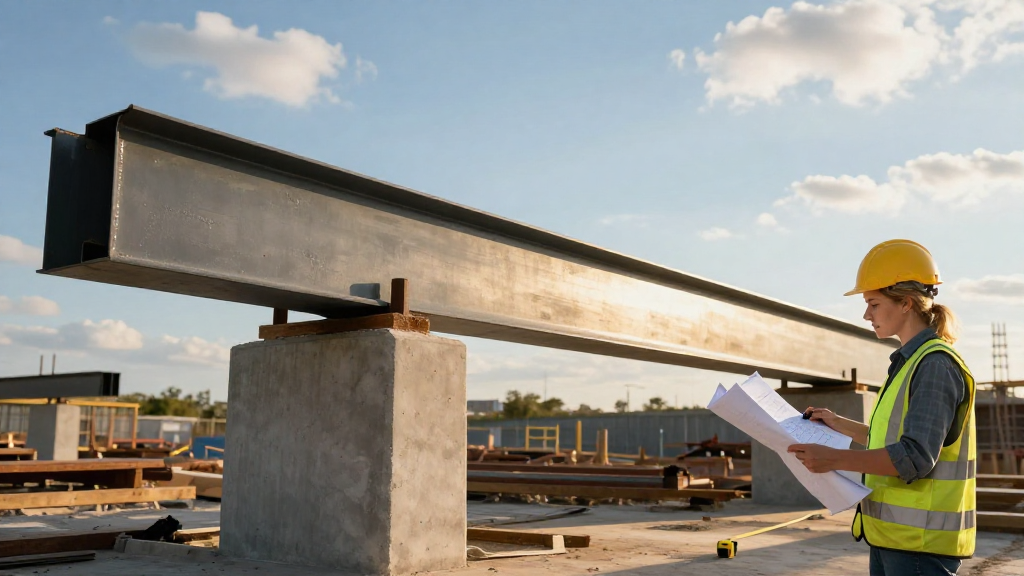
When it comes to structural engineering, understanding the concept of beam span vs load is crucial for ensuring that a building or structure remains safe and functional.
What is Beam Span?
Beam span refers to the distance between the points of support for a beam.
It’s a critical measurement since it influences the load capacity of the beam.
Typically, the longer the span, the more weight the beam must support, which directly affects its strength and stiffness.
What is Load Capacity?
Load capacity is the maximum load a beam can safely carry without failure.
This includes understanding both dead loads (permanent/static loads such as the weight of the beam itself, roofing, and walls) and live loads (temporary/dynamic loads like occupants, furniture, and weather conditions).
How Do Beam Span and Load Capacity Relate?
The relationship between beam span and load capacity is often summarized with the phrase, “the longer the span, the lower the load capacity.”
This principle is essential in construction and design.
Here’s how they interact:
- Increased Span: A longer beam span means that the beam will bend more under load.
-
As a result, the maximum load it can support decreases.
-
Material Strength: Different materials (like steel, wood, or concrete) flex differently over a span.
-
Stronger materials can better handle longer spans.
-
Beam Depth: Increasing the depth of the beam can improve its load capacity for a given span.
- A deeper beam can disperse weight more evenly, reducing stress.
What Factors Affect the Relationship Between Beam Span and Load?
Understanding beam span vs load is not just a matter of distance; several factors play a role in this relationship.
-
Material Type:
– Different materials have distinct properties.
– For example:- Steel beams have higher load capacities than wooden beams for the same span.
-
Beam Shape:
– The shape of the beam (I-beams vs rectangular beams) also affects load distribution.
– Certain shapes are more efficient at carrying loads over a span. -
Support Conditions:
– Depending on whether the beam is simply supported, continuous, or cantilevered, the load capacity can change significantly.
– For instance, a continuous beam spans over multiple supports, increasing its load capacity. -
Intended Use:
– The application of the beam influences its design.
– Residential buildings, commercial structures, and bridges each have unique loading conditions.
How to Calculate Load Capacity Based on Beam Span?
Calculating the load capacity based on beam span involves several steps and formulas, considering various factors:
-
Identify the Beam Material: Know the yield strength of the material.
-
Measure the Span: Determine the total distance between the beam supports.
-
Select a Beam Size and Shape: Choose the dimensions based on standard code requirements.
-
Use Formulas: Use engineering principles and formulas to calculate the load.
- A common formula is ( P = \frac{8 \cdot (E \cdot I)}{L^3} )
- Where ( P ) is load capacity, ( E ) is the modulus of elasticity, ( I ) is the moment of inertia, and ( L ) is the span length.
Consideration of Safety Factors
Safety factors play a significant role in the calculations as well.
Engineers typically apply safety factors in their design to account for uncertainties in load estimates, material defects, and environmental impacts.
This ensures that the structure is built to handle loads significantly greater than those expected during normal use.
What Are the Practical Implications of Beam Span vs Load?
Understanding beam span vs load has practical implications beyond theory.
- Design Efficiency: Optimizing beam spans allows for cost-effective designs that save materials without sacrificing safety.
- Construction Time: Correct calculations lead to fewer adjustments on-site, improving efficiency.
- Longevity of Structures: Properly designed beams that consider load capacities are less likely to suffer from fatigue and failure over time.
Can Beam Span Innovations Improve Load Capacity?
Recent innovations in building materials and technologies have aimed to enhance the relationship between beam span and load capacity.
Examples of Innovations:
- Composite Materials:
-
Combining different materials can yield superior strength and reduced weight.
-
Advanced Engineering Software:
-
Software solutions allow for precise modeling to optimize beams’ performance in ways previously impossible.
-
Pre-engineered Solutions:
- Off-the-shelf engineered I-beams can deliver significant advantages in load capacity for longer spans.
Conclusion
In summary, the relationship between beam span vs load is fundamental in structural engineering.
By understanding how span affects load capacity, engineers can design safer, more efficient structures.
Various factors—including material types, beam shape, support conditions, and intended use—contribute significantly to this relationship.
The innovations in materials and technology continue to expand our capabilities in designing beams that optimize load capacity while addressing practical considerations.
Being well-versed in these concepts not only enhances structural integrity but also aids in construction efficiency and ultimately leads to safe, sustainable building practices.