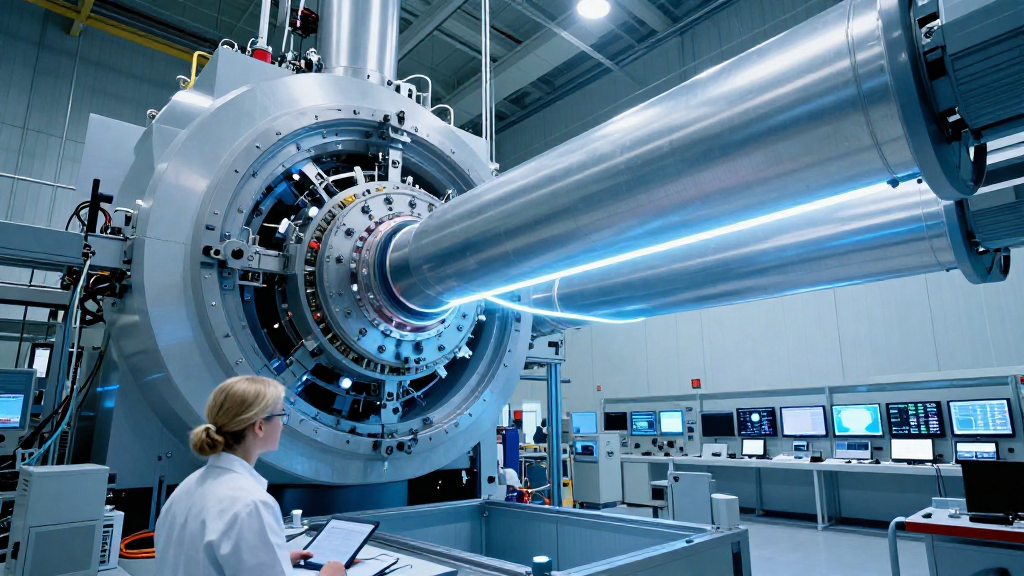
A beam synchrotron is a type of particle accelerator that plays a crucial role in various fields of research, utilizing synchrotron radiation to produce high-intensity beams of light.
How Does a Beam Synchrotron Work?
To understand how a beam synchrotron works, we need to break down its primary components and functions:
-
Electron Source:
– The process begins with a source, typically a linear accelerator (linac), that produces electrons.
– These electrons are injected into the synchrotron ring. -
Acceleration:
– Inside the synchrotron, powerful radiofrequency cavities accelerate the electrons.
– These cavities create an oscillating electric field that boosts the speed of the electrons multiple times. -
Magnetic Fields:
– The path of the electrons is controlled by powerful magnets arranged along the synchrotron ring.
– These include dipole magnets for bending the electron beam and quadrupole magnets for focusing it. -
Synchrotron Radiation:
– As the electrons travel at nearly the speed of light, they emit synchrotron radiation, which is highly collimated.
– This radiation can be harnessed for various applications, including imaging, spectroscopy, and x-ray production. -
Beamline Instrumentation:
– The emitted synchrotron radiation is directed into beamlines equipped with state-of-the-art detectors and instruments.
– These allow researchers to analyze the properties of materials at the atomic and molecular levels.
Why Are Beam Synchrotrons Important?
Beam synchrotrons have several significant benefits for scientific research and industry. Here are a few key reasons why they are essential:
- High Brightness:
-
The synchrotron radiation produced is incredibly bright, making it invaluable for experiments requiring extreme sensitivity.
-
Wide Range of Applications:
- From materials science to medical research, beam synchrotrons are utilized in various fields.
-
Applications include drug development, biomolecular studies, and even advanced manufacturing processes.
-
Time-Resolved Studies:
-
Researchers can conduct time-resolved experiments, allowing them to observe changes in materials at atomic resolutions over time.
-
Unique Techniques:
- Techniques such as x-ray crystallography and small-angle x-ray scattering (SAXS) heavily rely on synchrotron radiation.
What Are the Different Types of Beam Synchrotrons?
There are various types of beam synchrotrons, each designed with specific applications in mind. Some notable types include:
-
Storage Rings:
– These consist of closed synchrotron paths that maintain a stable beam intensity.
– They are often used for continuous operations over long periods. -
Synchrotron Light Sources:
– These facilities primarily focus on generating synchrotron radiation for various research applications.
– They feature multiple beamlines that can accommodate different experimental setups. -
Free Electron Lasers (FEL):
– An advanced type of synchrotron that uses free electrons to produce coherent light.
– They can generate light at varying wavelengths, catering to specific experimental requirements.
What Are the Key Components of a Beam Synchrotron?
Understanding the essential features of a beam synchrotron can help appreciate its complexity and functionality. Here are the primary components:
- Accelerator
-
Generates and accelerates electrons to high energies.
-
Vacuum Chamber
-
Provides a near-perfect vacuum for the electrons to travel without interference.
-
Magnetic Systems
-
Control and maintain the electron beam’s trajectory and focus.
-
Beamlines
-
Pathways that guide synchrotron radiation to specific experimental stations.
-
Control Systems
- Ensure the machine runs smoothly, managing various operational parameters and settings.
What Advantages Do Beam Synchrotrons Offer Over Other Techniques?
When comparing a beam synchrotron to other research techniques, a few distinct advantages stand out:
-
Precision Measurement:
– The high intensity of synchrotron radiation enables precision measurements that are often unattainable with other light sources. -
Diversity of Techniques:
– Multiple analytical methods can be performed simultaneously, making beam synchrotrons versatile platforms for multidisciplinary research. -
In Situ Analysis:
– The real-time nature of synchrotron radiation allows for in situ studies, providing immediate insights into material behavior under various conditions. -
Collective Knowledge Sharing:
– Due to their collaborative nature, synchrotron facilities allow researchers from diverse disciplines to share knowledge and techniques, fostering innovation.
What Are Some Notable Beam Synchrotrons Around the World?
Several prominent beam synchrotrons around the globe have made landmark contributions to science. Here are a few of the most notable facilities:
-
Advanced Photon Source (APS) – Argonne National Laboratory, USA
– Known for producing intense, high-energy x-rays for advanced scientific research. -
European Synchrotron Radiation Facility (ESRF) – France
– A leading light source for diverse research applications, especially in materials science and biology. -
SPring-8 – Japan
– One of the most powerful synchrotron radiation sources, primarily focusing on structural biology and material science. -
MAX IV – Sweden
– The world’s newest multi-purpose synchrotron source designed for various experimental techniques. -
Diamond Light Source – UK
– A national synchrotron facility known for its varied beamlines catering to various scientific investigations.
Conclusion: The Future of Beam Synchrotrons
As technology advances, the future of beam synchrotrons appears promising. Emerging developments in:
- Next-Generation Light Sources:
-
Innovations in synchrotron design and operation hold the potential for even higher brightness and improved beam stability.
-
Increased Collaboration:
-
International efforts among research institutions may lead to new insights and more efficient use of synchrotron facilities.
-
Novel Applications:
- Research in areas like quantum computing, nanotechnology, and environmental science could benefit immensely from synchrotron capabilities.
Beam synchrotrons are invaluable assets to the scientific community, driving forward our understanding of the universe and unlocking new potential in various industries.
In summary, these facilities are not just accelerators of particles; they are catalysts for innovation and discovery across a multitude of scientific fields.