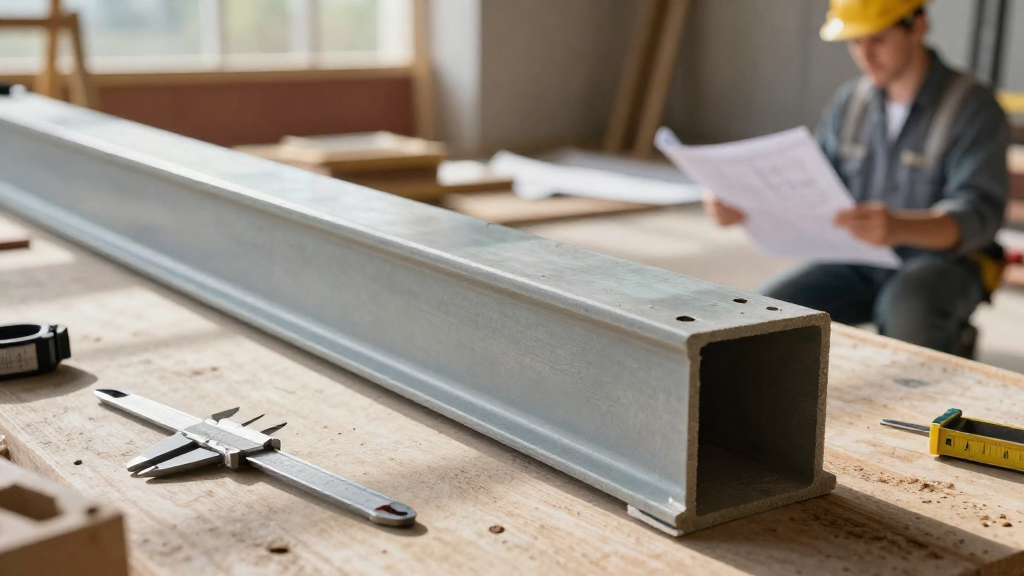
Handling a beam with point load effectively is crucial in structural engineering.
In this article, we will explore strategies and best practices for managing beams that support point loads, ensuring both safety and efficiency in design.
What Is a Beam with Point Load?
A beam with point load is a structural element that supports a concentrated force or load applied at a specific point along its length.
Points loads can originate from various sources, such as:
- Structural components: Columns, walls, or other beams.
- Live loads: Furniture, equipment, or occupants in a building.
- Static loads: Machinery or other heavy materials placed on the beam.
Understanding how these point loads affect a beam is essential for proper structural analysis.
How Do Point Loads Affect Beams?
The effects of point loads on beams are characterized by bending and shear. Here’s what you need to know:
1. Shear Forces
Point loads create shear forces that vary along the length of the beam.
The maximum shear occurs directly under the point load and decreases linearly towards the beams’ ends.
2. Bending Moments
A beam with point load also experiences bending moments.
The maximum bending moment occurs at the location of the load, causing the beam to bend downward.
3. Deflection
As a point load is applied, the beam will deflect.
The amount of deflection depends on several factors, including:
- Material properties (modulus of elasticity).
- Beam geometry (length, moment of inertia).
- The magnitude of the point load.
Formulae to Remember
- Shear Force (V) can be calculated using:
[
V = P \quad \text{(where P is the point load)}
]
- Bending Moment (M) can be calculated at a distance ( x ) from the left support by:
[
M = P \times x \quad \text{(if x is less than the load)}
]
Understanding these forces and moments will guide you in designing a safe and efficient beam system.
How to Analyze a Beam with Point Load?
Analyzing a beam with point load involves several steps:
1. Determine the Support Conditions
Different support conditions can drastically change the analysis.
The main types of support conditions are:
- Simply Supported: The beam rests freely on supports without any restrictions.
- Fixed Support: The beam is fixed at the ends, preventing rotation and translation.
- Cantilever Beam: One end is fixed, and the other is free.
2. Calculate Reactions at Supports
Using static equilibrium principles, calculate the reactions at the supports:
- For a simply supported beam, use:
[
\Sigma F_y = 0 \quad \text{(sum of vertical forces)}
]
- (\Sigma M = 0) (about any point of support).
3. Sketch Shear and Moment Diagrams
Create shear and bending moment diagrams to visualize how forces are distributed along the beam:
-
Shear Diagram: Shows the variation of shear force across the length of the beam.
-
Moment Diagram: Illustrates how the bending moment changes.
4. Utilize Structural Analysis Software
For complex structures, employing structural analysis software like SAP2000, ETABS, or Revit can simplify the calculations.
These tools are designed to simulate how a beam with point load will perform under various conditions.
What Materials Are Best for Beams with Point Loads?
Choosing the right material is vital for a beam with point load. Common materials include:
1. Steel
- Strength: High tensile and compressive strength.
- Durability: Resistant to environmental factors.
2. Concrete
- Stiffness: High compressive strength but low tensile strength.
- Versatility: Can be molded into various shapes.
3. Wood
- Weight: Lightweight and easy to work with.
- Sustainability: Natural and renewable resource.
The choice of material will depend on application, budget, and load demands.
How to Design a Beam for Point Loads?
Designing a beam with point load requires attention to several critical factors:
1. Load Consideration
- Always factor in dead loads (permanent) and live loads (temporary).
2. Safety Factors
- Apply safety factors to ensure the beam can handle unexpected load increases. A common safety factor ranges from 1.5 to 3, depending on building codes.
3. Beam Sizing
-
Calculate the appropriate beam dimensions based on:
-
Span length: Greater spans generally require deeper beams.
- Load magnitude: Heavier loads necessitate larger cross-sections.
4. Use of Reinforcements
- In some cases, additional reinforcements such as steel plates or grillages can increase a beam’s load-carrying capacity.
What Are Common Mistakes in Handling Beams with Point Loads?
Avoid these common pitfalls when working on a beam with point load:
1. Ignoring Load Combinations
Always consider various load combinations, such as live loads applied concurrently with wind or seismic forces.
2. Inaccurate Material Properties
Double-check material properties, especially if they are sourced from different suppliers. Conduct tests if uncertain.
3. Underestimating Deflection Limits
Ensure the beam meets serviceability requirements regarding deflection, which could otherwise lead to structural damage or comfort issues.
Conclusion: Mastering Beams with Point Loads
In summary, effectively handling a beam with point load is a process that incorporates understanding structural mechanics, selecting appropriate materials, and following rigorous design procedures.
By considering the factors mentioned in this article, you can ensure that your beam systems are safe, efficient, and compliant with industry standards.
With a solid foundation in the principles of structural analysis, you can tackle any challenge that arises when dealing with beams under point loads.
Make sure you stay updated on engineering best practices and regulations to ensure optimal designs in your projects!