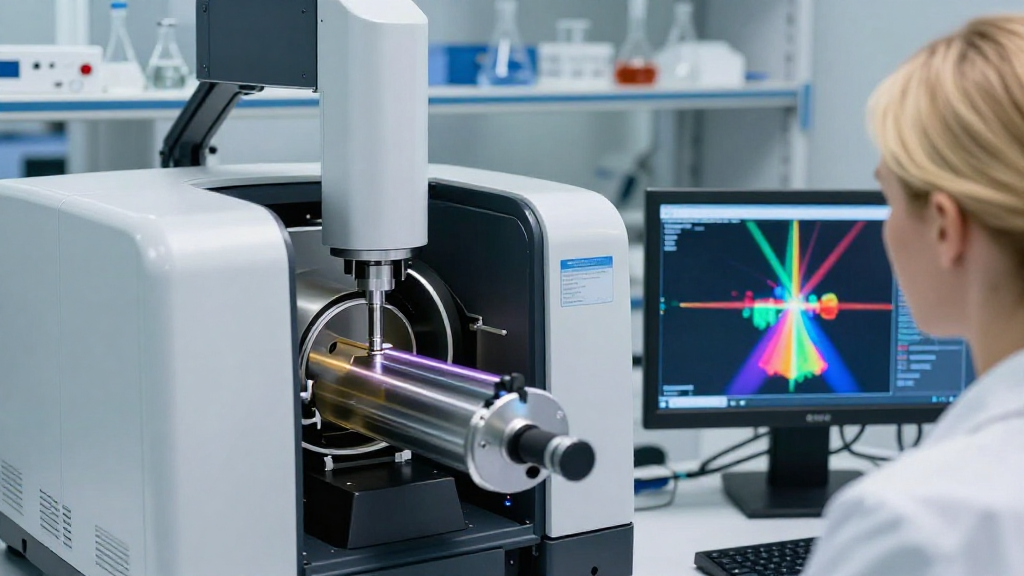
Beam X-ray diffraction is a powerful analytical technique used in various scientific fields to study the structure of materials at the atomic or molecular level.
What Does Beam X-ray Diffraction Involve?
Beam X-ray diffraction is based on the interaction of X-rays with the atomic structure of a material.
This interaction causes:
- Scattering of X-rays: The X-rays are directed at a sample, which leads to scattering based on the material’s internal structure.
- Interference patterns: The scattered X-rays produce a pattern that is characteristic of the atomic arrangement within the sample.
These patterns are then analyzed to derive important information about the material’s properties, such as its:
- Crystal structure
- Phase composition
- Grain size
- Strain variations
How Does Beam X-ray Diffraction Work?
The operation of beam X-ray diffraction can be broken down into several key steps:
-
X-ray Generation:
– X-rays are produced using an X-ray tube or synchrotron radiation source. -
X-ray Beam Interaction:
– A narrow beam of X-rays is directed at the sample material. -
Diffraction and Scattering:
– When the X-ray beam interacts with the sample, it is diffracted at specific angles according to Bragg’s Law.
– This results in a unique diffraction pattern reflecting the arrangement of atoms within the material. -
Detection:
– The diffracted rays are detected using a specialized detector.
– The data collected are processed to construct the diffraction pattern. -
Data Analysis:
– Sophisticated software analyzes the diffraction data to extract details about the sample.
Why Is Beam X-ray Diffraction Important?
Beam X-ray diffraction is essential for various reasons:
- Material Identification:
-
It helps identify unknown materials by comparing obtained patterns with standard databases.
-
Quality Control:
-
In industries such as pharmaceuticals, it is used for routine quality checks of crystalline materials.
-
Research and Development:
- It plays a critical role in material science, chemistry, geology, and biology for research purposes.
What Are the Applications of Beam X-ray Diffraction?
Beam X-ray diffraction is widely used across different scientific and industrial domains. Here are a few examples of its applications:
-
Crystallography:
– Beam X-ray diffraction is indispensable for determining the crystal structures of minerals and organic compounds. -
Metallurgy:
– It assists in understanding the mechanical properties of metals and alloys, including phase identification and stress analysis. -
Pharmaceuticals:
– This technology is employed in the development and quality control of drugs, especially in polymorphism studies. -
Nanotechnology:
– It helps in characterizing nanoparticles and nanostructured materials. -
Materials Science:
– Researchers utilize beam X-ray diffraction to investigate complex materials, including composites and ceramics.
What Are the Advantages of Beam X-ray Diffraction?
There are several advantages to utilizing beam X-ray diffraction as an analytical technique:
- Non-destructive:
-
The technique does not alter the sample, allowing for further analysis if needed.
-
High-resolution:
-
Beam X-ray diffraction provides detailed information about the atomic arrangement, enabling precise measurements.
-
Rapid analysis:
-
Many modern instruments allow for quick data acquisition and analysis.
-
Versatility:
- This method can be applied to a wide range of materials, from thin films to bulk samples.
What Are the Limitations of Beam X-ray Diffraction?
Despite its numerous advantages, beam X-ray diffraction also has some limitations:
- Sample Quality:
-
The technique requires high-quality crystalline samples for accurate results. Amorphous materials can yield limited information.
-
Complex Data Analysis:
-
The interpretation of diffraction patterns can be complicated, often requiring extensive experience and specialized software.
-
Size Limitations:
- The method typically requires samples sized appropriately to interact with the X-ray beam.
How Does Beam X-ray Diffraction Compare to Other Techniques?
Beam X-ray diffraction is often compared to other structural analysis techniques, such as:
- Transmission Electron Microscopy (TEM):
-
While TEM provides detailed images of sample morphology, beam X-ray diffraction excels in determining bulk material properties and crystal structures.
-
Scanning Electron Microscopy (SEM):
-
SEM offers excellent surface detail; however, it is not explicitly used for structural determination, unlike beam X-ray diffraction.
-
Nuclear Magnetic Resonance (NMR):
- NMR focuses on elucidating molecular environments and dynamics rather than static crystal structures.
How Can You Get Started with Beam X-ray Diffraction?
Whether you are a researcher, student, or engineer looking to delve into beam X-ray diffraction, here are some steps to get started:
-
Education and Training:
– Familiarize yourself with fundamental concepts of crystallography and X-ray physics through courses or workshops. -
Use Software for Data Analysis:
– Learn to use specialized software for analyzing diffraction patterns, such as GSAS or TOPAS. -
Collaborate with Established Labs:
– Consider collaborating with labs equipped for beam X-ray diffraction. This will provide hands-on experience and insights from experienced professionals. -
Stay Updated:
– Read recent literature and journals to keep abreast of the latest developments in beam X-ray diffraction techniques and applications.
Conclusion
Beam X-ray diffraction is a vital technique employed to explore and understand the underlying structures of various materials.
Its capacity to generate detailed information about crystal structures, phases, and material properties makes it indispensable in various industries and research fields.
Whether you are delving into materials science, pharmaceuticals, or nanotechnology, mastering beam X-ray diffraction is a valuable skill that can open numerous doors.