External recorders can give a DSLR a larger monitoring screen, higher-quality capture options, and more control than the camera’s built-in recording system. The right choice depends on your camera’s output, preferred resolution, workflow, and whether you need video, audio, or both.
We compared 10 options ranging from compact HDMI monitors and recorder units to dedicated video and on-camera audio systems, with an emphasis on practical features for production, streaming, and field use.
Best 10 Camera External Recorders for Dslr Cameras Picks for 2026
Top Complete Kit
Atomos Ninja 4K Recorder + 240GB SSD

- Records 4Kp60 and supports up to 6Kp30 ProRes RAW
- Includes 240GB SSD and power accessories
- 5.2-inch monitor with AtomOS 11 tools
Best For: Users wanting a ready-to-use monitor and recorder bundle
Best Computer Capture Option
Blackmagic UltraStudio Mini Recorder 12G

- Accepts 12G-SDI and HDMI input
- Supports UHD 4K60 video
- Connects to computers through Thunderbolt 4
Best For: Desktop capture, streaming, and production setups
Best Standalone Monitor Recorder
Atomos Ninja 5.2-inch 4K Recorder
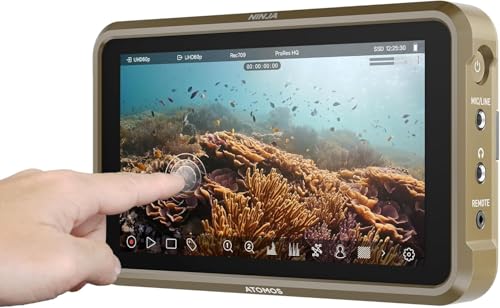
- Records HDMI video up to 4Kp60
- Supports ProRes RAW up to 6Kp30
- Bright 5.2-inch, 1000-nit display
Best For: Portable on-camera monitoring and recording
Best Audio Companion
Zoom F1-SP Shotgun Audio Recorder

- Includes shotgun microphone and shock mount
- Records up to 24-bit/96 kHz audio
- Outputs audio to a camera and records to microSD
Best For: Dedicated audio capture for DSLR video
Best Recording Monitor
FEELWORLD CUT6 6-Inch Touch Recorder

- Records HDMI video up to 1080p30 to USB
- 6-inch 1080p touchscreen with LUT support
- Includes scopes, focus, and exposure tools
Best For: DSLR filmmakers wanting recording and monitoring in one unit
Best Professional Recorder
Blackmagic Video Assist 5-inch 3G

- Combines monitor, recorder, scopes, and viewfinder
- 5-inch 1080p LCD touchscreen
- Includes focus assist, 3D LUT, and HDR support
Best For: Users seeking professional monitoring tools in a compact unit
Best Bright-Daylight Monitor

- Bright 1200-nit 1080p HDMI display
- Loads custom 3D LUTs from an SD card
- Includes scopes, focus tools, and sunshade
Best For: Daylight DSLR monitoring and LUT-based image preview
Premium Cloud-Ready Pick

- 1500-nit 5.2-inch touchscreen
- 4K60 I/O with broad codec support
- CFexpress recording and Wi-Fi uploading
Best For: Professional DSLR video workflows and camera-to-cloud production
Compact Budget Monitor
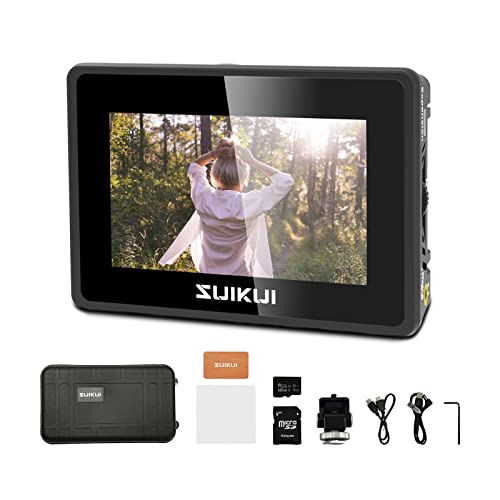
- 3.5-inch, 600-nit LCD monitor
- 1080p60 HDMI input/output
- H.264 1080p30 recording to removable media
Best For: Portable DSLR monitoring and basic Full HD recording
Creator Kit Choice
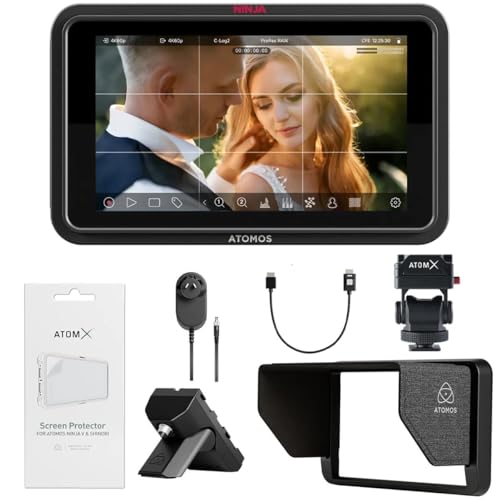
- Bright 5.2-inch Full HD touchscreen
- Supports ProRes RAW and other codecs
- HDMI 2.0 up to 6Kp30 with Wi-Fi 6E
Best For: Creators building an HDMI-based DSLR recording rig
Top Complete Kit – Atomos Ninja 4K Recorder + 240GB SSD
For camera external recorders for DSLR cameras, this Atomos Ninja bundle combines a 5.2-inch recording monitor with a supplied 240GB SSD. It records HDMI camera output in several professional formats while adding a bright, portable monitoring screen.
Best For: DSLR, cinema, and mirrorless users who want an all-in-one monitor and recorder kit.
Pros:
- Records up to 4Kp60 in ProRes, DNxHD, and H.265.
- Supports up to 6Kp30 in Apple ProRes RAW.
- Includes a 240GB SSD and power accessories.
- AtomOS 11 adds updated memory management and recording tools.
Cons:
- Requires an HDMI-output camera and compatible power setup.
- Limited to the included 240GB storage capacity unless additional media is used.
This is the strongest convenience-focused option in the group because the SSD and power accessories are included. Its format support also gives creators room to choose between high-quality recording workflows.
Best Computer Capture Option – Blackmagic UltraStudio Mini Recorder 12G
This Blackmagic device is a compact choice among camera external recorders for DSLR cameras when the recording workflow centers on a computer. It accepts 12G-SDI or HDMI and sends video to a computer through Thunderbolt 4 for use with popular production software.
Best For: Computer-based capture, streaming, and production workflows using compatible software.
Pros:
- Provides both 12G-SDI and HDMI inputs.
- Supports common codecs up to UHD 4K60.
- Works with DaVinci Resolve, Wirecast, vMix, and OBS.
- Supports uncompressed and compressed 10-bit video formats.
Cons:
- Uses a Thunderbolt 4 computer connection rather than standalone storage.
- Its 2-pound weight is less travel-friendly than the compact monitor recorders listed here.
Choose this model when your priority is routing camera video into a computer rather than recording directly to an on-camera drive. Its broad software compatibility makes it particularly practical for live production and desktop capture.
Best Standalone Monitor Recorder – Atomos Ninja 5.2-inch 4K Recorder
The Atomos Ninja is a practical pick for camera external recorders for DSLR cameras when you want a compact on-camera monitor with recording capability. Its HDMI connection supports recording up to 4Kp60, while the 5.2-inch display provides a larger monitoring view than the camera screen.
Best For: DSLR, mirrorless, and camera operators who need portable monitoring and high-quality external recording.
Pros:
- Records up to 4Kp60 in ProRes, DNxHD, and H.265.
- Supports up to 6Kp30 in Apple ProRes RAW.
- Includes a 1000-nit 5.2-inch display with camera mounting.
- AtomOS 11 includes updated responsiveness and recording features.
Cons:
- No storage capacity is specified in the supplied product details.
- Requires an HDMI-output camera and separate compatible recording media or accessories as needed.
This is a good fit for creators who already have storage and accessories or prefer to configure their own setup. It offers the same core recording capabilities as the bundled Ninja without the listed 240GB SSD.
Best Audio Companion – Zoom F1-SP Shotgun Audio Recorder
Although it is an audio recorder rather than a video recorder, the Zoom F1-SP complements camera external recorders for DSLR cameras by capturing sound separately. It includes a shotgun microphone, records to microSD or SDHC cards, and can output audio to the camera.
Best For: DSLR video creators who need a dedicated shotgun microphone and separate audio recording.
Pros:
- Includes a shotgun microphone, windscreen, and shock mount.
- Records two-channel audio at up to 24-bit/96 kHz.
- Records directly to microSD and SDHC cards up to 32GB.
- Offers one-touch controls and camera output through a 3.5mm connection.
Cons:
- Records audio only, not external video.
- Requires two AAA batteries.
- No warranty is listed in the supplied details.
This is the right add-on when your main concern is improving production audio rather than expanding video recording formats. Pair it with a video recorder for a more complete DSLR filmmaking setup.
Best Recording Monitor – FEELWORLD CUT6 6-Inch Touch Recorder
For camera external recorders for DSLR cameras, the FEELWORLD CUT6 combines a 6-inch touchscreen monitor with direct USB recording. It can capture compatible HDMI video up to 1080p30 in MP4 format to a FAT32 USB flash drive, making it a practical choice for filmmakers who want recording and monitoring in one unit.
Best For: DSLR users who want an integrated field monitor, USB recording, LUT support, and detailed exposure and focus tools.
Pros:
- Records compatible HDMI video up to 1080p30 directly to a FAT32 USB flash drive.
- 6-inch 1920×1080 touchscreen provides a generous, detailed viewing area.
- Includes waveform, scopes, focus peaking, zebra, false color, and other production tools.
- Supports LUT recording and HDMI loop-out with 4K 60Hz input support.
Cons:
- USB recording is limited to 1080p30.
- Recording requires a separately supplied FAT32 USB flash drive.
- Its 450-nit display may be less suited to very bright outdoor conditions than higher-brightness monitors.
The CUT6 is a strong all-in-one option when recording convenience matters as much as monitoring. Its larger screen and broad toolset are especially useful for controlled exposure, focus, and on-set review.
Best Professional Recorder – Blackmagic Video Assist 5-inch 3G
Among camera external recorders for DSLR cameras, the Blackmagic Design Video Assist 5” 3G is aimed at users who want a compact professional monitoring and recording assistant. Its 5-inch 1080p LCD touchscreen combines recorder, viewfinder, scope, and focus-assist functions in a portable body.
Best For: DSLR and consumer-broadcast camera users who prioritize professional monitoring tools, scopes, and a compact 1080p touchscreen.
Pros:
- Combines a monitor, recorder, scopes, and viewfinder in one device.
- Provides a 5-inch 1920×1080 LCD touchscreen.
- Includes professional scopes, focus assist, 3D LUT, and HDR support.
- Offers HDMI connectivity and a stated two-year warranty.
Cons:
- The supplied notes do not specify recording resolution, codec, or media format.
- Its 2500-candela-per-square-meter brightness specification may not be directly comparable to typical monitor nit ratings.
- The 5-inch display is smaller than the FEELWORLD CUT6’s 6-inch screen.
The Video Assist 5” 3G suits buyers looking beyond basic HDMI monitoring. It is best considered when professional scopes, focus assistance, and a consolidated field-monitor design are more important than a large display.
Best Bright-Daylight Monitor – VILTROX DC-550 5.5-Inch
For camera external recorders for DSLR cameras where clear outdoor viewing is the priority, the VILTROX DC-550 offers a 5.5-inch 1080p HDMI monitor with a 1200-nit display. It is primarily a monitoring and image-control solution, with 3D LUT loading, waveform tools, and anamorphic de-squeeze support.
Best For: DSLR shooters who need a bright, lightweight HDMI monitor for daylight framing, focus, exposure, and LUT-based previewing.
Pros:
- 1200-nit brightness is designed for visibility in intense lighting conditions.
- Provides waveform, parade, vectorscope, histogram, focus peaking, zebra, and false color tools.
- Loads custom 3D LUTs through its SD card slot and supports anamorphic de-squeeze monitoring.
- Includes an NP-F550 battery, sunshade, mounting points, and HDMI cables.
Cons:
- The supplied notes describe HDMI monitoring features but do not specify onboard video recording.
- It has one HDMI port.
- The glossy screen finish may create reflections in some environments.
The DC-550 is a sensible pick when a bright screen and extensive monitoring tools matter more than built-in recording. Its included accessories and multiple mounting options also make it convenient for camera rigs.
Premium Cloud-Ready Pick – Atomos Ninja TX
For creators comparing camera external recorders for DSLR cameras, the Atomos Ninja TX combines a bright 5.2-inch touchscreen with professional recording, connectivity, and camera-to-cloud features. It supports 4K60 input/output, multiple codecs, CFexpress Type B recording, and 8K30 ProRes RAW recording.
Best For: DSLR and mirrorless filmmakers who need advanced recording, monitoring, wireless uploading, and professional I/O.
Pros:
- Bright 1500-nit 1920 x 1080 IPS touchscreen.
- Records Apple ProRes, Avid DNx, H.265/H.264, and up to 8K30 ProRes RAW.
- Includes locking 12G-SDI and HDMI 2.0 input/output, Wi-Fi 6, and timecode sync.
- Records to a CFexpress Type B card and supports USB-C power and data.
Cons:
- Its extensive professional features may be more than casual DSLR users need.
- CFexpress Type B media and an L-series battery are not indicated as included.
The Ninja TX is a feature-rich choice when monitoring quality, codec flexibility, and production connectivity matter more than keeping the setup minimal. Its bright display and camera-to-cloud workflow make it especially suitable for demanding field productions.
Compact Budget Monitor – RH35 Unlimited Recorder
The RH35 is a compact option for shoppers seeking camera external recorders for DSLR cameras without moving to a larger professional monitor. It accepts and outputs 1080p60 HDMI, records H.264 1080p30 video, and stores MP4 files on a microSD card or USB flash drive.
Best For: DSLR users who want a lightweight 3.5-inch monitor with basic recording and on-camera exposure tools.
Pros:
- Small 3.5-inch design with a stated 120g weight.
- Supports HDMI 1080p60 input/output and H.264 1080p30 recording.
- Includes peaking, zebra, waveform, focus assist, exposure assist, and false color.
- Records MP4 video to microSD cards or USB flash drives.
Cons:
- The 800 x 480 display is less detailed than Full HD monitors.
- Recording is limited to H.264 1080p30.
- Only one HDMI port and one USB port are listed.
The RH35 prioritizes portability and straightforward 1080p capture over advanced codecs or high-resolution monitoring. It is a practical fit for basic DSLR recording, streaming, presentations, and other setups where a small external screen is useful.
Creator Kit Choice – Atomos Ninja TX GO
The Atomos Ninja TX GO is a streamlined choice among camera external recorders for DSLR cameras, pairing a 5.2-inch Full HD touchscreen with a creator-focused kit. Its 1500-nit display, HDMI 2.0 connectivity, and broad codec support suit both outdoor monitoring and flexible post-production.
Best For: Creators who want a bright touchscreen recorder with ProRes RAW support, HDMI connectivity, and a bundled 5-inch creator setup.
Pros:
- 1920 x 1080 touchscreen with strong 1500-nit brightness.
- Supports Apple ProRes RAW, ProRes, Avid DNxHD/HR, and H.265.
- HDMI 2.0 input/output supports up to 6Kp30.
- Offers Wi-Fi 6E and dual USB-C ports for data transfer and control.
Cons:
- Connectivity is HDMI-based rather than offering the Ninja TX’s listed SDI connections.
- The listed item weight is 3 pounds, which may be substantial for some on-camera rigs.
- Recording media is not specified as included in the supplied details.
The Ninja TX GO balances a highly visible monitor with professional codec options and modern wireless connectivity. It is a compelling middle ground for creators who need more than basic capture but prefer an HDMI-centered workflow.
How We Picked the Best Camera External Recorders for Dslr Cameras
We evaluated these Camera External Recorders for Dslr Cameras by looking at compatibility, signal support, recording capability, monitoring tools, portability, power requirements, and workflow flexibility. We also considered whether each product is best suited to handheld shooting, studio production, live streaming, or professional post-production.
Because DSLR outputs vary, compatibility should come first. Check whether your camera provides HDMI, whether that output is clean, and which resolution and frame rates it supports. A recorder cannot improve a signal your camera does not provide.
Quick Comparison
| Best For | Look For | Typical Choice |
|---|---|---|
| Professional 4K capture | 4K HDMI input, SSD support, high-bitrate codecs | Atomos Ninja models |
| Monitoring and basic recording | Bright display, HDMI capture, waveform tools | FEELWORLD, VILTROX, or RH35 options |
| Video production workflows | Scope tools, external media, reliable signal handling | Blackmagic Video Assist |
| Computer-based capture | USB or Thunderbolt connectivity and supported formats | Blackmagic UltraStudio Mini Recorder |
| Improved production audio | Microphone input, onboard recording, camera output | Zoom F1-SP |
Key Buying Factors
Resolution, Frame Rate, and HDMI Format
Match the recorder to your DSLR’s actual HDMI output. Some units support 4K signals, while others are intended for Full HD capture or monitoring. Also verify frame-rate compatibility and whether the camera sends a clean feed without menus or focus indicators.
Recording Media and Codecs
External recorders may use SSDs, SD cards, or a connected computer. SSD-based systems can offer fast, high-bitrate recording, but they add cost and mounting requirements. Consider codec support, file sizes, editing compatibility, and the amount of storage needed for a typical shoot.
Display, Brightness, and Monitoring Tools
A larger screen helps with focus and exposure, especially when shooting outdoors. Brightness ratings matter in direct sunlight, while tools such as zebras, false color, waveform displays, focus peaking, and vectorscopes are valuable for controlled exposure and accurate focus.
Power, Size, and Mounting
On-camera recorders increase rig size and can draw substantial power. Check battery type, expected runtime, charging options, mounting points, and overall balance. A compact monitor may be preferable for travel, while a larger professional recorder can be worthwhile on a tripod or cinema rig.
Audio and Connectivity
If audio is important, confirm the recorder’s input and output connections. A dedicated audio recorder can provide cleaner microphone handling than a camera alone, while video recorders may offer only monitoring audio or pass-through. For streaming, verify computer connectivity and supported capture software.
Who Should Buy Which Camera External Recorders for Dslr Cameras?
Choose an Atomos Ninja or Ninja TX model if you want a versatile on-camera monitor, higher-quality recording, or cloud-connected production features. Choose Blackmagic Video Assist if professional monitoring scopes and a video-focused workflow are priorities.
Choose a FEELWORLD, VILTROX, or RH35 monitor/recorder for affordable field monitoring, basic HDMI capture, or a larger display. Choose the UltraStudio Mini Recorder for computer-based capture rather than a self-contained on-camera setup. Choose the Zoom F1-SP when better portable audio is more important than external video recording.