A reliable field monitor can make exposure, focus, and color decisions far easier than relying on a camera’s built-in screen. Waveform tools are especially valuable when you need a more objective view of brightness levels in changing light.
Our 2026 roundup compares 10 camera field monitors with waveform and related monitoring features, from compact touchscreen models to ultra-bright displays designed for outdoor production.
Best 10 Camera Field Monitors with Waveform Picks for 2026
Bright Outdoor Precision
FEELWORLD F6 Pro 5.5-inch Monitor

- 1600-nit Full HD touchscreen
- Waveform, vectorscope, and focus tools
- Battery, case, sunshade, and tilt arm included
Best For: Outdoor filmmakers needing bright, detailed monitoring
Large-Screen Monitoring Power

- 2000-nit 7-inch Full HD touchscreen
- Full waveform and 60 custom LUT uploads
- 4K HDMI loop-through and two batteries
Best For: Longer shoots and creators wanting a large, bright display
Lightweight Scope Control

- Compact Full HD touchscreen design
- Luma and RGB waveform displays
- 3D LUT output and broad monitoring tools
Best For: Lightweight rigs and gimbal-based shooting
Balanced Run-and-Gun Choice
FEELWORLD FW568 PRO 6-inch Monitor

- 1200-nit 6-inch Full HD display
- Waveform, vectorscope, and RGB histogram
- Lightweight with HDMI, USB-C, and camera power output
Best For: Portable outdoor, vlog, wedding, and interview production
Compact Scope Control

- Luma, RGB, and histogram scopes
- 5-inch Full HD touchscreen
- 4K30P I/O and 3D LUT support
Best For: Lightweight DSLR and mirrorless rigs
Bright Outdoor Monitoring

- 1600-nit screen for daylight use
- Waveform, histogram, and false color
- Focus peaking and LUT preview
Best For: Outdoor production and mobile rigs
Multi-Input Production Monitor

- Waveform, vector, and histogram scopes
- 4K HDMI and 3G SDI I/O
- Touch, buttons, and F1-F7 shortcuts
Best For: Crew shoots needing HDMI and SDI flexibility
Bright-Daylight Specialist

- 2600-nit display for bright outdoor shoots
- Waveform, vectorscope, and histogram tools
- 4K HDMI loop-out and custom LUT support
Best For: Outdoor filmmakers needing maximum screen brightness
Portable Battery Pick
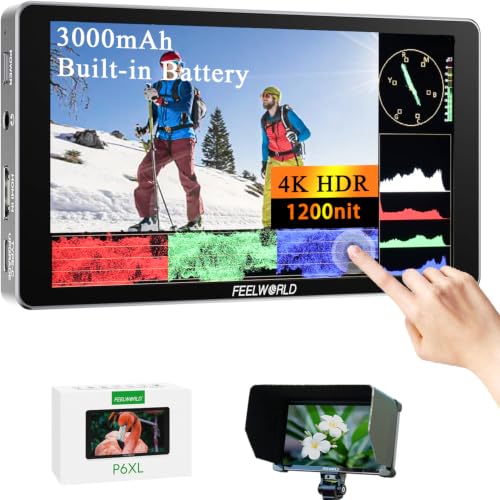
- Built-in battery with up to two hours of runtime
- Multiple waveform modes and audio displays
- Lightweight 332-gram touchscreen design
Best For: Mobile creators wanting integrated monitor power
Flexible Power Option

- Waveform, false color, histogram, and focus assist
- 4K HDMI input and output with headphone monitoring
- Includes NP-F550 battery and sunshade hood
Best For: Camera crews needing versatile field power
Bright Outdoor Precision – FEELWORLD F6 Pro 5.5-inch Monitor
For filmmakers seeking camera field monitors with waveform support, the FEELWORLD F6 Pro combines a highly visible 1600-nit display with touchscreen controls and a broad set of exposure and focus tools. Its included battery, carry case, sunshade, and tilt arm make it a practical option for outdoor production.
Best For: Outdoor filmmakers and videographers who need strong sunlight visibility, touchscreen operation, and detailed monitoring tools.
Pros:
- 1600-nit, 1920×1080 display with REC-709 color calibration
- Includes waveform, vectorscope, histogram, false color, and focus-assist tools
- Supports 4K HDMI input, HDMI output, USB-C power, and an included battery
- Includes a sunshade, tilt arm, carry case, and mini HDMI cable
Cons:
- Its 5.5-inch screen is smaller than some 7-inch alternatives
- The listed weight is 2.33 pounds, which may matter for lightweight rigs
The F6 Pro is especially compelling when outdoor visibility and built-in exposure analysis matter more than keeping the rig as small as possible. Its bundled accessories also reduce the need for immediate add-on purchases.
Large-Screen Monitoring Power – NEEWER F700 7-inch Monitor
The NEEWER F700 is a strong choice among camera field monitors with waveform functionality when you want a larger 7-inch viewing area and high brightness. It adds 4K HDMI loop-through, touch and button controls, custom LUT support, and flexible battery options for extended shoots.
Best For: Filmmakers and production teams who prefer a large, bright screen with extensive signal support and customizable monitoring tools.
Pros:
- 7-inch 1920×1080 IPS screen with 2000-nit brightness
- Offers full waveform, vectorscope, histogram, false color, zebras, and focus peaking
- Supports 4K HDMI loop in and out plus headphone audio monitoring
- Accepts NP-F batteries, USB-C charging, and DC power; includes two batteries
Cons:
- Its larger size and up-to-30.2-ounce battery-equipped weight can add bulk
- DC power cable and headphones are not included
- An SD card is required separately for firmware upgrades
Choose the F700 if screen size, sunlight readability, and connectivity are priorities. Its two-battery setup and cooling fans are useful for longer sessions, while the shortcut buttons make frequently used tools easier to access.
Lightweight Scope Control – Portkeys PT6 5.2-inch Monitor
The Portkeys PT6 offers a compact approach to camera field monitors with waveform support. Its 5.2-inch Full HD touchscreen includes adjustable luma and RGB waveforms, 3D LUT output, anamorphic tools, and a wide 178-degree viewing angle in a slim design.
Best For: Lightweight camera rigs, gimbal setups, and shooters who want comprehensive scopes without a large monitor.
Pros:
- Light 5.2-inch design with a 1920×1080 screen and 178-degree viewing angle
- Provides both luma and RGB waveform displays plus a luma histogram
- Includes 3D LUT output, false color, zebra, peaking, zoom, and audio meters
- Supports Sony NP-F and Canon LP-E6 battery types
Cons:
- 600-nit brightness is lower than the brighter monitors in this roundup
- Battery is not included
- The smaller screen may be less comfortable for detailed group viewing
The PT6 is a sensible fit when minimizing rig weight is important. It gives advanced waveform and LUT features in a compact package, though its lower brightness is better suited to controlled or less sun-intense environments.
Balanced Run-and-Gun Choice – FEELWORLD FW568 PRO 6-inch Monitor
The FEELWORLD FW568 PRO balances a useful 6-inch Full HD screen with a lightweight design and core tools expected from camera field monitors with waveform. Its 1200-nit display, 4K HDMI input/output, LUT preview, and focus and exposure aids make it suited to mobile production.
Best For: Vloggers, wedding shooters, interview crews, and filmmakers who need a portable monitor for outdoor and on-camera use.
Pros:
- 6-inch 1920×1080 IPS display with 1200-nit brightness
- Includes waveform, vectorscope, RGB histogram, and focus-assist tools
- Supports 4K HDMI input/output and LUT preview for Log shooting
- Offers NP-F or USB-C power plus a DC 8.4V camera output
Cons:
- Its 1200-nit screen is less bright than the 1600- and 2000-nit options
- The supplied details do not specify included NP-F battery capacity or accessories
The FW568 PRO is a practical middle ground for creators who want professional scopes without moving to a larger 7-inch monitor. Its 204-gram lightweight design is particularly helpful on stabilizers and gimbals.
Compact Scope Control – Portkeys PT5 II
The Portkeys PT5 II is a lightweight option for camera operators who want camera field monitors with waveform in a compact 5-inch format. Its Luma and RGB Waveforms, histogram, 3D LUT support, and Full HD touchscreen provide practical tools for checking exposure, color, and focus while recording.
Best For: DSLR and mirrorless shooters who prioritize a lightweight monitor with detailed waveform tools and flexible image-assist features.
Pros:
- Includes adjustable Luma Waveform, RGB Waveform, and Luma Histogram displays.
- Supports 3D LUTs, new peaking, false color, zebra, guides, and audio meters.
- Compact 5-inch Full HD touchscreen with a 178-degree viewing angle.
- Accepts 4K30P input and output and supports several NP-F and LP-E6 battery options.
Cons:
- Battery is not included.
- The 5-inch display may feel small for crews wanting a larger viewing area.
- The supplied specifications list a glossy screen finish, which may be less convenient in bright conditions.
The PT5 II stands out when portability and exposure analysis matter more than a large screen. Its combination of RGB and Luma scopes, LUT tools, and broad monitoring aids makes it a capable small-rig video assist.
Bright Outdoor Monitoring – FEELWORLD F5 PROX
The FEELWORLD F5 PROX is designed for shooters who need camera field monitors with waveform that remain useful outside. Its 5.5-inch, 1600-nit display pairs waveform, histogram, false color, and focus peaking with a bright viewing surface for checking exposure and focus in demanding daylight.
Best For: Outdoor filmmakers, wedding shooters, vloggers, and mobile production teams working with DSLR, mirrorless, or cinema cameras.
Pros:
- 1600-nit brightness is designed for clear monitoring in direct sunlight.
- Waveform, histogram, false color, and focus peaking support exposure and focus checks.
- Includes LUT preview for monitoring a Log shooting look.
- Mounts to rigs, cages, gimbals, tripods, and handheld setups.
Cons:
- The supplied notes do not specify HDMI or SDI input/output details.
- It requires a lithium-ion battery, adding power-management considerations.
- The listed package weight is 2.82 pounds, which may be substantial for some lightweight setups.
Choose the F5 PROX when daylight visibility is a primary concern. It combines a very bright screen with the essential scope and focus tools needed to make more reliable exposure and framing decisions in the field.
Multi-Input Production Monitor – Fotga A50TLS
The Fotga A50TLS is a feature-rich choice for camera field monitors with waveform, especially when a production needs both HDMI and SDI connectivity. Along with waveform, vector, and histogram scopes, it offers 3D LUTs, touchscreen and button control, customizable function keys, and 4K HDMI plus 3G SDI input/output.
Best For: Crew-based shoots and camera rigs that need flexible signal routing, multiple scopes, and quick access to monitoring functions.
Pros:
- Provides waveform, vector, histogram, zebra, peaking, false color, and other monitoring tools.
- Supports 4K HDMI input/output and 3G SDI input/output for flexible connectivity.
- Offers touchscreen control, physical buttons, and customizable F1-F7 shortcuts.
- Includes a 700-nit display, foldable sunshade hood, and 3.5mm headphone output.
Cons:
- Its 700-nit brightness is lower than some specialized high-brightness field monitors.
- The listed warranty is three months.
- At 0.79 kg, it is less lightweight than some compact monitor options.
The A50TLS is a strong fit for more involved video setups where signal compatibility and hands-on control are important. Its HDMI/SDI I/O and broad scope selection make it particularly useful when monitoring or distributing a feed across multiple displays.
Bright-Daylight Specialist – FEELWORLD LUT6
For camera field monitors with waveform, the FEELWORLD LUT6 stands out when outdoor visibility is the priority. Its 2600-nit display is designed for bright daylight, while waveform, vectorscope, and histogram tools support more precise exposure and image evaluation.
Best For: Outdoor filmmakers and photographers who need a highly visible monitor without relying on a hood.
Pros:
- Very bright 2600-nit screen for daylight shooting
- Includes waveform, vectorscope, and histogram monitoring tools
- Supports HDR, 3D LUTs, and up to 50 custom LUTs
- 4K HDMI input and loop-out support
Cons:
- Battery is not included
- Built-in fan activates when backlight brightness exceeds 80
- At 1.54 pounds, it is heavier than some compact monitors
The LUT6 is a strong choice for exposure-focused outdoor work, particularly where screen visibility matters more than minimal weight. Its touch controls and extensive LUT support also make it useful for streamlined on-set monitoring.
Portable Battery Pick – FEELWORLD P6XL
The FEELWORLD P6XL combines camera field monitors with waveform functionality and a built-in rechargeable battery. Its 1200-nit IPS touchscreen provides practical daylight visibility, while multiple waveform modes, HDR, focus tools, and LUT support give shooters a broad set of video-assist options.
Best For: Mobile shooters who want an all-in-one monitor with integrated power and a compact 332-gram design.
Pros:
- Built-in 3000mAh battery provides up to two hours at full brightness
- Waveform includes RGB Parade, YUV Parade, and Y Parade modes
- Supports vector scope, histogram, audio displays, and focus peaking
- Loads custom .cube LUT files and supports image overlay comparison
Cons:
- 1200 nits is less bright than the LUT6’s 2600-nit display
- Battery runtime is limited to about two hours at 100% brightness
- Only one HDMI port is listed
The P6XL is particularly convenient for handheld or location work because it reduces the need for a separate monitor battery. Its combination of waveform choices, image comparison, and LUT workflow makes it a versatile option for production monitoring.
Flexible Power Option – VILTROX DC-550
The VILTROX DC-550 is a practical choice among camera field monitors with waveform for shooters who need daylight visibility, exposure aids, and flexible power. Its 1200-nit 5.5-inch IPS touchscreen includes parade waveform, false color, histogram, and focus-assist tools, plus 4K HDMI input and output.
Best For: DSLR, mirrorless, and cinema-camera users who value flexible powering and a supplied battery kit.
Pros:
- 1200-nit display with a supplied sunshade hood
- Includes waveform, vector graph, histogram, false color, and focus assist
- Supports 4K HDMI input and output with audio monitoring through headphones
- Works with NP-F batteries, DC input, or USB-C power-bank input; one NP-F550 battery is included
Cons:
- 5.5-inch screen is smaller than the 6-inch FEELWORLD options
- Native display resolution is 1920×1080 despite accepting 4K HDMI signals
- Listed weight is 1.1 pounds
The DC-550 offers a well-rounded monitoring toolkit and more than one way to power the display in the field. It is a sensible fit for productions that want a supplied battery, sunshade, and 4K signal compatibility in one package.
How We Picked the Best Camera Field Monitors with Waveform
We focused on monitors that suit DSLR, mirrorless, and compact cinema-camera workflows, giving priority to useful production features rather than screen size alone. Our comparison considered display brightness, resolution, touchscreen control, HDMI input and output, 3D LUT support, waveform or other exposure tools, battery compatibility, and portability.
Because product specifications and bundles can vary, confirm the included battery, charger, cables, mounting hardware, and current firmware before buying. A monitor with a strong feature list is only useful if it matches your camera’s video output and your preferred power setup.
Quick Comparison
| What to Compare | Why It Matters |
|---|---|
| Brightness | Higher nit ratings improve visibility outdoors, especially with a fitted sun hood. |
| Waveform and scopes | Help evaluate exposure and signal levels more consistently than judging the image by eye. |
| Resolution and size | A sharper or larger screen makes framing and focus checks easier, but adds bulk. |
| Touch controls and LUTs | Speed up menu access and provide a more useful preview of the final grade. |
| Power and connectivity | Determine how well the monitor fits your camera rig and shooting duration. |
Key Buying Factors for Camera Field Monitors with Waveform
Brightness for Your Shooting Environment
For indoor work or shaded setups, a mid-range display may be sufficient. Outdoor shooters should look for a high-brightness monitor and consider whether the package includes a sunshade. A bright screen can improve visibility, but it may also increase power consumption.
Waveform, Histogram, and Other Exposure Tools
A waveform monitor is one of the most useful features for judging luminance across the frame. Histogram, vectorscope, false color, zebras, and focus peaking can add further assistance. If exposure consistency is a priority, verify that the exact model—not just the product family—includes the scopes you need.
Resolution, Screen Size, and Focus Checking
Five-inch monitors are compact and well suited to lightweight rigs. Six- and seven-inch displays offer a larger viewing area for composition and manual focus, but they occupy more space and may require a stronger mounting arm. Full HD resolution is generally adequate for monitoring many HDMI camera feeds.
Camera Compatibility and Power
Check your camera’s HDMI connector, supported resolution and frame rates, and whether the monitor passes through the signal you need. Also review battery type, USB or DC power options, runtime, and whether a battery is included. Touchscreen controls are convenient, but physical buttons can be easier to use while the camera is mounted.
Who Should Buy Which Camera Field Monitors with Waveform?
- Outdoor filmmakers: Prioritize the brightest display available within your budget, plus a sunshade and dependable battery support.
- Solo creators and run-and-gun shooters: Choose a compact touchscreen monitor with waveform, peaking, and straightforward HDMI connectivity.
- Color-conscious users: Look for waveform or vectorscope tools, wide color gamut, and 3D LUT support for a more useful preview.
- Small cinema rigs: A larger six- or seven-inch monitor can make focus and framing easier, provided your cage and mounting arm can support it.
- Travel and lightweight setups: Favor a five-inch model with modest power needs, flexible mounting, and minimal accessories.
The best Camera Field Monitors with Waveform are not necessarily the largest or brightest models. Match the monitor’s scopes, signal support, power system, and physical size to the way you actually shoot, then verify current specifications before checkout.