The best compact MIDI interfaces make it easier to connect keyboards, synthesizers, drum machines, controllers, and computers without sacrificing valuable desk space. The right model depends on whether you need simple USB MIDI, hardware-host support, MIDI routing, or full audio recording.
We selected 10 compact options spanning basic cables, multi-port MIDI interfaces, USB host devices, controllers, and audio/MIDI interfaces. Use the guide below to narrow your choice by connectivity, workflow, and expansion needs.
Best 10 Compact Midi Interfaces Picks for 2026
Best All-Around Pick
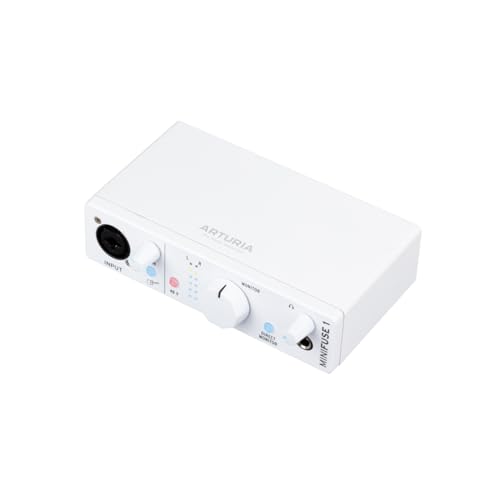
- Audio interface with 5-pin MIDI input and output
- 192 kHz support, loopback, and balanced outputs
- Includes recording, synth, effects, and sample software
Best For: Beginners and compact home studios needing audio plus MIDI
Most Portable MIDI Option

- One MIDI input and one MIDI output in an integrated cable
- USB bus-powered with no external power supply
- Works with Mac, Windows, and compatible iPad setups
Best For: Mobile MIDI setups and simple computer-to-instrument connections
Best for Expanding Setups
Focusrite Scarlett 4i4 4th Gen

- 4-in/4-out audio interface with MIDI input and output
- Two mic preamps, Hi-Z inputs, and four line inputs
- Auto Gain, Clip Safe, Air mode, and 192 kHz support
Best For: Producers connecting multiple instruments and studio devices
Best MIDI Routing Hub

- Distributes one MIDI input to five MIDI outputs
- Supports clock, SysEx, timecode, MPE, and all MIDI channels
- USB-C power with compact, reinforced housing
Best For: Hardware rigs routing one MIDI source to multiple devices
Best Plug-and-Play Host
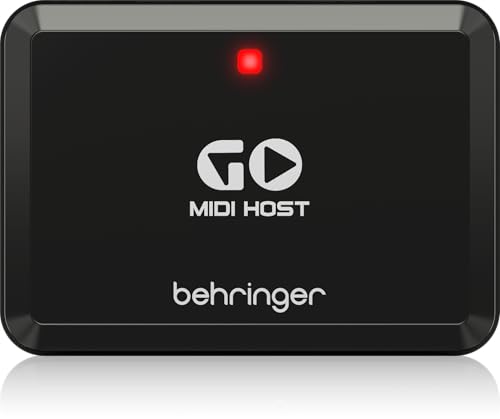
- Simple keyboard-to-USB connectivity
- Compact, single-channel design
- Supports up to 192 kHz
Best For: Straightforward keyboard MIDI/USB setups
Best Advanced Routing

- Standalone 3-in-3-out MIDI
- Router, filter, merge, split, and mapper
- Broad computer and mobile OS support
Best For: Multi-device MIDI routing and configuration
Best Ableton Pad Controller

- 64 RGB pads for clip launching
- Nine assignable faders
- USB-powered Ableton Live control
Best For: Portable Ableton Live production and performance
Best Compact MIDI Host

- Standalone USB host for USB-to-DIN MIDI setups
- Expandable to eight USB MIDI device ports
- Routing, filtering, mapping, and four presets
Best For: Hybrid MIDI rigs, pedalboards, and compact hardware setups
Best Compact Audio/MIDI Interface

- 2-in/2-out USB audio with MIDI I/O
- Two combo inputs, phantom power, and Hi-Z support
- DSP monitoring with included effects and software
Best For: Compact recording setups needing audio and MIDI
Best Expandable Compact MIDI Interface

- Up to 2-in/2-out DIN and 4-in/4-out USB-C MIDI
- USB or 9V DC standalone power options
- Optional WIDI Bluetooth and eight-port USB expansion
Best For: Guitar pedalboards, live rigs, and expandable MIDI systems
Best All-Around Pick – Arturia MiniFuse 1
The Arturia MiniFuse 1 is a compact MIDI interface and USB recording hub for musicians who want straightforward connections for a microphone, instrument, synth, or other MIDI gear. Its plug-and-play workflow, loopback feature, and bundled software make it especially approachable for home recording and content creation.
Best For: Beginners, vocalists, guitarists, and compact home studios needing audio and 5-pin MIDI connectivity.
Pros:
- Includes 5-pin MIDI input and output alongside microphone, instrument, and line connections.
- Supports up to 192 kHz and includes balanced line outputs plus a headphone output.
- Comes with useful software, including Ableton Live Lite, Analog Lab Intro, and effects tools.
- Backed by a five-year warranty and extensive reliability testing.
Cons:
- Its single-channel design is less suitable for recording several sources at once.
- Its 5.9-inch width may be less portable than a dedicated MIDI cable interface.
The MiniFuse 1 is a strong choice when you need more than MIDI alone. It combines essential studio I/O, beginner-friendly software, and a long warranty in a compact desktop format.
Most Portable MIDI Option – Roland UM-ONE-MK2
The Roland UM-ONE-MK2 is a compact MIDI interface in an integrated cable design. This bus-powered one-in/one-out adapter is a practical pick for connecting a keyboard, controller, or other MIDI device to a Mac, Windows computer, or compatible iPad setup without adding a separate power supply.
Best For: Mobile musicians and producers who need a simple one-device MIDI connection.
Pros:
- Very small and lightweight at approximately 3.2 ounces.
- Integrated USB and MIDI cables simplify setup and reduce extra adapters.
- High-performance FPT processing is designed for low latency and tighter clock timing.
- Input and output indicators make MIDI signal flow easy to monitor.
Cons:
- Provides one MIDI input and one MIDI output rather than multiple ports.
- Does not provide audio inputs or outputs for recording microphones or instruments.
- Warranty coverage is shorter than some competing options, at one year for parts and 90 days for labor.
For a straightforward MIDI-only connection, the UM-ONE-MK2 is hard to overlook. Its integrated cable layout and USB bus power keep a small setup clean, though expanding systems will need a more capable interface.
Best for Expanding Setups – Focusrite Scarlett 4i4 4th Gen
The Focusrite Scarlett 4i4 4th Gen is a compact MIDI interface for producers who also need substantial audio I/O. With MIDI in/out, two mic preamps, two Hi-Z inputs, four line inputs, and four line outputs, it provides room for synths, drum machines, guitars, microphones, and studio monitors.
Best For: Producers with multiple instruments or outboard devices who want a capable compact studio hub.
Pros:
- Offers 4-in/4-out operation with MIDI input and output.
- Includes two mic preamps, two Hi-Z instrument inputs, and four line inputs.
- Provides 120 dB dynamic range and up to 24-bit/192 kHz operation.
- Auto Gain and Clip Safe help simplify level setting and reduce clipping concerns.
Cons:
- At 2.2 pounds and 7.09 inches wide, it is less travel-friendly than simpler MIDI adapters.
- Its broader feature set may be more than needed for users who only require basic MIDI connectivity.
- Requires USB-C power equipment included in the package.
The Scarlett 4i4 is the most versatile option here for a growing desktop rig. It costs more space and complexity than a MIDI cable interface, but its flexible routing and audio features make it a better long-term studio centerpiece.
Best MIDI Routing Hub – CME MIDI Thru5 WC
CME MIDI Thru5 WC 1-in-5-out MIDI Thru | 5-pin DIN, High-speed, Optional Bluetooth
Check Price On AmazonThe CME MIDI Thru5 WC is a compact MIDI interface for distributing one MIDI input to as many as five outputs. It is designed for studios, stages, and pedalboards where multiple 5-pin MIDI devices need synchronized data without relying on a computer for MIDI routing.
Best For: Hardware-focused setups that need one MIDI source routed to several devices.
Pros:
- Routes one MIDI input to five standard 5-pin MIDI outputs.
- Supports MIDI channels and messages including notes, controllers, clock, SysEx, timecode, and MPE.
- Uses high-speed optocouplers for low-latency, accurate transmission and ground-loop isolation.
- Compact, lightweight housing suits limited studio, stage, and pedalboard space.
Cons:
- It is a MIDI Thru box, not a USB computer interface for recording audio or MIDI software control.
- The USB-C port is for power only, not data.
- It requires separate MIDI cables and a standard 5V USB power source.
The MIDI Thru5 WC is a focused solution for expanding a hardware MIDI network. Choose it when reliable one-to-five distribution matters more than computer connectivity or audio recording features.
Best Plug-and-Play Host – Behringer GO MIDI HOST
Behringer GO MIDI HOST Compact MIDI/USB Host Interface for Plug-and-Play Connectivity
Check Price On AmazonThe Behringer GO MIDI HOST is a straightforward option for musicians seeking compact midi interfaces for connecting a keyboard to USB-based equipment. Its single-channel design keeps the setup simple, while USB connectivity and Windows compatibility suit basic home and practice rigs.
Best For: Keyboard players who need simple plug-and-play MIDI/USB connectivity.
Pros:
- Compact interface designed for plug-and-play connectivity.
- USB connectivity for compatible keyboard setups.
- Supports a maximum sample rate of 192 kHz.
Cons:
- Only one channel is specified.
- Compatibility details are centered on Windows.
- Its feature set is less expansive than routing-focused interfaces.
This is a practical choice when you want a compact MIDI host without advanced routing requirements. Check that your keyboard and Windows setup match the listed compatibility before buying.
Best Advanced Routing – CME U6MIDI Pro
The CME U6MIDI Pro stands out among compact midi interfaces for its standalone 3-in-3-out MIDI routing and broad device compatibility. It connects through USB-C to computers and mobile devices, while its router, filter, merge, split, and mapping tools give more involved MIDI systems room to grow.
Best For: Musicians and producers managing multiple keyboards, synthesizers, controllers, or MIDI workflows.
Pros:
- Standalone 3-in-3-out MIDI interface with router and filter functions.
- Works with macOS, iOS, Windows, Android, Linux, and Chrome OS.
- Supports MIDI messages including notes, controllers, clock, SysEx, MIDI timecode, and MPE.
- Compact 2.56-by-3.29-by-1.32-inch design weighing 3.49 ounces.
Cons:
- Provides MIDI only rather than audio input.
- Advanced routing requires the UxMIDI Tools software for configuration.
- Its one-year manufacturer warranty is shorter than the lifetime software updates.
Choose the U6MIDI Pro if routing flexibility matters more than audio connectivity. It is especially well suited to compact but complex MIDI setups that need reliable, configurable signal management.
Best Ableton Pad Controller – Akai APC Mini MK2
The Akai Professional APC Mini MK2 is a compact midi interface-style controller for Ableton Live users who want hands-on clip launching and mixing. Its 64 RGB pads, nine assignable faders, and dedicated Drum and Note modes make it more of a performance controller than a traditional MIDI I/O box.
Best For: Ableton Live producers, loopers, and performers who want portable clip and mixer control.
Pros:
- 64 RGB pads provide visual feedback for clip launching.
- Nine assignable faders support hands-on mixer and device control.
- Includes Drum and Note modes with Ableton Live integration.
- USB-powered plug-and-play operation requires no battery or power adapter.
Cons:
- Its listed software integration is focused on Ableton Live.
- It is a controller, not a traditional multi-port MIDI interface.
- USB 2.0 Type-B is the listed hardware connector.
The APC Mini MK2 is a strong fit for live clip launching and compact Ableton setups, but it should not be confused with a MIDI interface offering multiple DIN inputs and outputs. Choose it for tactile performance control rather than MIDI routing.
Best Compact MIDI Host – CME H2MIDI Pro
The CME H2MIDI Pro is one of the most compact MIDI interfaces for connecting modern USB MIDI gear with traditional 5-pin DIN hardware. Its standalone USB host capability, USB-C computer connection, and routing tools make it useful for hybrid rigs without requiring a computer for every setup.
Best For: Musicians and producers who need a tiny USB-to-DIN MIDI host for keyboards, controllers, synths, drum machines, or pedalboard setups.
Pros:
- Connects class-compliant USB MIDI devices directly to 5-pin DIN hardware without a computer.
- Supports up to eight USB MIDI device ports through a standard USB hub.
- Offers routing, filtering, mapping, splitting, and four saved presets through HxMIDI Tools.
- Works with macOS, Windows, iOS, Android, Linux, and ChromeOS.
Cons:
- Provides one-in/one-out 5-pin DIN MIDI connectivity.
- Advanced routing requires the HxMIDI Tools software.
Choose the H2MIDI Pro when minimum size and flexible USB hosting matter more than audio connectivity. Its 32-bit processing and support for complex MIDI data make it a capable control hub for compact or hybrid systems.
Best Compact Audio/MIDI Interface – Yamaha URX22C
The Yamaha URX22C is a practical choice among compact MIDI interfaces when you also need recording and monitoring features. It combines 2-in/2-out USB audio, MIDI I/O, two combo inputs, and DSP-powered effects in a rugged full-metal enclosure.
Best For: Home producers, vocalists, instrumentalists, and mobile creators who need compact audio recording with MIDI connectivity.
Pros:
- Provides 2-in/2-out audio with MIDI I/O and USB-C connectivity.
- Includes two XLR/TRS combo inputs with Class-A D-PRE preamps and +48 V phantom power.
- Offers one Hi-Z input and DSP-powered latency-free monitoring.
- Includes REV-X reverb, Channel Strip, Guitar Amp Classics, and Steinberg software.
Cons:
- Its focus is audio recording rather than standalone USB MIDI hosting.
- Compatibility is listed for Windows, macOS, and iOS rather than a broader range of operating systems.
The URX22C is the better fit if “MIDI interface” also needs to mean a capable audio front end. Its two combo inputs, Hi-Z support, and built-in monitoring effects give compact recording setups more functionality than a MIDI-only box.
Best Expandable Compact MIDI Interface – CME H4MIDI WC
The CME H4MIDI WC is a compact MIDI interface designed for more demanding hardware and pedalboard configurations. It adds dual standalone power options, two-way MIDI connectivity, four virtual USB-C MIDI ports, and optional WIDI Bluetooth expansion.
Best For: Guitarists, performers, and producers building expandable MIDI rigs for cramped studio spaces, pedalboards, or live use.
Pros:
- Hosts up to eight USB MIDI devices through a standard USB hub without a computer.
- Provides up to 2-in/2-out DIN MIDI and 4-in/4-out virtual MIDI over USB-C.
- Supports 5V USB or 9V DC standalone power for flexible stage and studio use.
- Offers advanced routing plus optional WIDI Bluetooth MIDI through the WIDI Core module.
Cons:
- WIDI Bluetooth functionality requires the optional WIDI Core module.
- Its wider enclosure is less minimal than the H2MIDI Pro.
- Configuration relies on HxMIDI Tools for advanced routing and processing.
The H4MIDI WC makes sense when a compact MIDI interface must handle expansion, standalone power, and more virtual ports. It is especially well suited to guitarists and performers who may need to change between several saved configurations.
How We Picked These Compact Midi Interfaces
We compared the selected devices by connection type, MIDI input and output count, computer and hardware compatibility, portability, and workflow flexibility. The roundup includes straightforward USB MIDI adapters as well as host interfaces and audio interfaces with MIDI built in, so different kinds of musicians can find a practical match.
We also considered how easily each product fits into a compact setup. A simple cable may be ideal for one keyboard, while a multi-port interface or MIDI thru box makes more sense for several hardware instruments. Features such as USB host support, routing, MIDI thru connections, USB-C, audio I/O, and bundled software can make a meaningful difference depending on your setup.
Quick Comparison
- For basic computer-to-MIDI connection: Roland UM-ONE-MK2 is a simple cable-style option.
- For MIDI routing and multiple devices: CME U6MIDI Pro and CME H4MIDI WC offer more flexible connectivity.
- For sending one MIDI signal to several instruments: CME MIDI Thru5 WC is designed for MIDI distribution.
- For connecting USB MIDI devices without a computer: Behringer GO MIDI HOST and CME H2MIDI Pro are useful host-interface choices.
- For recording audio and MIDI together: Focusrite Scarlett 4i4, Yamaha’s USB-C audio/MIDI interface, and Arturia MiniFuse 1 combine studio audio with MIDI connectivity.
- For hands-on clip and pad control: Akai APC Mini MK2 is a controller rather than a traditional MIDI interface, but it can be a strong centerpiece for computer-based performance.
Key Buying Factors for Compact Midi Interfaces
Ports and Signal Direction
Check whether you need MIDI input, MIDI output, or both. A one-in/one-out connection is enough for a single keyboard, but multiple synths may require several ports or a MIDI thru device. Pay attention to whether the listed connections are DIN MIDI, USB MIDI, or USB host ports, since they serve different purposes.
Computer Versus Hardware-Host Compatibility
Most USB MIDI interfaces expect a computer, tablet, or compatible host. A USB host interface is different: it can let USB MIDI gear communicate with traditional MIDI hardware without relying on a computer. Confirm power requirements and device compatibility before buying.
Audio Needs
If you also record microphones, instruments, or line-level hardware, an audio interface with MIDI may be more useful than a dedicated MIDI adapter. Look for the required input count, monitoring features, driver support, and operating-system compatibility.
Expansion and Desk Space
Compact gear saves room, but limited ports can become restrictive as your setup grows. Choose a little extra capacity if you expect to add synths, controllers, or external effects. For several identical destinations, a dedicated MIDI thru box can be cleaner than chaining devices.
Who Should Buy Which Compact Midi Interfaces?
Choose a basic MIDI cable if you only need to connect one traditional MIDI instrument to a computer. Pick a multi-port MIDI interface if you are building a hardware-focused setup and need independent inputs, outputs, or routing. A USB host interface is the better choice when you want to connect USB MIDI equipment directly to standalone hardware.
Musicians who need microphone or instrument recording should consider an audio/MIDI interface such as the MiniFuse, Scarlett, or Yamaha model. Producers working in Ableton Live or similar software may prefer the APC Mini MK2 for tactile pad and clip control. Before ordering, verify connector types, power requirements, software support, and the number of simultaneous MIDI connections your setup actually needs.