The best compact power amplifiers deliver useful power and flexible connectivity without taking over your desk, shelf, vehicle, or installation space. This roundup compares 10 options across stereo home audio, Bluetooth playback, car systems, bass shakers, and 70V/100V-style public address applications.
Use the buying guide below to match amplifier power, impedance support, inputs, output type, and installation needs to your speakers and listening environment.
Best 10 Compact Power Amplifiers Picks for 2026
Best High-Power Desktop Pick

- 300 watts per channel
- Bass and treble controls
- RCA connectivity for passive speakers
Best For: High-output desktop and small-room stereo systems
Best Compact Car Audio Option

- Four-channel Class D design
- 45 watts per channel at 4 ohms
- High/low-level inputs and filters
Best For: Space-limited vehicle audio upgrades
Best Balanced Hi-Fi Pick

- 140 watts per channel at 4 ohms
- Balanced TRS and RCA inputs
- Ultra-low stated distortion
Best For: Compact Hi-Fi and studio-monitoring systems
Best Small PA System Pick

- 40-watt compact PA amplifier
- 70V, 25V, 8-ohm, and COM outputs
- Two mic inputs with talkover
Best For: Small indoor PA and announcement systems
High-Fidelity Mini Powerhouse
AIYIMA A07 Premium TPA3255 Stereo Amplifier

- Up to 300W x 2 with the right power supply
- Pre-out supports a powered subwoofer or active speakers
- Swappable op-amp and full-metal cooling design
Best For: Compact high-power desktop or small-room passive-speaker systems
Versatile PA Control Center

- 60W output with 4/8/16-ohm, 25V, and 70V options
- Two microphone inputs with MIC 1 talkover
- Paging, telephone, AUX, and music-on-hold connections
Best For: Office, shop, and small distributed-speaker PA systems
Wireless Stereo Flexibility
Fosi Audio BT20A Pro Bluetooth Amplifier
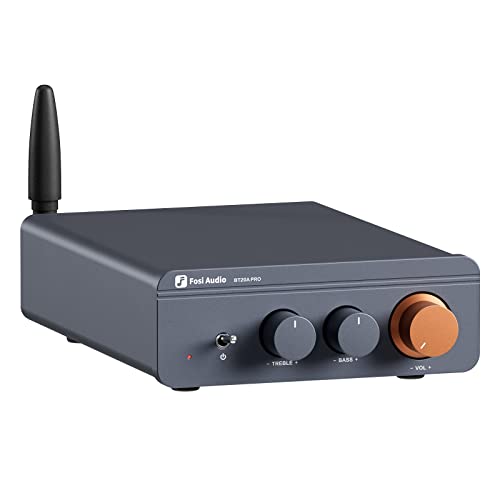
- Bluetooth 5.0 with pairing memory
- Up to 300W x 2 using a TPA3255 design
- Bass, treble, and replaceable op-amp options
Best For: Wireless passive-speaker stereo systems with adjustable sound
Best Simple Hi-Fi Option
Fosi Audio V1.0G Stereo Amplifier

- Two-channel Class D design
- Up to 50W per channel
- Compact aluminum chassis
Best For: Quiet, wired home speaker systems
Best High-Power Desktop Pick – Fosi Audio TB10D
The Fosi Audio TB10D is one of the more capable compact power amplifiers for driving passive bookshelf speakers or a bass shaker. Its Class D design delivers up to 300 watts per channel, while RCA connectivity and adjustable bass and treble controls make it easy to fit into a desktop, living-room, or small home-theater system.
Best For: Listeners who want substantial power and simple tone control in a compact stereo amplifier.
Pros:
- Up to 300 watts per channel with the TPA3255 chip
- Works with 2–8 ohm passive speakers
- RCA input, passive speaker output, and bass/treble controls
- Built-in protection circuits and a 24-month manufacturer warranty
Cons:
- Provides RCA connectivity rather than balanced inputs
- Designed for passive speakers, so it does not directly power active speakers
The TB10D stands out when compact size matters but output headroom matters more. It is a practical choice for users building a flexible stereo or bass-shaker setup around RCA-equipped sources.
Best Compact Car Audio Option – Sony XMS400D
The Sony XMS400D is a space-conscious four-channel Class D amplifier suited to vehicle audio installations. It supplies 45 watts per channel at 4 ohms and includes both high- and low-level inputs, making it useful when upgrading a factory or aftermarket system without adding a large amplifier.
Best For: Car audio users who need four-channel amplification in a compact chassis.
Pros:
- Four-channel output at 45 watts per channel into 4 ohms
- Compact 1.8-pound design
- High- and low-level input connections
- Built-in high-pass and low-pass filters plus protection circuitry
Cons:
- Lower per-channel output than the higher-powered stereo models here
- Its one-year warranty is shorter than the Fosi Audio model’s warranty
With four channels, filtering, and high-level sensing power-on, the XMS400D is focused on straightforward vehicle integration. Choose it when installation space and system compatibility are more important than maximum power.
Best Balanced Hi-Fi Pick – TOPPING Mini300
The TOPPING Mini300 is a premium-minded choice among compact power amplifiers, combining a fully balanced Class D architecture with up to 140 watts per channel at 4 ohms. Balanced TRS and unbalanced RCA inputs support flexible desktop, DAC, preamp, and studio-monitoring setups.
Best For: Hi-Fi listeners and studio users who value low distortion, balanced connectivity, and a compact aluminum chassis.
Pros:
- Up to 140 watts per channel at 4 ohms
- Very low stated distortion and 124dB SNR/DNR
- Balanced TRS and unbalanced RCA inputs
- TRIG power synchronization and overheat/overcurrent protection
Cons:
- Requires a suitable preamp, DAC, or source component for system control
- One-year manufacturer warranty
The Mini300 is best suited to carefully assembled desktop or nearfield systems where clean signal handling and connection flexibility matter. Its small aluminum enclosure also makes it easy to place alongside modern audio components.
Best Small PA System Pick – Pyle PCM20A
The Pyle PCM20A is a practical compact power amplifier for small public-address and distributed-speaker setups. It provides 40 watts of output with common COM, 8-ohm, 25V, and 70V speaker connections, plus two microphone inputs and an auxiliary input for announcements or background audio.
Best For: Small indoor PA systems, announcements, and installations using 8-ohm or 70V speakers.
Pros:
- Supports COM, 8-ohm, 25V, and 70V speaker outputs
- Two microphone inputs with MIC 1 talkover priority
- Independent input volume controls and front-panel operation
- Includes bass and treble controls, LED indication, and a replaceable fuse
Cons:
- Its 40-watt rating is intended for small systems rather than high-output venues
- Bulkier than the smallest desktop stereo amplifiers
- Its feature set is oriented toward PA use rather than high-fidelity balanced audio
The PCM20A makes the most sense when microphone control and distributed-speaker compatibility are priorities. Its multiple speaker taps and talkover function give it practical flexibility for small rooms, shops, and announcement systems.
High-Fidelity Mini Powerhouse – AIYIMA A07 Premium TPA3255 Stereo Amplifier
For listeners seeking compact power amplifiers with serious stereo output, the AIYIMA A07 pairs a TI TPA3255 Class D chip with a 32V/5A adapter and a compact metal enclosure. It drives 2–8 ohm passive speakers and includes a volume-controlled 3.5 mm pre-out for adding powered speakers or a subwoofer.
Best For: Desktop and small-room stereo systems where high output, a small footprint, and upgradeable op-amp options matter.
Pros:
- Up to 300W x 2 output with a suitable power supply
- 3.5 mm pre-out supports powered speakers or a powered subwoofer
- Swappable NE5532 op-amps allow sound-system experimentation
- Full-metal housing and enhanced cooling system
Cons:
- Does not support Wi-Fi
- Maximum output requires an upgraded power supply; the included adapter is 32V/5A
- Designed for passive speakers rather than an all-in-one speaker system
The A07 is a strong fit when you want compact dimensions without giving up substantial stereo power. Its pre-out and replaceable op-amp design also give a straightforward upgrade path as your system develops.
Versatile PA Control Center – Pyle PCM30A 60W PA Amplifier
The Pyle PCM30A is one of the more practical compact power amplifiers for paging, office audio, and small public-address setups. Its 60-watt design supports 4-, 8-, and 16-ohm speakers as well as 25V and 70V outputs, with multiple input and control options.
Best For: Offices, shops, and small PA installations needing microphone inputs, paging functions, and distributed-speaker compatibility.
Pros:
- Supports conventional speaker loads plus 25V and 70V outputs
- Five input functions include AUX, two microphone terminals, paging, and telephone connections
- MIC 1 offers automatic talkover for announcements
- Independent input controls and front-panel bass and treble adjustment
Cons:
- 60 watts is intended for modest systems rather than high-power stereo listening
- Its feature set is focused on PA and paging rather than Bluetooth streaming
- It is larger than the smallest desktop mini amplifiers
Choose the PCM30A when connection flexibility and announcement features are more important than audiophile simplicity. The 25V/70V outputs and paging terminals make it particularly suitable for fixed commercial or office audio.
Wireless Stereo Flexibility – Fosi Audio BT20A Pro Bluetooth Amplifier
The Fosi Audio BT20A Pro brings Bluetooth convenience to the compact power amplifiers category while retaining a TI TPA3255-based stereo design. It offers up to 300W x 2, bass and treble controls, and replaceable op-amps for listeners who want a small wireless amp with room to personalize.
Best For: Bluetooth-enabled home or outdoor stereo setups using passive speakers and a preference for adjustable tone controls.
Pros:
- Bluetooth 5.0 provides wireless playback with pairing memory
- Up to 300W x 2 output from the TPA3255-based design
- Replaceable NE5532 op-amps support several upgrade choices
- Dedicated bass and treble controls provide straightforward sound adjustment
Cons:
- Requires passive speakers; speakers are not included
- The stated maximum output depends on the system and supplied 32V/5A power adapter
- Its wireless feature set is Bluetooth-focused rather than Wi-Fi-based
The BT20A Pro is a convenient choice for a clean, compact stereo setup where wireless playback matters. Its tone controls and op-amp compatibility make it more adaptable than a basic Bluetooth amplifier.
Best Compact Bluetooth Pick – Facmogu F900S Mini Amplifier
The Facmogu F900S is one of the more versatile compact power amplifiers for desktop systems, workshops, RVs, and other tight spaces. Its two-channel design delivers up to 50W per channel and accepts Bluetooth 5.0, USB, or 3.5mm AUX sources.
Best For: Buyers who want wireless and wired input flexibility in a small amplifier for passive bookshelf or stereo speakers.
Pros:
- Up to 50W x 2 stereo output with an upgraded TPA3116 chip.
- Bluetooth 5.0, USB, and 3.5mm AUX inputs support common audio sources.
- Small footprint suits desktops, racing simulators, RVs, garages, and workshops.
- Includes a 12V power adapter and several audio cables.
Cons:
- Not compatible with Amazon Echo or Alexa.
- The power-on sound cannot be changed, and USB/Bluetooth mode announcements may be noticeable.
The F900S is a practical choice when you need compact size without giving up connection options. It is especially convenient for space-limited setups that use passive speakers.
Best Simple Hi-Fi Option – Fosi Audio V1.0G Stereo Amplifier
The Fosi Audio V1.0G is a straightforward two-channel choice among compact power amplifiers for home speakers. It uses a TPA3116D2 Class D design, an aluminum chassis, and a supplied power setup aimed at efficient, quiet operation.
Best For: Home listeners who want a minimalist wired stereo amplifier with a solid aluminum enclosure and low idle noise.
Pros:
- Two-channel Class D amplification rated at up to 50W per channel.
- TPA3116D2 circuitry is designed for efficient operation and improved audio performance.
- Built-in speaker protection circuit and aluminum chassis add practical appeal.
- Compact 5 x 3 x 1-inch form factor fits easily into small audio systems.
Cons:
- Compared with the other listed models, the supplied notes do not mention Bluetooth, USB, or AUX inputs.
- Its listed power specifications vary between the 50W output rating and 100W maximum rating, so expectations should be set accordingly.
The V1.0G focuses on uncomplicated stereo amplification rather than extensive connectivity. It makes sense for a dedicated wired setup where compact dimensions, efficient Class D operation, and a metal enclosure matter most.
Best Ready-to-Use Wireless Value – Nobsound Mini Bluetooth Amplifier
The Nobsound Mini Bluetooth amplifier is a convenient all-in-one option for compact power amplifier setups. It provides up to 50W per channel, Bluetooth 5.0, USB, and AUX inputs, plus the cables and 19V power supply needed for a quick installation.
Best For: Desktop, office, and home listeners who want a small wireless amplifier that is ready to connect out of the box.
Pros:
- Up to 100W total output, rated at 50W x 2.
- Bluetooth 5.0 provides a faster, more stable wireless connection than the earlier version.
- USB playback works without a driver and is described as lossless when connected to a computer.
- Includes a 19V power supply, AUX, USB, RCA cables, and manual.
Cons:
- The supplied specifications list multiple voltage values, so users should follow the included power-supply requirements.
- Its compact enclosure and included accessories are best suited to smaller passive-speaker systems rather than large installations.
With its broad input selection and complete accessory bundle, the Nobsound is an appealing choice for buyers who want minimal setup work. Its small aluminum body also makes it easy to place on a desk or shelf.
How We Picked These Compact Power Amplifiers
We selected models that combine a small footprint with a clear use case, practical connectivity, and specifications suited to their intended application. The lineup includes compact Class D stereo amplifiers, Bluetooth-enabled mini amps, a four-channel automotive amplifier, and public address models with microphone and distributed-audio outputs.
Power ratings were considered alongside speaker impedance, cooling requirements, input options, output configuration, and ease of installation. Because manufacturers may measure wattage under different conditions, rated power should be treated as a comparison point rather than a guarantee of identical real-world performance.
Quick Comparison
| Best For | Look For |
|---|---|
| Desktop or small-room stereo | Two-channel Class D design, RCA or AUX input, suitable impedance support |
| Wireless listening | Bluetooth 5.0 or newer, convenient controls, stable antenna placement |
| High-output passive speakers | Higher continuous power, adequate cooling, and a suitable power supply |
| Car audio upgrades | Multiple channels, automotive power compatibility, and correct wiring |
| Public address systems | 70V/100V outputs, microphone inputs, and mixer-style controls |
| Bass shakers | Dedicated channel capacity, compatible impedance, and safe low-frequency operation |
Key Buying Factors for Compact Power Amplifiers
Power and Speaker Impedance
Match the amplifier’s output rating to the speakers’ nominal impedance. A higher advertised wattage is not automatically better; excessive power can damage speakers, while an undersized amplifier pushed into clipping can also create problems. Check whether ratings are specified at 4 or 8 ohms and whether they apply to one or both channels.
Inputs and Wireless Features
RCA and AUX inputs suit traditional sources, while Bluetooth adds convenient phone and tablet playback. USB can be useful, but verify whether it accepts audio data or only supplies power. If the amplifier will connect to a television, check for the required analog or digital output, since many mini amps do not include optical or HDMI inputs.
Output Type and Installation
Standard speaker terminals are appropriate for ordinary passive speakers. Public address amplifiers with 70V or 100V outputs are designed for distributed speaker systems and should not be treated like conventional low-impedance stereo amps. Car amplifiers also require vehicle-compatible power wiring, fusing, and ventilation.
Size, Cooling, and Controls
Compact Class D designs are efficient, but they still need airflow. Avoid enclosing an amplifier tightly or covering its vents. Front-panel volume and source controls are useful for desktop setups, while remote placement may favor Bluetooth or a preamp output.
Who Should Buy Which Compact Power Amplifiers?
Choose a simple two-channel mini amplifier for bookshelf speakers, a desk system, or a small room. Pick a Bluetooth model when wireless convenience matters most. For demanding passive speakers, prioritize verified power, impedance compatibility, and cooling over headline wattage.
Car owners should select a dedicated multi-channel automotive model and follow its wiring requirements. Businesses, classrooms, shops, and other distributed-audio installations should choose a public address amplifier with the correct 70V or 100V output and enough microphone inputs. For the safest choice, start with your speakers’ impedance and input requirements, then select the smallest amplifier that provides the needed headroom and features.