Live lighting can make a band’s performance feel more polished, but the right controller depends on your fixture count, venue size, programming needs, and how much automation you want.
These DMX controllers for bands cover practical options for rehearsal spaces, small stages, mobile DJs, clubs, and touring setups. Use the guide below to narrow the list by control style, connectivity, and expansion potential.
Best 10 Dmx Controllers for Bands Picks for 2026
Software-Driven Pick

- Live audio BPM detection
- Two DMX universes with Thru
- Tactile pads, encoders, and touch strip
Best For: Bands wanting software-assisted, hands-on lighting control
Scene-Programming Choice

- 192 DMX channels for 12 fixtures
- Stores up to 240 scenes
- Includes fog, strobe, and MIDI control
Best For: Bands running programmed scenes across several fixtures
Wireless Rackmount Pick
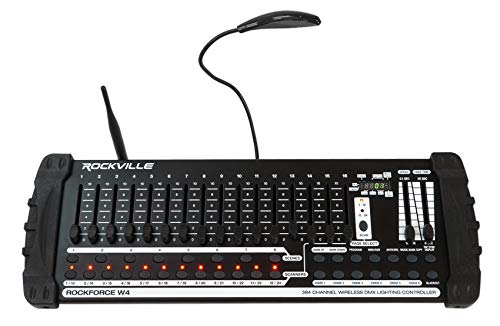
- 384 channels for up to 24 lights
- Built-in 2.4GHz wireless transmission
- MIDI, music sync, and manual override
Best For: Mobile bands with larger compatible lighting rigs
Budget 384-Channel Option

- 384 DMX channels
- 30 banks with eight scenes each
- Controls up to 24 fixtures
Best For: Bands wanting conventional programmed scene control
Best Wireless Setup
Wireless DMX Transmitter and Receivers

- One transmitter and two receivers
- Seven group IDs for separate rigs
- Up to 1,000-foot claimed range
Best For: Bands needing wireless links between DMX equipment
Best Full-Featured Console
CO-Z 192-Channel DMX Controller

- 192 channels for up to 12 fixtures
- Stores up to 240 scenes
- Includes fixture, scene, and speed controls
Best For: Bands programming larger multi-fixture lighting rigs
Best Compact Option

- Controls up to 12 DMX channels
- Portable aluminum design
- Standard three-pin XLR output
Best For: Small-stage bands with compact DMX lighting rigs
Best Value Manual Control

- Controls up to 12 intelligent lights
- Eight sliders for live adjustments
- Programmable scenes and chases
Best For: Small bands and compact stage lighting rigs
Best Wireless Flexibility

- 384-channel DMX512 control
- 2.4G wireless and wired modes
- Sound, MIDI, auto, and manual control
Best For: Bands needing flexible stage layouts and synchronized effects
Best for Voice-Controlled Scenes

- Voice control for scene switching
- Up to 240 programmable scenes
- Detailed step timing and transitions
Best For: Small bands seeking accessible scene programming
Software-Driven Pick – SoundSwitch Control One
For bands seeking flexible dmx controllers for bands, the SoundSwitch Control One combines tactile hardware with software-based lighting control. It supports live audio BPM detection, making it useful for syncing lights to a band, DJ setup, DAW, or other external audio source.
Best For: Bands and performers who want software-assisted, real-time lighting control with hands-on adjustments.
Pros:
- Supports live audio BPM detection for external audio sources, including live bands.
- Provides two DMX universes with input, output, and Thru options.
- Offers touch-strip control, encoders, and customizable RGB performance pads.
- Works directly with compatible Engine DJ devices without a computer.
Cons:
- Many expanded features require SoundSwitch software and, for some setups, a laptop.
- Its compact control surface may be less suited to operators who prefer many dedicated faders.
The Control One is the most performance-oriented option here for musicians who want lighting changes to follow live audio while retaining manual control over intensity, color, strobes, moving heads, and other effects.
Scene-Programming Choice – CHAUVET DJ OBEY40
The CHAUVET DJ OBEY40 is a practical choice among dmx controllers for bands that need structured scene playback. It controls up to 12 fixtures with 16 channels each and includes substantial storage for programmed scenes and chases.
Best For: Bands using multiple intelligent lights, fog, or strobe effects with preprogrammed looks.
Pros:
- Controls up to 12 fixtures and provides 192 DMX channels.
- Stores up to 240 scenes across 30 banks and supports six chases.
- Includes dedicated fog and strobe control.
- MIDI compatibility and reversible sliders add integration and operating flexibility.
Cons:
- It offers fewer fixture channels than the 384-channel alternatives in this roundup.
- The product is designed around programmed scenes and chases rather than software-based live audio automation.
Choose the OBEY40 when repeatable scene changes matter more than wireless operation or computer-based control. Its banks and chases can help a band run consistent lighting cues from show to show.
Wireless Rackmount Pick – Rockville ROCKFORCE W4
The Rockville ROCKFORCE W4 stands out among dmx controllers for bands that want broad fixture capacity and wireless control. Its built-in 2.4GHz transmitter, wired DMX connections, MIDI support, and music-synced operation suit mobile or professional stage setups.
Best For: Touring or mobile bands controlling numerous compatible fixtures without running DMX cables to every light.
Pros:
- Controls up to 24 intelligent lights across 384 DMX channels.
- Wireless transmitter supports up to seven light groups and 25 receivers.
- Includes 30 banks, six chases, 240 scenes, and 16 sliders.
- Offers MIDI, built-in microphone music sync, manual override, and wired DMX in/out.
Cons:
- Wireless compatibility is specified for Rockville, Chauvet, and American DJ lights.
- Its 20.7-inch rackmountable design is less compact than a small tabletop controller.
With both wireless and wired connectivity, the ROCKFORCE W4 is a versatile fit for bands with larger lighting rigs. The scene, chase, and manual controls also give an operator several ways to manage a live performance.
Budget 384-Channel Option – DMX512 DJ Controller
This DMX512 DJ Controller is a straightforward option for bands comparing dmx controllers for bands on the basis of channel capacity and scene storage. It provides 384 channels, 30 banks of eight programmable scenes, and control for 24 fixtures.
Best For: Bands needing a basic console for programmed stage-lighting scenes and transitions.
Pros:
- Provides 384 DMX channels for detailed fixture control.
- Supports 30 banks with eight programmable scenes each.
- Designed for 24 fixtures and DMX512 control.
- Compact construction includes side handles and an LED gooseneck light.
Cons:
- The supplied notes do not identify wireless, MIDI, or audio-sync functionality.
- Its feature documentation is less extensive than the more fully specified controllers in this list.
This controller makes sense when the priority is a high channel count and programmable scenes in a conventional console format. It is best evaluated as a basic programmed-lighting solution rather than an integrated live-audio system.
Best Wireless Setup – Wireless DMX Transmitter and Receivers
For bands that need flexible stage layouts, this wireless DMX set can reduce cable runs between a lighting controller and compatible fixtures. It includes one transmitter, two receivers, power adapters, seven group IDs, and a claimed range of up to 1,000 feet, making it a practical option among DMX controllers for bands with multiple lighting positions.
Best For: Bands, mobile performers, DJs, and event setups that need wireless DMX links for moving heads, PAR lights, or other compatible fixtures.
Pros:
- Includes one transmitter and two receivers for linking multiple lighting locations.
- Seven independent group IDs can help separate lighting rigs in the same venue.
- 2.4G frequency hopping is designed for stable, delay-free signal transmission.
- Power adapters are included, supporting continuous operation without battery recharging.
Cons:
- Every unit requires a power adapter; the system is not battery-powered.
- This is a wireless DMX transmission set rather than a standalone scene-programming console.
Choose this system when eliminating long DMX cable runs is more important than having onboard faders or scene controls. Confirm that your existing controller and fixtures use compatible DMX connections and that power is available at each receiver location.
Best Full-Featured Console – CO-Z 192-Channel DMX Controller
The CO-Z 192 DMX console gives bands a more hands-on way to manage intelligent lighting, scenes, and effects. Its 192 channels can control up to 12 fixtures with up to 16 channels each, while 240 available scenes provide room for more involved show programming.
Best For: Bands, DJs, clubs, churches, and event operators building programmed lighting scenes across multiple DMX fixtures.
Pros:
- Controls up to 12 intelligent lights with up to 16 channels per fixture.
- Supports up to 240 scenes for complex show arrangements.
- Dedicated controls include fixture selection, scene switching, channel selection, and speed/time adjustment.
- Voice control is available for switching among lighting scenes.
Cons:
- Its larger console format is less convenient for highly portable setups.
- The interface may offer more controls than a small band needs for a simple lighting rig.
- It uses corded electric power.
This is the strongest fit of the three for bands that want a conventional lighting mixer with scene and fixture control. Its channel capacity is useful for expanding rigs, but plan your fixture addressing and programming before a show.
Best Compact Option – MAD OWL 12-Channel DMX Dimmer
The MAD OWL 12-channel controller is a compact choice for bands running a small DMX512 lighting rig. Six sub-control faders plus a master fader provide direct adjustment, and its portable aluminum design is suited to quick setup and travel.
Best For: Small-stage bands and performers using DMX fixtures with no more than 12 channels.
Pros:
- Controls up to 12 DMX512 channels with six sub-faders and a master fader.
- Compact, lightweight design is convenient for transport and quick installation.
- One-key black-field function supports straightforward operation.
- Uses a standard three-pin XLR DMX output.
Cons:
- It cannot be used with stage lighting equipment requiring more than 12 channels.
- It is a basic dimming controller rather than a larger scene-programming console.
- A compatible DMX-controlled dimming power supply may be needed for a permanent control system.
For a small band setup, this controller keeps operation simple and portable. Check the channel requirements of every fixture first; the 12-channel limit makes compatibility the key consideration.
Best Value Manual Control – 192-Channel DMX Controller
For bands looking for practical dmx controllers for bands, this 192-channel console offers hands-on control of multiple fixtures without an overly complex setup. It supports up to 12 intelligent lights, with eight sliders for real-time adjustments and programmable scenes and chases for repeatable show cues.
Best For: Bands and small-stage performers who want affordable, fader-based control for par lights, strobes, fog machines, and similar 3-pin DMX fixtures.
Pros:
- Controls up to 12 intelligent lights with up to 16 channels each.
- Includes 30 banks of eight programmable scenes and six programmable chases.
- Eight sliders provide direct manual channel control during performances.
- Supports auto operation with speed and fade-time controls.
Cons:
- Uses a 3-pin XLR connection and may require suitable adapters for other setups.
- Its 192-channel layout may be limiting for larger, fixture-heavy productions.
This is a straightforward choice when your band needs reliable manual control and programmable cues at a relatively accessible feature level. It is best suited to compact rigs rather than highly expansive lighting systems.
Best Wireless Flexibility – 384-Channel DMX Controller
This 384-channel model is a flexible option among dmx controllers for bands, particularly when a live setup benefits from wireless placement. It combines 2.4G wireless transmission with traditional 3-pin XLR operation, plus sound-activated, MIDI, automatic, and manual control modes.
Best For: Bands playing weddings, bars, live houses, and indoor stages where wireless fixture placement, music synchronization, or MIDI control is useful.
Pros:
- Provides 384 DMX channels and supports up to 12 intelligent lights.
- Offers both 2.4G wireless and wired 3-pin XLR operation.
- Includes sound-activated, MIDI, auto, and manual control modes.
- Stores 30 banks and 240 programmable static scenes.
Cons:
- The wireless mode requires compatible wireless lighting equipment.
- Its broader feature set may take more time to learn than a basic controller.
With the highest channel count in this selection and multiple operating modes, this controller gives bands room to build more flexible lighting arrangements. It is especially appealing for performers who want sound-responsive effects or fewer cables on stage.
Best for Voice-Controlled Scenes – 192-Channel Stage Console
For performers wanting approachable programming, this 192-channel console is a practical pick among dmx controllers for bands. It handles up to 12 fixtures, supports voice control, and lets you create scenes with adjustable step timing for more customized lighting transitions.
Best For: Amateur and personal-use performers who want organized controls, voice-activated scene changes, and programmable effects for small shows or gatherings.
Pros:
- Controls up to 12 intelligent lights and up to 240 scenes.
- Voice control can switch between lighting scenes.
- Allows up to 40 steps per scene with adjustable pause and fade timing.
- Upgraded buttons and control sticks are designed for smoother operation.
Cons:
- Provides 192 channels, so larger lighting rigs may outgrow its capacity.
- Voice control may be less suitable in noisy live environments.
- The notes specify a 3-core XLR DMX output, so connection compatibility should be checked.
This controller stands out for its voice-control feature and detailed scene timing rather than wireless operation. It makes sense for smaller bands that value straightforward programming and creative transitions over a higher channel count.
How We Picked the Best Dmx Controllers for Bands
We compared these controllers by channel capacity, fixture support, programming flexibility, portability, connection options, and suitability for live operation. We also considered whether a controller supports wireless DMX, MIDI, sound activation, or software integration, since bands often need to trigger lighting while performing rather than manage every scene manually.
Basic consoles can be a good value for straightforward PAR-can and dimmer setups. More advanced units are better suited to moving heads, multiple fixture groups, and shows that require repeatable scenes or rapid changes.
Quick Comparison
| Controller Type | Best For | Main Advantage |
|---|---|---|
| Software-oriented controller | Automated live shows | Detailed programming and show control |
| Wireless DMX controller | Mobile stages and quick setups | Fewer cables between control points and fixtures |
| 192-channel console | Small bands and basic rigs | Simple manual scene control |
| 384-channel console | Larger fixture packages | More room for fixtures and programming |
| Compact dimmer controller | Minimal lighting rigs | Low cost and easy transport |
Key Buying Factors for Dmx Controllers for Bands
Channel and Fixture Capacity
Check the DMX channel count against the total channels used by every fixture. A moving head may require far more channels than a simple PAR light, so leave extra capacity for future additions.
Programming and Live Control
Look for scene banks, chases, fixture buttons, faders, and blackout controls that can be reached quickly in a dark venue. If lighting must follow songs or set sections, MIDI or software support can make cues easier to repeat.
Wired Versus Wireless DMX
Wired DMX is usually the predictable choice for permanent or carefully managed installations. Wireless systems can speed up setup and reduce cable runs, but verify range, receiver compatibility, interference resistance, and whether the controller can also operate conventionally by cable.
Portability and Reliability
For touring bands, consider enclosure size, power requirements, connector layout, and how safely the unit can be packed. A compact controller is useful only if its controls remain practical with your actual fixture setup.
Who Should Buy Which Dmx Controllers for Bands?
Small bands with a few PAR lights: Choose a compact 192-channel or mini controller with straightforward faders and scene controls.
Bands using moving heads or expanding rigs: A 384-channel controller offers more programming space and fixture capacity.
Mobile performers and quick-change venues: Consider a wireless or dual-mode controller, especially when reducing DMX cable runs saves setup time.
Performers who want synchronized shows: Prioritize MIDI or software-compatible control so lighting cues can be tied to playback, foot control, or a performance workflow.
Hands-off or automated setups: A software-focused system is worth considering when you need reusable timelines, dynamic effects, and more precise show design than a basic console provides.