Choosing the right DMX controller can make the difference between smooth, repeatable lighting cues and a setup that feels difficult to manage. The options in this roundup range from compact beginner boards to software-focused and wireless-capable controllers.
We compare channel capacity, control style, portability, compatibility, and ease of use so you can match your lighting rig to a controller that fits your space, experience level, and performance needs.
Best 10 Dmx Controllers Picks for 2026
Best for Software-Driven Shows

- Two DMX universes with Thru option
- Dual USB and Engine DJ compatibility
- Touch strip, encoders, and RGB pads
Best For: DJs creating synchronized SoundSwitch lighting shows
Best for Basic Dimmer and Relay Control

- Four DMX-512 channels
- Dimming or relay operation per channel
- 0–100% variable electronic dimming
Best For: Small installations needing direct dimmer or relay control
Best for Standalone Operation

- Standalone DMX controller
- 37 backlit silicone buttons
- Up to four universes and four outputs
Best For: Operators wanting dedicated control for multi-universe setups
Best for Scene and Chase Programming

- Controls up to 12 fixtures
- 192 DMX channels
- Stores 240 scenes and supports six chases
Best For: Shows requiring organized scenes and programmed chases
Simple Control
ADJ SDC12 12-Channel DMX Controller

- 12 channel faders plus a master fader
- Portable battery or wall-mounted operation
- 3-pin and 5-pin DMX outputs
Best For: Basic demos and portable lighting setups
Show Programming
CO-Z 192-Channel DMX Stage Controller

- Controls up to 12 fixtures with 192 channels
- Stores up to 240 scenes
- Includes voice control and timing controls
Best For: DJs and small event lighting shows
Wireless Flexibility
DMX512 384-Channel Dual-Mode Controller

- 384 channels for up to 12 intelligent lights
- 2.4G wireless and 3-pin wired modes
- Sound, auto, manual, and MIDI control
Best For: Flexible DJ, event, and stage lighting
Versatile 192-Channel Choice
192-Channel Stage Lighting Console

- Controls up to 12 fixtures with 16 channels each
- Programs up to 240 scenes and 40 steps per scene
- Adds voice control and 3-pin DMX512 output
Best For: DJs, events, clubs, churches, and multi-fixture lighting setups
Portable Wireless Pick
Mini 512-Channel Wireless Controller

- Combines 2.4G wireless with DMX512 control
- Offers manual dimming and automatic scene loops
- Compact design with six banks and eight scenes
Best For: Mobile DJs, parties, weddings, clubs, and small lighting projects
Programmable Show Builder
192-Channel DMX Board with Cable
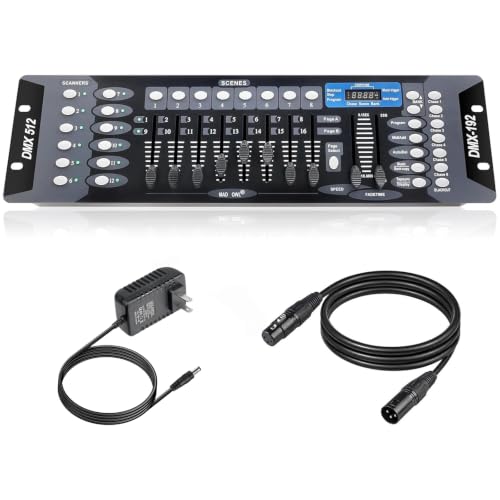
- Controls up to 12 fixtures with 16 channels each
- Stores 23 banks of programmable scenes
- Supports 240-step scenes across six chases
Best For: Stages, clubs, DJs, and wired performance-lighting setups
Best for Software-Driven Shows – SoundSwitch Control One
The SoundSwitch Control One is one of the more versatile DMX controllers for DJs who want hands-on control alongside SoundSwitch software. It offers two DMX universes, tactile performance controls, and direct compatibility with Engine DJ devices.
Best For: DJs and performers building synchronized lighting shows with SoundSwitch, Engine DJ, or compatible AlphaTheta setups.
Pros:
- Provides two DMX universe inputs and outputs, including a Thru option.
- Dual USB ports support seamless DJ transitions.
- Includes a touch strip, encoders, and customizable RGB performance pads.
- Supports live audio BPM detection from external audio sources.
Cons:
- Some AlphaTheta PRO DJ LINK Bridge configurations require a laptop running SoundSwitch.
- Its feature set is most useful when paired with compatible software or hardware.
Control One is a strong choice when lighting needs to respond closely to music and the operator wants physical access to intensity, effects, and fixture parameters.
Best for Basic Dimmer and Relay Control – CHAUVET DJ DMX-4
The CHAUVET DJ DMX-4 is a practical choice among DMX controllers for managing conventional lighting loads through four channels. Each channel can operate as a dimmer or relay and can be assigned to any DMX address.
Best For: Installations and operators who need straightforward four-channel dimming or relay switching.
Pros:
- Offers four DMX-512 dimmer or relay channels.
- Each channel can be assigned to any DMX address.
- Variable electronic dimming ranges from 0% to 100%.
- Supports adjustable speed and dimming with or without DMX.
Cons:
- Four channels provide less capacity than larger multi-universe controllers.
- Its function is focused on dimmer and relay control rather than broader show programming.
For smaller systems that prioritize dependable channel-level power and dimming control, the DMX-4 keeps the setup relatively direct without adding unnecessary programming features.
Best for Standalone Operation – ADJ WMX1 Mk2
The ADJ WMX1 Mk2 is a standalone option for users comparing DMX controllers that can operate without a computer-based workflow. Its interface combines 37 backlit silicone buttons with four rotary encoders and supports up to four universes.
Best For: Lighting operators who want dedicated onboard controls for multi-universe DMX setups.
Pros:
- Standalone design avoids dependence on a computer during operation.
- Provides 37 backlit silicone buttons for hands-on control.
- Four rotary encoders support parameter adjustment.
- Supports up to four universes and has four output sockets.
Cons:
- The supplied notes do not specify software integration or programming capacity.
- Its larger universe capacity may be more than necessary for compact lighting rigs.
The WMX1 Mk2 makes the most sense when a physical, standalone console is preferred and the lighting system may grow beyond a single DMX universe.
Best for Scene and Chase Programming – CHAUVET DJ OBEY40
The CHAUVET DJ OBEY40 is a useful pick among DMX controllers for organized fixture programming and repeatable live playback. It controls up to 12 fixtures with up to 16 channels each, while providing extensive scene banks, chases, fog control, and MIDI compatibility.
Best For: Performances and installations requiring stored scenes, programmed chases, and control of multiple intelligent fixtures.
Pros:
- Controls up to 12 fixtures with up to 16 channels each.
- Provides 192 DMX channels for detailed fixture management.
- Stores up to 240 scenes across 30 banks.
- Includes six chases, fog and strobe control, MIDI compatibility, and reversible sliders.
Cons:
- Programming 240 scenes and multiple chases may take more preparation than simple controllers.
- Its capacity may be excessive for very small lighting systems.
Choose the OBEY40 when repeatable looks and sequenced effects matter more than minimal controls. Its scene and chase capacity gives operators room to build structured performances.
Simple Control – ADJ SDC12 12-Channel DMX Controller
ADJ Products SDC12, 12 Channel Basic DMX Controller, Easily Fade and Dim Multiple Lights
Check Price On AmazonThe ADJ SDC12 is a straightforward choice for shoppers comparing dmx controllers for basic lighting setups. Its 12 channel faders and master fader make it practical for fading and dimming multiple fixtures without a complicated interface.
Best For: Demos, simple lighting systems, mobile setups, and users who want hands-on control.
Pros:
- Provides 12 channel faders plus a master fader for direct control.
- Compact, lightweight design can be used as a handheld controller with a 9V battery, sold separately.
- Supports standard 3-pin and 5-pin DMX outputs for connecting compatible fixtures.
- Can be wall-mounted for a more permanent installation.
Cons:
- Its 12-channel layout is intended for basic control rather than complex programmed shows.
- 9V battery operation requires a battery that is not included.
- The supplied notes do not specify software-update support.
Choose the SDC12 when simplicity and portability matter more than extensive scene programming. It is a focused controller for straightforward dimming and fading tasks.
Show Programming – CO-Z 192-Channel DMX Stage Controller
The CO-Z 192 is a practical option among dmx controllers for users who need more fixtures and scenes than a basic board can provide. It can control up to 12 intelligent lights with up to 16 channels each and supports up to 240 scenes.
Best For: DJs, small venues, weddings, church events, and users creating programmed lighting shows.
Pros:
- Offers 192 channels for controlling up to 12 fixtures with up to 16 channels each.
- Supports up to 240 scenes for more involved show programming.
- Includes dedicated areas for light selection, scenes, channels, page selection, timing, and functions.
- Voice control can switch between lighting scenes, and the included three-pin cable supports compatible fixtures such as fog machines.
Cons:
- Its larger console layout may be more than needed for simple dimming tasks.
- It is corded electric rather than battery powered.
- The supplied specifications list a plastic material and a weight of 3.9 pounds, which may be less convenient for frequent transport than a compact handheld unit.
The CO-Z makes sense when scene capacity and fixture control are priorities. Its organized console layout offers more creative range than a basic 12-channel controller while remaining aimed at accessible operation.
Wireless Flexibility – DMX512 384-Channel Dual-Mode Controller
This DMX512 console stands out among dmx controllers for combining 384-channel control with both 2.4G wireless and traditional 3-pin XLR wired operation. It also adds sound-activated, automatic, manual, and MIDI control modes for more flexible stage setups.
Best For: DJs, weddings, bars, discos, live stages, and indoor venues that need wireless or wired fixture control.
Pros:
- Provides 384 channels and supports up to 12 intelligent lights.
- Offers 2.4G wireless transmission alongside wired 3-pin XLR connectivity.
- Supports sound-activated, auto, manual, and MIDI control modes.
- Stores 30 banks and 240 preset static scenes, with scene copy, insert, and delete functions.
Cons:
- Its broader feature set may require more setup than a basic manual controller.
- The supplied notes specify that one 9V battery is required but do not state whether it is included.
- Wireless operation may not suit installations that prefer exclusively wired connections.
Consider this model if wireless flexibility, rhythm-based effects, and higher channel capacity are central to your setup. The wired fallback and programmable scene storage make it adaptable across several indoor event environments.
Versatile 192-Channel Choice – 192-Channel Stage Lighting Console
This 192-channel DMX controller is designed for users who want hands-on programming for complex stage and event lighting setups. It can control up to 12 fixtures with up to 16 channels each, while supporting voice control, scene programming, and a standard 3-pin DMX512 output.
Best For: DJs, church gatherings, weddings, parties, clubs, and users managing multiple intelligent lights or compatible 3-pin equipment.
Pros:
- Controls up to 12 fixtures and supports up to 240 scenes.
- Allows up to 40 steps per scene with adjustable pause and fade times.
- Includes voice control and a 3-pin XLR DMX512 output.
- Organized controls are approachable for amateur users.
Cons:
- The corded design is less convenient for mobile setups.
- Its many programming controls may take time to learn.
Choose this model if scene depth and broad fixture compatibility matter more than a minimalist interface. Its programming range makes it a flexible option for building customized lighting shows.
Portable Wireless Pick – Mini 512-Channel Wireless Controller
This compact DMX controller combines 2.4G wireless transmission with standard DMX512 support across 512 channels. Its manual dimming, automatic scene playback, and portable design make it practical for mobile lighting at parties, weddings, clubs, and small stage projects.
Best For: Mobile DJs, wedding and party setups, clubs, bars, and users who want wireless control in a compact enclosure.
Pros:
- Supports 512 channels with 2.4G wireless and DMX512 operation.
- Offers manual dimming and automatic scene-loop playback.
- Provides six banks with eight programmable scenes and one-key recording.
- Compact, lightweight design is easy to carry.
Cons:
- Requires an external 9V–12V DC adapter.
- Its compact format may provide less hands-on control than larger consoles.
This is a sensible choice when portability and wireless convenience are priorities. The 512-channel capacity and programmable scene functions give it useful flexibility without the footprint of a full-size console.
Programmable Show Builder – 192-Channel DMX Board with Cable
This 192-channel DMX controller focuses on hands-on programming through faders and buttons. It can operate up to 12 fixtures with up to 16 channels each, and it includes a 6.6-foot DMX cable for connecting compatible stage and DJ lighting equipment.
Best For: Stage operators, DJs, clubs, and performance venues that need programmable scenes, chases, and wired fixture control.
Pros:
- Controls up to 12 lighting fixtures with up to 16 channels each.
- Provides 23 banks of eight programmable scenes.
- Supports 240-step scenes across six programmable chases.
- Includes a 6.6-foot DMX cable.
Cons:
- Uses wired DMX control rather than wireless operation.
- The larger rack-mount design is less portable than a mini controller.
For buyers who prefer physical faders and detailed chase programming, this controller offers a strong feature set. Its included cable and metal construction also suit fixed stage, club, or performance installations.
How We Picked These Dmx Controllers
We evaluated this selection by focusing on the features that affect real-world lighting control: channel count, fixture compatibility, programming workflow, control modes, portability, and setup complexity. We also considered whether each unit is better suited to simple dimming, live DJ use, stage production, fog-machine control, or more advanced show programming.
Channel count is useful, but it is not the only measure of capability. A compact controller with straightforward faders may be more practical for a small mobile rig than a higher-channel console with a steeper learning curve. Wireless support, MIDI or software integration, and standalone operation can also matter depending on how your system is built.
Quick Comparison
- Best for software-driven shows: SoundSwitch Control One.
- Best for dimming and relay control: CHAUVET DJ DMX-4.
- Best for standalone operation: ADJ WMX1 Mk2.
- Best for fog-machine control: CHAUVET DJ OBEY40.
- Best for basic multi-light control: ADJ SDC12.
- Best for budget 192-channel control: CO-Z and similar DMX512 consoles.
- Best for flexible wireless setups: the 2.4G wireless and wired controllers.
Key Buying Factors for Dmx Controllers
Channel Count and Fixture Needs
Make sure the controller can address every channel your fixtures require, not just the number of lights you own. A basic RGB fixture may use only a few channels, while moving heads and effect lights can require many more. Leave room for future additions if you expect your rig to grow.
Programming and Live Control
Faders and dedicated buttons are useful for hands-on adjustments, while scene, chase, and playback functions help create repeatable shows. Beginners may prefer a direct manual layout; experienced users may benefit from MIDI, software, or more advanced cue programming.
Wired Versus Wireless Operation
Standard DMX cabling is dependable and widely compatible. Wireless models can simplify installations and reduce cable runs, but confirm transmitter and receiver compatibility, range, interference resistance, and whether wireless hardware is included.
Portability and Build
Mobile DJs and event crews should consider size, weight, power requirements, and protection during transport. A compact console is easier to carry, while a larger surface may offer faster access to multiple fixtures during a live show.
Who Should Buy Which Dmx Controllers?
Choose a simple 12- or 192-channel board if you are learning DMX, controlling a small fixture collection, or need affordable manual adjustments. A controller with dedicated fog-machine support makes more sense for mobile entertainers using atmosphere effects. For larger or more varied rigs, consider a higher-channel model with scenes, chases, MIDI, or wireless operation.
Software-oriented users should look at the SoundSwitch option, while performers who need a self-contained controller should prioritize standalone models such as the ADJ WMX1 Mk2. Before buying, verify your fixtures’ DMX channel modes, connector requirements, and control protocol to avoid compatibility surprises.