Infrared repeaters let you control hidden components without pointing a remote directly at each device. They are useful for TVs, cable boxes, streaming players, AV receivers, and other equipment stored in cabinets or across a room.
We selected 10 infrared repeaters spanning wired kits, wireless systems, multi-device designs, and long-range options. Use the guide below to match emitter count, installation style, compatibility, and range to your setup.
Best 10 Infrared Repeaters Picks for 2026
Whole-Cabinet Control
High-Capacity IR Repeater System

- Controls up to 10 devices, expandable to 12
- Includes five dual emitters with 10-foot leads
- Supports hidden equipment up to 10 meters away
Best For: Large home theater systems with multiple concealed components
Dual-Frequency Choice
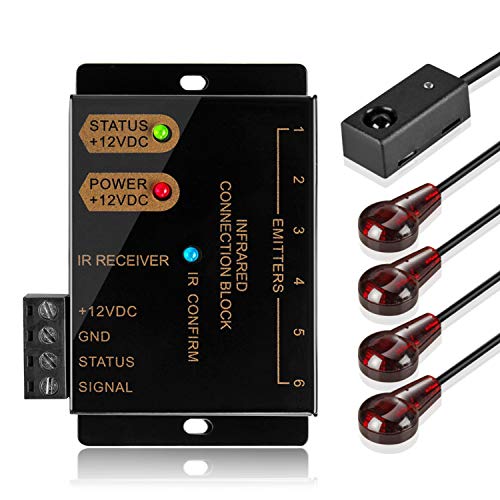
- Supports 38 kHz and 56 kHz IR signals
- Includes four 10-foot emitter leads
- Offers up to six emitter outputs
Best For: Cabinet installations with varied home theater components
Room-to-Room Value
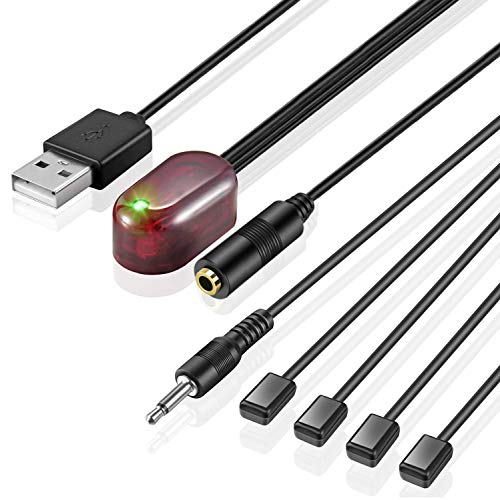
- Controls up to four IR devices
- Includes four emitters and one receiver
- Uses convenient 5V USB power
Best For: Small home theater systems and simple room-to-room control
Simple Cable Setup
Cable Matters 6-Foot IR Extender

- Six-foot cable reaches concealed A/V sources
- USB-powered with a signal-confirmation LED
- Adhesive-backed cables simplify mounting
Best For: Wall-mounted TVs and single-source IR extensions
Best Multi-Device Expansion

- Controls multiple hidden A/V components
- Supports 20–60 kHz IR signals
- Expandable with additional emitters
Best For: Large or expandable home-theater installations
Best Long-Range Wireless Option

- Wireless design for hidden A/V equipment
- Advertised range up to 700 feet
- Supports 20–60 kHz IR devices
Best For: Long-distance wireless IR installations
Best for Concealed Components

- Controls hidden equipment behind doors or walls
- Supports up to 32 A/V components
- Includes confirmation LED and four outputs
Best For: Multi-component entertainment cabinets and closets
Best with Extra Features

- 500-foot stated wireless range
- Two channels help avoid cross-control
- Includes receiver, emitter, cables, and adapters
Best For: Long-distance control of IR devices in cabinets or other rooms
Multi-Device Cabinet Solution
IR Repeater for Up to 10 Devices

- Controls up to 10 devices
- Includes five IR emitters
- Plug-and-play, no programming required
Best For: Centralized control of multiple hidden A/V components
Expandable Wired System

- Supports up to 18 devices
- Expandable emitter configurations
- Optional Ethernet receiver extension up to 100 meters
Best For: Larger wired home-theater installations
Whole-Cabinet Control – High-Capacity IR Repeater System
This infrared repeaters kit is designed for larger home theater setups where several components are concealed behind cabinet doors or positioned in different locations. It supports up to 10 devices, with expansion to 12, and provides real-time signal transmission across distances up to 10 meters.
Best For: Multi-device entertainment centers with hidden amplifiers, receivers, disc players, cable boxes, or satellite equipment.
Pros:
- Controls up to 10 devices and can expand to 12.
- Includes five dual IR emitters with 10-foot leads.
- CFL-friendly design and signal-status lights help with installation and troubleshooting.
- Supports equipment placed in cabinets or other rooms up to 10 meters away.
Cons:
- Plasma displays may interfere with the IR receiver.
- Multiple receivers require spacing of at least 6 meters to help avoid interference.
- The relatively extensive emitter setup may take more planning than a basic cable extender.
With its distribution block, long emitter leads, and support for numerous components, this is the most flexible choice here for a complex concealed-equipment installation.
Dual-Frequency Choice – TNP IR Repeater Kit
This infrared repeaters kit is a practical option for controlling home theater components behind cabinet doors while supporting both 38 kHz and 56 kHz signals. Its four 10-foot emitter leads and up to six emitter outputs provide useful flexibility for common A/V installations.
Best For: Entertainment cabinets containing cable boxes, set-top boxes, and other home theater components that may use different IR frequencies.
Pros:
- Dual-frequency support covers 38 kHz and 56 kHz remotes.
- Includes four emitter leads, each measuring 10 feet.
- Supports up to six emitter output connections.
- An IR confirmation LED provides visual feedback during use.
Cons:
- The kit is intended for IR equipment and does not address RF-controlled devices.
- Additional IR emitters are sold separately.
- Extending the emitter cable may require adapters and a stereo audio extension cable.
Its dual-frequency design makes this a well-rounded cabinet solution when compatibility with both standard 38 kHz and 56 kHz remotes matters.
Room-to-Room Value – USB-Powered IR Extender
This infrared repeaters kit is suited to straightforward installations where one remote needs to control equipment in another room or behind a cabinet. It includes one receiver, four emitters, USB power, and a 34–60 kHz operating range for broad compatibility with common IR-controlled components.
Best For: Simple home theater setups needing control of up to four devices across a room or between two rooms.
Pros:
- Includes four emitters for simultaneous control of multiple devices.
- USB-powered design offers convenient 5V power connectivity.
- 34–60 kHz operating range supports many IR devices.
- Receiver includes an IR confirmation LED.
Cons:
- Supports a maximum of four devices.
- The receiver cable is 2 meters and emitter cables are 1 meter, which may limit placement in larger cabinets.
- Optimal performance requires aiming the remote at the IR receiver.
This kit keeps the setup relatively simple while still providing four-device control, making it a sensible fit for smaller entertainment systems and room-to-room use.
Simple Cable Setup – Cable Matters 6-Foot IR Extender
This infrared repeaters cable is a compact choice for extending control from a TV or viewing position to a concealed Blu-ray player, cable box, receiver, or other IR-equipped source. Its six-foot Y-cable uses 5V USB power, while adhesive-backed transmitter and receiver cables simplify mounting.
Best For: Wall-mounted TV setups and compact entertainment systems with a single concealed A/V source.
Pros:
- Six-foot cable provides flexible placement for a TV and hidden source.
- USB-powered design connects to a 5V USB wall charger.
- Blue receiver LED verifies signal transmission.
- Adhesive backing helps secure the IR transmitter and receiver.
Cons:
- Supports IR devices only, not RF signal equipment.
- It is a cable-style extender rather than a multi-emitter distribution system.
- The TV USB port may not provide power when the TV is off, so a wall charger is recommended.
For a clean, focused installation, this Cable Matters model offers a straightforward way to control one concealed IR source without the extra hardware of a larger repeater system.
Best Multi-Device Expansion – 1-to-18 IR Repeater System
For shoppers comparing infrared repeaters for a hidden home-theater setup, this Ensigear kit stands out for its expandable distribution design. It can control multiple IR components inside a cabinet or in another location, with optional Ethernet extension support for longer runs.
Best For: Home theaters needing centralized control of several IR devices.
Pros:
- Works with many common A/V devices, including cable boxes, receivers, DVD/Blu-ray players, game consoles, and streamers.
- Supports up to 1-to-18 devices with compatible double or triple IR emitters.
- Broad 20–60 kHz frequency support and compatibility with RCMM devices such as certain SKY and Cisco equipment.
- Can use CAT5 or higher Ethernet cable for receiver placement up to 120 meters with additional equipment.
Cons:
- Additional terminal blocks and emitters may be required for extended or expanded installations.
- The package includes four emitters, not the maximum supported quantity.
This is a flexible wired option for larger A/V installations. Its included receiver, connecting block, power supply, and mounting hardware make it a practical starting point, while the expansion capability leaves room to grow.
Best Long-Range Wireless Option – 700-Foot IR Extender
If you want infrared repeaters without running a conventional connection across a room or building, the Fourair wireless kit emphasizes long-distance transmission. It is designed to hide compatible A/V equipment in cabinets or wardrobes while retaining remote control access.
Best For: Users prioritizing wireless placement flexibility and extended transmitter-to-receiver distance.
Pros:
- Advertises up to 700 feet between the infrared emitter and receiver.
- Supports mainstream IR devices operating from 20–60 kHz, including DVD players, cable or satellite boxes, and Hi-Fi equipment.
- Provides real-time signal transmission, a built-in receiving indicator, and a remote-control coverage angle of 90 degrees up to 30 feet.
- Includes an extension cable and carries a 12-month warranty.
Cons:
- It cannot control Bluetooth-remotes, app-controlled devices, or equipment operated through Wi-Fi.
- For best results, the extension cables should be positioned within two inches and in line with the source IR sensor.
- Compatibility should be checked for the specific device before purchase.
The Fourair is a compelling choice when wireless reach matters more than universal compatibility. Confirm that your equipment has an active IR receiver, especially if you use newer streaming devices or smart TVs.
Best for Concealed Components – 32-Device IR Repeater Kit
This Ensigear kit is a straightforward choice for infrared repeaters that let one existing remote control reach equipment behind cabinet doors or walls. Its distribution system is designed for concealed A/V components and includes a confirmation LED to show when an IR command is received.
Best For: Entertainment cabinets or equipment closets containing several hidden IR-controlled components.
Pros:
- Can operate up to 32 A/V components according to the supplied product notes.
- Works with practically all brands of IR remote controls and does not require line-of-sight to the components.
- Provides one IR receiver input and four IR emitter outputs.
- Built-in confirmation LED acknowledges received remote commands.
Cons:
- The listed range is 4 meters, so it is less suited to very large spaces.
- Only four emitter outputs are included, despite the stated capacity for up to 32 components.
- Designed for IR equipment and will not address devices using non-IR control methods.
With its concealed-installation focus and confirmation indicator, this kit is well suited to tidy cabinet or closet setups. Its four-output distribution block offers a practical base for controlling multiple components from one remote.
Best with Extra Features – 2CH Wireless IR Repeater Kit
If you need infrared repeaters for equipment hidden in a cabinet or closet, the OrangeLight 2CH IRBlast offers a wireless connection between the receiver and emitter. Its stated 500-foot range, adjustable channels, and included extension cables make it suitable for multi-device home entertainment setups, provided your remotes use IR rather than RF, Bluetooth, or Wi-Fi.
Best For: Long-distance wireless control of standard IR devices in separate rooms or enclosed cabinets.
Pros:
- Wireless 433MHz range is rated up to 500 feet, with up to 984 feet in open air.
- Two adjustable channels help prevent cross-control between paired devices.
- Includes an IR receiver, emitter, two extension cables, power adapters, adhesive pads, and a manual.
- Receiver LED flashes when an IR signal is received, aiding installation troubleshooting.
Cons:
- Works only with IR remotes and is not compatible with Bluetooth, Wi-Fi, or app-controlled devices.
- Remote reception is specified within a 45-degree angle.
This is a flexible choice when wireless placement matters, especially for cable boxes, Blu-ray players, DVD players, and home audio receivers. Confirm IR compatibility before ordering.
Multi-Device Cabinet Solution – IR Repeater for Up to 10 Devices
This Herfair system is one of the more expansive infrared repeaters for a centralized TV console or cabinet. It controls up to 10 devices, with claimed expandability to 12, and uses a console box with five emitters to route commands from one IR receiver to multiple hidden components.
Best For: Homes with several concealed A/V components controlled from one location.
Pros:
- Supports up to 10 devices and is described as expandable to 12.
- Five included IR emitters provide connections for multiple components.
- Broad 20KHz-60KHz frequency range is designed for many common A/V devices.
- Plug-and-play operation requires no programming, with indicator lights for power and signal activity.
Cons:
- The listed operating range is 8 meters.
- Receivers should be spaced at least 20 feet apart when using two or more to reduce interference.
- It is intended for IR-controlled equipment, not devices that rely on other remote-control technologies.
With its five-emitter layout and broad device compatibility, this kit is practical for consolidating cable boxes, receivers, disc players, and similar equipment behind cabinet doors. Its wired design favors organized permanent installations over flexible wireless placement.
Expandable Wired System – 1×6 IR Extender Repeater Kit
The Tmoksue DMIR1116 is a wired option for infrared repeaters, using a 1×6 connecting block to distribute commands to multiple hidden A/V devices. It includes six emitter connections in its described configuration and supports longer receiver placement through an Ethernet input, though the required terminal block for that extension is sold separately.
Best For: Expandable home-theater installations with several IR devices or a remotely positioned receiver.
Pros:
- Supports up to 18 devices depending on the emitter configuration.
- Six double IR emitters can expand to 12, while six triple emitters can expand to 18.
- 20KHz-60KHz frequency range is designed to work with many common IR A/V devices.
- Ethernet input can support receiver placement up to 100 meters with additional hardware.
Cons:
- The extra terminal block required for Ethernet extension is sold separately.
- The package includes four emitters, so the full expansion capacity requires additional emitters.
- Its stated maximum range is 100 feet for the standard setup.
This kit stands out for expandability and installation flexibility rather than a simple wireless setup. It is a strong fit for a larger cabinet or home-theater system, but budget for extra emitter hardware if you plan to use its maximum device capacity.
How We Picked These Infrared Repeaters
We focused on the features that affect everyday reliability: signal compatibility, receiver and emitter design, installation flexibility, device capacity, cable length, and stated operating range. The lineup includes simple wired extenders for a single cabinet, multi-emitter kits for larger systems, and wireless models intended for rooms where running an IR cable is inconvenient.
Because infrared performance depends on the remote, the target device, cabinet construction, and placement, advertised range should be treated as a best-case figure rather than a guarantee. We also favored kits that clearly identify their included accessories and intended use.
Quick Comparison
| Best For | Look For |
|---|---|
| One or two hidden components | Compact wired kit with one or more adhesive emitters |
| Several devices in a cabinet | Multiple IR emitters and support for several components |
| Long cable runs | Extended receiver or emitter cables and easy cable routing |
| Rooms where wiring is difficult | Wireless repeater with a clearly stated range |
| Large home theater installations | Multi-device capacity, strong placement options, and reliable power connection |
Key Buying Factors for Infrared Repeaters
Compatibility
Most repeaters work with standard infrared remotes, but they are not universal signal converters. Check whether your equipment uses IR rather than Bluetooth, radio frequency, or a proprietary control system. Some devices may also require a particular emitter position over the front-panel sensor.
Emitter Count and Device Capacity
Count the components you need to control now, then allow room for future additions. A single-emitter kit can be neat and inexpensive, while four-emitter or higher-capacity systems are better for receivers, disc players, cable boxes, and streaming devices stored together.
Wired Versus Wireless Installation
Wired kits are generally straightforward and avoid wireless range concerns, but they require routing a cable from the receiver to the hidden equipment. Wireless models offer more placement freedom and can suit separate rooms or difficult layouts. Confirm that both the transmitter and receiver have suitable power access.
Range, Placement, and Adhesion
Place the main receiver where the remote has a clear line of sight, and attach each small emitter directly over the target device’s IR window. Thick cabinet doors, bright sunlight, and crowded equipment can reduce performance. Removable adhesive or well-labeled cables make troubleshooting easier.
Who Should Buy Which Infrared Repeaters?
Choose a basic wired IR repeater if you simply need to operate one or two devices inside a TV stand. Select a multi-emitter system if several components share a cabinet or if you want to avoid buying another kit later. A wireless long-range model makes more sense when the source and equipment are separated by a room or when concealed cable routing would be disruptive.
For a full home theater, prioritize device capacity, dependable power, cable reach, and clean emitter placement over the largest advertised distance. Whichever model you choose, verify that your remotes use infrared and test the receiver position before permanently securing the components.