Large-capacity filament dryers make it easier to prepare several spools at once, especially when printing with moisture-sensitive materials such as nylon, TPU, and PETG. The right model can combine active heating, controlled airflow, humidity management, and dry storage in one workspace-friendly unit.
We compared 10 multi-spool dryers across capacity, temperature control, chamber design, storage features, and printing convenience to help you choose a practical fit for your materials and workflow.
Best 10 Large Capacity Filament Dryers Picks for 2026
Best Overall

- Holds four 1kg spools
- Eight filament exit holes
- Three fans with 70°C maximum temperature
Best For: Multi-printer setups and routine four-spool drying
Best for Sealed Storage

- Holds four 1kg or two 2kg spools
- Dual 200W heating chambers
- Sealed enclosure with up to 85°C drying
Best For: High-volume drying with moisture-controlled storage
Best for Engineering Filaments
- Supports up to one 3kg spool
- 110°C annealing capability
- 500W heater with dual chambers
Best For: Engineering materials and combined drying and annealing
Best for Independent Chambers

- Two independent chambers for four 1kg spools
- Dual 200W heaters reach 85°C
- Automatic humidity-based drying mode
Best For: Mixed filaments needing separate chamber controls
Four-Spool Fast-Drying Workhorse
- Handles four 1 kg spools simultaneously
- 350W heating with three-fan circulation
- Automatic humidity control and triple protection
Best For: Multi-printer and high-volume filament drying
Flexible Four-Spool Filament Station

- Dries up to four 1 kg spools
- Eight outlets support flexible filament routing
- 35–70°C control with 99-hour timer
Best For: Multi-printer setups needing flexible spool feeds
Best Large-Capacity Cabinet

- Holds up to 12 one-kilogram spools
- Auto, Stay-Dry, and Manual modes
- Stainless cabinet with five-layer safety system
Best For: High-volume drying and long-term spool storage
Best Multi-Material Control
Chitu Systems E1 4-Spool Dryer
- Dries up to four spools
- Independent chamber temperature and time controls
- Automatic humidity-triggered drying
Best For: Users drying different materials simultaneously
Best AMS Upgrade
- Four independently controlled drying chambers
- Dries while printing with AMS Gen 1
- Automatic venting, sealing, and humidity control
Best For: Bambu Lab AMS Gen 1 owners needing integrated drying
Best Overall – SUNLU S4 Four-Spool Dryer
For makers comparing large capacity filament dryers, the SUNLU S4 is a practical four-spool option designed to dry filament while it prints. Its 350W PTC heater, three circulation fans, and adjustable 35–70°C range support even heating across a spacious chamber.
Best For: Multi-printer setups and users who need to dry up to four 1kg spools at once.
Pros:
- Holds four 1kg spools and supports 1.75mm, 2.85mm, and 3.00mm filament.
- Eight filament exit holes provide flexible loading for multiple printers.
- Three fans and 360-degree surround heating promote consistent temperature distribution.
- Supports temperatures up to 70°C and timers from 0–99 hours.
Cons:
- Its large external footprint may require dedicated workspace.
- The standard configuration is intended for four 1kg spools; larger-roll use requires modification.
The S4 stands out as a straightforward high-capacity dryer for routine multi-spool printing. Its broad material compatibility and flexible outlet layout make it a versatile choice, while the optional modification path adds flexibility for experienced users.
Best for Sealed Storage – Creality Space Pi X4
The Creality Space Pi X4 is one of the more storage-focused large capacity filament dryers, holding four standard 1kg spools or two 2kg spools. Its dual heating chambers reach up to 85°C and the silicone-sealed enclosure is designed to limit moisture reabsorption during pauses.
Best For: High-volume users who want drying and ongoing humidity-controlled storage in one enclosure.
Pros:
- Accommodates four 1kg spools or two large 2kg spools.
- Dual independent 200W heating chambers provide separate drying zones.
- Reaches up to 85°C for materials including ABS, PET, PC, ASA, PA, and PAHT.
- Illuminated viewing and sealed storage help monitor spools without opening the enclosure.
Cons:
- The supplied notes do not specify individual chamber dimensions.
- Its 2.64-pound listed item weight may not reflect the full operating setup.
Choose the Space Pi X4 when storage matters as much as active drying. The dual-chamber design and higher temperature ceiling broaden material compatibility, while the sealed enclosure is useful for keeping filament protected between print sessions.
Best for Engineering Filaments – SUNLU E2 Dry and Anneal
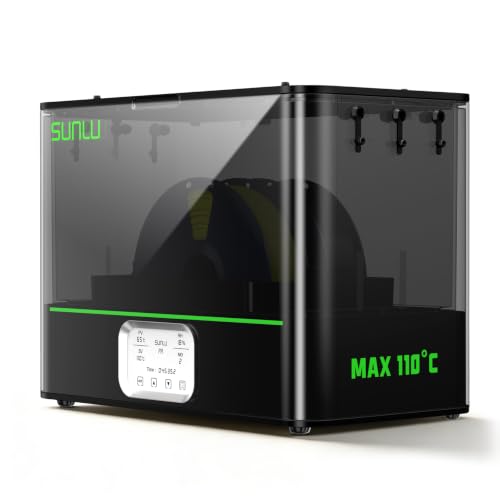
The SUNLU E2 is a large capacity filament dryer aimed at demanding materials and post-processing workflows. It combines filament drying with annealing, reaches 110°C, and uses a 500W PTC heater with dual chambers for drying and annealing operations.
Best For: Users working with PA, PC, nylon, and reinforced engineering filaments who also need annealing capability.
Pros:
- Supports two 1kg spools, two 2kg spools, or one 3kg spool.
- 110°C annealing chamber is designed for engineering materials and reinforced filaments.
- 500W PTC heater reaches 70°C in about 30 minutes according to the supplied notes.
- Safety features include dual temperature protection, smart software control, and a cool-touch exterior.
Cons:
- At 7.6kg, it is substantially heavier than simpler filament dryers.
- Its specialized annealing functions may be unnecessary for users who only dry PLA or PETG.
The E2 is a specialized choice rather than a basic dry box. Its capacity accommodates large rolls, but its main advantage is combining high-temperature drying and annealing for users who need stronger, more dimensionally stable printed parts.
Best for Independent Chambers – Comgrow SH03 Four-Spool Dryer
The Comgrow SH03 gives large capacity filament dryers a flexible dual-chamber layout, with space for four 1kg spools loaded as two rolls per chamber. Each side has separate temperature control and power, making it practical for drying different filament types at the same time.
Best For: Users who want independent control over two groups of filament and automated humidity-based drying.
Pros:
- Holds up to four 1kg spools in two independently controlled chambers.
- Dual 200W PTC heating modules reach 85°C with a 45–85°C adjustment range.
- Automatic drying mode responds to humidity and switches to energy-saving storage mode.
- 360-degree hot-air circulation and independent airflow channels support temperature uniformity.
Cons:
- The supplied notes do not provide external dimensions or item weight.
- Independent chamber controls may require more setup than a single-compartment dryer.
The SH03 is a strong fit for mixed-material workflows. Its independent chambers, long adjustable drying time of up to 98 hours, and automatic humidity management offer useful control for users running several filament types or printers.
Four-Spool Fast-Drying Workhorse – SUNLU S4 Black
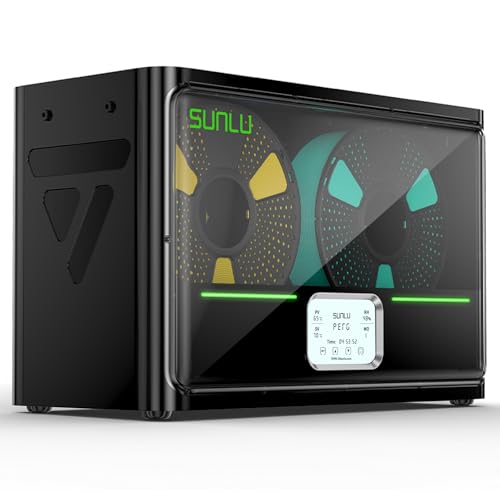
For makers comparing large capacity filament dryers, the SUNLU S4 Black stands out for handling four 1 kg spools at once. Its 350W heater, three-fan circulation, automatic humidity control, and support for four simultaneous printer connections make it suited to high-throughput, multi-color printing.
Best For: Multi-printer setups and users who want fast, automated drying for four spools.
Pros:
- Dries four 1 kg spools simultaneously.
- 350W PTC heater reaches 50°C from 25°C in about 30 minutes, according to the supplied specifications.
- Three fans help maintain temperature balance within ±3°C.
- Automatic humidity control and three-layer temperature protection add convenience and safety.
Cons:
- Its large footprint may require considerable workspace.
- It is not water resistant.
The S4 Black is a practical choice when capacity and throughput matter more than compactness. Its four-compartment design and automated humidity management reduce the need for frequent manual monitoring.
Dual-Chamber Precision Dryer – Sovol SH03 4-Spool Dryer
The Sovol SH03 is a strong option among large capacity filament dryers for users who need flexibility across different materials. Its two independently controlled chambers can dry at separate temperatures, while the four-spool capacity supports multicolor printing or multiple printers.
Best For: Filament users who need separate temperature control for different materials or simultaneous drying and storage.
Pros:
- Two chambers operate independently and can reach different temperatures.
- Dual 200W PTC heaters provide up to 85°C and fast warm-up times.
- Automatic dehumidification vents moisture when the set temperature is reached.
- Preset programs cover 10 filament types, including PLA, PETG, ABS, TPU, PA, and PC.
Cons:
- The dual-chamber controls may be more involved than a single-zone dryer.
- Its supplied weight is 3.6 kg, so it is not a lightweight portable option.
Choose the SH03 when material-specific control is a priority. Independent chambers make it more versatile than a basic four-spool box, particularly for mixed-material workflows.
Flexible Four-Spool Filament Station – SUNLU S4 White
For buyers seeking large capacity filament dryers with flexible feed options, the SUNLU S4 White combines four-spool capacity with eight filament exit holes. Its 350W heater, three circulation fans, adjustable temperature and timer, and broad material compatibility make it useful for multi-printer workspaces.
Best For: Users who need flexible filament routing, broad material support, and a dedicated four-spool drying station.
Pros:
- Holds and dries up to four 1 kg spools at once.
- Eight outlets accommodate different printer positions and loading angles.
- Temperature adjusts from 35–70°C, with a timer of up to 99 hours.
- Supports 1.75 mm, 2.85 mm, and 3.00 mm filament sizes and includes energy-saving storage mode.
Cons:
- The large external dimensions may be difficult to fit in smaller work areas.
- The listed maximum temperature is 70°C, lower than some high-temperature dryers.
The S4 White is a versatile capacity-focused dryer for organized multi-printer setups. Its outlet count and storage mode are especially useful when several filament paths must remain ready between printing sessions.
Best Large-Capacity Cabinet – Hydryer H2O 12-Spool Dryer
For shoppers comparing large capacity filament dryers, the Hydryer H2O stands out as a cabinet-style option that holds up to 12 one-kilogram spools. Its stainless-steel construction, active hot-air circulation, multiple operating modes, and safety features make it suited to high-volume drying and storage.
Best For: Makers, print farms, and workspaces that need to dry or store many spools at once.
Pros:
- Large 12-spool capacity with drying performance designed to remain consistent when fully loaded.
- Manual temperature control from 100–220°F, plus Auto and Stay-Dry modes.
- Five-layer safety system, including overheat protection, a thermal fuse, and heating shutoff when the door opens.
- Stainless-steel body, double tempered-glass door, triple-layer insulation, and quiet 40 dB operation.
Cons:
- The humidity display on early batches may read slightly higher than the actual chamber humidity.
- The set temperature is a peak ceiling rather than a fixed hold point, so users may need to set it 10–15°F above the desired chamber temperature.
- At 22 pounds and roughly 17.5 by 14.4 by 24.19 inches, it requires more space than compact dryers.
The Hydryer H2O is the strongest capacity-focused choice here, particularly for overnight operation and multi-spool workflows. Its temperature behavior requires some adjustment, but the cabinet construction and safety-oriented design support demanding use.
Best Multi-Material Control – Chitu Systems E1 4-Spool Dryer
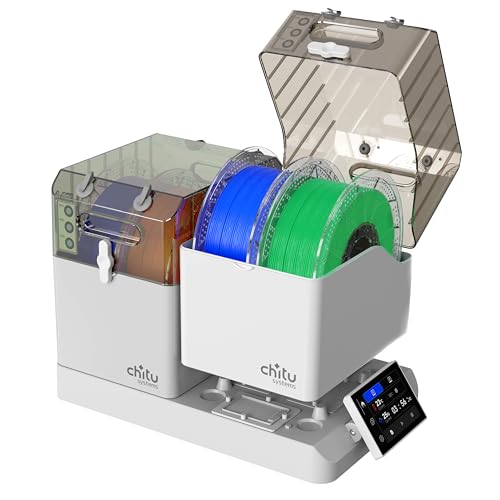
Among large capacity filament dryers, the Chitu Systems E1 offers a practical middle ground for users who need several spools without moving to a full cabinet. Its two removable chambers have independent heating and airflow controls, allowing different materials to be dried at separate temperatures and durations.
Best For: Multi-material users who want independent drying settings for up to four spools.
Pros:
- Four-spool capacity with eight filament holes and PTFE tubes for multi-printer setups.
- Separate chambers with independently controllable hot-air circulation systems.
- Automatic humidity monitoring can activate drying when humidity reaches or exceeds 50%.
- Four-inch touchscreen with preset settings for PLA, ABS, PETG, PA, and PC.
Cons:
- Its four-spool capacity is substantially smaller than a 12-spool cabinet dryer.
- The supplied information does not specify the unit’s overall dimensions or temperature range.
- Automatic activation is tied to the stated 50% humidity threshold, which may not suit every material or storage preference.
The E1 is a flexible option when independent chamber control matters more than maximum capacity. It can also function as a storage box, helping keep multiple materials ready for printing between drying cycles.
Best AMS Upgrade – EIBOS Tetras 4-Spool Dryer
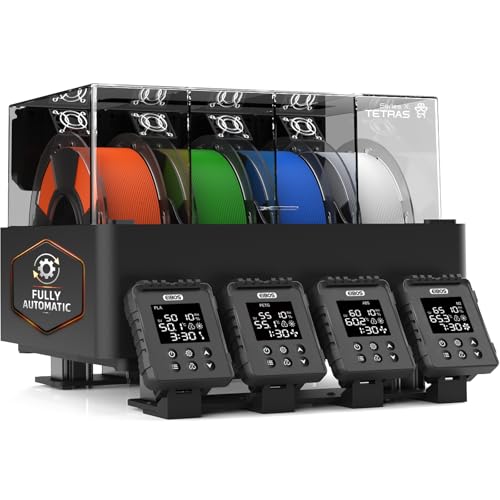
The EIBOS Tetras is a specialized choice among large capacity filament dryers: it upgrades a first-generation Bambu Lab AMS into a four-chamber drying and storage system. Each spool receives independent temperature, humidity sensing, airflow, and exhaust control, and the unit can dry while printing.
Best For: Bambu Lab AMS Gen 1 owners who want active drying during prints and sealed spool storage.
Pros:
- Four independent chambers support separate settings for materials such as PLA, PETG, TPU, and Nylon.
- Can dry filament while printing, with temperature control from 20–65°C and cycles from 30 minutes to 24 hours or unlimited.
- Automatic exhaust, sealing, and humidity-based reactivation help maintain low-moisture storage.
- Drop-in installation with a separate power supply means dryer operation is independent of Bambu Lab firmware updates.
Cons:
- It is an add-on for Bambu Lab AMS Gen 1 and does not include the AMS.
- Its four-spool capacity is smaller than cabinet-style large-capacity dryers.
- The supplied warranty is one year.
Tetras makes the most sense for an existing AMS Gen 1 setup rather than as a standalone universal dryer. Its independent chambers and while-printing operation are compelling for multi-material workflows, while AMS compatibility limits its audience.
How We Picked the Best Large Capacity Filament Dryers
We focused on dryers that can handle multiple spools rather than compact single-roll boxes. Our comparisons considered usable spool capacity, maximum temperature, heating design, humidity control, chamber layout, compatibility with common 1.75 mm and 2.85 mm filament, and whether each unit supports printing directly from the dryer.
We also looked for practical differences between shared chambers and independently controlled compartments. Independent control can be useful when drying materials with different temperature requirements, while a larger shared chamber may be simpler and more economical for regular PLA or PETG use.
Quick Comparison
- Best overall capacity: A four-spool dryer offers a useful balance for most multi-material workflows.
- Best for high-volume users: A 12-spool cabinet is better suited to production printing, workshops, and long-term dry storage.
- Best for advanced materials: Choose a model with higher heat capability, accurate controls, and strong sealing for nylon, ABS, or PC.
- Best for flexible workflows: Dual chambers or independent controls let you dry different materials at the same time.
- Best for Bambu Lab AMS owners: An AMS-focused dryer can improve moisture control without requiring a separate spool-handling setup.
Key Buying Factors for Large-Capacity Filament Dryers
Capacity and Spool Compatibility
Check both the advertised spool count and the maximum spool dimensions. Four-spool units are convenient for everyday printing, but wide or oversized rolls may reduce the practical capacity. Confirm that the internal holders and filament paths support your spool width and filament diameter.
Temperature Range and Control
PLA generally needs less heat than nylon or other engineering materials. Look for adjustable temperature settings, stable heating, and clear controls rather than relying only on a high maximum temperature. Excessive heat can deform some spools or damage unsuitable filament.
Humidity Management and Sealing
Heating removes moisture, but storage performance depends on the enclosure and seals. Auto-humidity hold, desiccant compatibility, and a visible humidity reading can help maintain dry filament between prints. A dryer that supports continuous dry storage is especially useful for hygroscopic materials.
Chamber Layout and Printing Access
Independent chambers provide more flexibility, while a shared chamber may simplify loading and operation. If you plan to print directly from the dryer, inspect the outlet design, roller placement, and compatibility with your printer’s filament path.
Who Should Buy Which Large Capacity Filament Dryers?
Choose a four-spool model if you regularly print several colors or materials and want a manageable footprint. Select a dual-chamber or independently controlled design if your projects mix PLA, TPU, PETG, and higher-temperature filaments. A 12-spool cabinet makes the most sense for serious hobbyists, farms, or users who need both bulk drying and organized dry storage. Bambu Lab AMS owners should prioritize an AMS-compatible heater or dryer when maintaining a streamlined automated setup matters most.