Portable DMX controllers make it easier to program and operate lighting rigs without carrying a full-size console. The models in this roundup range from compact 192- and 384-channel boards to wireless 512-channel systems and software-based controllers.
When choosing among portable DMX controllers, focus on channel capacity, fixture support, wireless reliability, programming workflow, and the controls you can use comfortably during a live show.
Best 10 Portable Dmx Controllers Picks for 2026
Wireless Freedom Pick
Lixada DMX 512 Wireless Controller

- Wireless DMX512 transmission
- 16 coded wireless groups
- Four selectable output levels
Best For: Cable-free disco, DJ, and party lighting
Software-Controlled Pro Pick

- Two DMX universes plus Art-Net
- Dual-mode built-in Wi-Fi
- ShowXpress and mobile-app support
Best For: Software-based event and venue lighting control
Hands-On Programming Pick

- 384 DMX channels
- 30 banks of eight scenes
- LED gooseneck and side handles
Best For: Hands-on stage and club lighting programming
Simple Compact Console

- Controls up to eight lights
- 96 total DMX channels
- Six chases with 999 steps each
Best For: Small intelligent-lighting rigs and chase effects
Best Wireless Pick
Rockforce W4 Wireless DMX Controller
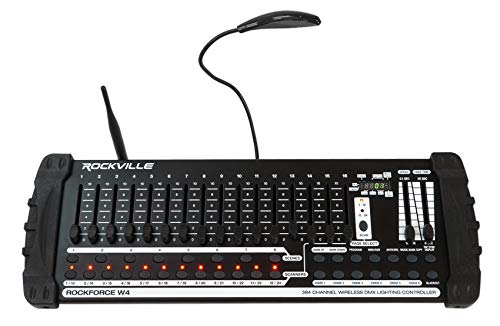
- 384 channels for up to 24 intelligent lights
- Built-in 2.4GHz transmitter and MIDI support
- Rugged 4U rack-mountable design with wired DMX I/O
Best For: Wireless control of larger mobile or professional lighting rigs
Best Beginner-Friendly Option
CO-Z 192-Channel DMX Controller

- Controls up to 12 fixtures with 16 channels each
- Stores up to 240 scenes
- Voice control and clearly separated operating sections
Best For: Amateur DJs and smaller event lighting setups
Best Wired Performance Value

- 384 channels for up to 24 intelligent lights
- 240 scenes across six programmable chases
- Metal housing with MIDI, music mode, and manual override
Best For: DJs, clubs, and stage rigs needing robust wired control
Feature-Rich Pick
192-Channel Stage Lighting Console

- Controls up to 12 fixtures and 240 scenes
- Programmable scenes with adjustable timing
- Voice control and 3-pin DMX512 output
Best For: Complex stage shows, DJs, clubs, weddings, and churches
Best Wireless Portability
Mini 512-Channel DMX Controller

- 2.4G wireless and standard DMX512 support
- Compact design for mobile events
- Six banks with eight programmable scenes
Best For: Portable DJ, wedding, party, club, and small-event lighting
Best for Beat-Synced Shows
Wireless 192-Channel DMX Controller
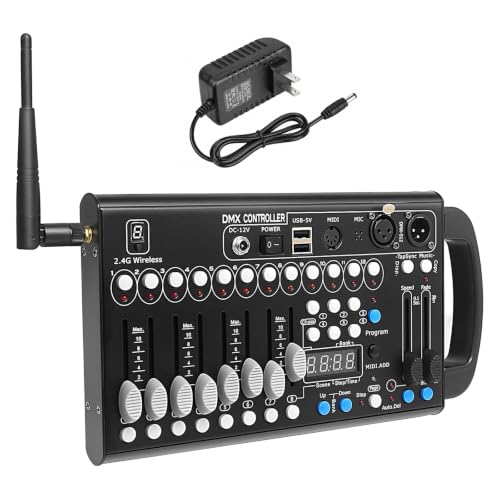
- Controls 12 fixtures and 240 scenarios
- Built-in microphone and MIDI beat activation
- Six chase sets with tap synchronization
Best For: Music-responsive DJ, band, club, bar, and party lighting
Wireless Freedom Pick – Lixada DMX 512 Wireless Controller
The Lixada DMX 512 controller is a practical choice when portable DMX controllers need to send standard DMX512 data without a cable between the controller and lighting equipment. Its wireless system offers adjustable output power, LCD control, and multiple coding options for disco, DJ, party, and stage-lighting setups.
Best For: Wireless lighting control where avoiding cable runs is a priority.
Pros:
- Wireless DMX512 transmission removes cable limitations.
- Supports 126-channel jumping frequency and 16 ID-coded wireless groups.
- Offers four selectable power levels and real-time signal transmission.
- Compact 13.7-ounce design is easy to transport.
Cons:
- Its wireless operating range is not specified in the supplied details.
- The product is focused on wireless transmission rather than a stated channel-programming workflow.
Choose this model if your setup benefits most from flexible wireless DMX linking and interference management. Verify compatibility and placement requirements before building a larger system.
Software-Controlled Pro Pick – CHAUVET DJ Xpress 1024W
The CHAUVET DJ Xpress 1024W is one of the more capable portable DMX controllers for ShowXpress-based programming and live operation. Its aluminum interface combines dual-mode Wi-Fi, two DMX universes, Art-Net expansion, and broad computer and mobile compatibility.
Best For: DJs, venues, event productions, and programmers who want software-based wireless show control.
Pros:
- Controls two DMX universes and unlocks one additional Art-Net universe.
- Dual-mode Wi-Fi supports an existing network or a direct access-point setup.
- Works with ShowXpress and the Live Mobile app across Windows, Mac, Linux, iOS, Android, and Raspberry Pi systems.
- 3-pin XLR outputs include electrical and optical isolation, plus protection circuits.
Cons:
- Operation depends on ShowXpress software or the compatible mobile app.
- Its feature set may be more than needed for small, simple lighting rigs.
This is a strong fit for users who want scalable, software-driven control rather than a traditional standalone console. The hot-swappable design and automatic reconnection are useful for event environments where continuity matters.
Hands-On Programming Pick – 384CH DMX512 Stage Controller
This 384-channel DMX512 console is a traditional option among portable DMX controllers, with physical programming controls for stage, bar, club, and live-show lighting. It provides 30 banks of eight programmable scenes and is designed for detailed fixture and scene management.
Best For: Users who prefer hands-on programming for compact stage-lighting systems.
Pros:
- Provides 384 DMX channels for detailed lighting control.
- Stores 30 banks with eight programmable scenes each.
- Compact structure includes side handles and an LED gooseneck light.
- Supports 110–240Vac, 50–60Hz input according to the supplied specifications.
Cons:
- At 6 pounds, it is heavier than the smallest portable controllers.
- The supplied details do not mention wireless operation or mobile-app control.
- Its listed dimensions vary between the product specifications, so confirm fit before transport or installation.
Consider this console when tactile scene programming and a generous channel count matter more than wireless convenience. Its scene-bank layout suits repeatable live-show cues and organized fixture control.
Simple Compact Console – CHAUVET DJ Obey 10
The CHAUVET DJ Obey 10 is a straightforward choice among portable DMX controllers for operating a smaller intelligent-lighting rig. It controls up to eight lights, provides 96 DMX channels, and supports sequential chase linking for programmed effects.
Best For: Compact setups using up to eight intelligent lights with chase-based control.
Pros:
- Controls up to eight intelligent lights.
- Provides up to 12 channels per light and 96 DMX channels overall.
- Supports six chase sets with up to 999 steps each.
- Its compact 4-pound design is relatively easy to transport.
Cons:
- It is limited to eight intelligent lights.
- The supplied details do not mention wireless connectivity or app control.
- Its 96-channel capacity is lower than the other multi-universe or 384-channel options in this roundup.
The Obey 10 makes sense when you want a dedicated, compact console for a modest lighting package. Choose a higher-capacity model if your fixtures require more channels or your show needs wireless or software-based operation.
Best Wireless Pick – Rockforce W4 Wireless DMX Controller
The Rockville ROCKFORCE W4 is a strong choice among portable dmx controllers when you need wireless flexibility and extensive fixture programming. Its built-in 2.4GHz transmitter, 384 channels, MIDI support, and rugged rack-mountable design suit mobile entertainers and professional event setups.
Best For: Wireless control of larger lighting setups, including up to 24 intelligent lights or up to 25 compatible receivers.
Pros:
- Built-in 2.4GHz wireless transmission with frequency hopping and a stated range of up to 1,968 feet.
- Controls up to 24 fixtures with 16 channels each, plus 30 banks, six chases, and 240 scenes.
- Offers MIDI, music-sync operation, manual override, wired DMX in/out, and a USB-powered gooseneck light.
Cons:
- Its 20.7-inch length and 6.2-pound weight may be more than smaller mobile setups need.
- Wireless compatibility is specifically listed for Rockville, Chauvet, and American DJ lights.
Choose the W4 when wireless operation and maximum fixture capacity matter most. Its broad control options make it versatile, though its larger rack-style form is better suited to serious setups than casual use.
Best Beginner-Friendly Option – CO-Z 192-Channel DMX Controller
The CO-Z 192 DMX controller is a practical entry point for shoppers comparing portable dmx controllers for smaller shows. Its layout separates fixture selection, scenes, channels, timing, and functions, while voice control adds a convenient way to change lighting scenes.
Best For: Amateur DJs, small events, weddings, church gatherings, and setups using up to 12 intelligent lights.
Pros:
- Controls up to 12 intelligent lights with up to 16 channels each.
- Supports up to 240 scenes for building more involved lighting shows.
- Includes voice control, precision control sticks, and a three-pin cable for compatible fixtures such as fog machines.
Cons:
- Its 192-channel capacity is lower than the two Rockforce models in this roundup.
- The supplied notes do not list MIDI or wireless DMX capability.
The CO-Z makes sense if straightforward operation and voice-controlled scene changes are more important than maximum channel capacity. It provides useful show-building features without targeting the larger professional systems.
Best Wired Performance Value – Rockforce 384 DMX Controller
The Rockville ROCKFORCE 384 is a capable wired option among portable dmx controllers, combining 384 channels with extensive scene and chase programming. Its built-in microphone, MIDI control, manual override, and durable metal housing give DJs and stage users several ways to manage a show.
Best For: DJs, clubs, and stage setups that need high fixture capacity and programmable wired control.
Pros:
- Controls up to 24 intelligent lights with 16 channels each.
- Stores 30 banks of eight scenes and six programmable chases, totaling 240 scenes.
- Includes MIDI, music mode, manual override, power-failure memory, reversible channels, and an LED gooseneck lamp.
- Uses a durable metal housing with three-pin XLR DMX in/out and universal 110–240V power.
Cons:
- Unlike the W4 model, the supplied notes do not list wireless DMX transmission.
- Its 20.71-inch metal console may be less convenient for very compact travel setups.
This model is a good fit when you want the W4’s broad 384-channel programming without relying on wireless transmission. It favors dependable wired control, rugged construction, and hands-on show programming.
Feature-Rich Pick – 192-Channel Stage Lighting Console
This 192-channel console is a practical choice among portable dmx controllers when you need extensive scene programming and hands-on control. It supports up to 12 intelligent lights with up to 16 channels each, plus as many as 240 scenes.
Best For: DJs, clubs, weddings, churches, and users building more complex stage-lighting shows.
Pros:
- Controls up to 12 fixtures and 240 scenes.
- Offers up to 40 steps per scene with adjustable timing.
- Includes a 3-pin DMX512 output and voice-control functionality.
- Organized controls are designed to be approachable for beginners.
Cons:
- Corded electric operation is less convenient for fully mobile setups.
- The larger feature set may take time for casual users to learn.
Choose this model if detailed programming and broad fixture control matter more than minimal size. Its upgraded controls and professional 3-core XLR output also suit repeated personal or professional use.
Best Wireless Portability – Mini 512-Channel DMX Controller
This mini console stands out among portable dmx controllers with 2.4G wireless transmission alongside standard DMX512 support. Its compact body, manual dimming, and automatic scene playback make it suitable for mobile event lighting.
Best For: DJs, weddings, parties, clubs, bars, and small lighting projects where easy transport is important.
Pros:
- Supports 512 channels and 2.4G wireless DMX transmission.
- Provides manual control and automatic scene-loop playback.
- Offers six banks with eight programmable scenes.
- Includes master dimming, blackout, record, and clear functions.
Cons:
- Requires an external 9V–12V DC adapter.
- Does not include a built-in battery.
This is a strong fit for users who prioritize a compact footprint and wireless flexibility. The external power requirement is worth planning for, especially at locations where outlets may be limited.
Best for Beat-Synced Shows – Wireless 192-Channel DMX Controller
This 192-channel console is one of the more performance-oriented portable dmx controllers, combining fixture control with built-in microphone, MIDI beat activation, tap synchronization, and automatic operation. It can control up to 12 smart lights with up to 16 channels each.
Best For: DJs, bands, bars, clubs, house parties, and weddings that benefit from music-responsive lighting.
Pros:
- Controls up to 12 fixtures and supports 240 scenarios.
- Provides six sets of chases with simultaneous chase operation.
- Includes microphone, MIDI beat activation, tap sync, and automatic modes.
- Uses a compact aluminum body with rack-mount positioning.
Cons:
- Its 192-channel capacity is lower than a 512-channel controller.
- Operation requires corded 9-volt power.
- The feature set may be more than needed for simple static lighting.
Consider this model when synchronized effects are central to your show. Its scenario and chase capacity provide creative flexibility, while the beat-activation options reduce the need for constant manual adjustments.
How We Picked These Portable Dmx Controllers
We focused on controllers that balance portability with useful real-world lighting control. The selection includes compact consoles, wireless DMX options, MIDI-equipped boards, and computer-connected systems suitable for DJs, mobile entertainers, small venues, and stage applications. We considered channel count, fixture and scene support, connectivity, programming features, operating modes, and the practical demands of transporting and running a lighting rig.
Channel count is only one part of the decision. A smaller console with clear controls may be faster to operate than a larger unit with a crowded interface, while software-based control can provide more flexibility if you already use a laptop.
Quick Comparison
| Controller type | Best suited to | What to prioritize |
|---|---|---|
| 192-channel console | Basic DJ and small-stage rigs | Simple scene and fixture programming |
| 384-channel console | Growing mobile setups | More fixtures, banks, and MIDI control |
| 512-channel or wireless unit | Larger or cable-conscious rigs | Wireless stability, range, and channel management |
| Software-based controller | Show production and advanced programming | Computer compatibility, universes, and networking |
Key Buying Factors for Portable Dmx Controllers
Channels, Fixtures, and Universes
Estimate the DMX channels required by every fixture, including pan, tilt, color, dimmer, gobo, and effects functions. Leave room for expansion. A 192-channel controller can suit a small rig, while 384 or 512 channels provide more flexibility. Controllers supporting multiple universes or Art-Net are better suited to larger installations.
Programming and Live Operation
Look for the scene, chase, bank, and fixture capacity you actually need. Dedicated faders and buttons can make live adjustments quick, whereas software may offer deeper editing. Confirm whether the controller supports manual, automatic, sound-active, or MIDI-triggered operation.
Wired Versus Wireless DMX
Wireless control can reduce cable runs and speed setup, but performance depends on range, interference, antenna placement, and compatible receivers. For critical shows, check whether the system can fall back to wired DMX and whether transmitters and receivers use compatible protocols.
Connections and Compatibility
Check the number and type of DMX outputs, XLR pin configuration, power requirements, and included adapters. For software controllers, verify operating-system support, required interfaces, and whether the listed software or license is included.
Portability and Build Quality
Consider weight, footprint, fader protection, display readability, and how easily the unit fits in your case. A portable controller should be convenient to transport without sacrificing controls that are important during a performance.
Who Should Buy Which Portable Dmx Controllers?
Choose a compact 192-channel console if you run a small number of fixtures and want straightforward, self-contained operation. A 384-channel model is a better match for mobile DJs or entertainers adding moving lights, fog machines, or more complex chases. Wireless 512-channel controllers suit users who value faster setup and fewer signal cables, provided the venue has a dependable wireless environment.
For advanced shows, installations, or multiple universes, a software-based option with Wi-Fi or Art-Net connectivity may offer the greatest control. Whichever model you choose, map your fixtures before buying and confirm that its channel capacity, connectors, and programming workflow match your current rig—not just your planned upgrades.