The best portable video switchers make multicamera production easier without requiring a full control room. They combine HDMI or SDI inputs with live switching, monitoring, streaming, recording, and production controls in compact units.
Our 2026 selection covers simple four-input switchers, touchscreen models, SDI-capable systems, and all-in-one production decks. Consider your cameras, output resolution, streaming workflow, and portability before choosing.
Best 10 Portable Video Switchers Picks for 2026
Best Portable Multicam Value

- Built-in 4-inch multiview display
- Four HDMI inputs with zero-latency switching
- PTZ, keying, PIP, and custom AUX routing
Best For: Small multi-camera streams, classes, and events
Best for Larger HDMI Setups

- Eight HDMI inputs for complex productions
- 18-channel digital audio mixer
- Built-in monitor, AUX output, macros, and still storage
Best For: Events, presentations, and multi-source broadcasts
Best All-in-One Mobile Studio
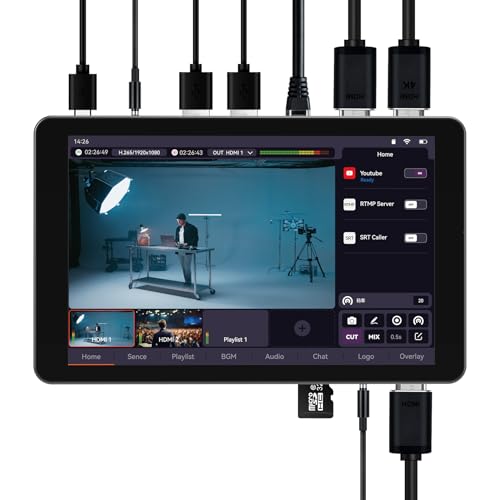
- 8-inch touchscreen with switcher, encoder, and recorder
- 4K input, wireless sources, and up to eight signals
- 8000mAh battery with direct vertical and horizontal streaming
Best For: Laptop-free mobile and outdoor streaming
Best for Solo Operators

- Standalone switcher with 14-channel audio mixer
- Four-layer effects and keying engine
- Automatic switching, eight presets, and remote app control
Best For: Solo-run events and livestreams
Compact 4K Pick
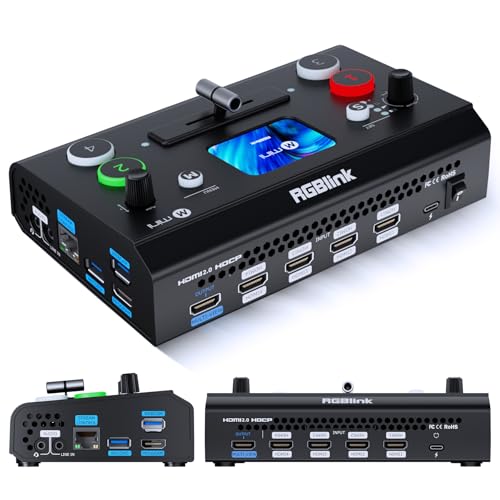
- Four HDMI inputs with dual 1080p outputs
- 2.1-inch touchscreen and T-bar control
- UVC webcam mode and optional advanced features
Best For: Compact entry-level multi-camera streaming
All-in-One Mobile Rig

- Includes a 14-inch monitor and mounting plates
- Four HDMI inputs, two HDMI outputs, and two USB ports
- AC, DC, or USB power-bank operation
Best For: Mobile streaming kits and event production
Professional Hybrid Option

- Up to four HDMI and four SDI inputs
- 10-inch screen with PTZ and wireless IP control
- Dual RTMP streaming, recording, PIP, and keying
Best For: Hybrid SDI/HDMI productions and PTZ workflows
Best All-in-One HD Pick

- Four HDMI inputs with 1080p60 support
- Built-in monitor, USB recording, and UVC streaming
- XLR audio, scene presets, chroma key, and overlays
Best For: HD multi-camera events and live productions
Best Touchscreen Workflow

- 5.5-inch touchscreen with six-picture preview
- Four 1080p HDMI inputs and USB 3.0 streaming
- PTZ control, chroma key, PIP, and logo overlays
Best For: Compact HD productions with touchscreen and PTZ control
Best Hybrid 4K-Input System

- Four SDI and four HDMI inputs with selected 4K60 input support
- NDI|HX3, SRT, RTMP, RTSP, and UVC streaming
- PTZ control, dual recording, and browser-based management
Best For: Professional mixed HDMI, SDI, PTZ, and IP productions
Best Portable Multicam Value – Compact 4-Input Switcher
For buyers comparing portable video switchers, the Mixer Plus stands out as a compact four-input HDMI option with an integrated 4-inch display. It combines live multiview monitoring, scene presets, transitions, keying, and PTZ control in a travel-friendly unit for small productions.
Best For: Multi-camera streaming, online classes, events, and creators using HDMI cameras with OBS, Zoom, or similar setups.
Pros:
- Built-in 4-inch screen provides multiview monitoring without requiring a separate display.
- Supports four HDMI inputs, zero-latency switching, 30 transition effects, and four scene presets.
- Includes PTZ control, chroma key, luma key, PIP, DSK, and logo overlay tools.
- Customizable AUX output can route program, preview, clean feeds, inputs, patterns, or multiview.
Cons:
- Its four HDMI inputs provide less source capacity than eight-input alternatives.
- The supplied notes do not specify onboard recording or direct streaming features.
The Mixer Plus is a practical choice when portability and built-in monitoring matter more than maximum input count. Its control and composition tools make it capable for compact, multi-camera productions.
Best for Larger HDMI Setups – Roland V-8HD Switcher
The Roland V-8HD is one of the more capable portable video switchers for productions that need many HDMI sources. Its eight-input design, built-in multiviewer, audio mixer, AUX routing, still storage, and automated switching tools support more complex live workflows.
Best For: Live events, presentations, broadcasts, and operators managing multiple HDMI cameras, computers, or playback sources.
Pros:
- Eight HDMI inputs accommodate larger multi-source productions.
- Built-in preview monitor works with an optional external display for source monitoring.
- Includes an 18-channel digital audio mixer with effects and sync delay on every channel.
- Provides AUX output, automated switching, macros, presets, keying, and an eight-slot still store.
Cons:
- At 5.1 pounds, it is less lightweight than smaller compact switchers.
- Its feature-rich workflow may be more than a simple two- or four-camera setup requires.
Choose the V-8HD when source capacity and integrated production control are priorities. It is especially well suited to repeatable event workflows where audio, graphics, routing, and switching need to be managed from one unit.
Best All-in-One Mobile Studio – SPROLINK NeoLIVE MD8
The SPROLINK NeoLIVE MD8 takes a different approach to portable video switchers by combining switching, encoding, recording, monitoring, and streaming in one touchscreen unit. With 4K input support, wireless mobile sources, built-in platform apps, and an 8000mAh battery, it is designed for productions away from a traditional computer setup.
Best For: Outdoor streaming, vertical and horizontal social broadcasts, mobile multi-camera productions, schools, churches, sports teams, and creators who want laptop-free operation.
Pros:
- Combines a switcher, encoder, recorder, and 8-inch touchscreen monitor in one device.
- Processes up to eight sources, including HDMI, UVC, USB, and up to four remote network streams.
- Supports direct streaming to horizontal and vertical platforms, including YouTube, TikTok, and Instagram.
- Offers wireless mobile integration, dual recording, Wi-Fi or Ethernet streaming, and an 8000mAh battery.
Cons:
- HDMI output is limited to 1080p even when using 4K input sources.
- Its all-in-one feature set may be unnecessary for users who only need basic HDMI switching.
The NeoLIVE MD8 is the strongest fit for creators who value mobility and direct streaming over a conventional desktop workflow. Its touchscreen, battery, wireless inputs, and recording features reduce the need for additional production hardware.
Best for Solo Operators – Roland V-1HD+ Switcher
The Roland V-1HD+ is a compact choice among portable video switchers for users who need video switching and audio mixing in one standalone device. Its four HDMI inputs, automatic switching assistance, effects engine, memory presets, and remote-control app support a streamlined single-operator workflow.
Best For: Live events and livestreams handled by solo operators who need straightforward HDMI switching, integrated audio, and quick setup.
Pros:
- Combines a standalone video switcher with a 14-channel audio mixer.
- Four-layer effects and keying support graphics, lower thirds, and social callouts.
- Technology-assisted automatic switching and eight memory presets help speed up production.
- Compact design and the V-1HD+ Remote application support flexible operation.
Cons:
- Four HDMI inputs limit the number of connected video sources.
- The supplied notes do not indicate a built-in preview monitor or recording function.
The V-1HD+ makes sense for solo producers who want a familiar, focused control surface rather than a full streaming computer. Its integrated audio capabilities and presets are particularly useful when one person is managing the show.
Compact 4K Pick – RGBlink Mini V3
The RGBlink Mini V3 is a compact choice among portable video switchers for creators who need four HDMI inputs, dual 1080p outputs, and a built-in 2.1-inch touchscreen. It also supports UVC webcam mode for use with streaming platforms and software, while selected recording and creative functions can be activated through TAO Cloud.
Best For: Entry-level multi-camera livestreaming, HDMI-based productions, and creators who value a small touchscreen control surface.
Pros:
- Four HDMI inputs and dual HDMI outputs for program and preview monitoring.
- Compact 0.49 kg design with a 2.1-inch touchscreen and T-bar control.
- Supports UVC webcam mode, USB recording, PIP layouts, chroma key, and transition effects, subject to feature activation where noted.
Cons:
- Some advanced functions require optional TAO Cloud activation.
- Stable operation calls for a 35W or higher USB-C power adapter.
- Setup requires firmware updating, network access, and TAO Cloud binding for activation.
The Mini V3 stands out when portability and straightforward HDMI connectivity matter most. Confirm camera compatibility and plan for the activation process if you need recording or other premium features.
All-in-One Mobile Rig – Osee GoStream Deck Kit
The Osee GoStream Deck Kit is one of the more complete portable video switchers for mobile productions, combining a four-HDMI-input switcher with a 14-inch monitor, mounting plates, and multiple power options. Its USB connectivity also supports camera connections and streaming software such as OBS, vMix, and Zoom.
Best For: Mobile crews and event streamers who want a monitor, mounting hardware, and flexible power in one carryable kit.
Pros:
- Includes the switcher, 14-inch 1080×1920 screen, silent fan, and three cheese plates.
- Four HDMI inputs, two HDMI outputs, and two USB ports support flexible monitoring and streaming setups.
- Can run from AC, DC, or a USB power bank and provides USB 5V output for additional devices.
Cons:
- At 11.9 pounds, it is portable but less lightweight than a standalone compact switcher.
- The supplied notes describe HDMI connectivity rather than SDI input support.
- Its all-in-one form may be more equipment than a simple desktop streaming setup requires.
Choose the GoStream Deck Kit when reducing the number of separate pieces in a mobile setup is a priority. The integrated display, mounting options, and three power modes make it especially practical for changing locations.
Professional Hybrid Option – CINETREAK Stream Master SDI
The CINETREAK Stream Master SDI is a feature-rich option among portable video switchers, combining HDMI and SDI connectivity with a 10-inch monitoring screen. It adds dual RTMP streaming, PTZ control, recording, playback, PIP layouts, and support for landscape or 9:16 portrait production.
Best For: Hybrid HDMI/SDI productions, PTZ camera workflows, and operators who need integrated streaming and studio-style effects.
Pros:
- Supports up to four HDMI and four SDI inputs, plus an AUX channel for media access.
- Built-in PTZ control for up to four VISCA cameras with wireless IP control.
- Offers dual-destination RTMPS streaming, recording, playback, PIP, chroma and luma keying, and more than 30 transitions.
Cons:
- The supplied specifications list a 1080p resolution while only HDMI 1 and HDMI 2 are noted as supporting 4K input.
- NDI functionality is identified as a future update rather than a currently confirmed feature.
- Its broad feature set and 15-by-9-by-5-inch form may be more than basic streaming requires.
The Stream Master SDI is the strongest fit here for more demanding productions that mix signal types and require remote camera control. Verify the current NDI update status and connection requirements before purchasing around that workflow.
Best All-in-One HD Pick – FoMaKo KC601 Pro
For shoppers comparing portable video switchers for worship services, events, education, or business streaming, the FoMaKo KC601 Pro combines camera switching, monitoring, encoding, and USB recording in one unit. Its four HDMI inputs support up to 1080p at 60fps, but it does not support 4K sources.
Best For: HD multi-camera productions that need built-in recording, audio connections, scene presets, and direct USB webcam streaming.
Pros:
- Four HDMI inputs with 1080p60 support and a built-in 5.5-inch monitor.
- Includes USB recording, playback, UVC streaming, and support for up to three simultaneous streaming destinations.
- Offers XLR and mic/line audio inputs, chroma key, PIP, DSK, logo overlays, and more than 20 transitions.
- Stores and recalls up to 10 customizable production scenes.
Cons:
- Does not support 4K video.
- Its broad feature set may require setup time for first-time operators.
The KC601 Pro is a practical choice when you want a compact HD production hub rather than a basic HDMI switcher. Its audio I/O, scene recall, effects, and recording features make it especially useful for repeatable live productions.
Best Touchscreen Workflow – FEELWORLD L2 Plus
The FEELWORLD L2 Plus is one of the more approachable portable video switchers for creators who want hands-on monitoring and straightforward camera selection. Its 5.5-inch touchscreen, four HDMI inputs, and USB 3.0 webcam output support real-time 1080p live production and streaming.
Best For: Presentations, conferences, education, church streams, and small productions that benefit from touchscreen control and PTZ camera operation.
Pros:
- Provides a 5.5-inch touchscreen with six-picture preview showing inputs, preview, and program output.
- Supports four 1080p HDMI inputs and USB 3.0 live streaming as a webcam source.
- Includes 15 transition effects, nine PIP modes, chroma key, and logo overlay functions.
- Can control up to eight VISCA-compatible PTZ cameras and supports remote operation through XPOSE software.
Cons:
- Video input and output support is limited to 1080p rather than 4K.
- Audio connectivity is limited to standard 3.5mm input and output connections.
The L2 Plus stands out for its compact touchscreen interface and clear multi-view monitoring. It is a sensible fit for operators who want useful production effects and PTZ control without moving to a larger, more complex switcher.
Best Hybrid 4K-Input System – Tenveo PC500
For professional users who need more flexible connectivity, the Tenveo PC500 expands beyond typical portable video switchers with four SDI inputs, four HDMI inputs, NDI|HX3 support, PTZ control, and network streaming. It accepts selected 4K60 inputs while producing up to 1080p60 output, making it suited to complex live production systems.
Best For: Professional events, studios, conferences, churches, and other productions using mixed HDMI, SDI, PTZ, and IP video sources.
Pros:
- Combines four SDI inputs, four HDMI inputs, USB input, NDI|HX3, and multiple customizable outputs.
- Accepts 4K60 input on two HDMI connections while supporting 1080p60 output.
- Supports UVC, SRT, RTMP, RTSP, and NDI|HX3 streaming, with simultaneous streaming to two platforms.
- Offers USB and SD-card/HDD recording, PTZ control, web-browser management, and playback as an auxiliary source.
Cons:
- Although it accepts 4K60 input, its listed output is limited to 1080p60.
- The extensive SDI, IP, PTZ, and recording features may be more than small productions need.
The PC500 is the strongest option here for hybrid workflows and expansion. Its combination of SDI, HDMI, network protocols, recording, and browser control makes it better suited to professional installations than simple plug-and-play streaming.
How We Picked These Portable Video Switchers
We focused on features that matter during real-world multicamera production: input and output formats, switching speed, preview monitoring, recording, streaming options, audio handling, control layout, and portability. The lineup includes models for beginners as well as more capable systems for events, classrooms, houses of worship, social video, and small studios.
We also considered workflow flexibility. Some units are best connected to a computer, while others can stream or record directly. Touchscreens, PTZ control, chroma key, logo overlays, NDI, SDI, and multiple streaming destinations can be valuable, but they may add cost and complexity.
Quick Comparison
| Best For | Look For |
|---|---|
| Simple multicamera switching | Four HDMI inputs, physical buttons, USB output |
| Portable event production | Built-in display, direct streaming, recording |
| Professional camera systems | SDI inputs, genlock support, reliable long-distance cabling |
| Social and online video | Vertical formats, app integration, multiple RTMP outputs |
| Small studios | Keying, overlays, PTZ control, audio mixing |
Key Buying Factors for Portable Video Switchers
Inputs and Camera Compatibility
Match the switcher to your cameras first. HDMI is common on consumer and mirrorless cameras, while SDI is preferred for longer cable runs and production environments. Check the supported resolution and frame rate for every input, not only the maximum output specification.
Monitoring and Control
A built-in screen can simplify setup in the field, especially when no external monitor is available. Physical buttons are fast and dependable for live cuts, while touchscreens can provide deeper controls in a smaller footprint. For recurring productions, PTZ control and customizable layouts may save significant time.
Streaming, Recording, and Connectivity
USB output is useful when the switcher will feed streaming software such as OBS. Direct RTMP streaming reduces the need for a computer, but verify network connectivity and platform support. If recording matters, check whether the unit records to USB storage, an SD card, or an external recorder, and confirm the file format and resolution.
Audio and Production Tools
Review the available audio inputs, embedded-audio handling, delay controls, and mixing features. Chroma key, picture-in-picture, graphics, transitions, and logo overlays can make a compact switcher suitable for polished presentations rather than basic camera cuts.
Who Should Buy Which Portable Video Switchers?
Choose a compact four-input HDMI model if you need an affordable setup for classes, interviews, presentations, or occasional events. Choose a touchscreen all-in-one system if you want monitoring, recording, and streaming controls in one portable case. SDI models are the better fit for venues, stages, and cameras positioned far from the switcher. Buyers producing social content should prioritize direct platform or RTMP support, while small studios and worship teams may benefit most from PTZ control, overlays, keying, and multiple outputs.