The right subwoofer can give a desktop audio system deeper, fuller bass without taking over your workspace. This roundup compares 10 options spanning compact PC speaker systems, powered studio subwoofers, and larger home-audio models.
Consider your available space, connection options, amplifier requirements, and listening habits before choosing. The best match depends as much on system compatibility and placement as on rated power.
Best 10 Subwoofers for Desktop Setups Picks for 2026
Studio-Ready Bass

- 8-inch driver reaches down to 30 Hz
- Bluetooth 5.0 plus TRS and RCA inputs
- Adjustable crossover and room-tuning controls
Best For: Desktop studio monitors and music production
THX Desktop Favorite

- THX-certified 2.1 speaker system
- 6.5-inch side-firing ported subwoofer
- Simple 3.5mm setup with subwoofer gain control
Best For: Gaming, movies, and plug-and-play computer audio
Remote-Controlled Impact
Mackie CR8SBT 8-inch Subwoofer

- 8-inch subwoofer for CR Series monitors
- TRS, RCA, and Bluetooth connectivity
- Desktop remote with volume and bypass controls
Best For: Mackie CR monitor systems and larger desktop setups
Compact USB Bass
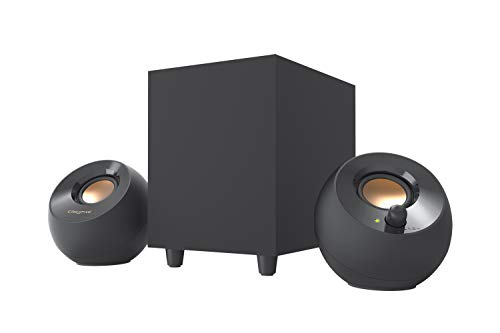
- 4-inch down-firing ported subwoofer
- USB-powered with 3.5mm AUX input
- High Gain Mode supports up to 8W RMS
Best For: Small desks, laptops, and everyday computer audio
Powerful Room-Filling Bass
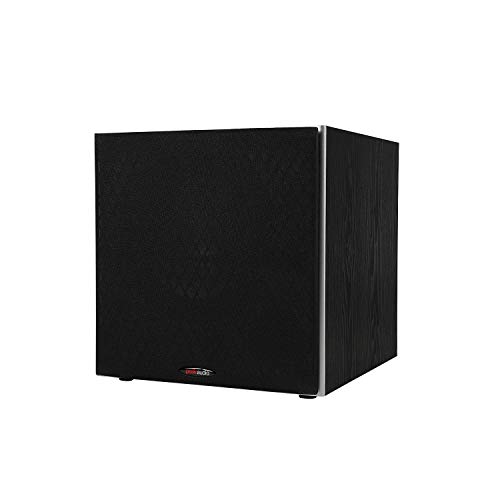
- 10-inch driver for deep, punchy bass
- Up to 100 watts with built-in amplifier
- Adjustable crossover and multiple inputs
Best For: Desktop setups that double as home theaters
Balanced Desktop Bass

- 8-inch driver with 70-watt RMS output
- Low-pass filter reaches down to 38 Hz
- MDF enclosure and automatic standby
Best For: Dedicated desktop listening stations
Best All-in-One Pick
Bluedee 2.1 Computer Speakers with Subwoofer

- 80W peak 2.1 system with dedicated subwoofer
- Bluetooth 5.4, USB, USB-C, and AUX inputs
- DSP tuning, RGB lighting, and one-knob control
Best For: Complete plug-and-play desktop audio
Best High-Powered Upgrade
Edifier T5s 8-Inch Powered Subwoofer
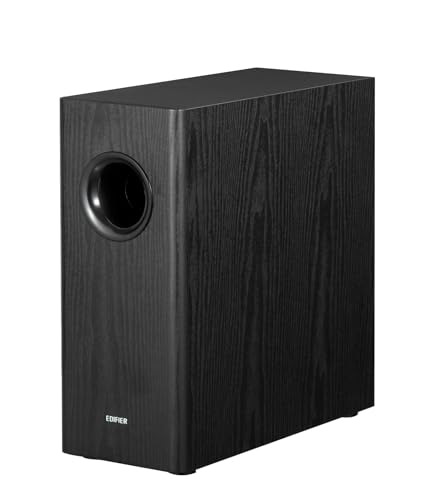
- 8-inch woofer with 70W RMS Class-D amplification
- 35Hz response with adjustable crossover and phase
- RCA connections and auto-standby power saving
Best For: Existing RCA-equipped desktop or home audio systems
Best Compact Standalone Subwoofer

- Compact 5.24-inch long-throw woofer
- 60W maximum output with Class-D amplification
- Includes vibration pads for shelf or desktop placement
Best For: Space-conscious desktop gaming and studio audio
Studio-Ready Bass – PreSonus Eris Sub 8BT
The PreSonus Eris Sub 8BT is a strong choice for subwoofers for desktop setups that need controlled, room-tunable bass. Its 8-inch driver, Bluetooth 5.0, crossover controls, and balanced or unbalanced inputs suit music production, hi-fi listening, and multimedia work.
Best For: Compact studio-monitor systems, content creation, and listeners who want flexible wired or Bluetooth connectivity.
Pros:
- 8-inch woven-composite driver reaches down to 30 Hz.
- Bluetooth 5.0 works alongside TRS, RCA, and front-panel auxiliary connections.
- Adjustable highpass, lowpass, and room-tuning controls help integrate the sub with desktop monitors.
- Front headphone output and automatic power-saving mode add convenience.
Cons:
- Its studio-focused controls may be more than casual listeners need.
- Bluetooth range is listed at up to 10 meters.
Choose the Eris Sub 8BT when accurate, adjustable low end matters as much as added impact. It is especially practical for desktop monitoring setups that may switch between wired studio equipment and wireless personal devices.
THX Desktop Favorite – Klipsch ProMedia 2.1
The Klipsch ProMedia 2.1 is a complete speaker system rather than a standalone subwoofer, making it an easy entry point for subwoofers for desktop setups. Its 6.5-inch side-firing subwoofer, two satellites, THX certification, and simple wired connection are suited to gaming, movies, and music.
Best For: Plug-and-play computer audio with substantial bass and included satellite speakers.
Pros:
- THX-certified 2.1 design combines two satellites with a ported 6.5-inch subwoofer.
- Klipsch MicroTractrix horn technology supports clear satellite output.
- Control pod provides convenient main-volume and subwoofer-gain adjustment.
- Works with computers, TVs, music players, and gaming consoles through a 3.5mm input.
Cons:
- It is a full speaker package, not an upgrade-only subwoofer for existing monitors.
- Connectivity is wired rather than Bluetooth.
The ProMedia 2.1 makes sense when you want a straightforward desktop audio system with dedicated bass and satellites in one package. Its convenient controls and broad device compatibility keep setup simple.
Remote-Controlled Impact – Mackie CR8SBT 8-inch Subwoofer
The Mackie CR8SBT adds dedicated low-end weight to desktop monitors through TRS or RCA connections, while also accepting Bluetooth audio. For subwoofers for desktop setups, its adjustable crossover and included desktop remote make it appealing when convenient level control is a priority.
Best For: CR Series monitor users and desktop systems that need remote bass control plus Bluetooth input.
Pros:
- 8-inch subwoofer is designed to add bass to CR Series monitors.
- TRS, RCA, and Bluetooth connectivity support varied desktop sources.
- Adjustable crossover helps blend the subwoofer with the main monitors.
- Included desktop remote provides volume and sub-bypass control.
Cons:
- The listed dimensions and 32.4-pound weight require substantial desk or floor space.
- Its stated frequency response begins at 40 Hz, so it is not the deepest-reaching option here.
The CR8SBT is a practical fit for a larger desktop or nearfield setup where bass management and quick remote adjustments matter. It is particularly natural alongside Mackie CR monitors, though its inputs support other compatible systems too.
Compact USB Bass – Creative Pebble Plus 2.1
The Creative Pebble Plus is a compact 2.1 speaker package for subwoofers for desktop setups where USB power and a small footprint matter. Its standalone 4-inch down-firing subwoofer, angled satellite drivers, and front volume controls provide a simple upgrade for computers and laptops.
Best For: Small desks, laptops, and budget-conscious users who want separate bass without a wall-power connection.
Pros:
- Down-firing 4-inch ported subwoofer adds depth while remaining compact.
- USB-powered design avoids the need for a wall socket.
- 45-degree elevated drivers aim sound toward the listener.
- High Gain Mode raises output to 8W RMS with a 5V 2A USB adapter.
Cons:
- The USB adapter needed for High Gain Mode is not included.
- Its 8W RMS output is intended for smaller desktop listening rather than high-volume rooms.
- It uses a wired 3.5mm audio connection rather than a wireless audio input.
The Pebble Plus is the most space-conscious option in this group. It suits everyday computer audio when you want a dedicated subwoofer, easy front controls, and USB convenience without moving to a larger studio-style unit.
Powerful Room-Filling Bass – Polk Audio PSW10
For desktop setups that also serve as compact home-theater systems, the Polk Audio PSW10 adds substantial low-end impact without requiring a premium-size subwoofer. Its 10-inch driver, 100-watt maximum output, and adjustable crossover make it a flexible wired option for music, movies, and gaming.
Best For: Desktop listeners who want stronger bass and already have a receiver or compatible speaker system.
Pros:
- 10-inch Dynamic Balance woofer delivers deep bass and punch.
- Built-in 50-watt RMS amplifier supports up to 100 watts of output.
- 80–160 Hz variable crossover helps blend the subwoofer with existing speakers.
- Offers RCA, speaker-level connectivity, and a phase toggle switch.
Cons:
- Its 17-inch depth and roughly 11.8 kg weight may be large for a compact desk area.
- Wired connectivity requires a compatible receiver or audio output.
The PSW10 is a strong choice when bass performance matters more than minimizing the subwoofer footprint. Its connection options make integration straightforward, but measure your available floor space before buying.
Balanced Desktop Bass – Edifier T5 Powered Subwoofer
Edifier T5 Powered Subwoofer - 70w RMS Active Woofer with 8 inch Driver and Low Pass Filter
Check Price On AmazonThe Edifier T5 is a practical powered addition to desktop setups when you want fuller low frequencies from existing speakers. Its 8-inch driver, 70-watt RMS output, and low-pass filter extending down to 38 Hz focus the system on dedicated bass reproduction.
Best For: Desktop audio users seeking a substantial wired subwoofer with automatic standby and a resonance-reducing MDF enclosure.
Pros:
- 8-inch driver provides powerful, accurate bass.
- 70-watt RMS active woofer adds considerable output for music and media.
- Low-pass filter keeps the subwoofer focused on frequencies your main speakers may not handle.
- Automatic standby helps avoid unnecessary power use when idle.
Cons:
- The 16.5-inch depth and 8.65 kg weight may be excessive for very small desks.
- Uses wired RCA connectivity rather than a wireless subwoofer connection.
With its sturdy MDF cabinet and focused low-pass filtering, the T5 is well suited to a dedicated desktop listening station. Confirm that your source provides a compatible SUB OUT or line-out connection before purchasing.
Simple All-in-One Desktop Audio – Logitech Z313 2.1 Speaker System
The Logitech Z313 takes a different approach to subwoofers for desktop setups: it combines a compact subwoofer with two satellite speakers in one 2.1 multimedia system. Its 25-watt RMS output, 3.5mm auxiliary connection, and wired control pod make it a simple upgrade for computers and other personal audio sources.
Best For: Desktop users who need an affordable, complete speaker system rather than a standalone subwoofer.
Pros:
- Includes satellites and subwoofer for a complete 2.1 setup.
- Compact subwoofer and tabletop-oriented design suit personal desktop listening.
- Wired control pod provides convenient volume control.
- 3.5mm auxiliary input works with desktops, MP3 players, and televisions.
Cons:
- Its 25-watt RMS output is less powerful than the standalone powered subwoofers in this roundup.
- The system uses an auxiliary wired connection and does not function as a standalone subwoofer.
The Z313 is best viewed as a convenient desktop speaker package with added bass, not as a high-output subwoofer for an existing audio system. Choose it when simplicity, compact personal audio, and included satellites are the priorities.
Best All-in-One Pick – Bluedee 2.1 Computer Speakers with Subwoofer
For shoppers seeking subwoofers for desktop setups without assembling separate components, the Bluedee SK900pro combines two satellite speakers with a dedicated wired subwoofer. Its 80W peak output, DSP tuning, Bluetooth 5.4, USB, USB-C, and AUX inputs make it a flexible choice for work, gaming, music, and movies.
Best For: Desktop users who want a complete, plug-and-play 2.1 speaker system with adjustable RGB lighting and multiple connection options.
Pros:
- Dedicated subwoofer delivers deeper, punchier bass while keeping the satellite speakers clearer.
- Supports Bluetooth 5.4, USB-A, USB-C, and 3.5mm AUX connections.
- DSP tuning is designed to reduce distortion and harsh highs.
- Single control knob handles volume, playback, lighting, and mode changes.
Cons:
- The subwoofer uses a wired connection and the system requires a DC power adapter.
- Plastic enclosures may appeal less to shoppers seeking premium cabinet materials.
The Bluedee is the simplest option here for a full desktop audio upgrade because it includes the satellites and subwoofer in one package. It is especially practical when convenience, wireless playback, and desk-friendly lighting matter as much as bass.
Best High-Powered Upgrade – Edifier T5s 8-Inch Powered Subwoofer
The Edifier T5s is a standalone powered subwoofer for desktop setups that already have compatible speakers or an amplifier. Its 8-inch long-throw woofer, 70W RMS Class-D amplifier, and 35Hz frequency response are aimed at adding substantial low-end impact to an existing audio system.
Best For: Users with RCA-equipped active speakers, amplifiers, or home audio systems who want powerful bass extension and detailed integration controls.
Pros:
- 8-inch woofer and 70W RMS output provide substantial bass capability.
- Adjustable 30Hz–160Hz low-pass filter and 0°/180° phase selector help match the main speakers.
- Built-in amplifier enables plug-and-play operation without an external receiver.
- Auto-standby activates after 15 minutes of inactivity to reduce power use.
Cons:
- Its 15.71-inch depth and 10.38 kg weight require considerably more space than compact desktop subwoofers.
- Connectivity is wired RCA only, with no wireless communication.
- Series connection without a sub-out requires main speakers with LINE IN; Bluetooth, USB, and optical connections are not supported in that setup.
The T5s is the strongest choice when bass output takes priority over minimal footprint. Before buying, confirm that your desktop speakers or amplifier provide a compatible sub-out or RCA line connection and that your desk or room can accommodate its larger cabinet.
Best Compact Standalone Subwoofer – Ortizan V8 Active Subwoofer
The Ortizan V8 is a compact active subwoofer designed for desktop gaming and studio audio. Its 5.24-inch long-throw woofer, 60W maximum output, Class-D amplifier, and included vibration pads offer a space-conscious way to add bass to a desktop setup.
Best For: Desktop users who want a smaller standalone subwoofer for compatible computer or gaming audio equipment.
Pros:
- Compact shelf-mount design is easier to place than a larger 8-inch subwoofer.
- 5.24-inch long-throw woofer is designed for deep bass extension.
- Built-in Class-D amplification avoids the need for a separate amplifier.
- Vibration pads are included for desktop or shelf placement.
Cons:
- The supplied specifications list Bluetooth connectivity but do not provide detailed pairing or input information.
- There is no supplied frequency-response figure for comparing bass extension precisely.
- It is sold as a standalone subwoofer, so compatibility with the rest of the desktop audio system should be confirmed.
The Ortizan V8 makes the most sense when desk space is limited and you want a dedicated bass unit rather than a complete speaker set. Its compact dimensions and vibration pads are useful for shelf placement, but verify how it connects to your existing desktop speakers before ordering.
How We Picked the Best Subwoofers for Desktop Setups
We selected models based on desktop suitability, connection flexibility, bass performance potential, size, ease of setup, and value. The lineup includes complete 2.1 speaker systems as well as standalone powered subwoofers, so buyers can compare simple plug-and-play solutions with upgrade-focused options.
We also considered practical details such as included controls, crossover functionality, Bluetooth or USB connectivity, down-firing and front-firing designs, and whether a subwoofer is best suited to small computer speakers, studio monitors, or a broader home-audio system.
Quick Comparison
- Most compact: Creative Pebble Plus and Ortizan’s compact active design are suited to smaller desks.
- Simple PC audio: Logitech, Klipsch, Creative, and Bluedee provide complete 2.1 systems with matching satellite speakers.
- Studio-focused: PreSonus Eris Sub 8 and Mackie CR8SBT are designed for use with studio monitors and offer more flexible integration.
- Deeper bass potential: Polk Audio PSW10 and Edifier’s 8-inch powered models provide larger drivers for fuller low-end output.
Key Buying Factors for Subwoofers for Desktop Setups
System Compatibility
First determine whether you need a complete speaker system or a standalone subwoofer. A powered subwoofer must have a suitable audio connection and, in some cases, a compatible output from your speakers, DAC, computer, or monitor controller. Complete 2.1 systems are generally easier to install.
Size and Placement
Measure the space beneath or beside your desk before buying. Larger 8- and 10-inch models can deliver stronger low bass but require more floor area and may transmit more vibration. Keep the enclosure stable and avoid blocking vents or placing it directly against a wall unless the manufacturer allows it.
Power and Bass Control
RMS power is more useful for comparison than peak power, although specifications are not perfectly standardized. Look for adjustable volume and, when available, crossover or phase controls. These features help blend the subwoofer with small desktop speakers instead of making bass sound boomy or disconnected.
Connections and Controls
USB-powered systems simplify computer setups, while Bluetooth adds convenience for phones and tablets. Studio-oriented models typically offer more conventional audio inputs and may integrate better with powered monitors. A wired remote or front-panel control can also be useful when the subwoofer is positioned under a desk.
Who Should Buy Which Subwoofers for Desktop Setups?
Choose a complete 2.1 system if you want an uncomplicated upgrade for everyday music, gaming, streaming, or video calls. These systems include matched satellite speakers and avoid compatibility concerns.
Choose a compact subwoofer if desk space is limited or you mainly want a modest improvement in fullness rather than room-filling bass.
Choose a studio subwoofer if you already use powered monitors and want better low-frequency extension for music production, editing, or critical listening. Adjustable integration controls are especially valuable in this category.
Choose a larger home-audio subwoofer if maximum bass impact matters more than footprint. These models can suit gaming and movies, but placement, vibration, and connection compatibility deserve extra attention in a desktop environment.