Cutting the cord does not mean giving up local news, sports, weather, or major broadcast networks. The best wireless TV antennas can bring those channels back without a monthly subscription, provided your home has a suitable signal path to nearby broadcast towers.
This roundup compares 10 indoor and outdoor options across installation flexibility, amplification, cable length, rotation, and advertised range. Use the guide below to match antenna design and features to your location rather than relying on mileage claims alone.
Best 10 Wireless TV Antennas Picks for 2026
Best Long-Cable Indoor/Outdoor Pick

- Indoor or outdoor installation
- 16.5-foot coaxial cable
- Includes signal booster
Best For: Flexible antenna placement with optional signal boosting
Best Portable Pick

- Compact travel-friendly design
- Magnetic base for metal surfaces
- Supports VHF, UHF, and NEXTGEN TV
Best For: RV trips, camping, boating, and tailgating
Best Outdoor Motorized Pick

- Remote-controlled 360° rotation
- Dual TV outputs
- Includes 40-foot RG6 cable and mounting kit
Best For: Permanent outdoor setups serving two TVs
Best Simple Indoor Setup

- 16-foot coaxial cable
- Supports 4K, UHD, and 1080p
- Simple plug-in installation
Best For: Smart TVs and digital TVs needing an easy indoor setup
Best Low-Profile Pick
UltraPro Hover Digital TV Antenna

- TV-top hover design keeps installation discreet
- Supports 4K, 8K, and NextGen TV where available
- 40-mile VHF/UHF reception with flexible placement
Best For: Cord-cutters who want a neat indoor setup
Best Outdoor Omni-Directional Pick

- 360-degree reception eliminates manual rotation
- 65-mile outdoor range with VHF/UHF support
- Smartpass amplification and built-in signal filter
Best For: RV, marine, and multi-direction tower locations
Best Long-Cable Value Pick
Indoor TV Antenna with 18-Foot Cable

- 18-foot reinforced coaxial cable aids placement
- Magnetic base supports indoor or outdoor positioning
- Switchable booster for distances beyond 35 miles
Best For: Homes needing extra cable reach and flexible placement
All-Weather Choice
Fabriyut 5000+ Mile TV Antenna

- Indoor/outdoor weather-resistant design
- Built-in amplifier with USB power
- 33.8-foot cable for flexible placement
Best For: Flexible indoor or outdoor antenna installations
Compact Indoor Pick
TKTDBX 80-Mile Digital TV Antenna
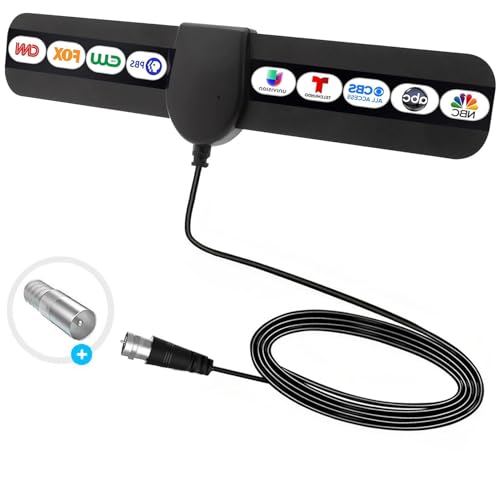
- Slim indoor design with 360-degree reception
- Detachable amplifier and USB power
- 10-foot cable with adhesive mounting stickers
Best For: Discreet indoor placement in apartments and small rooms
Omnidirectional Long-Range Pick
DivesKet 4200+ Mile TV Antenna
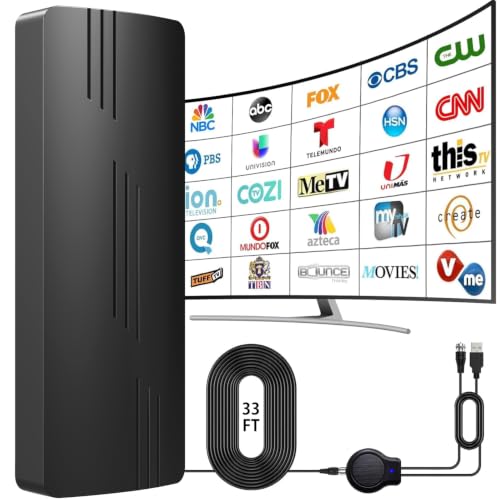
- 360-degree reception for flexible aiming
- Indoor/outdoor use with weather-resistant construction
- 33-foot cable and interference-filtering amplifier
Best For: Flexible home, RV, attic, or garage installations
Best Long-Cable Indoor/Outdoor Pick – NEOSIGN 180-Mile HDTV Antenna
This NEOSIGN model is a flexible option among wireless TV antennas because it can be used indoors or outdoors and includes a 16.5-foot coaxial cable. Its signal booster, 4K/1080p support, and stated 180-mile maximum range make it worth considering for homes that need more placement flexibility, though actual reception depends on local signal coverage.
Best For: Buyers who want an indoor/outdoor antenna with a long cable and optional signal boosting.
Pros:
- Supports 4K and 1080p digital formats.
- Includes a durable 16.5-foot coaxial cable for flexible placement.
- Can be used indoors or outdoors and includes a signal booster.
Cons:
- Reception depends heavily on local broadcast coverage.
- The booster requires switching it on when greater range is needed.
- Channel scanning is required after changing placement or range settings.
Choose this model if cable length and placement versatility matter most. Before buying, check available local channels and plan to test positioning near a window or outdoors for stronger reception.
Best Portable Pick – GE Compact HD TV Antenna
For shoppers comparing wireless TV antennas for travel, the GE Portable HD TV Antenna offers a compact design suited to home use, camping, boating, RV trips, and tailgating. Its magnetic base, 360-degree reception, and compatibility with VHF and UHF channels make it a convenient low-profile choice.
Best For: Travelers and occasional viewers who need a compact antenna for an RV, boat, vehicle, or small indoor setup.
Pros:
- Compact design stands just under 7 inches high.
- Magnetic base helps keep the antenna in place on metal surfaces.
- Supports HDTV, 4K/8K Ultra HD-ready broadcasts, and NEXTGEN TV compatibility.
- Includes a limited-lifetime replacement pledge and U.S.-based technical support.
Cons:
- Its listed maximum range is 20 feet.
- Compact portability may be less suitable for viewers seeking long-range reception.
This is a practical pick when portability and simple storage matter more than extended range. The magnetic base is especially useful for temporary setups on compatible metal surfaces.
Best Outdoor Motorized Pick – PBD 360° Amplified Antenna
This PBD unit is one of the more feature-rich wireless TV antennas for outdoor installation. It combines a motorized 360-degree rotation system, remote control, weather-resistant construction, a 40-foot RG6 cable, and dual TV outputs for households that want a more permanent setup.
Best For: Homes needing outdoor installation, remote directional adjustment, and connections for two TVs.
Pros:
- Remote-controlled 360-degree rotation helps adjust antenna alignment.
- Weatherproof design is intended for year-round outdoor use.
- Supports two TVs without a splitter or additional equipment.
- Includes a 40-foot RG6 cable, mounting hardware, and installation guide.
Cons:
- Outdoor installation is more involved than setting up an indoor antenna.
- Performance still depends on local broadcast conditions despite the stated long range.
This model makes the most sense for buyers prepared to mount an antenna and who value remote aiming and multi-TV support. Its included installation kit helps, but placement and local signal conditions remain important.
Best Simple Indoor Setup – DAANT Long-Range TV Antenna
The DAANT Long Range antenna is a straightforward choice among wireless TV antennas for smart TVs and digital TVs. It includes a 16-foot coaxial cable, supports 4K, UHD, and 1080p broadcasts, and is designed for simple plug-in installation followed by a channel scan.
Best For: Viewers wanting an uncomplicated indoor antenna with a long cable and broad digital-format support.
Pros:
- Includes a 16-foot coaxial cable for flexible indoor placement.
- Supports 4K, UHD, and 1080p HDTV broadcasts.
- Designed for simple connection and channel scanning.
- Includes 24-hour online support.
Cons:
- Not suitable for older analog televisions.
- Optimal reception may require testing locations and antenna orientation.
- Backed by a three-month warranty.
Consider the DAANT when you want a basic indoor setup without outdoor mounting hardware. Check local channel availability first, then experiment with placement near a window and both vertical and horizontal orientations.
Best Low-Profile Pick – UltraPro Hover Digital TV Antenna
If you want wireless TV antennas that stay out of the way, the UltraPro Hover is designed to attach directly to the top of a television. It supports VHF and UHF reception up to 40 miles, works with 4K and 8K TVs, and is compatible with NextGen TV where available.
Best For: Cord-cutters seeking a discreet indoor antenna for local channels and easy placement.
Pros:
- Low-profile hover design mounts directly to the TV or can sit on a surface or wall.
- Supports 4K, 8K, 1080p HDTV, and NextGen TV (ATSC 3.0) where available.
- Receives VHF and UHF signals up to 40 miles and includes a swivel for positioning.
- Includes a push-on coax connector, mounting tape, and limited-lifetime replacement pledge.
Cons:
- Its 40-mile range may be less suitable for homes farther from broadcast towers.
- Indoor reception can vary with location and surrounding obstructions.
The UltraPro stands out for its clean, TV-mounted design and straightforward setup. It is a practical choice when appearance and convenience matter more than maximum range.
Best Outdoor Omni-Directional Pick – ANTOP 360-Degree HDTV Antenna
Among wireless TV antennas, the ANTOP outdoor model is built for broad reception from multiple directions. Its omni-directional design covers 360 degrees, while Smartpass amplification and a built-in cellular-signal filter are intended to support cleaner reception without manually rotating the antenna.
Best For: RV, marine, and outdoor installations where broadcast towers may be located in different directions.
Pros:
- Omni-directional 360-degree reception avoids manual antenna rotation.
- 65-mile stated range with enhanced VHF and UHF reception.
- Smartpass amplifier technology balances short- and long-range reception.
- Built-in filter is designed to reduce interference from 3G, 4G, and 5G signals.
Cons:
- Outdoor installation requires more space and setup than an indoor antenna.
- The included warranty is one year.
This ANTOP antenna makes the most sense when you need wide-angle outdoor coverage and do not want to reposition a directional antenna. The included 33-foot coaxial cable also gives installers more flexibility with placement.
Best Long-Cable Value Pick – Indoor TV Antenna with 18-Foot Cable
This indoor model is one of the more flexible wireless TV antennas for setups where the antenna needs to sit away from the television. It includes an 18-foot reinforced coaxial cable, a magnetic base for indoor or outdoor placement, and a signal booster that can be switched on for distances beyond 35 miles.
Best For: Viewers who need flexible antenna placement and extra cable reach for local-channel reception.
Pros:
- Includes an 18-foot reinforced coaxial cable for flexible positioning.
- Magnetic base supports indoor use and placement on compatible outdoor metal surfaces.
- Signal booster can be activated when the transmission distance exceeds 35 miles.
- Supports 4K and 1080p formats and includes a two-year manufacturer warranty.
Cons:
- Reception depends on location, nearby towers, and surrounding conditions.
- The booster requires manual activation and channel rescanning after changes.
- Its advertised 180-mile range should not be treated as a guarantee of available channels.
The long cable and magnetic base are the main reasons to consider this antenna. Before buying, check local channel availability and be prepared to rescan after moving the antenna or changing the booster setting.
All-Weather Choice – Fabriyut 5000+ Mile TV Antenna
For shoppers comparing wireless TV antennas, the Fabriyut model stands out for its indoor/outdoor design, built-in amplifier, and unusually long 33.8-foot cable. It is compatible with smart TVs and older TVs that have an HDTV tuner, and it supports 4K, 1080p, and higher-resolution signals where available.
Best For: Households wanting flexible indoor or outdoor placement and a weather-resistant antenna with a long cable.
Pros:
- Designed for indoor or outdoor use with waterproof, windproof, and anti-thunder construction.
- Built-in amplifier helps reduce interference and improve reception.
- Includes a 33.8-foot coaxial cable for more flexible positioning.
- Works with compatible smart TVs and older TVs.
Cons:
- Reception depends on local broadcast towers, terrain, and placement.
- Older TVs may require an HDTV tuner or compatible converter equipment.
- The amplifier requires USB power.
The long cable and weather-resistant build make this a versatile option for homes where the best signal may come from a window, attic, or exterior location. As with any wireless TV antenna, the advertised range should not replace checking local signal conditions.
Compact Indoor Pick – TKTDBX 80-Mile Digital TV Antenna
This TKTDBX model is a practical choice for shoppers seeking wireless TV antennas with a slim, unobtrusive indoor design. Its detachable amplifier, 360-degree reception, adhesive mounting stickers, and 10-foot coaxial cable make it easy to try different locations around the room.
Best For: Apartment dwellers and indoor users who want a lightweight antenna that can be placed on a wall, shelf, or near a window.
Pros:
- 360-degree reception is designed to receive signals from any direction.
- Thin, lightweight design can be mounted or hidden discreetly.
- Includes a 10-foot coaxial cable and adhesive stickers for placement flexibility.
- Supports 4K and 1080p signals where available.
Cons:
- Indoor reception can vary with distance from towers, terrain, foliage, and obstructions.
- The 10-foot cable may be limiting for TVs far from a suitable mounting location.
- The amplifier requires USB power or a compatible power adapter.
This is the simplest fit for a tidy indoor setup, especially when you want to experiment with placement without installing an outdoor antenna. Its stated 80-mile range is a guideline, so local conditions remain important.
Omnidirectional Long-Range Pick – DivesKet 4200+ Mile TV Antenna
The DivesKet TV-pro is aimed at shoppers who want wireless TV antennas with broad placement options and an amplifier for weak-signal areas. It supports indoor or outdoor installation, offers 360-degree reception, and includes a thickened 33-foot low-loss coaxial cable for positioning on a table, wall, window, attic, RV, or garage.
Best For: Users seeking an omnidirectional antenna for flexible home, RV, attic, garage, or outdoor installation.
Pros:
- 360-degree reception is designed to capture signals without precise aiming.
- Indoor/outdoor construction supports several installation locations.
- Includes a 33-foot coaxial cable for flexible placement.
- Amplifier is designed to filter cellular and FM interference.
Cons:
- Reception still depends on local tower distance and surrounding obstructions.
- Traditional TVs may need a digital set-top box.
- The amplifier requires power and may not be necessary in strong-signal locations.
With its long cable, omnidirectional design, and indoor/outdoor compatibility, this antenna is suited to installations where placement flexibility matters. It is a particularly practical option for RVs and secondary spaces, provided the TV has a compatible coaxial connection or converter.
How We Picked These Wireless TV Antennas
We focused on the features that affect real-world setup and reception: indoor versus outdoor installation, cable length, amplification, directional control, weather resistance, smart TV compatibility, and support for current HD broadcast signals. We also considered whether each antenna is practical for apartments, suburban homes, or locations where a roof- or pole-mounted setup is more appropriate.
Advertised range is only a rough reference. Terrain, building materials, trees, interference, and distance from broadcast towers can have a greater effect on performance than a large mileage number on the package.
Quick Comparison
| Best For | Features to Prioritize | Recommended Type |
|---|---|---|
| Apartments and small homes | Compact design, included cable, easy repositioning | Indoor antenna |
| Weak or inconsistent indoor signals | Amplifier, adjustable placement, longer cable | Amplified indoor antenna |
| Rural or obstructed locations | Outdoor mounting, weather resistance, rotation | Outdoor amplified antenna |
| Several nearby broadcast directions | Omnidirectional reception or remote rotation | Omnidirectional or rotating antenna |
Key Buying Factors for Wireless TV Antennas
Indoor or Outdoor Installation
Indoor models are easiest to install and work best near windows, on exterior walls, or in areas with relatively strong signals. Outdoor antennas generally have a better chance of overcoming walls, roofs, and obstructions, but they require secure mounting and protection from weather.
Amplification and Signal Control
An amplifier can help compensate for signal loss through long coaxial cables or splitters. It cannot create a missing broadcast signal and may worsen interference in a very strong-signal area. If reception is unstable, try changing antenna position before assuming more amplification is the answer.
Cable Length, Rotation, and Placement
Choose enough cable to place the antenna high and away from large electronics. A rotating or omnidirectional design can simplify aiming when stations come from different directions. For directional antennas, check tower locations before mounting and be prepared to fine-tune the angle.
Compatibility and Realistic Range
Most modern antennas connect to a TV’s coaxial input and receive over-the-air digital broadcasts; “4K” or “8K” labeling does not guarantee 4K channels. Confirm that your television has a built-in tuner or plan to use a compatible tuner box. Use a local broadcast-coverage map to evaluate the claimed range.
Who Should Buy Which Wireless TV Antennas?
Choose a basic indoor antenna if you live close to broadcast towers and want the simplest, lowest-cost setup. An amplified indoor model is a better starting point for larger rooms, longer cable runs, or moderate signal loss. Select an outdoor antenna if walls, elevation, distance, or terrain make indoor reception unreliable. A rotating model suits homes receiving stations from multiple directions, while an omnidirectional option reduces the need for manual aiming.
Before buying, check tower direction, return policies, mounting requirements, and whether the included cable reaches your preferred location. The right placement usually matters more than the most impressive specification.