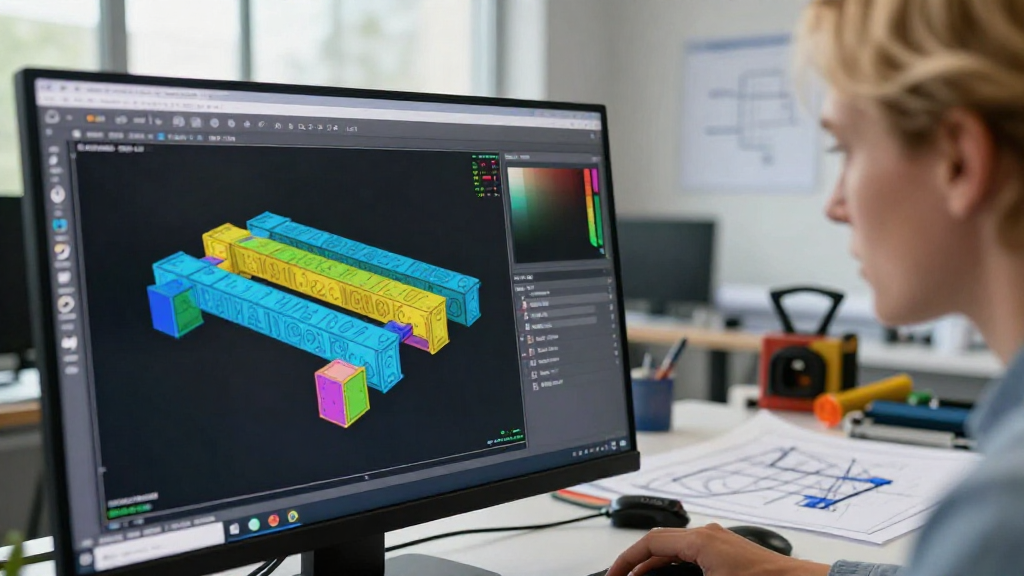
Beam finite element analysis is a powerful computational method that engineers and designers utilize to study the structural behavior of beams under various load conditions.
Understanding how to effectively perform beam finite element analysis can lead to significant improvements in design efficiency and structural reliability.
What is Beam Finite Element Analysis?
Beam finite element analysis is a numerical technique used to obtain approximate solutions to complex structural problems.
What Are the Key Components of Beam Finite Element Analysis?
-
Elements: A beam is divided into smaller, simpler parts called finite elements.
-
Nodes: These are points at the ends of elements where calculations occur.
-
Material Properties: Understanding the mechanical properties of the materials (like Young’s modulus) is crucial for accurate results.
-
Boundary Conditions: These are constraints applied to the structure that influence its behavior.
-
Load Cases: Applying different loads (point loads, distributed loads, etc.) will help in understanding how the beam will respond.
By combining these aspects, beam finite element analysis allows for a detailed simulation of forces, moments, and deformations.
How Do You Perform Beam Finite Element Analysis?
What Are the Steps Involved in Conducting Beam Finite Element Analysis?
-
Define the Geometry:
– Start by outlining the beam’s dimensions and shape.
– Use CAD software or FEM software to create an accurate model. -
Select the Element Type:
– Choose suitable beam element types based on your analysis objectives.
– Common options include 1D line elements, 2D surface elements, or specialized beam elements. -
Assign Material Properties:
– Input material properties such as modulus of elasticity, Poisson’s ratio, and density.
– Accurate material data significantly impacts the validity of simulation results. -
Apply Boundary Conditions:
– Establish how the beam is supported.
– Fix, roller, or simple supports will alter the beam’s reaction to loads. -
Define Load Cases:
– Specify the type of loads to which the beam will be subjected.
– This can include static, dynamic, or thermal loads. -
Mesh the Model:
– Divide the beam into finite elements (mesh generation).
– A finer mesh provides more accurate results, but requires more computational resources. -
Run the Analysis:
– Use software to perform the analysis based on the defined parameters.
– Common software include ANSYS, Abaqus, and SolidWorks. -
Post-Processing:
– Analyze the results, focusing on deflections, stress distribution, and failure points.
– Visualization tools like contour plots can help in interpreting results.
What Software is Used for Beam Finite Element Analysis?
Which are the Popular Tools for Beam Finite Element Analysis?
-
ANSYS:
– A leading tool in engineering simulation, especially popular for structural analysis. -
Abaqus:
– Known for its advanced modeling capabilities and ability to handle nonlinear materials. -
SolidWorks:
– A widely used CAD application that includes FEA capabilities, making it accessible for designers. -
COMSOL Multiphysics:
– Allows for the coupling of multiple physics, useful for complex beam analysis scenarios. -
MATLAB:
– It’s flexible for custom FEA algorithms but may require more coding expertise.
By utilizing these tools, engineers can enhance their beam finite element analysis effectiveness, ensuring robust designs.
Why is Beam Finite Element Analysis Important?
What Benefits Does Beam Finite Element Analysis Provide?
-
Accuracy:
– Allows for detailed examination of stresses, strains, and deflections. -
Optimization:
– Possible materials and geometrical configurations can be tested virtually, reducing material use and costs. -
Risk Mitigation:
– Identifying potential failure points before physical testing limits safety risks and ensures compliance with codes. -
Time-Efficiency:
– Speeds up the design process by enabling quick iterations and modifications. -
Documentation and Reporting:
– Generates comprehensive reports for project documentation which are useful for presentations and compliance checks.
By integrating these benefits, beam finite element analysis aids in achieving ultimate project goals in structural engineering.
What Should You Keep in Mind When Using Beam Finite Element Analysis?
How Do You Ensure Effective Beam Finite Element Analysis?
-
Quality of Mesh:
– A finer mesh increases accuracy but comes at the cost of computational efficiency.
– Always check for mesh quality metrics. -
Validation:
– Compare results obtained from beam finite element analysis with experimental data or analytical solutions. -
Sensitivity Analysis:
– Assess how variations in input parameters affect the results to ensure robustness. -
Iterative Approach:
– Be prepared to refine the model iteratively based on insights gained from preliminary analyses. -
Updates in Software:
– Stay updated with software versions, adding new features and improving simulation techniques.
Emphasizing these factors can significantly enhance the quality and reliability of your beam finite element analysis.
Conclusion: Maximizing the Potential of Beam Finite Element Analysis
Incorporating beam finite element analysis into engineering practices can drastically improve design accuracy and performance.
By understanding the fundamental steps, tools available, and best practices, engineers can confidently apply this analysis technique to optimize structural designs.
The modern engineering landscape demands precision and efficiency, and beam finite element analysis provides just that—transforming challenges into opportunities for innovation.
Adopting this approach not only drives success in individual projects but also fosters a culture of excellence in engineering practices.