Fast, dependable media offloads can make the difference between a smooth production day and a frustrating wait after every shoot. The best memory card reader for videographers should match your camera formats, computer ports, and preferred workflow without adding unnecessary complexity.
We’ve gathered 10 options covering CFexpress Type A and Type B, SD, microSD, XQD, and legacy formats. Use the guide below to narrow the list by speed, compatibility, portability, and the number of cards you need to manage at once.
Best 10 Memory Card Reader for Videographers Picks for 2026
Best Smart Hub Reader
DOCKCASE 8-in-1 CFexpress Reader

- Reads CFexpress Type A/B, SD UHS-II, and microSD
- 10Gbps USB connectivity with 4K HDMI
- Touchscreen hub with power delivery
Best For: Filmmakers using multiple card formats and peripherals
Best Value Multi-Format Reader

- Supports SD, microSD, CF, and Memory Stick
- USB-A and USB-C connectors
- Reads four cards simultaneously
Best For: Mixed-card workflows and everyday media transfers
Best for CFexpress Type B
ProGrade Digital Dual-Slot Reader
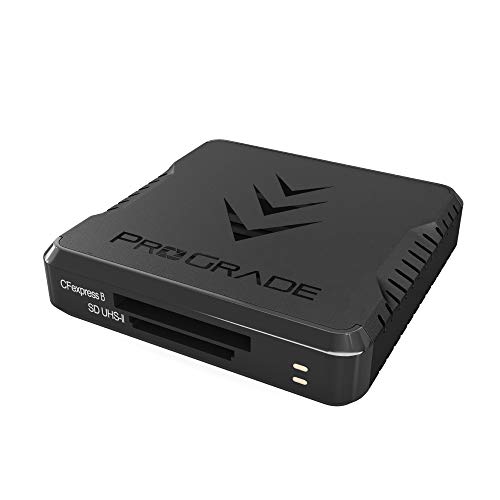
- Reads CFexpress Type B and SD cards
- Up to 10Gbps transfer speeds
- Magnetic mounting for mobile workstations
Best For: Fast CFexpress Type B and SD offloads
Best Legacy-Format Coverage

- Supports CF, SD, microSD, MS, and xD cards
- USB-C and USB-A connectivity
- Reads up to five cards simultaneously
Best For: Mixed-camera productions and legacy media
Professional Speed Pick
ProGrade CFexpress Type A & SD Reader

- Up to 10Gbps USB 3.2 Gen 2 transfers
- Dual-slot CFexpress Type A and SDXC support
- Magnetic, compact design with two-year warranty
Best For: Fast mobile offloads for CFexpress Type A and SDXC workflows
Format Flexibility Pick
7-in-1 USB-C Multi-Card Reader

- Seven ports cover SD, TF, CF, MS, and XD cards
- Transfers between up to five cards simultaneously
- Compatible with major desktop and mobile platforms
Best For: Mixed-format camera kits and USB-C devices
8K Workflow Pick
Lexar CFexpress Type B & SD Reader

- Up to 10Gbps USB 3.2 Gen 2 performance
- Simultaneous CFexpress Type B and SD offloads
- Includes USB-C cable and USB-A adapter
Best For: CFexpress Type B and SD workflows, including 8K RAW video
Fast CFexpress Workflow

- CFexpress Type B and SD slots
- Advertised 10Gbps USB 3.2 Gen 2
- USB-C and USB-A connectivity
Best For: Videographers using CFexpress Type B and SD cards across mixed computer ports
Multi-Format Field Workhorse

- Supports CFexpress Type B, XQD, and SD
- Simultaneous reading and writing
- Includes USB-C and USB-A cables
Best For: Professional crews managing several card formats on location
Portable Pro Media Hub
Aluminum CFexpress/XQD/SD Reader

- Three-format CFexpress, XQD, and SD support
- Advertised 10Gbps USB 3.2 Gen 2
- Includes USB-C and USB-A cables
Best For: Traveling videographers who need a compact mixed-media reader
Best Smart Hub Reader – DOCKCASE 8-in-1 CFexpress Reader
For videographers working with modern cinema and mirrorless cameras, this memory card reader for videographers combines CFexpress Type A, CFexpress Type B, SD UHS-II, and microSD support with a USB hub. Its touchscreen, HDMI output, and high-speed connectivity make it suited to demanding on-location workflows.
Best For: Filmmakers and creators who need CFexpress support plus hub functionality in one portable device.
Pros:
- Supports CFexpress Type A and Type B, plus SD UHS-II and microSD cards.
- Offers USB 3.2 Gen 2 transfer speeds up to 10Gbps.
- Includes a touchscreen, 4K HDMI, USB-A, USB-C, and up to 100W power delivery.
- Can support three cards simultaneously, with Type A and Type B excluded from simultaneous use.
Cons:
- CFexpress Type A and Type B cannot be used at the same time.
- The broad feature set may be more than needed for simple card transfers.
This is a versatile choice when a videographer wants one compact workstation for ingesting footage, connecting peripherals, and viewing media. Its support for both CFexpress formats is particularly useful for mixed-camera kits.
Best Value Multi-Format Reader – BENFEI 4-in-1 USB Card Reader
This memory card reader for videographers is a practical option for crews handling SD, microSD, CompactFlash, and Memory Stick media. Its integrated USB-A and USB-C design works with many laptops and compatible mobile devices, while four cards can be read simultaneously.
Best For: Videographers who need broad legacy-card compatibility at a straightforward, portable price point.
Pros:
- Supports SD, microSD, Memory Stick, and CompactFlash formats.
- USB-C and USB 3.0 connectors accommodate newer and older computers.
- Can read and write four cards at the same time.
- Provides transfer rates up to 160MB/s in UHS-I mode.
Cons:
- Does not support CF Type I, standard Memory Stick, or Memory Stick Micro.
- It is limited to UHS-I speeds rather than faster UHS-II performance.
Choose this reader when flexibility matters more than maximum throughput. It is well suited to mixed media from older cameras, recorders, and accessories, though users with high-speed UHS-II cards may want a faster model.
Best for CFexpress Type B – ProGrade Digital Dual-Slot Reader
For cameras that record to CFexpress Type B and SD cards, this memory card reader for videographers focuses on fast, efficient offloads. Its USB 3.2 Gen 2 interface can transfer data from both slots simultaneously, and the magnetic mounting system helps create a compact mobile workstation.
Best For: Professional video and photo workflows centered on CFexpress Type B and SD media.
Pros:
- Supports CFexpress Type B and SD cards in a dual-slot design.
- Rated for up to 1.25GB/s or 10Gbps transfer speeds.
- Can transfer from both cards simultaneously.
- Includes a magnetic mounting system and a two-year warranty.
Cons:
- Does not support CFexpress Type A or microSD directly.
- With two slots, it is less versatile for crews carrying many card formats.
This reader is a strong fit for fast post-shoot ingest when CFexpress Type B is your primary format. The magnetic mounting option is especially useful for travel, mobile editing, and compact laptop setups.
Best Legacy-Format Coverage – Rocketek 7-in-1 Card Reader
This memory card reader for videographers covers an unusually wide range of older and current formats, including CF, SD, microSD, Memory Stick, and xD Picture Card. Its USB-C and USB-A connectors make it convenient for transferring footage and photos across Windows, Mac, Linux, Android, and Chrome OS systems.
Best For: Production teams managing cards from a wide variety of cameras and legacy devices.
Pros:
- Supports CF, SD, microSD, Memory Stick, xD, and related card formats.
- USB-C and USB 3.0 connectors improve compatibility across devices.
- Can read and write up to five cards simultaneously.
- Offers plug-and-play operation and up to 5Gbps transfer rates.
Cons:
- Its 5Gbps interface is slower than the 10Gbps readers in this roundup.
- It does not support CFexpress cards.
Consider this reader for archive work, mixed-camera productions, or teams that still encounter legacy media. It prioritizes format coverage and simultaneous access over the specialized high-speed performance of CFexpress readers.
Professional Speed Pick – ProGrade CFexpress Type A & SD Reader
For videographers moving large files from CFexpress Type A and SDXC cards, the ProGrade Digital PG09 is a fast, compact memory card reader for videographers. Its USB 3.2 Gen 2 connection supports transfers up to 10Gbps, helping shorten offload and post-production waits.
Best For: Video professionals who use CFexpress Type A and SDXC cards and need a rugged, travel-ready reader.
Pros:
- Supports CFexpress Type A and SDXC cards in two slots.
- Offers transfer speeds up to 10Gbps.
- Magnetic attachment and included metal plate suit mobile workflows.
- Includes a two-year warranty.
Cons:
- Its two-slot design supports fewer card formats than a multi-format reader.
- The supplied details identify USB Type A connectivity, which may require an adapter for some newer devices.
The PG09 is a focused choice when fast CFexpress Type A and SDXC offloads matter more than broad format compatibility. Its compact construction and magnetic mounting are particularly useful for location work.
Format Flexibility Pick – 7-in-1 USB-C Multi-Card Reader
If your camera kit uses several card formats, this 7-in-1 model is a versatile memory card reader for videographers. It provides seven ports for SD, TF, CF, MS, and XD cards, with support for transferring between up to five cards simultaneously at speeds up to 5Gbps.
Best For: Videographers and mixed-device users who need broad card compatibility and USB-C connectivity.
Pros:
- Supports SD, TF/microSD, CF, MS/Memory Stick, and XD cards.
- Seven ports enable transfers between up to five cards simultaneously.
- Works with Windows, iOS, macOS, Android, and Linux devices.
- Aluminum construction and reinforced cables are designed for portable use.
Cons:
- Its 5Gbps maximum is slower than the 10Gbps readers in this roundup.
- The wide range of slots may be unnecessary for users with only one or two card formats.
This reader stands out for flexibility rather than top transfer speed. It is a practical choice for crews handling legacy, camera, and removable-storage formats from laptops, phones, or tablets.
8K Workflow Pick – Lexar CFexpress Type B & SD Reader
For cameras using CFexpress Type B and SD cards, the Lexar RW520 is a streamlined memory card reader for videographers. Its USB 3.2 Gen 2 interface reaches up to 10Gbps and is designed for quickly offloading high-resolution images and 8K RAW video.
Best For: Videographers using CFexpress Type B and SD cards who want a compact reader for location or studio work.
Pros:
- Supports CFexpress Type B and SD cards with two dedicated slots.
- Enables simultaneous offloads from both slots.
- Supports transfer speeds up to 10Gbps.
- Includes USB-C and USB-A connection options and a two-year limited warranty.
Cons:
- It does not support CFexpress Type A according to the supplied specifications.
- Only two card formats are supported.
The RW520 is a strong fit for Type B-based production kits, especially when fast 8K RAW offloads and simultaneous card handling are priorities. Its included adapter improves compatibility across newer and older computers.
Fast CFexpress Workflow – Dual-Slot USB-C/USB-A Reader
For videographers searching for a memory card reader for videographers, this Rocketek model combines a CFexpress Type B slot with an SD slot and USB 3.2 Gen 2 connectivity. Its advertised 10Gbps transfer rate, dual USB-C/USB-A support, and plug-and-play operation make it practical for moving large video files between cameras, computers, tablets, and compatible mobile devices.
Best For: Videographers who use CFexpress Type B and SD cards and need a compact reader that works with both newer USB-C systems and older USB-A computers.
Pros:
- Supports CFexpress Type B and SD cards in a dual-slot design.
- USB 3.2 Gen 2 provides advertised transfer speeds up to 10Gbps.
- Includes USB-C and USB-A connectivity without requiring an additional adapter.
- Works across Windows, Mac, Linux, and Android without drivers.
Cons:
- It does not provide the XQD compatibility offered by some competing readers.
- Actual transfer performance depends on the card, host device, and files being transferred.
The aluminum body and compact design suit travel and field production, while the two-slot layout can simplify transfers between different media types. It is a focused choice for CFexpress Type B and SD workflows rather than a broader multi-format solution.
Multi-Format Field Workhorse – CFexpress, XQD & SD Reader
This 3-in-1 memory card reader for videographers is built for crews working with CFexpress Type B, XQD, and SD media. It supports simultaneous reading and writing between its card slots and advertises 10Gbps USB 3.2 Gen 2 transfers, making it a versatile option for on-set downloads, backups, and post-production work.
Best For: Professional filmmakers, wedding teams, DITs, and creators who need one portable reader for CFexpress Type B, XQD, and SD cards.
Pros:
- Combines CFexpress Type B/XQD and SD compatibility in one reader.
- Supports simultaneous card reading and writing for convenient backups.
- Includes both USB-C-to-USB-C and USB-A-to-USB-C cables.
- Compact aluminum construction is designed for travel and field kits.
Cons:
- The notes specify that Sony XQD N/S/H series cards are not supported.
- Transfer speeds are dependent on the cards and connected computer.
Its broad media support reduces the need to carry separate readers, and the included cables help it fit into mixed-port production setups. Check your exact XQD card series before buying, especially when supporting multiple camera systems.
Portable Pro Media Hub – Aluminum CFexpress/XQD/SD Reader
For videographers who want a memory card reader for videographers with broad format support, this compact Rocketek reader handles CFexpress Type B, XQD, and SD cards through two slots. USB 3.2 Gen 2 connectivity is rated at 10Gbps, and the included USB-C and USB-A cables make it adaptable to laptops, phones, and other compatible devices.
Best For: Mobile photographers and videographers who value a rugged, palm-sized reader with CFexpress/XQD and SD support.
Pros:
- Reads CFexpress Type B, XQD, and SD cards in a dual-slot configuration.
- Can read and write two cards at the same time.
- Aluminum housing and slim design suit travel and field use.
- LED indicator shows the reader’s working status.
Cons:
- The supplied details list compatibility broadly but do not identify specific XQD series limitations.
- Its advertised 10Gbps rate may vary with the card and host connection.
This model balances three-format compatibility with a small footprint and straightforward plug-and-play operation. It is a sensible travel companion when you need one reader for mixed CFexpress, XQD, and SD media without carrying a larger hub.
How We Picked the Best Memory Card Reader for Videographers
We focused on readers that support current video-production media formats and practical desktop workflows. The selection includes dedicated CFexpress Type A or Type B models, dual-format readers, and multi-card adapters for creators who work with several cameras or older media. We also considered advertised interface speeds, USB-C and USB-A compatibility, simultaneous read/write support, portability, build materials, and useful extras such as HDMI or hub functionality.
Rated transfer speeds are only part of real-world performance. Your card, computer, cable, port, and file type can all limit throughput, so we treated connectivity and format support as equally important as headline specifications.
Quick Comparison
- CFexpress Type B: Best for cameras using larger, high-performance cards and demanding high-bitrate recording.
- CFexpress Type A: Choose a dedicated Type A reader if your camera uses Sony-style Type A media.
- CFexpress/XQD/SD combinations: Useful for mixed camera kits and teams handling several card standards.
- Multi-format readers: Better for photographers, editors, and videographers who also use microSD, CompactFlash, Memory Stick, or xD cards.
- USB 3.2 Gen 2 models: A strong fit for faster modern transfers when paired with a compatible 10Gbps host port.
Key Buying Factors for a Memory Card Reader for Videographers
Card Format Compatibility
Start with the cards your cameras actually use. CFexpress Type A and Type B are not interchangeable, and neither is automatically compatible with XQD. SD readers should also support the speed class and capacity standards used by your cards.
Connection and Transfer Speed
USB 3.2 Gen 2 can provide up to 10Gbps of link bandwidth, but the reader and host device must both support it. Check whether the package includes USB-C, USB-A, or both, and use a certified cable capable of the advertised speed.
Workflow and Simultaneous Access
If you regularly back up footage from multiple cards, a dual-slot or multi-card design can reduce cable swapping. Confirm whether slots can read simultaneously and whether inserting multiple cards affects performance.
Build and Portability
Traveling crews benefit from compact readers with sturdy housings, secure connectors, and minimal loose adapters. Aluminum bodies may improve durability and heat dissipation, while a hub-style model can be useful at a fixed editing station.
Who Should Buy Which Memory Card Reader for Videographers?
Choose the DOCKCASE if you want a feature-rich desk setup with multiple formats, a display, and extra connectivity. Choose ProGrade’s Type B or Type A reader when you want a focused solution matched to your camera’s CFexpress format. Choose a Lexar or dual-slot CFexpress/SD model for a streamlined modern workflow with fewer card swaps. Choose a CFexpress/XQD/SD reader if your kit spans newer and legacy cameras. Choose a 4-in-1 or 7-in-1 reader when broad media compatibility matters more than specialized CFexpress performance.