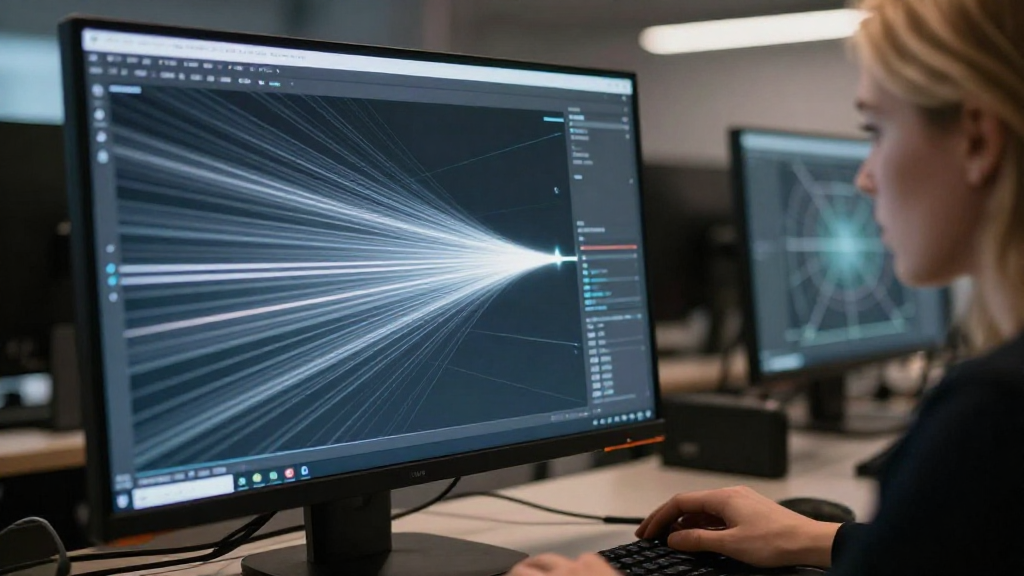
Beam ray tracing is an innovative technique used in computer graphics and computational physics to simulate the behavior of light in complex environments.
This powerful method has significant applications in various fields, including virtual reality, sound design, and architectural visualization.
How Does Beam Ray Tracing Work?
At its core, beam ray tracing operates on the principle of tracing paths that light or sound waves might take as they interact with surfaces and materials in their environment.
The process generally involves the following steps:
-
Initialization: The algorithm starts by defining a light source and the medium through which light travels.
-
Ray Generation: Rays are emitted from the light source in various directions, based on the properties and characteristics of the beam.
-
Interactions: As the rays travel, they encounter surfaces, materials, and obstacles. The algorithm calculates how each ray interacts with these elements.
-
Reflections and Refractions: Depending on the properties of the material, rays may reflect off surfaces or refract as they pass through.
-
Color Calculation: The final colors are determined based on the material properties, light intensity, angle of incidence, and observer’s position.
This iterative process continues until rays reach their destination or are absorbed by surfaces.
Why Is Beam Ray Tracing Important?
Beam ray tracing offers several advantages over traditional rasterization methods.
Enhanced Realism
-
Accurate Lighting Models: Beam ray tracing accurately simulates light behavior, resulting in highly realistic images with intricate lighting effects.
-
Global Illumination: This method accounts for indirect light reflecting off surfaces which contributes to more natural-looking scenes.
Complex Scenarios
-
Virtual Environments: It can handle complex virtual environments by accurately simulating the interactions between light rays and the environment.
-
3D Sound Design: In addition to visual representation, beam ray tracing can simulate sound propagation. This includes how sound interacts with different materials and surfaces.
Versatile Applications
-
Architectural Visualization: Architects use beam ray tracing to render lifelike images of buildings, taking into consideration reflections, shadows, and light diffusion for more convincing presentations.
-
Virtual Reality: In VR, it enhances immersion by providing realistic lighting and sound experiences that respond dynamically as the user moves through the environment.
How Is Beam Ray Tracing Different from Traditional Methods?
Rasterization vs. Ray Tracing
Rasterization is the traditional technique used for rendering images in real-time graphics. It converts 3D models into a 2D image by projecting them onto a plane.
However, it has limitations, especially in achieving realistic light effects.
In comparison, beam ray tracing captures the intricacies of light behavior, providing much higher fidelity in rendering.
Ray Tracing Variants
There are several types of ray tracing techniques, including:
-
Primary Ray Tracing: Traces rays from the viewpoint to the scene.
-
Shadow Ray Tracing: Determines if a point is in shadow or lit by checking intersections with light sources.
Beam ray tracing employs a comprehensive approach that incorporates beam propagation, unlike traditional ray tracing.
What Are the Challenges of Beam Ray Tracing?
Despite its significant advantages, beam ray tracing comes with certain challenges:
-
Computational Complexity: The intricate calculations required for accurate light interactions can be computationally intensive, making real-time applications challenging.
-
Algorithm Efficiency: Developers must optimize algorithms to handle high-quality rendering without sacrificing performance.
-
Hardware Limitations: Not all devices are equipped to handle the processing requirements of advanced beam ray tracing techniques, which may limit accessibility.
How Is Beam Ray Tracing Used in Various Industries?
Film and Animation
In the film industry, beam ray tracing is pivotal for producing cinematic visual effects.
It allows filmmakers to create breathtaking scenes with realistic lighting, shadows, and reflections that draw audiences into the story.
Video Games
In gaming, this technique can elevate graphics to an entirely new level.
Developers leverage beam ray tracing to create immersive worlds with detailed sunlight, water reflections, and realistic environments that adapt to player movements.
Architectural Design
Architects use beam ray tracing extensively for visualizing designs before construction.
It helps clients envision how light interacts with buildings at different times of the day, ultimately making design adjustments more informed.
Scientific Visualization
Scientists employ beam ray tracing to visualize phenomena that involve light propagation through various media, such as in optical engineering and medical imaging.
It aids in understanding complex interactions in a controlled visual format.
What Software Supports Beam Ray Tracing?
Several software applications incorporate beam ray tracing functionalities, including:
-
Autodesk Revit: Widely used in architectural design and building information modeling (BIM).
-
Blender: An open-source platform that is popular for both 3D modeling and rendering.
-
Unity & Unreal Engine: These game engines have integrated capabilities for rendering with ray tracing, enabling developers to create highly realistic game environments.
How to Get Started with Beam Ray Tracing
If you’re interested in exploring beam ray tracing, here are some steps to help you begin:
-
Familiarize Yourself with 3D Modeling: Learn the basics of 3D graphics and modeling using software such as Blender or Autodesk.
-
Study Beam Propagation: Understand the principles of optical behaviors including reflection, refraction, and dispersion.
-
Explore Programming: Enhance your programming skills with languages commonly used in graphics development, such as Python or C++.
-
Experiment with Beam Ray Tracing Libraries: Utilize libraries that facilitate ray tracing, such as Embree, which provides high-performance ray tracing kernels.
-
Join Online Communities: Participate in forums, workshops, and online courses dedicated to computer graphics and ray tracing techniques.
Conclusion
Beam ray tracing has revolutionized the way we visualize and interact with light in digital spaces.
Its applications stretch across numerous industries, enhancing realism and user experience in everything from movies to architectural design.
As technology continues to evolve, the capabilities of beam ray tracing will only expand, promising even more immersive environments in the future.
For those interested in graphics technology, understanding beam ray tracing is essential for staying ahead in the field.