A well-chosen patch bay can make a home studio easier to reconfigure, troubleshoot, and expand. Instead of reaching behind racks or repeatedly unplugging equipment, you can manage common signal paths from one accessible panel.
This roundup compares 10 options across balanced TRS, XLR, multi-format, and compact designs. The right choice depends on your equipment connections, channel count, normaling needs, and available rack space.
Best 10 Patch Bays for Home Studios Picks for 2026
Flexible Routing

- 48-point fully balanced TRS design
- Normal, half-normal, and thru modes
- 1U rack-mountable metal chassis
Best For: Balanced home-studio routing and equipment racks
Connected Workflow

- 46-point TRS patch bay
- Bluetooth for portable devices
- Gold-plated TRS connectors
Best For: Studios integrating smartphones, laptops, or tablets
Versatile Studio Routing
Behringer ULTRAPATCH PRO PX3000

- 48-point balanced patch bay
- Parallel, normalled, half-normalled, and open modes
- Rugged construction for studio use
Best For: Flexible signal routing and cable organization
High-Resolution Routing

- 48-point design with 96 gold-plated TRS connectors
- Three-way mode switch
- Supports up to 192 kHz
Best For: TRS-based home studios using high-resolution audio workflows
Rack-Ready Organization

- 48-point balanced XLR patch bay
- Fits a standard 19-inch rack
- Fully shielded steel construction
Best For: XLR-based recording, PA, and home theater setups
Premium XLR Routing

- 16-point XLR patchbay
- 32 gold-plated XLR connectors
- Aluminum construction
Best For: Moderate XLR routing in recording or live sound studios
Flexible TRS Patching
- Eight balanced patch points
- Switchable normal and half-normal modes
- Rugged extruded aluminum case
Best For: Smaller DAW-based studios using balanced 1/4-inch TRS gear
High-Capacity TRS Routing

- 48-point patchbay with 96 TRS connectors
- Gold-plated connectors and stainless-steel construction
- Designed for extensive TRS-based routing
Best For: Home studios with many TRS connections
Reliable XLR Rack Routing

- 16-channel XLR patchbay with 32 connectors
- Shielded 1U all-steel rack enclosure
- Reversible rack ears and PCB wiring
Best For: Balanced XLR studio rack systems
Modular XLR Flexibility
AA Audio Accessory AP16 XLR Patchbay

- Four modular blocks support 4- to 16-channel setups
- 24K gold-plated XLR pins and full-steel chassis
- Reversible rack ears for flexible mounting
Best For: Studios needing adaptable XLR routing
Flexible Routing – Samson S-Patch Plus
Samson S-Patch Plus Balanced 48-Point 1/4" Patch Bay | 1/4 Inch Phone Connections
Check Price On AmazonFor home studios that need flexible patch bays for home studios, the Samson S-Patch Plus provides 48 fully balanced 1/4-inch points in a rack-mountable 1U chassis. Its front-panel switches let you change routing without reaching behind your equipment.
Best For: Home studios and equipment racks needing balanced connections with selectable routing modes.
Pros:
- 48-point, fully balanced 1/4-inch TRS patch bay
- Supports normal, half-normal, and thru operation
- Front-panel switches simplify configuration changes
- Solid 1U rack-mountable metal construction
Cons:
- Requires understanding of patch-bay routing modes
- Designed for indoor studio and rack use rather than portable setups
The S-Patch Plus is a strong all-purpose choice when clean signal paths, accessible connections, and flexible normaling options matter more than extra connectivity features.
Connected Workflow – Black Lion Audio PBR TRS-BT
The Black Lion Audio PBR TRS-BT adds Bluetooth connectivity to a 46-point patch bay, making it a distinctive option among patch bays for home studios. Its gold-plated TRS connectors are intended for professional audio production and portable-device integration.
Best For: Studios that want to connect smartphones, laptops, or tablets alongside traditional 1/4-inch TRS equipment.
Pros:
- 46-point patch bay with 94 gold-plated TRS connectors
- Built-in Bluetooth connectivity for compatible portable devices
- Designed for studio production and equipment integration
- Aluminum construction with a two-year warranty
Cons:
- Specific compatible phone models are not listed
- Bluetooth may be unnecessary for a strictly wired studio setup
This model stands out when wireless device integration is part of the workflow. For conventional rack routing alone, its Bluetooth feature may be less important than the patch-bay layout.
Versatile Studio Routing – Behringer ULTRAPATCH PRO PX3000
Behringer ULTRAPATCH PRO PX3000 Multi-Functional 48-Point 3-Mode Balanced Patchbay
Check Price On AmazonThe Behringer ULTRAPATCH PRO PX3000 is a 48-point balanced patch bay built to reduce cable clutter and organize studio connections. Its selectable routing functions make it a flexible contender among patch bays for home studios.
Best For: Home-studio users who need multiple routing configurations from a rugged, rack-oriented patch bay.
Pros:
- 48-point balanced TRS patch-bay format
- Supports parallel, half-normalled, normalled, and open functions
- High-quality jack connectors and rugged construction
- Helps organize connections and reduce cable clutter
Cons:
- Its multiple operating modes may require careful setup
- No Bluetooth or other stated wireless connectivity
The PX3000 is a practical choice for a growing studio where routing flexibility and connection organization are priorities. Its broad selection of modes can accommodate varied signal-flow needs.
High-Resolution Routing – Black Lion Audio PBR TRS3
The Black Lion Audio PBR TRS3 is a 48-point patch bay with 96 gold-plated TRS connectors and a three-way mode switch. For users comparing patch bays for home studios, it offers a straightforward TRS-focused design with support for high-resolution audio workflows.
Best For: Home studios routing guitars, microphones, computers, speakers, and other TRS-compatible equipment.
Pros:
- 48-point layout with 96 gold-plated TRS connectors
- Three-way mode switch for routing flexibility
- Supports a maximum sample rate of 192 kHz
- Compatible with guitar, microphone, computer, speaker, and XLR setups
Cons:
- Supplied notes do not specify the individual three-way modes
- TRS-focused connectivity may not suit every studio configuration
The PBR TRS3 is a focused option for studios that want a modern TRS patch bay with gold-plated connections and high sample-rate support. Confirm the available routing modes before installation.
Rack-Ready Organization – Art Pro Audio P48
The Art Pro Audio P48 is a practical choice for home studios that need to organize XLR connections in a standard 19-inch rack. Its fully shielded construction helps keep cabling orderly while reducing wear on your equipment’s connectors, making it a straightforward option among patch bays for home studios.
Best For: Home or professional recording studios, PA and AV installations, home theaters, and live sound setups using XLR connections.
Pros:
- Fits a standard 19-inch rack.
- Provides 48 points for XLR patching.
- Fully shielded steel construction.
- Helps organize cables and reduce connector wear.
Cons:
- Uses XLR connections rather than 1/4-inch TRS jacks.
- Designed for indoor use.
Choose the P48 if your studio is built around XLR-equipped microphones, mixers, amplifiers, or other audio devices and you want high-capacity rack organization.
Premium XLR Routing – Black Lion Audio PBR XLR
The Black Lion Audio PBR XLR is a compact 16-point patchbay with 32 gold-plated XLR connectors. For home studios using XLR-based signal routing, it emphasizes accessible patching and connector quality in a straightforward format.
Best For: Recording or live sound studios that need XLR signal routing for musical instruments and related audio equipment.
Pros:
- Offers 16 patch points.
- Includes 32 gold-plated XLR connectors.
- Designed for easy patching.
- Uses a durable aluminum outer construction.
Cons:
- Provides fewer patch points than 48-point models.
- Uses XLR connections, so it is not a 1/4-inch TRS patchbay.
The PBR XLR makes sense when your routing needs are moderate and you prefer an XLR-only patchbay with gold-plated connectors for a clean, purpose-built setup.
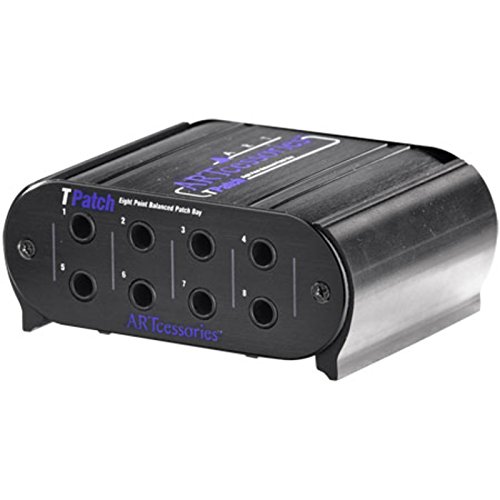
Flexible TRS Patching – Art Pro Audio TPatch
The Art Pro Audio TPatch is an eight-point balanced patch bay with 1/4-inch TRS phone jacks, making it a flexible fit for home studios built around balanced line-level connections. Its switchable half-normal and normal modes support different routing approaches without requiring a large patchbay.
Best For: Home studios and computer-based DAW setups that need balanced 1/4-inch TRS routing and configurable input/output connections.
Pros:
- Provides eight points of balanced direct signals.
- Includes four linked input/output pairs.
- Supports switchable half-normal and normal modes.
- Uses a rugged extruded aluminum case.
Cons:
- Offers fewer points than larger patchbay models.
- Uses 1/4-inch TRS connections rather than XLR.
The TPatch is a good match for smaller setups where routing flexibility matters more than maximum capacity, especially when your interface and outboard equipment use balanced TRS connections.
High-Capacity TRS Routing – Black Lion Audio PBR
For home studios that need extensive balanced connectivity, the Black Lion Audio PBR is a 48-point TRS patchbay with 96 gold-plated connectors. Its rack-oriented design and broad device compatibility make it a practical option for organizing multiple signal paths.
Best For: Home studios with numerous TRS connections and complex routing needs.
Pros:
- Provides 48 patchbay points and 96 TRS connectors.
- Uses gold-plated connectors for durable connections.
- Compatible with all devices according to the supplied specifications.
- Stainless-steel construction and a black-anodized finish offer a solid studio-rack appearance.
Cons:
- Its 4.31-pound weight and larger dimensions may require careful rack planning.
- Uses TRS connectivity rather than XLR.
- Requires corded electric power according to the listed specifications.
The PBR is a strong fit when the priority is maximizing TRS patch points in a home-studio setup. Choose it over an XLR model when your routing system is built around TRS connections.
Reliable XLR Rack Routing – ART P16 XLR Balanced Patchbay
The ART P16 is a straightforward choice for home studios that use balanced XLR connections. It places 16 female XLR connectors on the front and 16 male XLR connectors on the rear in a shielded 1U steel rack enclosure.
Best For: XLR-based studio racks needing organized 16-channel balanced connections.
Pros:
- Offers 16 channels with 32 total XLR connectors.
- Uses PCB wiring for all connections.
- Rugged, fully shielded all-steel 1U rack enclosure.
- Reversible rack ears support flexible installation.
Cons:
- Provides fewer channels than the 48-point TRS option in this roundup.
- Designed specifically around XLR connectivity rather than TRS.
- The supplied specifications list a 240-volt rating, so installation requirements should be checked before purchase.
For studios built around XLR microphones, outboard equipment, or balanced rack connections, the P16 keeps the format simple and rack-friendly. Its 1U steel enclosure and reversible ears add useful installation flexibility.
Modular XLR Flexibility – AA Audio Accessory AP16 XLR Patchbay
The AA Audio Accessory AP16 brings modular organization to XLR patching for home studios. Its four factory-assembled blocks can be configured in 4-, 8-, 12-, or 16-channel arrangements, making it useful when routing needs may change over time.
Best For: Home studios that value modular XLR routing, easier maintenance, and flexible rack installation.
Pros:
- Four independent modular blocks require no PCB cutting or modification.
- Blocks can be assigned to separate system zones for cleaner cabling.
- 24K gold-plated XLR pins are designed for corrosion resistance and stable transmission.
- Full-steel chassis and reversible rack ears support studio-rack installation.
Cons:
- Its modular features may be unnecessary for a simple fixed 16-channel setup.
- It is an XLR patchbay, so it is not intended for TRS-based routing.
- The supplied notes do not specify a warranty period.
The AP16 stands out among patch bays for home studios when maintenance and future reconfiguration matter. Its removable four-channel blocks can help reduce disruption when a particular routing zone needs service or replacement.
How We Picked the Best Patch Bays for Home Studios
We focused on practical studio requirements rather than features that add complexity without improving everyday routing. The selection covers 48-point TRS patch bays, compact eight-point units, XLR panels, and flexible models with switchable routing modes. We considered balanced connectivity, front-panel access, rack compatibility, channel capacity, normalled or half-normalled operation, and how easily each format can integrate with interfaces, preamps, compressors, mixers, and outboard gear.
Because home studios vary widely, no single patch bay is best for every setup. A large TRS model may suit a growing rack, while an XLR or compact unit may be more practical for microphone lines and smaller systems.
Quick Comparison
| Studio Need | Best-Suited Format | Why It Matters |
|---|---|---|
| Many balanced line-level connections | 48-point TRS | Provides high channel density for interfaces and outboard gear. |
| Flexible routing options | Switchable multi-mode TRS | Lets you change normalled, half-normalled, and through operation. |
| Microphone or balanced XLR wiring | XLR patch panel | Keeps XLR connections accessible and organized. |
| Small or specialized setup | Compact eight-point unit | Uses less rack space while handling essential connections. |
Key Buying Factors for Patch Bays for Home Studios
Connector Format
Match the patch bay to the connectors used by your equipment. TRS models are common for balanced line-level signals, while XLR panels are more suitable for microphone inputs, preamp outputs, and other XLR-based connections. Adapters can work, but a native connector format usually creates a cleaner and more reliable installation.
Channel Capacity and Rack Space
Count the connections you expect to use now, then allow room for expansion. A 48-point bay offers substantial flexibility, but it may be excessive for a small interface-and-monitoring setup. Compact models can be a better fit when rack space or cable management is limited.
Normaling and Signal Flow
Normalled connections route a source to a destination without a patch cable. Half-normalled designs typically allow signal tapping, while through connections keep front and rear jacks directly linked. Switchable modes are valuable if your routing needs change, but fixed configurations can be simpler to set up.
Balanced Operation and Build Quality
Balanced wiring helps reduce noise over longer cable runs, provided the connected equipment and cables support it. Look for sturdy rack hardware, clearly labeled jacks, secure connections, and a layout that makes rear-panel wiring manageable.
Who Should Buy Which Patch Bays for Home Studios?
Choose a 48-point TRS patch bay if you regularly connect multiple pieces of balanced outboard gear or expect your studio to grow. A switchable model is especially useful for producers who frequently change routing schemes. XLR patch bays suit studios centered on microphones, preamps, and XLR-equipped interfaces. A compact eight-point option makes sense for a focused setup with only a few critical connections.
Before buying, draw your current signal flow and label every input, output, and destination. This simple step helps you choose the correct connector type, avoid unnecessary adapters, and determine whether you need normalled routing or straightforward through connections.